
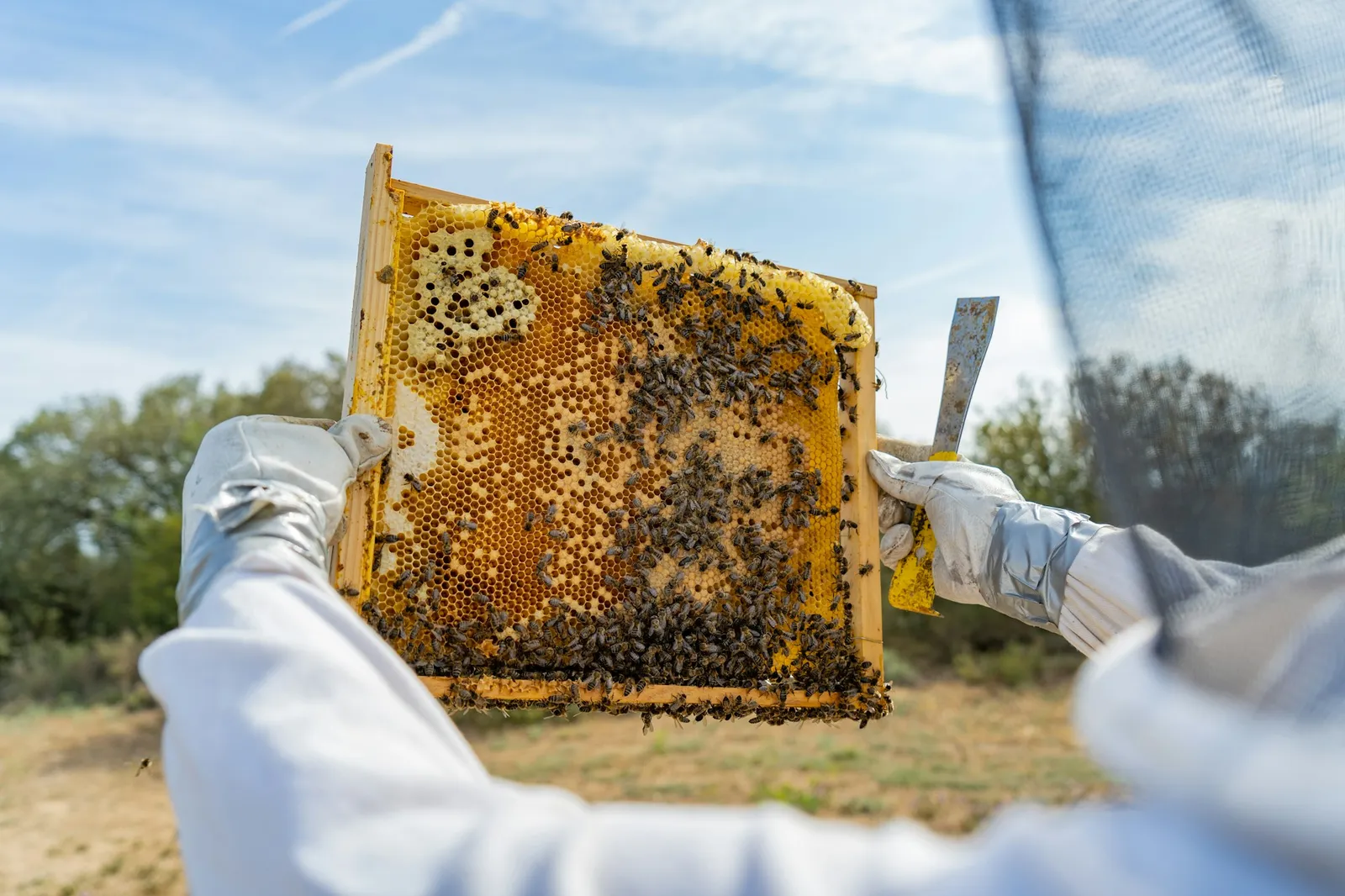
How do bees make honey, step by step?
Only some insects make honey, and the honey on a breakfast table almost all comes from the western honey bee, Apis mellifera. The process runs like this:
- Foraging. An older worker bee, a forager, visits flowers and sucks up nectar through her tongue (proboscis).
- Storing in the honey stomach. The nectar goes into her crop, or honey stomach, a storage bag in front of her digestive gut. Enzymes from her glands start working on it on the flight home.
- Handing over. At the hive she passes the nectar mouth to mouth to younger house bees, a transfer called trophallaxis.
- Processing. The house bees work the nectar, adding more enzymes and repeatedly exposing small droplets to the warm air of the hive.
- Drying. They spread the nectar thinly in wax cells, and bees fan their wings to move air through the hive and carry the moisture away.
- Capping. When the honey is ripe, at about 17 to 18% water, the bees seal each cell with a thin lid of fresh wax.
EU law captures the whole process neatly. Council Directive 2001/110/EC defines honey as the natural sweet substance produced by Apis mellifera bees from nectar, or from honeydew, which the bees "collect, transform by combining with specific substances of their own, deposit, dehydrate, store and leave in honeycombs to ripen and mature".
What is nectar, and why do bees collect it?
Nectar is a sugary liquid that flowers produce to reward the animals that pollinate them. It is mostly water with dissolved sugars, chiefly sucrose, glucose and fructose, in proportions that differ from plant to plant, along with tiny amounts of acids, minerals and aromatic compounds. Its water content varies widely with the plant and the weather; North Carolina State University puts it at around 70% for a typical nectar, and Mississippi State University Extension at up to 80%.
Those small differences between plants are why honey from citrus blossom, thyme or chestnut tastes so different, and why some honeys set solid quickly while others stay runny; see why honey crystallises. In western Sicily our bees work citrus blossom in early spring, then wildflowers, sulla and wild thyme, and later carob and eucalyptus. The guides to orange blossom honey and thyme honey cover two of them.
Not every flower a bee visits gives nectar. Olive flowers, for example, offer pollen but no nectar, so the olive trees around our hives feed the bees' brood but add nothing to the honey; I explain that in do olive trees need bees. Pollen, the bees' protein, is packed into cells separately as "bee bread" and is not the raw material of honey, though a little always ends up in it.
What happens in a bee’s honey stomach?
A honey bee has two stomachs in a sense. The crop, or honey stomach, is a stretchy bag where she carries nectar or water; a valve separates it from the midgut, where she digests her own food. She can take a little nectar through the valve when she needs energy, but the load she carries home is not digested. Mississippi State University Extension says a full honey stomach can hold up to about a third of the bee's own weight.
The key change starts here. The forager adds invertase, an enzyme from glands in her head, which splits sucrose, a double sugar, into its two simple sugars, glucose and fructose. That is why honey is mostly glucose and fructose with only a little sucrose left. So is honey bee vomit? Not really: it never reaches the part of the bee that digests food, and it is changed on the way, more like a carrier bag than a stomach.
How do bees turn nectar into honey in the hive?
Back at the hive, the forager does not store the nectar herself. She unloads it to one or more house bees, younger workers who stay inside, and goes straight back out. The house bees carry on with the chemistry. As well as more invertase, they add glucose oxidase, an enzyme that turns a small part of the glucose into gluconic acid and hydrogen peroxide. The gluconic acid makes honey mildly acidic, part of what makes ripe honey so stable.
Then comes the drying. House bees hold small droplets of nectar on their mouthparts and draw them back and forth, which exposes them to the warm air of the hive, and they spread the nectar thinly across many cells rather than filling one at a time. Meanwhile other bees stand in rows fanning their wings, pulling air through the hive to carry the moisture out. Ripening usually takes several days, depending on the nectar and the weather.
| Nectar | Ripe honey | |
|---|---|---|
| Water | Often 70 to 80% | About 17 to 18% (EU rules allow up to 20% for most honey) |
| Main sugars | Often mostly sucrose | Mostly glucose and fructose |
| Keeping quality | Ferments within days | Keeps for years if sealed and dry |
| Where it is | In flowers, then the honey stomach | Stored in wax cells and capped |
Once a cell is full and ripe, the bees cap it with fresh wax. Capped honey is the signal beekeepers look for, because honey with too much water can ferment once it is in a jar. Capping and checking moisture are covered in when to harvest honey, and why honey keeps so well in does honey go off.
How do bees make wax and honeycomb?
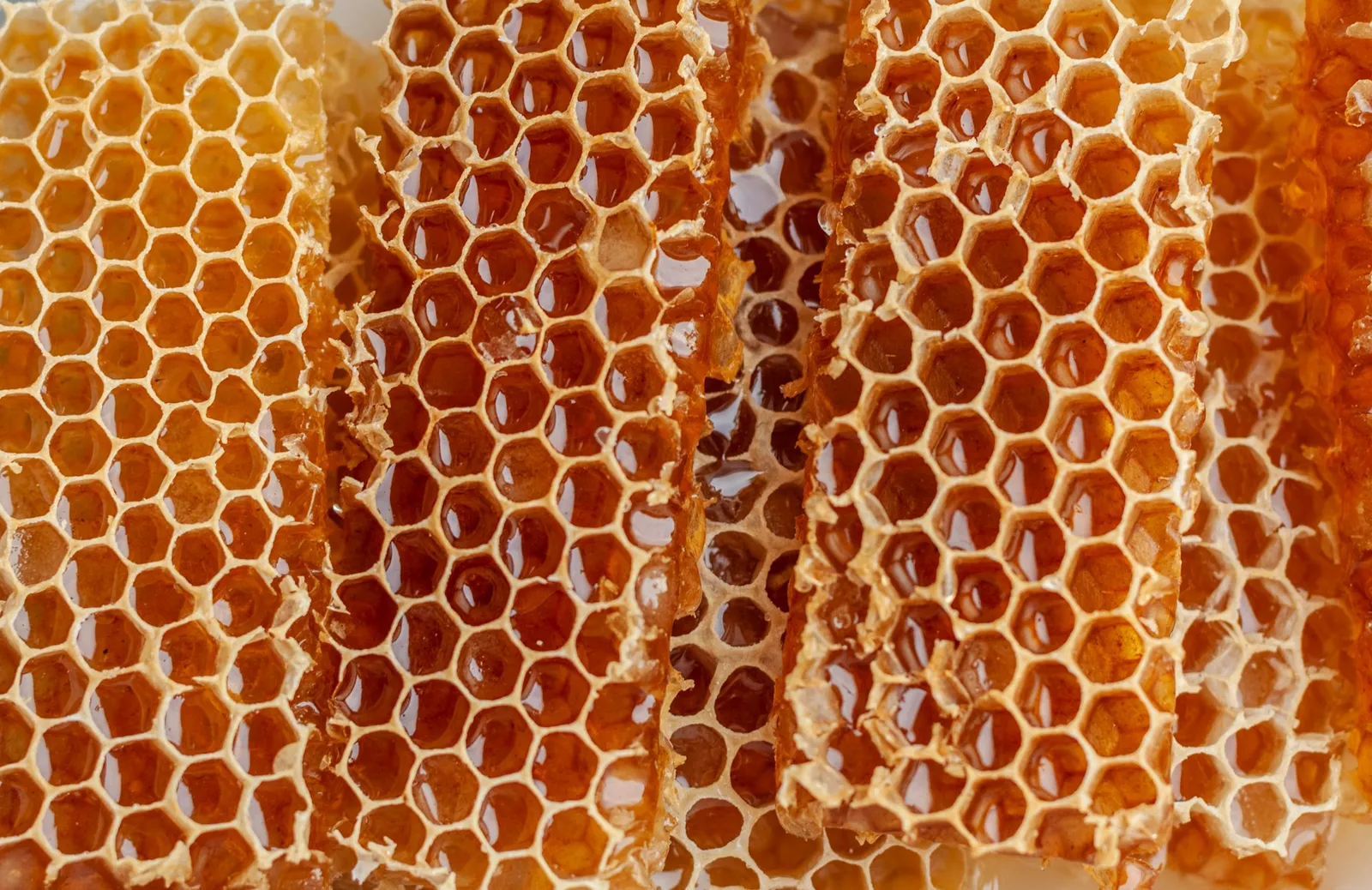
Bees make wax from honey, inside their own bodies. According to the FAO's guide to beeswax production, young worker bees have four pairs of wax glands on the underside of the abdomen. The glands are largest when a bee is about 12 days old and shrink after about the eighteenth day, so comb building is mostly young bees' work. The wax comes out as a liquid that hardens into small, clear scales. A bee passes the scales forward to her jaws, chews them with saliva until they are soft, and adds them to the comb, working in a warm cluster of bees, because wax can only be shaped when it is warm.
The numbers show what wax costs the colony:
- About one million wax scales go into a kilogram of wax.
- Bees consume around 8 kg of honey to make 1 kg of wax, the FAO estimates.
- That kilogram of wax, built into comb, can hold about 22 kg of honey, pollen and brood.
The six-sided cells are no accident. A hexagonal grid is the way to divide a surface into equal cells with the least total wall length, something the mathematician Thomas Hales proved in 1999 (The Honeycomb Conjecture). For bees, that means the most storage for the least wax. How much of the final shape comes from the bees actively shaping each cell and how much from warm wax pulling itself into hexagons is still debated by researchers. If you want to eat it straight from the frame, see how to eat honeycomb.
How much honey does one bee make?
Very little. The US National Honey Board estimates that an average worker makes about one twelfth of a teaspoon of honey in her whole life. A summer worker lives only around five to six weeks, and spends roughly the first half of that working inside the hive before she forages.
On that estimate, a teaspoon of honey weighs about 7 g, so one bee's lifetime share is around 0.6 g, and a 340 g jar represents the life's work of several hundred foragers. The Honey Board also puts the effort at about two million flower visits for a pound (454 g) of honey. Both figures are rough illustrations rather than measurements, since they depend entirely on the flowers and the season, but they make the point: honey is a concentrated product of an enormous number of small trips.
How much a whole colony stores depends on its strength and on the nectar flow. A strong colony in a good season can store far more than it needs, which is the surplus beekeepers take; in a poor season it may store only enough for itself.
Why do bees make honey?
To survive the times when there is nothing to collect. A honey bee colony does not hibernate: tens of thousands of bees stay alive through the lean months, and they need energy to move, keep the brood warm and, in cold climates, keep the winter cluster warm. Honey is their fuel. Because it is so concentrated and holds so little water, it keeps for months in the comb without spoiling. How colonies use it through the cold months is covered in bees in winter.
In northern Europe the lean season is winter. In western Sicily there are two: a short, mild winter, and the high summer of July and August, when heat and drought can stop most plants producing nectar for weeks on end. Bees in a Sicilian summer are often living on their stores rather than adding to them. Beekeeping only works because a strong colony, given space and a good flow, stores more than it will eat, and a careful beekeeper takes only that surplus and leaves the bees enough.
What is honeydew honey?
Not all honey comes from flowers. Bees also collect honeydew, the sugary liquid excreted by sap-sucking insects such as aphids and scale insects on trees like oak, fir and pine, and sometimes sugary secretions from the plants themselves. EU law recognises the difference: blossom honey is made from nectar, while honeydew honey is "obtained mainly from excretions of plant sucking insects (Hemiptera) on the living part of plants or secretions of living parts of plants".
Honeydew honey is usually darker, less sweet and more mineral in taste than most blossom honeys, and it tends to stay liquid for longer. The EU rules set it apart chemically too, with a higher minimum electrical conductivity than blossom honey. In Italy it is sold as miele di melata, often from forests in the north. The way the label describes honeydew and blossom honey is covered in honey labels explained.
How our bees make honey in western Sicily
My apiary started in spring 2026 with a nucleus colony from a beekeeper near Trapani, then grew with a swarm that settled in one of our olive trees. A third, weaker colony from a smaller swarm was lost to robbing, and the apiary went into winter with two strong colonies. I do not know the exact type of bee in them; the native Sicilian black bee is a separate story.
The first year showed me the honey-making process from the inside. In spring the colonies built up quickly while the countryside was in flower. By early August, after two to three months with almost no rain and some days above 40°C, the brood boxes held capped and uncapped honey, but the honey boxes above them (the supers) had barely been touched and almost no new wax had been drawn. With no nectar coming in, the bees had nothing to spare for the expensive work of making wax, and they guarded what they had.
It also explains my one firm rule: feed or honey, never both. Bees will take sugar syrup and store it in comb just as they would nectar, so syrup fed while honey boxes are on the hive can end up in the jar. Under the EU definition that would not be honey at all. When a colony needs feeding, the honey boxes come off first. We have not taken a honey harvest yet, and I will write about the first one when it happens; the full story of the year is in my first year keeping bees in Sicily, and why the flowers here give such distinctive honey is in why Sicilian honey tastes different.
Frequently asked questions
Is honey bee vomit?
Not really. Bees carry nectar in their crop, or honey stomach, a storage bag that sits in front of the part of the gut that digests food. The nectar is not digested; it is changed by enzymes and dried in the comb, then handed on and stored.
How long does it take bees to make honey?
Turning nectar into ripe honey usually takes several days, depending on how watery the nectar is and on the weather. Filling a whole honey box takes weeks of good nectar flow, and in a dry spell it may not happen at all.
Do all bees make honey?
No. Honey bees make it in quantity, and some tropical stingless bees make honey too. Bumblebees store only small amounts of nectar in wax pots, and most of the world's bee species, which live alone, make no honey at all.
What do bees do with pollen?
They eat it. Pollen is the colony's source of protein, fed mostly to the young. Bees pack it into cells as "bee bread", separate from the honey, though a little pollen always ends up in honey.
Why do bees cap honey with wax?
To seal ripe honey so it cannot absorb moisture from the air and start to ferment. Capped cells tell the beekeeper that the honey in them is ripe.
Can bees make honey from sugar water?
Bees will store sugar syrup in the comb much as they store nectar, but the result is not honey. Under EU rules honey must come from nectar or honeydew, which is why beekeepers do not feed syrup while honey boxes are on the hive.
Do bees make honey in winter?
No. In winter there is almost no nectar to collect, so bees live on the honey they stored earlier. In very mild places some flowers give a little forage on warm days, but the colony is mostly eating its stores, not adding to them.
How many bees does it take to make a jar of honey?
On the US National Honey Board's estimate that a worker makes about one twelfth of a teaspoon in her life, a 340 g jar is the life's work of several hundred foragers, plus the house bees that process it. It is a rough illustration, not a measurement.
Do bees eat their own honey?
Yes. Honey is the colony's food store. Bees eat it whenever there is no nectar coming in, through winter and, in Sicily, through the dry weeks of high summer, which is why a beekeeper must always leave them enough.
Sources and small print
- Council Directive 2001/110/EC relating to honey (EUR-Lex)
- FAO, Bees and their role in forest livelihoods: production and trade of beeswax
- NC State University: how do bees make honey?
- Mississippi State University Extension: how is honey made?
- US National Honey Board: honey trivia
- Hales T. C. (1999), The Honeycomb Conjecture
Figures for nectar, wax and honey per bee are averages and estimates; real colonies vary with the flowers, the weather and the season.
Credits
Photo: Júlia Babot, Unsplash Licence, via Unsplash.
Photo: Cristina Marin, Unsplash Licence, via Unsplash.
 The weekly YouTube series