
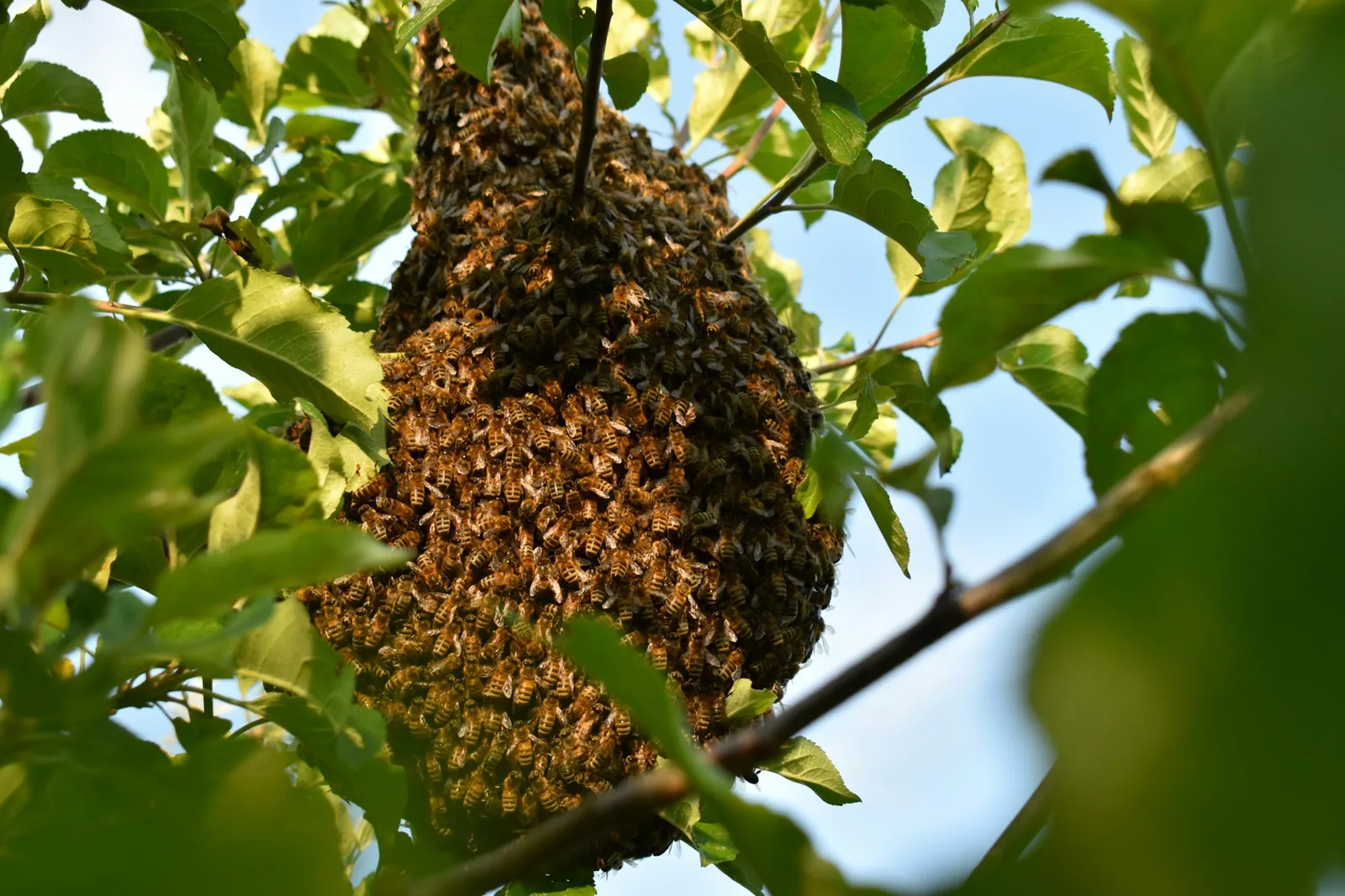
What should you do if a bee swarm lands in your garden?
If you see a cloud of bees, or a cluster of them hanging from a branch, fence or wall:
- Stay calm and keep your distance. Stand back a few metres and watch. Do not wave your arms or try to shoo them.
- Bring children and pets indoors and close nearby windows and doors, so the bees do not end up inside.
- Do not spray, hose, smoke or knock it. That turns a calm swarm into an angry one and helps nobody.
- Check what kind of insect it is. Collectors can only help with honey bees, so look carefully, from a distance, or take a photo (see below).
- Decide whether it is in the way. The UK National Bee Unit's advice on dealing with swarms is that a swarm out of the way can be left alone, and should move on in a day or so.
- If it is a nuisance, call a swarm collector while the bees are still clustered in one place.
Why do bees swarm?
Swarming is how a honey bee colony reproduces. A single colony cannot make a new one by laying eggs alone, so it divides. When a hive is strong and crowded, usually in late spring, the workers raise several new queens in special cells. Before the first of them emerges, the old queen leaves with a large part of the workers, often around half of the colony and sometimes more, while the rest stay behind with the developing queens.
Before they leave, the swarming bees fill up on honey, enough to live on for a few days and to start building wax in their new home. They fly out together in a loud, swirling cloud, and within minutes they settle in a cluster around the queen, often on a branch near the old nest. From there, a few hundred scout bees fly off to look for a new home, such as a hollow tree, a chimney or a gap in a wall, and report back with dances on the surface of the cluster until the swarm agrees on one site. Then the whole cluster lifts off and goes.
For a beekeeper, a swarm means losing half a colony and much of that year's honey, which is why we try to give hives enough room. But it is a sign of a strong, successful colony, not a failing one. How the bees make the honey they carry with them is in how bees make honey.
When do bees swarm?
Swarming follows the spring build-up, so the timing depends on climate. In the UK, the National Bee Unit gives the swarm season as usually between April and late July. The BBKA notes that most swarms come on warm, sunny days from May to the end of July, usually between about 11am and 4pm, often on the first fine day after a spell of poor weather.
In Sicily the season starts earlier, because spring does. Colonies build up fast in the warm, flowery weeks of early spring, and swarms can appear from about March, with April and May the busiest months. By the time the summer dearth arrives in July and August, with heat and almost no nectar, colonies have little reason to swarm.
| UK | Western Sicily | |
|---|---|---|
| Main swarm season | April to late July, most from May | Roughly March to June, most in April and May |
| Typical time of day | Warm, sunny days, about 11am to 4pm | Warm, calm days, late morning to afternoon |
| Quiet period | August to March | High summer and winter |
Are swarming bees dangerous?
Usually not. A swarm has no home, no brood and no stores to defend, and the bees have filled themselves with honey, which tends to make them placid. The BBKA says that most honey bee swarms are not aggressive and that swarming bees usually do not sting. Beekeepers routinely handle swarms with little protection for exactly that reason.
Usually is not always. Bees will sting if they are squashed, swatted, sprayed or blasted with water, and a swarm that has been hanging around for several days, hungry and in bad weather, can be grumpier. Anyone with a known allergy to bee stings should stay well away. The real difference is between a swarm and an established nest:
| Swarm | Established nest |
|---|---|
| A hanging cluster on a branch, fence or wall | Bees flying in and out of a hole in a wall, roof, chimney or tree |
| There for hours or a few days | There for weeks, months or years |
| Calm: nothing to defend | Defensive: brood and honey to protect |
| Easy for a beekeeper to collect | Needs a specialist to remove, if it can be removed |
How long will a bee swarm stay?
The flying cloud normally settles into a cluster within about 15 minutes, according to the BBKA. How long the cluster then stays depends on how quickly the scouts agree on a new home. Often it is a few hours; sometimes it is two or three days, especially if the weather turns cool or wet.
Leaving it alone is a perfectly reasonable choice if it is out of the way. The one risk is where the bees decide to go next. If the scouts choose your chimney, roof space or a cavity wall, you no longer have a swarm but a nest, and the BBKA notes that volunteer collectors are not normally able to remove bees from roof voids, cavity walls and chimneys. That is a good reason to call a collector early if the swarm is near a house.
Is it honey bees, bumblebees or wasps?
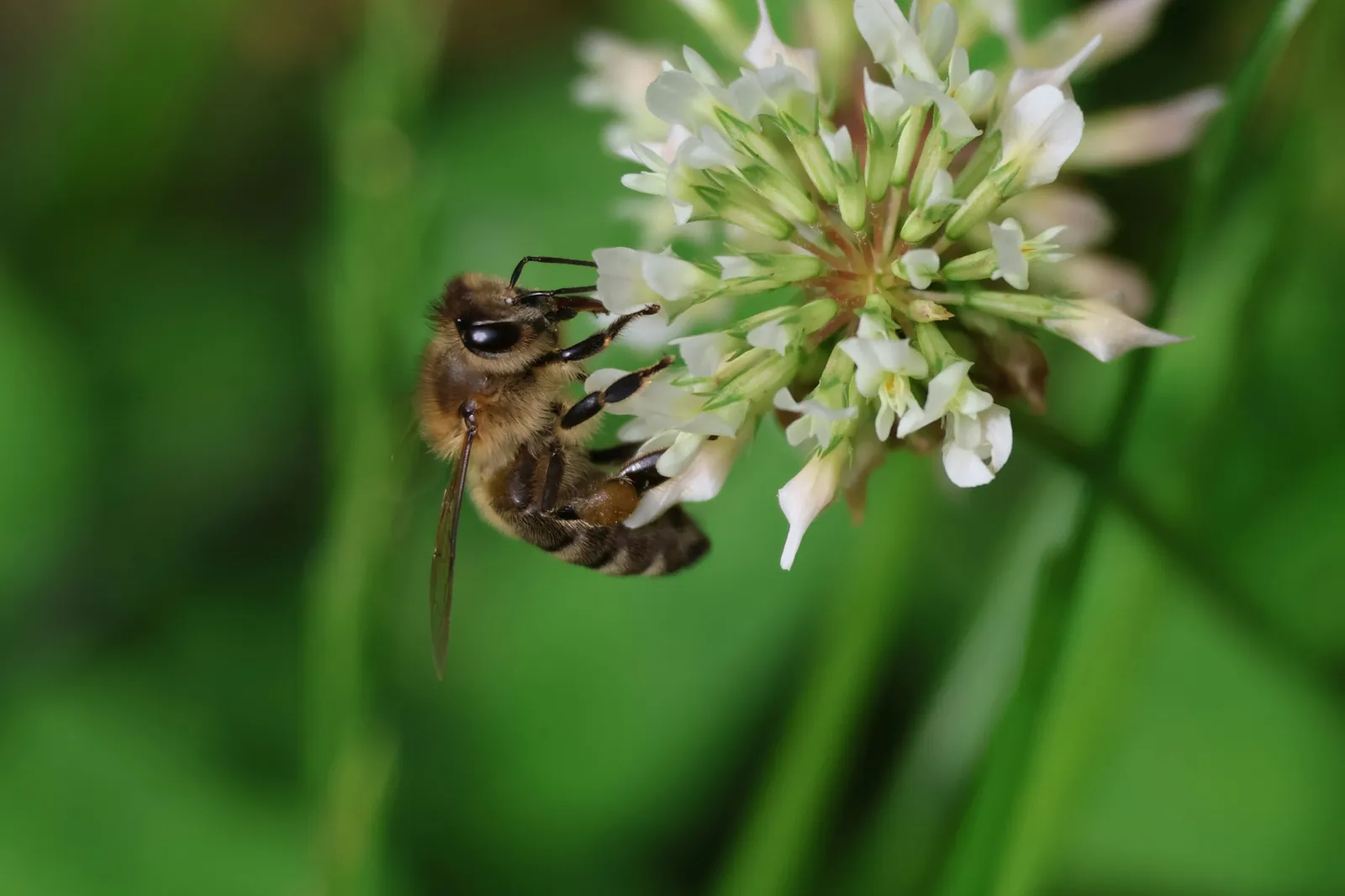
Collectors can help only with honey bee swarms, so this matters. The BBKA's identification guide gives these pointers:
- Honey bees: small, slim and golden brown to almost black, with a furry thorax. A swarm is thousands of bees, a dense cluster about the size and shape of a rugby ball or larger, not a dozen or so.
- Bumblebees: rounder, larger and furrier, often with coloured bands and a white, orange or buff tail. They live in small nests in bird boxes, compost heaps, under decking or in walls, and they do not swarm. Leave them alone: they rarely sting and the nest dies out at the end of summer.
- Solitary bees: lots of small bees going in and out of separate tiny holes in the ground or in old mortar. Harmless, and gone within weeks.
- Wasps: smooth, bright yellow and black, with a narrow waist, and drawn to sweet things. They build papery nests in roofs, sheds and hedges. Beekeepers do not remove wasps; if a nest is in a dangerous place, call a pest controller.
- Hornets: much bigger, brown and orange, with a loud buzz. In the UK, a yellow-legged Asian hornet must be reported.
If you are not sure, a clear photo sent to the collector will settle it in seconds.
Who do you call about a bee swarm?
In the UK, the British Beekeepers Association keeps a swarm collector map: enter your postcode to find volunteer beekeepers nearby. The BBKA asks you first to make sure the bees are honey bees, because its volunteers cannot help with bumblebees, solitary bees or wasps. A collector will want to know:
- what you can see, ideally with a photo, and roughly how big the cluster is
- exactly where it is, how high up and whether it is easy to reach
- how long it has been there, and whether you have called anyone else
- your address, parking and a phone number
Collectors are volunteers with their own jobs, so they may not come at once, and some ask for expenses. Call them back if the swarm leaves or someone else collects it, and once one beekeeper has agreed to come, do not give the details to others.
In Italy there is no single national map. The usual route is a local beekeeper or the local beekeepers' association (associazione apicoltori), many of which keep volunteer lists for recupero sciami, swarm collection. Some local ASLs, the public bodies that run veterinary services, publish them too: the AUSL of Bologna, for example, lists association beekeepers who collect swarms. The beekeeping magazine Apicoltore Moderno keeps a national list by region, including Sicily. If you have no contact, ask at the comune. If the swarm is a real danger, in a school, a busy street or high on a building, or someone allergic is at risk, call 112: the vigili del fuoco (fire brigade) deal with it, often working with local beekeepers who take the bees.
In either country, a pest controller is the wrong call for a honey bee swarm. A beekeeper will usually collect it for free or for expenses, and the bees get a new home. How beekeeping is organised in Italy, including hive registration, is in beekeeping in Italy.
Why you should never spray or kill a swarm
The BBKA asks people not to use chemicals or other products on bees, and there are good reasons beyond kindness:
- It is unnecessary. A swarm will leave by itself, or a beekeeper will take it away, usually within a day.
- It is dangerous. Spraying, hosing or smoking a swarm breaks up the calm cluster and sends thousands of irritated bees into the air.
- It spreads poison. Insecticide on a cluster can end up on plants, in soil and on other insects.
- It wastes a colony. A swarm is thousands of honey bees that a beekeeper would be glad to give a home.
Destroying an established feral colony in a building is a different and rarer question. The National Bee Unit says it should be considered only after a careful look at the risk to people, and only with approved products, and that live colonies can often be removed by professional bee removers instead.
How do beekeepers collect a swarm?
Collecting a swarm on a low branch is one of the simplest jobs in beekeeping:
- A box goes under the cluster. Often a cardboard box, a nucleus box or an old straw skep, with a sheet spread underneath.
- One sharp shake. A firm jolt to the branch drops most of the bees, and with luck the queen, into the box. Bees on a wall or post are gently brushed in.
- The box is left near the spot. If the queen is inside, bees at the entrance raise their tails and fan a scent that calls the others in, and the stragglers march into the box.
- It is collected in the evening. The BBKA describes it as a two-part job: bees into the box, then a return in the evening, when the flying bees are home, to close it and take it away.
- The swarm is hived. At the apiary it goes into a hive, often with some feeding to help it start building comb.
Beekeepers also set up bait hives, or swarm traps: an empty box with old comb or a lure, placed where scout bees will find it, in the hope that a swarm moves in by itself. If you catch a swarm in Italy, it becomes a colony like any other and must be registered, as beekeeping in Italy explains.
The swarm that settled in my olive tree
In my first year of beekeeping at the villa, a swarm landed on one of the mature Nocellara del Belice olive trees in the front garden, about five metres from my original hive. Watching a swarm cluster in your own olive tree is one of the more remarkable things beekeeping can show you.
Because I had empty Italian hive equipment ready, I could do something useful about it. I shook the swarm into the empty Italian hive, moved it to the hive stand, reduced the entrance and fed it. I also put branches at the entrance, so the bees would stop and reorientate to their new home rather than fly back to the spot where they had clustered. The bees were full of honey and very docile, with nothing yet to defend, and shaking them into a box and then watching them settle in was both tense and satisfying.
I also had swarm traps with lure set up, and scout bees investigated them at various points in the year. A scout at a trap does not mean a swarm will follow, but it does mean the trap is being weighed up as a home. The olive-tree swarm settled well in its Italian hive and went into winter as one of my two strong colonies, as I describe in bees in winter. A third, weaker colony, which came from a smaller swarm, did not have a happy ending: it was badly robbed and lost while I was away, which is in beekeeping in Sicily: my first year.
The lesson I took from it is the one I would pass on to anyone who finds a swarm in their garden: swarming is not a failure or an attack. It is bees doing exactly what bees have always done, and with a little patience, or a phone call to a beekeeper, it ends well for everyone.
Frequently asked questions
How long does a bee swarm stay in one place?
Usually from a few hours to a couple of days. The flying swarm settles into a cluster within about 15 minutes, then waits while scout bees find a new home. Cool or wet weather can make it stay longer.
Will a bee swarm sting me?
It is unlikely if you leave it alone. Swarming bees have no nest to defend and are full of honey, so they are usually calm. They will sting if squashed, swatted, sprayed or hosed, so keep a few metres away and keep children and pets inside.
Can I just leave a bee swarm alone?
Yes, if it is out of the way. The swarm will normally move on within a day or so. The risk is that it moves into your chimney, roof or a cavity wall, so if it is close to a house, call a swarm collector early.
Do beekeepers charge to collect a swarm?
In the UK, BBKA swarm collectors are volunteers who are not paid for the service, though some may ask for expenses. In Italy, local beekeepers usually collect a swarm free or for a small contribution to costs.
Who removes bee swarms in Italy?
Local beekeepers, often found through a beekeepers’ association or a list kept by the local ASL or the comune. In an emergency, such as a swarm at a school or high on a building, call 112 and the vigili del fuoco will deal with it, often with a local beekeeper.
Should I spray a bee swarm with water?
No. Hosing or spraying a swarm breaks up the cluster and makes the bees far more likely to sting. It does not make them leave any faster. Keep away and call a collector if the swarm is a problem.
What time of day do bees swarm?
Usually on warm, sunny days, from late morning to mid afternoon, roughly 11am to 4pm in the UK, and often on the first fine day after a spell of poor weather.
Is it a swarm or a nest in my wall?
A swarm is a hanging cluster of bees out in the open that stays for hours or days. Bees flying steadily in and out of a hole in a wall, roof or chimney are an established nest, which is a job for a specialist bee remover rather than a swarm collector.
Sources and small print
- APHA National Bee Unit (BeeBase): dealing with swarms
- British Beekeepers Association: honey bee swarms and swarm collection
- British Beekeepers Association: bee identification guide
- Azienda USL di Bologna: recupero sciami d'api (swarm collection by local beekeepers)
- Apicoltore Moderno: national list of beekeepers who collect swarms, by region
General guidance; local arrangements differ, and if anyone is at risk from stings, call the emergency services.
Credits
Photo: Josef Hejpetr, Unsplash Licence, via Unsplash.
Photo: Andrey Larionov, Unsplash Licence, via Unsplash.
 The weekly YouTube series