
What is the Sicilian black bee?
Every honey bee kept in Europe belongs to one species, Apis mellifera, but over thousands of years it formed local subspecies suited to their own climates: the dark bee of northern Europe, the Carniolan bee of the Alps and Balkans, the Italian bee of the Italian peninsula, and others. Sicily's is Apis mellifera siciliana, known in Italian as the ape nera sicula or ape nera siciliana.
It is a small bee with a dark, almost black abdomen and yellowish down, and shorter wings than the Italian bee. Its origins are debated, but it is generally thought to be related to the honey bees of North Africa, just across the Sicilian Channel, which would make sense of how well it copes with heat.
How is it different from the Italian bee?
The Italian honey bee, Apis mellifera ligustica, is one of the most widely kept honey bees in the world: golden, gentle and very productive in a temperate summer. It is the bee most Sicilian beekeepers switched to, and the one sold by most queen breeders.
| Sicilian black bee (siciliana) | Italian bee (ligustica) | |
|---|---|---|
| Colour | Dark, almost black abdomen, yellowish down | Golden yellow bands |
| Size | Small, with short wings | Larger |
| Heat | Keeps working above 40°C | Slows down in extreme heat |
| Temperament | Docile | Docile |
| Where kept | Mainly Palermo and Trapani provinces and the small islands | Worldwide |
Slow Food describes the black bee as productive even in very high temperatures and able to cope with sudden changes in temperature, both useful in a Sicilian summer like 2026, when the area around my villa went two to three months with almost no rain and some days passed 40°C.
Why did the Sicilian black bee nearly disappear?
For centuries Sicilian beekeepers kept the black bee in traditional hives made from the hollow stems of giant fennel (ferula) or from cork, stacked in walls. From the 1970s and 1980s, as beekeeping modernised, they replaced those hives with modern movable-frame boxes and replaced the native bee with imported Italian queens, which were easy to buy and bred for gentleness and yield.
Honey bee queens mate in the air with drones from many colonies over a wide area, so once the island filled with Italian bees, the native bee was quickly diluted by crossbreeding. Within a generation of beekeepers, pure black bee colonies had all but gone.
How was the Sicilian black bee saved?
The story is mostly one man's. The beekeeper Carlo Amodeo was introduced to the black bee by the Palermo entomologist Pietro Genduso. In 1987 he found a few surviving colonies at Carini, near Palermo's airport, kept by an old beekeeper.
The problem was how to breed them pure on an island full of Italian bees. The answer was other islands. Amodeo raised black bee queens in isolation on small islands where no other honey bees were kept, first Ustica, then the Aeolian Islands such as Filicudi, Alicudi and Vulcano, and later Linosa and Lampedusa, so that the queens could only mate with black bee drones.
In 2008, after Amodeo raised the alarm about the bee's survival, Slow Food made the Sicilian black bee one of its presidia, the projects that protect endangered foods and breeds. An association of breeders followed, and by 2019 he reported that around 30,000 black bee queens had been reintroduced, with about 2,500 hives kept by some 240 beekeepers.
Where are Sicilian black bees kept today?
The Slow Food presidium covers the provinces of Palermo and Trapani, with support from the Sicilian Region, and its producers include beekeepers across western Sicily; one of them is in Mazara del Vallo, my nearest town. Breeding lines are still kept on the small islands, where isolation keeps them pure.
Black bee honey is sold by presidium producers, at Slow Food markets and in delicatessens in Sicily and further afield. It is never cheap, because the colonies are few and the bee is valued for keeping the subspecies alive rather than for sheer yield.
What is Sicilian black bee honey like?
There is no single black bee honey flavour: like any honey, it tastes of the flowers the bees were working. Presidium honey is produced from about April to July, so it is typically from the spring and early summer flowers of western Sicily: citrus blossom (zagara), sulla, wild thyme, wildflowers and, in some places, eucalyptus. My guide to why Sicilian honey tastes different covers those flowers.
You will see big claims made for black bee honey online, such as the bee resisting the varroa mite. I have not found solid, published evidence for those claims, so I do not repeat them. What makes the honey special is simpler: it comes from a rare native bee kept by a small number of beekeepers, mostly in small batches.
Can you keep Sicilian black bees?
In Sicily, yes. Breeders associated with the presidium sell queens and colonies, and keeping them helps the project, as each new apiary of pure black bees adds drones that help keep local mating pure. Outside Sicily it makes less sense: the bee is adapted to the Sicilian climate, and moving bees and queens between countries is controlled by animal health rules.
Anyone keeping bees in Italy must register their hives in the national beekeeping register, whatever bee they keep. My first year of beekeeping, including the equipment mistakes I made, is in beekeeping in Sicily: my first year.
Our bees at the villa
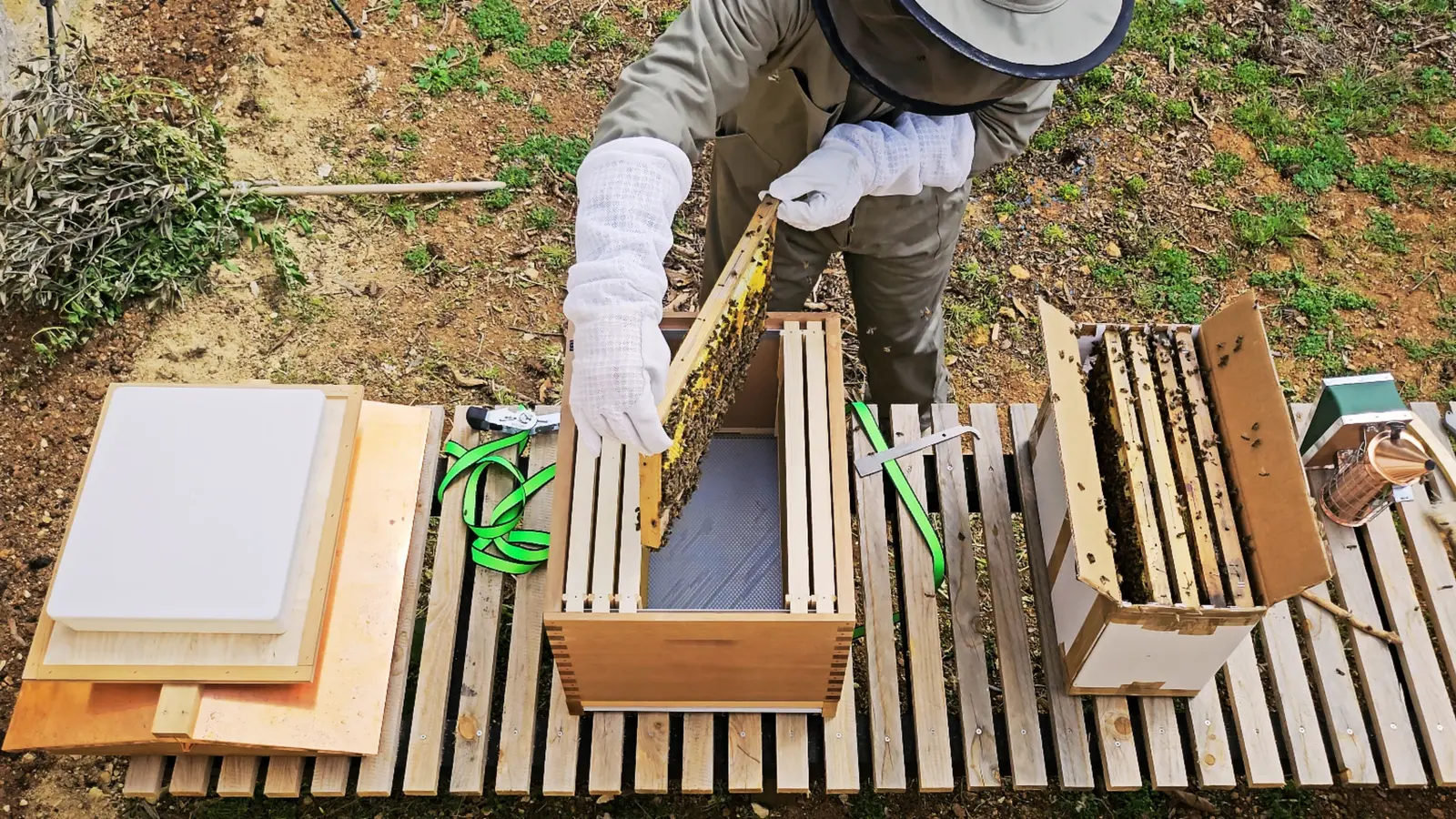
My first colony came as a nucleus from a beekeeper near Trapani in spring 2026, and by August the apiary had two strong colonies after a swarm, a robbed hive and a very dry summer. Which bees I keep in future, and whether the black bee belongs in my own apiary, is something I am still learning about, and I will write about it as the hives grow.
The bees forage on the wild flowers, citrus and herbs around the villa, and how they get through the mild Sicilian winter is in bees in winter.
Frequently asked questions
What is the Sicilian black bee?
The Sicilian black bee, Apis mellifera siciliana, is the native honey bee subspecies of Sicily. It is small, with a dark abdomen and yellowish hairs, docile, and able to keep working in temperatures above 40°C. In Italian it is called the ape nera sicula or ape nera siciliana.
Is the Sicilian black bee endangered?
It came close to disappearing after Sicilian beekeepers switched to imported Italian bees from the 1970s, and pure colonies are still relatively few. Since the late 1980s it has been bred in isolation on small islands, and since 2008 it has been protected by a Slow Food presidium, with tens of thousands of queens reintroduced.
Who saved the Sicilian black bee?
Mainly the beekeeper Carlo Amodeo, who in 1987 found surviving colonies at Carini, near Palermo, and bred them in isolation on islands such as Ustica, Filicudi, Alicudi and Vulcano so the queens could only mate with black bee drones.
What is the difference between the black bee and the Italian bee?
The Sicilian black bee is smaller and darker, with shorter wings, and copes very well with extreme heat. The Italian bee, Apis mellifera ligustica, is golden, larger, very productive in temperate summers and kept worldwide. Both are docile.
What does Sicilian black bee honey taste like?
It depends on the flowers. Presidium honey is made from about April to July, so it is usually from spring and early summer flowers such as citrus blossom, sulla, wild thyme and wildflowers, each with its own taste and colour.
Where can I buy Sicilian black bee honey?
From beekeepers in the Slow Food presidium, mostly in the provinces of Palermo and Trapani, at Slow Food markets, and in some delicatessens in Italy and abroad. Look for the presidium name and a named producer.
Sources and small print
- Slow Food Foundation for Biodiversity: Sicilian black bee presidium
- University of Catania (IRIS): assessment of biological and behavioural characteristics of Apis mellifera siciliana and Apis mellifera ligustica colonies in Sicily
- Wikipedia: Apis mellifera siciliana
- La Sicilia, 17 June 2019: interview with Carlo Amodeo on the recovery of the black bee
- Anagrafe apistica nazionale (Italy's national beekeeping register), via the Ministry of Health's veterinary portal
Figures for queens, hives and beekeepers are those given by Carlo Amodeo in 2019. Black bee honey is not presented here as having any health benefit.
Credits
Photo: Operation Sicily®, all rights reserved, via operationsicily.com.
Photo: Operation Sicily®, all rights reserved, via operationsicily.com.
 The weekly YouTube series