
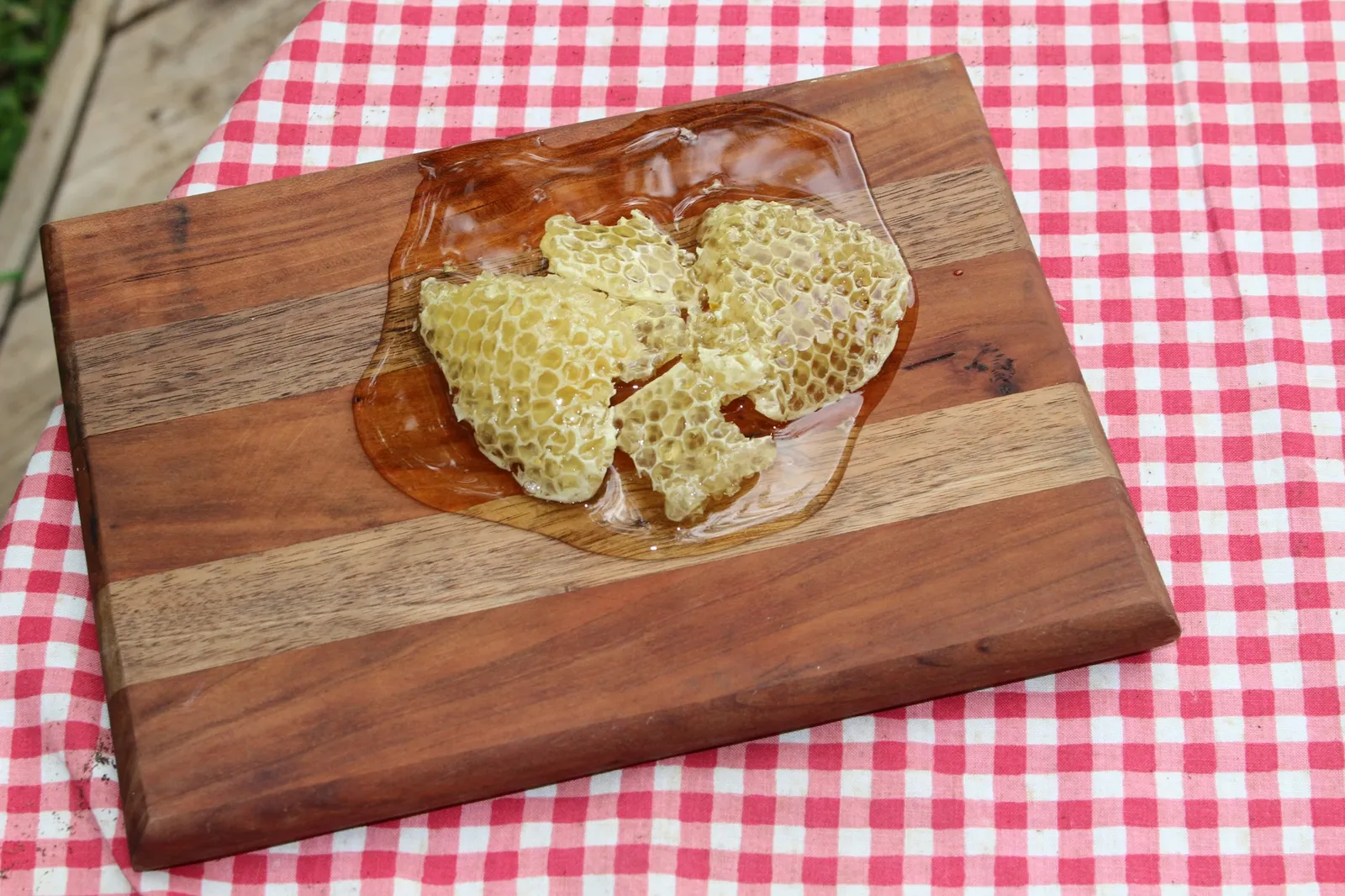
Can you eat honeycomb wax?
Yes. The comb is made of pure beeswax, which the bees produce from glands on the underside of their abdomen, and it is safe to eat in the amounts that come with a piece of honeycomb. Beeswax is also an authorised food additive in the EU, E 901, used as a glazing agent on sweets and fruit, and the European Food Safety Authority concluded in 2007 that those uses raise no safety concern.
What beeswax is not is digestible. People cannot break it down, and nor can most animals: the FAO notes in its guide to beeswax production that it just passes through the gut. So it adds no real nourishment; it is there for the texture and for the honey it holds.
That leaves you with two equally normal choices:
- Swallow it. Most people who eat honeycomb regularly do. A few small pieces of wax are not a problem.
- Spit it out. Once you have chewed all the honey out, the little ball of wax has no flavour left, and many people simply discard it, the way you would with chewing gum.
Common sense applies to quantity. Honeycomb is meant to be eaten a piece at a time, not by the slab, and a large amount of wax eaten in one go is not something anyone recommends.
How do you eat honeycomb?
Eating honeycomb on its own is the best way to taste it for the first time:
- Let it come to room temperature. Cold comb is hard and brittle, and the honey inside is stiff. At around 20°C the wax is soft and the honey flows.
- Cut a piece about the size of a sugar cube. A knife dipped in hot water and wiped dry goes through the wax cleanly.
- Chew it slowly. The cells burst and the honey floods out. It tastes fresher and more fragrant than most jarred honey, because nothing has been strained or warmed.
- Deal with the wax. After a minute or so you are left with a soft, pale ball of wax with a faint taste of honey. Swallow it or discard it.
The texture surprises people. Fresh, thin comb is tender and almost melts; comb that has been in the hive longer, or comb built on heavier foundation, is chewier. Both are fine to eat.
What is honeycomb? Comb honey, cut comb and chunk honey
Honeycomb is the bees' own storage system: sheets of six-sided wax cells, filled with ripe honey and sealed with a thin wax cap. How the bees build it is explained in how bees make honey. When it is sold or served still in that wax, it goes by a few names, and some of them are defined in law. Under the EU honey directive, Council Directive 2001/110/EC, which the UK kept in its own regulations, comb honey must be stored by the bees in freshly built comb with no brood in it, or on thin foundation sheets made solely of beeswax.
| Name | What it is | How you eat it |
|---|---|---|
| Comb honey (section or whole comb) | A whole sealed comb, or a square or round section the bees filled in its own small frame | Cut pieces straight from the block |
| Cut comb | A frame of comb honey cut into blocks, drained and boxed | The most common form; cut into smaller pieces to serve |
| Chunk honey (cut comb in honey) | A jar of liquid honey with one or more pieces of comb in it | Spoon out honey and comb together |
| Honey from the comb (extracted) | Honey spun or pressed out of the comb, then strained | Ordinary jarred honey, no wax |
On an Italian label, comb honey is miele in favo. What every name on a honey label must and need not tell you is in honey labels explained.
How do you cut and serve honeycomb?
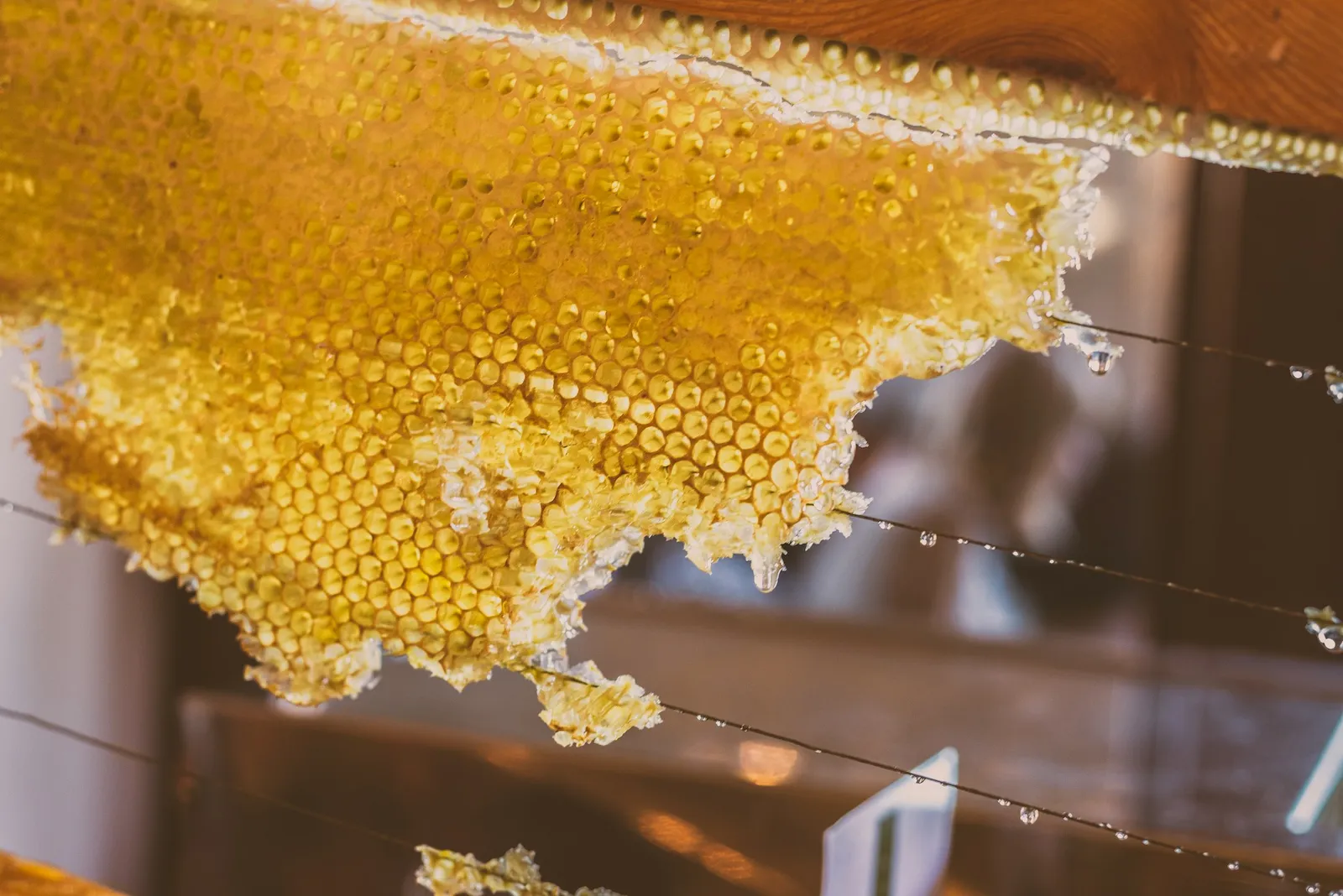
Put the comb on a plate or board with a rim, because cut comb weeps honey from every cut edge. Use a sharp knife warmed in hot water, cut straight down rather than sawing, and wipe the blade between cuts. For a cheese board, cut small cubes or fingers; for breakfast, a thin slice is enough.
Good ways to serve it:
- On warm toast or bread. Lay a thin slice on hot buttered toast and the wax softens while the honey soaks in.
- On a cheese board. Honeycomb is lovely beside a young pecorino, fresh ricotta or a sharper aged cheese. The salt and the honey balance each other. For what to put next to it, see my guide to Sicilian cheese.
- Over yoghurt. A small piece on thick, plain yoghurt, with walnuts or almonds.
- With fruit. Fresh figs, pears and sliced apples all work, and so do summer peaches.
- With pancakes or on ice cream. Add it at the last moment so the comb keeps its shape.
Do not cook with it. Beeswax melts at about 62 to 65°C, so in a hot pan or oven the comb turns into a film of wax rather than anything you would want to eat. If you need honey for cooking, use runny honey. The flavour of the comb depends on the flowers the bees worked: a citrus comb tastes very different from a thyme comb, as my guides to orange blossom honey and thyme honey explain.
How do you store comb honey?
Comb honey keeps well, but it needs slightly different care from a jar of honey:
- Keep it sealed. Leave it in its box or move it to an airtight container. Cut edges weep honey and dry out, and honey takes in moisture and smells from the air.
- Keep it at room temperature. A cool, dry cupboard is right. The fridge makes the wax hard and brittle and makes the honey crystallise faster.
- Keep it out of the sun. In a Sicilian summer, a box left in a hot room or a car can soften and slump.
Comb honey can crystallise in the comb, just as jarred honey does. The honey turns pale, cloudy and grainy inside the cells, sooner in honeys high in glucose and at cool temperatures. It is still perfectly good, and some people like the crunch. The trouble is that you cannot easily make it runny again: warming jarred honey works because the wax is not there, but warm the comb too much and the wax starts to soften and slump. Eat crystallised comb as it is. Why honey sets at all is in why does honey crystallise.
Freezing is useful for keeping comb for a long time. Beekeepers freeze cut comb to kill any wax moth eggs before packing it, and the University of Nebraska's comb honey guide notes that keeping it frozen also slows crystallisation. Thaw it in its sealed box, so condensation forms on the outside rather than on the comb. How long honey keeps in general, and what the best before date means, is in does honey go off.
Why is comb honey so expensive?
Because the beekeeper sells the wax as well as the honey, and wax is costly for bees to make. The FAO estimates that bees eat around 8 kg of honey to produce 1 kg of beeswax, and figures of 6 to 8 kg are often quoted. When a beekeeper extracts honey, the empty comb goes back into the hive and the bees can refill it straight away. When the comb is sold, the bees have to build it all again from scratch next time, using honey that would otherwise have been surplus.
There are other costs too:
- It needs a strong flow. Bees build good comb only when plenty of nectar is coming in, so comb honey is a crop of good years and good places.
- It needs crowded colonies. Beekeepers squeeze bees into less space to make them build, and crowded colonies are more likely to swarm, which can cost the beekeeper half the bees. What happens then is in a bee swarm in your garden.
- It is hand work. Each frame is cut, drained, packed and often frozen by hand, and it cannot be bottled by machine like runny honey.
- It travels badly. Comb is fragile and must be packed so it does not break or leak.
I saw the wax problem from the inside this year. In the dry Sicilian summer, with almost no nectar coming in, our colonies barely drew any new comb in the honey boxes above the brood. Without a flow, bees will not spend their stores on wax.
How do beekeepers produce cut comb?
Comb honey is planned from the start, because ordinary hive frames are fitted with wired foundation that you cannot cut or eat. For comb honey, beekeepers use:
- Thin foundation. A thin, unwired sheet made only of beeswax, which the bees draw out into delicate comb.
- Foundationless frames. An empty frame with just a narrow starter strip of wax along the top, so the bees build all of the comb themselves.
- Sections. Small square or round frames, each filled and capped by the bees as a single portion.
The frames go in a box above the brood, usually over a queen excluder, so the comb holds only honey and never eggs or larvae. They are put on at the start of a strong flow and taken off as soon as the comb is fully capped. Left too long, the bees walking over the white cappings stain them yellow, and the wax can pick up a slightly bitter taste. The beekeeper then cuts the comb into blocks, lets the cut edges drain on a rack, and boxes it. When to take honey off the hive, and how to judge that it is ripe, is covered in when to harvest honey.
Who should not eat honeycomb?
Babies under 12 months. Honey can contain spores of the bacterium that causes infant botulism, and a baby's gut cannot yet deal with them. The NHS advises not to give honey to children under one, and honeycomb is honey. Cooking does not make it safe for babies.
Young children. From the age of one, honey is fine, but a chewy lump of wax is the kind of thing small children can choke on. Give them only small pieces, sitting down, and teach them to spit the wax out.
People allergic to bee products. Comb can carry traces of pollen and propolis, the resin bees use to seal gaps. Anyone who reacts to these should avoid it.
Dark or brown comb is old comb that has held brood, and it is not sold as comb honey. If you are ever offered comb straight from a hive, eat only the pale, capped honey comb.
Honeycomb and our hives in Sicily
I have not cut any comb from our own hives yet. My first year of beekeeping, starting in spring 2026 with a nucleus colony from near Trapani, has been about building strong colonies rather than taking honey. Going into winter we have two strong colonies, and the boxes they will fill next year still need drawn comb. The whole story, including the hard lessons, is in beekeeping in Sicily: my first year.
What the year did teach me is how much each square of comb represents: weeks of nectar, a colony crowded and working in a flow, and a summer dearth in July and August when nothing is built at all. The flowers around us, from citrus blossom and sulla to thyme, carob and eucalyptus, all give comb its colour and taste, which is the subject of why Sicilian honey tastes different. And if you are wondering why comb honey is about the least processed honey there is, raw honey vs supermarket honey explains what processing does.
Frequently asked questions
Is it OK to swallow honeycomb wax?
Yes. Beeswax is edible and safe in the small amounts that come with a piece of honeycomb. Your body does not digest it, so it passes straight through. Many people swallow it; others chew out the honey and spit the wax out. Both are normal.
Do you chew honeycomb like gum?
Rather like it, yes. Chew a small piece until the honey has run out, and the wax softens into a pale, chewy ball with little taste left. Then either swallow it or discard it as you would gum.
What does honeycomb taste like?
Like the honey it holds, but fresher and more fragrant, with a soft, waxy chew. The flavour depends entirely on the flowers the bees visited, so citrus comb, thyme comb and wildflower comb all taste different.
How do you cut honeycomb without making a mess?
Work on a plate or board with a rim, use a sharp knife dipped in hot water and wiped dry, cut straight down, and wipe the blade between cuts. Comb at room temperature cuts more cleanly than cold comb.
Does honeycomb need to be refrigerated?
No. Keep comb honey sealed in its box or an airtight container at room temperature, in a cool, dry cupboard. The fridge makes the wax brittle and the honey crystallise faster. For very long storage you can freeze it in its sealed box.
How long does honeycomb last?
Sealed comb honey kept closed in a cool, dry cupboard keeps for many months, and like any ripe honey it stays safe to eat for years. Over time it may crystallise in the cells, which is natural. Frozen in its sealed box, it keeps even longer.
Why has my honeycomb gone white and crunchy?
The honey has crystallised in the cells. It is natural and the comb is still good to eat; many people like the crunch. It is hard to make comb runny again, because warming it enough to melt the crystals also softens the wax.
Why is honeycomb more expensive than runny honey?
Bees eat around 8 kg of honey to make 1 kg of wax, by the FAO estimate, and when comb is sold the bees must build it again from scratch. Comb honey also needs a strong nectar flow, crowded colonies and careful hand cutting and packing.
Can children eat honeycomb?
Never give honey or honeycomb to a baby under 12 months, because of the risk of infant botulism. Older children can eat it, but give them small pieces, sitting down, as a lump of wax can be a choking risk.
Sources and small print
- FAO: Bees and their role in forest livelihoods, chapter on beeswax (honey used per kg of wax, wax not digested)
- EFSA: Beeswax (E 901) as a glazing agent and as carrier for flavours, scientific opinion (2007)
- EUR-Lex: Council Directive 2001/110/EC relating to honey (definitions of comb honey and chunk honey)
- University of Nebraska-Lincoln Extension: Beekeepers' Guide to Comb Honey Production
- NHS: foods to avoid giving babies and young children, including honey
General guidance on eating and storing comb honey; ask your doctor about any allergy or dietary concern.
Credits
Photo: Hunter Trahan, Unsplash Licence, via Unsplash.
Photo: Jez Timms, Unsplash Licence, via Unsplash.
 The weekly YouTube series