
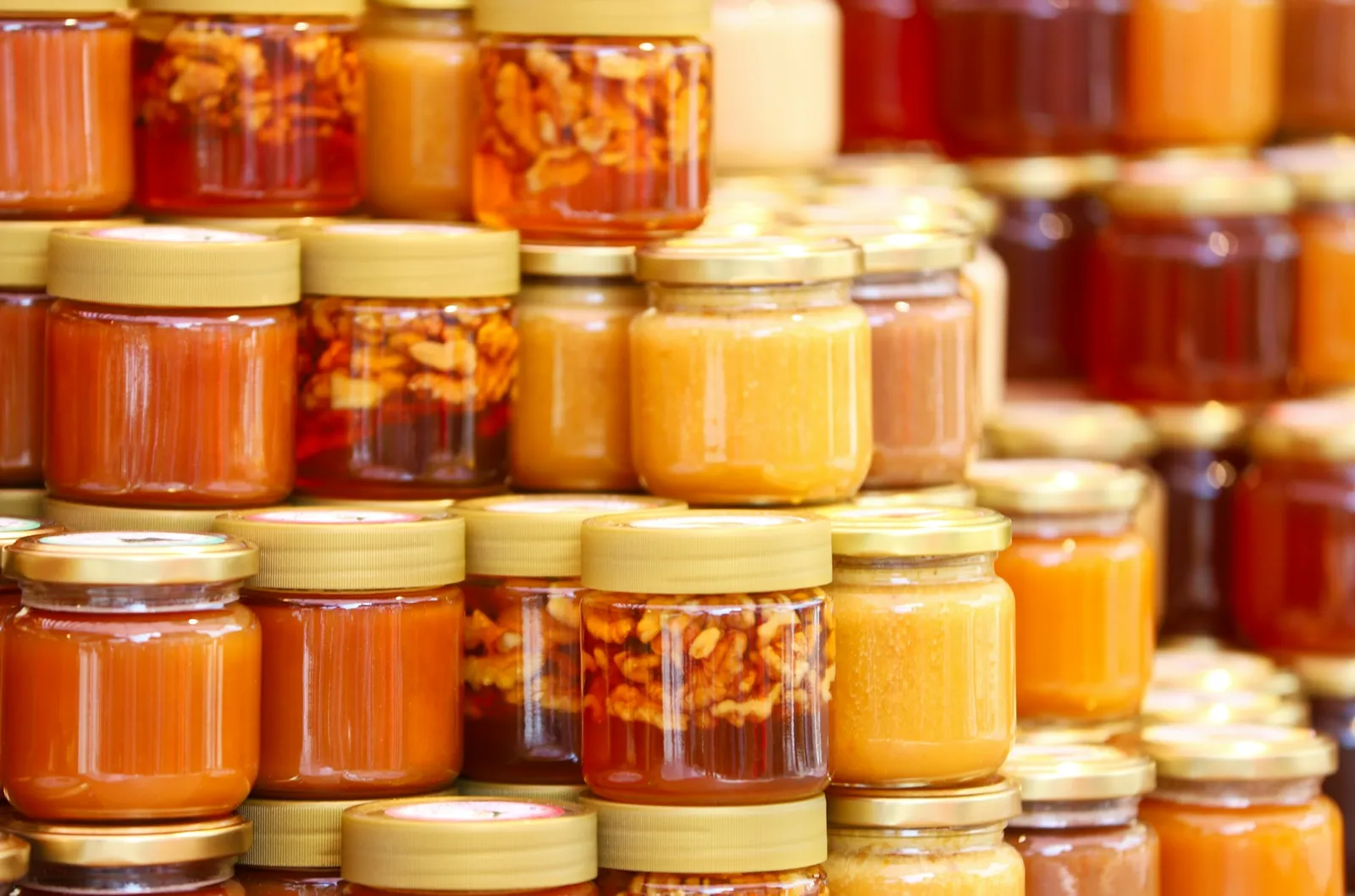
What must a honey label say by law?
Honey in both the EU and the UK is governed by the same original law, Council Directive 2001/110/EC, which the UK copied into its own regulations before Brexit. On top of the general food labelling rules (name, net weight, best before date, lot number, and the name and address of the business), a honey label must show:
- The name of the product. Usually just “honey”, but some types must use their full legal name (see the table below).
- The country or countries of origin where the honey was harvested. Not where it was packed. A jar packed in Italy or in England can contain honey harvested on another continent.
- “Intended for cooking only” next to the name, if it is baker’s honey.
The law also protects what is inside the jar. Nothing may be added to honey, and nothing particular to honey, such as pollen, may be removed except where that cannot be avoided while removing foreign matter. Apart from baker’s honey, honey must not be heated so much that its natural enzymes are destroyed or significantly inactivated, and in most cases it may contain no more than 20% water.
What does “blend of EU and non-EU honeys” mean?
It means the jar is a mix of honey harvested in at least one EU country and at least one country outside the EU, and nothing more. It does not tell you which countries, or in what proportions. A jar labelled this way could be 95% from one non-EU country with a spoonful of European honey, or the other way round.
Until June 2026, EU law allowed three vague phrases for blends: “blend of EU honeys”, “blend of non-EU honeys” and “blend of EU and non-EU honeys”. Some countries, Italy among them, already demanded more for honey packed on their territory, but most of the EU did not. Those phrases are why so many shoppers had no idea where their honey came from, and why blends are a favourite route for fraud, which I cover in how to tell if honey is real.
You will still see the old wording for a while. Jars that were labelled or placed on the market before 14 June 2026 may be sold until stocks run out, and in the UK a similar phrase is still allowed.
What are the new EU honey labelling rules from June 2026?
Directive (EU) 2024/1438, part of the revised “Breakfast Directives”, rewrote the origin rule for honey. Member States had to bring it into national law by December 2025, and it applies from 14 June 2026. The key points, from the text on EUR-Lex:
- Every country of origin must be named where the honey comes from more than one country, in descending order of its share by weight.
- Each country must have its percentage. A typical label now reads something like “Spain 60%, Ukraine 30%, Italy 10%”.
- It must be in the principal field of vision, the part of the pack you see first, not hidden on the back.
- A tolerance of 5% is allowed on each share, checked against the packer’s traceability records.
- Packs under 30 g, such as the little portions in hotels and cafés, may use two-letter country codes (IT, ES, UA) instead of full names.
- A national option for big blends: where there are more than four countries and the four largest make up more than 50% of the blend, a Member State may allow percentages for only those four, with the rest named in descending order without percentages. Italy took this option but tightened it: there, the four largest must make up more than 60%.
Italy brought the directive into force with Legislative Decree no. 207 of 30 December 2025, so a jar packed in Italy since June 2026 should show the full breakdown.
What are the UK rules on honey country of origin?
The UK did not adopt the 2024 EU change. In England the rules are in The Honey (England) Regulations 2015, with matching regulations in Wales, Scotland and Northern Ireland. Since a 2021 amendment, regulation 17 of the English rules says that if honey comes from more than one country, the countries “may be replaced with the indication ‘blend of honeys from more than one country’ or similar wording”. That is why UK supermarket jars still show a vague phrase and, often, a British company name and address with a Union flag, even when none of the honey was harvested in Britain.
Northern Ireland is the exception worth knowing about: under the Windsor Framework it follows EU rules on food like honey, so jars there are expected to follow the new country listing. If you buy honey in Great Britain and want to know where it came from, look for a named single country, or better a region or a named beekeeper. You can read the English regulation itself on legislation.gov.uk.
Which honey names are defined in law?
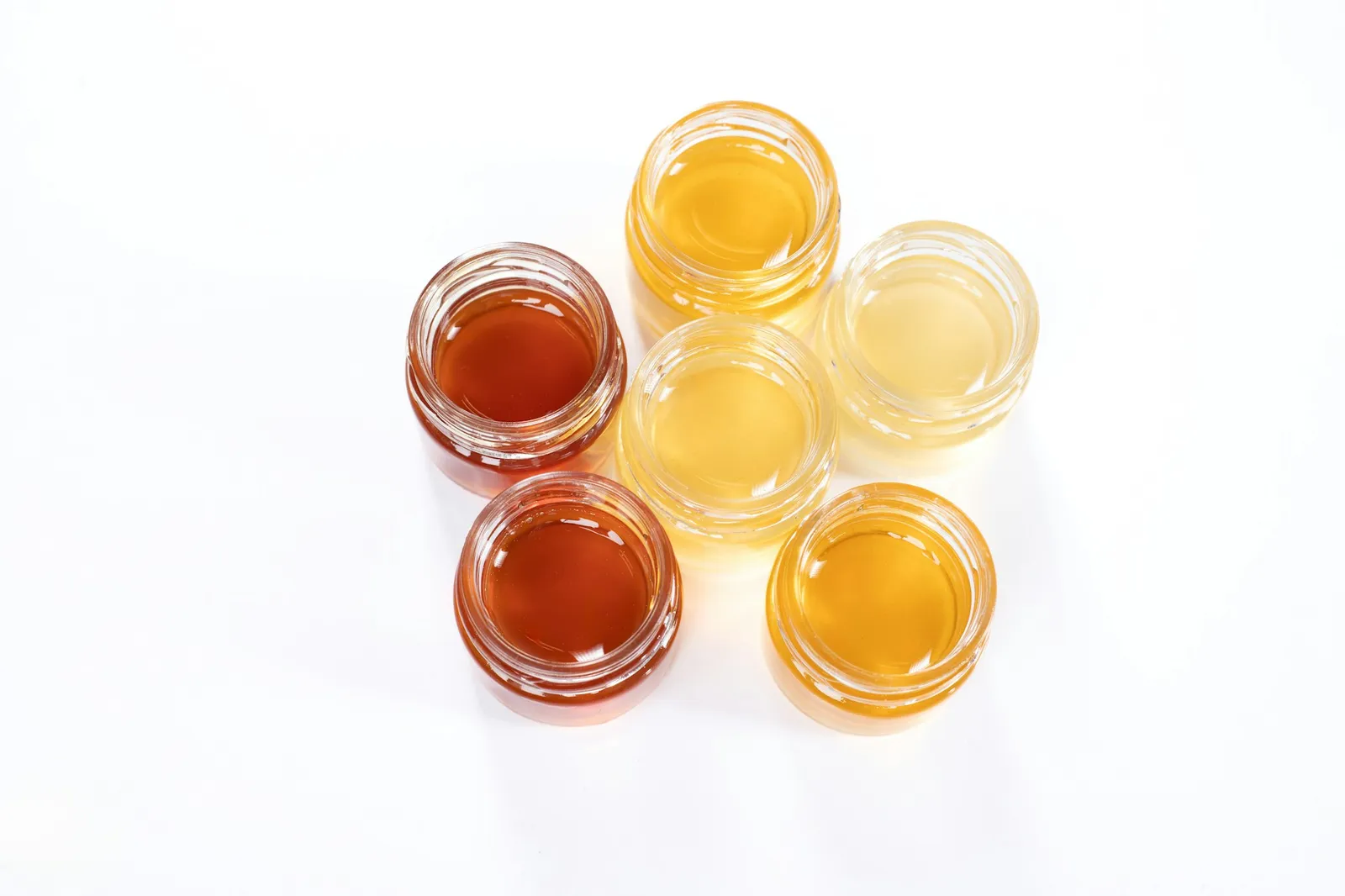
These names have a legal meaning in both the EU and the UK. Most can be shortened to just “honey” on the jar, but comb honey, chunk honey, filtered honey and baker’s honey must use their full name.
| Name on the label | What it means in law |
|---|---|
| Blossom or nectar honey | Made from the nectar of flowers |
| Honeydew honey | Made mainly from the sweet excretions of sap-sucking insects on plants, or from plant secretions; dark and malty, in Italy “melata” |
| Comb honey | Honey in freshly built, broodless comb, sold as whole sealed combs or sections |
| Chunk honey, or cut comb in honey | Liquid honey with one or more pieces of comb honey in the jar |
| Drained, extracted or pressed honey | How it left the comb: by draining, by spinning in a centrifuge, or by pressing, with gentle heat of no more than 45°C allowed for pressing |
| Filtered honey | Filtered so finely that most of the pollen is removed; it may not carry a flower or regional name |
| Baker’s honey | For industry and cooking; may taste odd, have begun to ferment or have been overheated; must say “intended for cooking only” |
Filtered honey and baker’s honey cannot be described by flower, region or quality. If a jar names a flower or a place, it cannot legally be either of those.
What do raw, pure, natural and cold extracted mean on honey?
None of these words is defined in honey law in the EU or the UK. They are not meaningless, but they are the producer’s claim, not a legal category.
- Raw: usually means honey that has only been strained, not heated beyond hive temperature and not finely filtered. Nobody checks a set temperature. I go into what raw honey is in raw honey vs supermarket honey.
- Pure and natural: all honey must already be pure honey with nothing added, so these words add nothing a law does not already require.
- Unpasteurised: honey is not pasteurised the way milk is, but much commercial honey is warmed to make it flow and slow crystallisation. “Unpasteurised” suggests it was not heated much; it is not a defined standard.
- Cold extracted or cold pressed: a description of the method. The only temperature in the law is the 45°C limit for pressed honey.
- Set, creamed or soft set: honey that has been crystallised on purpose into fine crystals. It is not a legal type and not a sign of anything wrong; why honey crystallises explains how it happens.
- Organic: the exception. It is a regulated term, and the jar should carry the certifier’s code and, in the EU, the green leaf logo.
What does a flower name on honey mean?
A flower or plant name, such as orange blossom, acacia, thyme, chestnut or eucalyptus, may only be used if the honey comes wholly or mainly from that source and has the taste, physical and microscopic characteristics of it. The law sets no fixed percentage. Laboratories judge it by pollen analysis, colour, smell and taste, and some plants are naturally poor in pollen, which makes the call harder.
A place name is stricter. A regional, territorial or topographical name, such as a region of Italy or a valley, may only be used if the honey comes entirely from there. Protected names such as the Italian DOP honeys (Miele della Lunigiana and Miele delle Dolomiti Bellunesi, for example) go further, with their own rules on area and method.
Here in western Sicily, flower names you will see at markets include zagara (citrus blossom), sulla, timo (thyme), eucalipto and carrubo (carob). The flowers behind Sicilian honey are what give those names their meaning; a dedicated guide to orange blossom honey covers the most famous one.
How do you read an Italian honey label?
A few Italian words come up on almost every jar in Italy:
- Millefiori: “thousand flowers”, a multifloral or wildflower honey from whatever was flowering. Not a legal type, and often the best expression of a place.
- Miele italiano or 100% italiano: harvested entirely in Italy. With the new rules a blend has to show its percentages instead, such as “Italia 70%, Spagna 30%”.
- Miscela di mieli originari e non originari dell’UE: the Italian version of “blend of EU and non-EU honeys”, now replaced on new stock by a country list. You may also see shorter forms such as “Paesi UE e non UE”.
- Paese d’origine, raccolto in: country of origin, harvested in.
- Melata: honeydew honey; miele in favo is comb honey; miele per uso industriale is baker’s honey.
- Miele vergine integrale, crudo, grezzo: various ways of saying raw or unprocessed. Like “raw” in English, they are marketing words.
- Prodotto e confezionato da: produced and packed by, followed by the producer; confezionato da alone often means a packer, not a beekeeper.
Under Italian law, beekeepers are registered in the national beekeeping register, and many small producers put their beekeeper code on the jar. How that register works is in my guide to beekeeping in Italy.
What should you look for on a honey label?
- The country list, first. One country is simplest. A blend should now list countries and percentages in the EU; in the UK, a vague blend phrase tells you almost nothing.
- A region, place or named beekeeper. A place name must be 100% from that place, which makes it a stronger claim than a flower.
- “Produced by” rather than only “packed by”. A beekeeper who produced the honey is easier to trust and to ask.
- A lot number and, ideally, a harvest year or season. Honey changes from season to season, and a good producer is proud of that.
- The legal type. “Filtered honey” or “baker’s honey” on a table honey is a sign it was made for industry.
- Treat “raw”, “pure” and “natural” as a promise to check, not as proof. Ask the producer what they mean.
One food safety rule applies whatever the label says: no honey, raw or heated, should be given to a baby under 12 months, because of the risk of infant botulism. If you want to know how honey is made in the first place, how bees make honey starts at the flower.
Why I read honey labels differently now
Before I kept bees, I bought honey by colour and price. After a first year with hives near Mazara del Vallo, in which the bees spent a hot, dry summer making only what they needed to survive, I understand why real honey is scarce and why blends are cheap. That is not a reason to avoid every blend. It is a reason to want the label to tell the truth, and the 2026 EU rules finally make that possible for country of origin.
My first year with the hives, and what the Sicilian summer does to a honey flow, is in beekeeping in Sicily: my first year.
Frequently asked questions
Does honey have to say which country it comes from?
Yes. In the EU and the UK, every honey label must name the country where the honey was harvested. In the EU since 14 June 2026 a blend must name every country with its percentage; in the UK a blend may still say “blend of honeys from more than one country” or similar.
Is “blend of EU and non-EU honeys” still allowed?
Not on honey labelled in the EU from 14 June 2026, although older stock may be sold until it runs out. In the UK, a vague blend phrase is still allowed, now usually worded as “blend of honeys from more than one country”.
Do small honey portions have to list countries?
Yes, but EU packs of less than 30 g may use two-letter country codes such as IT or ES instead of full country names.
Is raw honey legally defined?
No. Neither EU nor UK honey law defines “raw”. It usually means honey that was only strained and not heated beyond hive temperature, but it is the producer’s own description, so ask what they mean.
What is the difference between comb honey and chunk honey?
Comb honey is sold as whole sealed combs or sections of comb. Chunk honey, also called cut comb in honey, is liquid honey in a jar with one or more pieces of comb honey in it. Both are legal names.
What does baker’s honey mean?
Honey meant for industry or cooking that may have an odd taste or smell, have started to ferment or have been overheated. It must be labelled “intended for cooking only” and cannot carry a flower or regional name.
How much orange blossom must be in orange blossom honey?
There is no fixed percentage in law. The honey must come wholly or mainly from orange blossom and have its taste, physical and microscopic characteristics, which laboratories check with pollen analysis and tasting.
What does millefiori mean on Italian honey?
It means “thousand flowers”: a multifloral or wildflower honey made from whatever was in flower. It is not a legal type, and its taste changes from place to place and season to season.
Sources and small print
- EUR-Lex: Directive (EU) 2024/1438, new country of origin rules for honey blends
- EUR-Lex: Council Directive 2001/110/EC relating to honey (definitions and composition)
- EUR-Lex: summary of EU labelling rules for honey
- legislation.gov.uk: The Honey (England) Regulations 2015
- NHS: botulism, including infant botulism
This is a plain guide to the labelling rules as of November 2026, not legal advice; producers should check the current national text.
Credits
Photo: Matthias Münning, Unsplash Licence, via Unsplash.
Photo: Spyros Skareas, Unsplash Licence, via Unsplash.
 The weekly YouTube series