
Do olive trees need bees to produce fruit?
The belief that bees pollinate olive trees is very common, and it is easy to see why. In spring an olive tree in flower hums with insects, and most of the fruit trees people know, such as apples, cherries and almonds, really do depend on bees. Olives are different. The olive is a wind-pollinated tree, and it sets a full crop in places and seasons where hardly any insects visit at all.
A 2025 review of olive flowering by Julián Cuevas, a specialist in olive reproductive biology at the University of Almería, sums up the position: the olive is a wind-pollinated crop that produces billions of pollen grains per tree, and while its white, scented flowers still attract insects, mostly honey bees, the flowers do not depend on them. You can read it in full in Why olive produces many more flowers than fruit (Horticulturae, 2025).
So if you have olive trees and no bees, you are not missing anything for the olives. If you keep bees, as I do, the olive is a useful source of spring pollen for them, but the trees would set fruit without them.
How are olive trees pollinated?
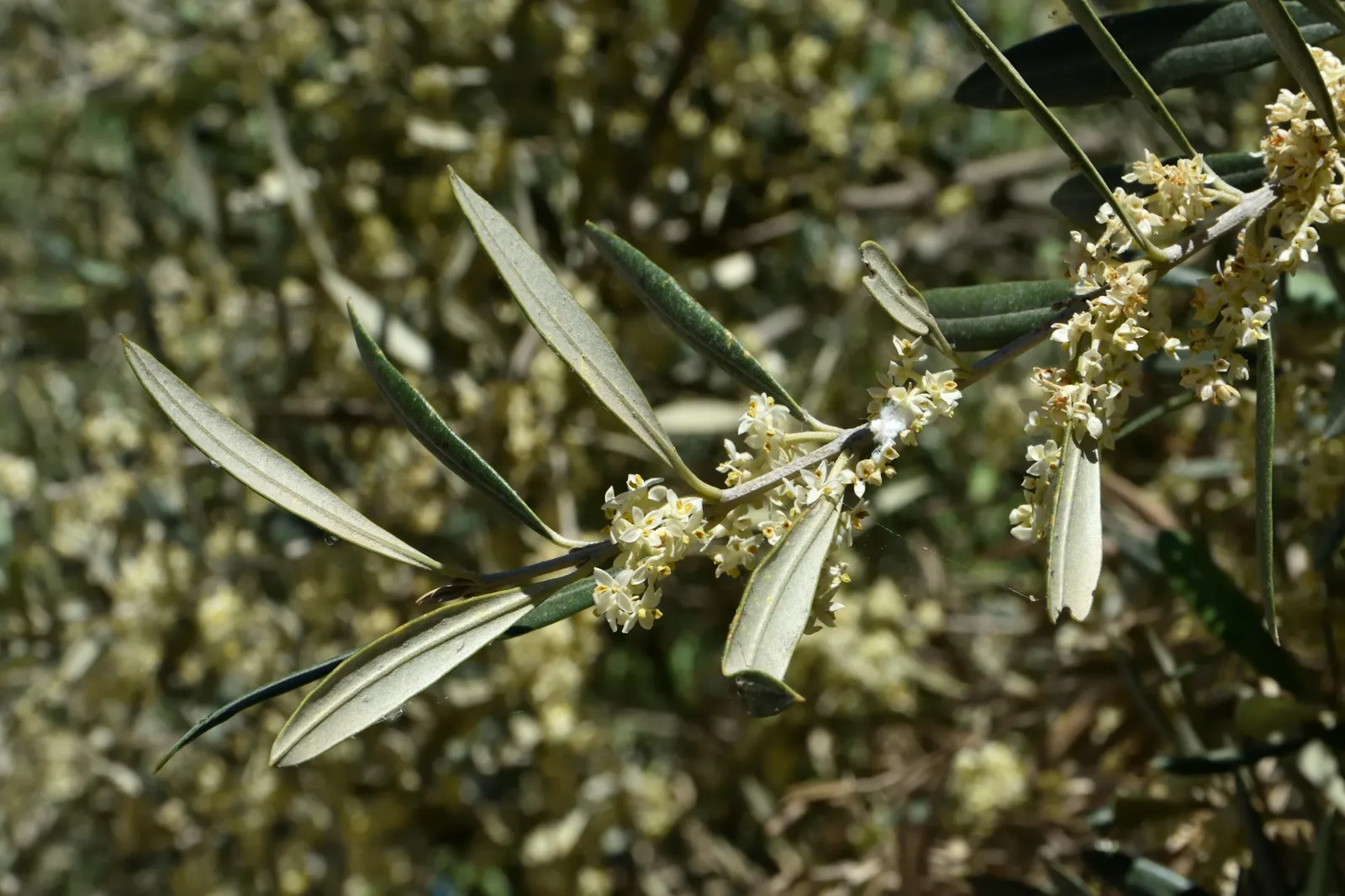
Olive flowers are small, creamy white and grouped in short clusters, called inflorescences, that grow from the leaf joints of the previous year's shoots. Each cluster carries roughly 15 to 30 flowers, and a mature tree in a good year can carry as many as 500,000 of them.
The tree produces two kinds of flower:
- Perfect (hermaphrodite) flowers have both male parts (stamens, which make pollen) and a female part (the pistil, which can become a fruit).
- Staminate flowers have stamens but no working pistil. They only make pollen. How many flowers lose their pistil varies with the variety, the year and how well the tree is fed and watered.
When the flowers open, the stamens shed light, dry pollen that the breeze carries from tree to tree. Pollen that lands on a receptive stigma of a compatible variety grows a tube down to the ovary and fertilises it, and the tiny fruit begins to swell. This is classic wind pollination: lots of pollen, released into the air, with no need for an animal to carry it. It is also why olive pollen is such a noticeable part of spring air in the Mediterranean.
Why do bees visit olive flowers?
For the pollen. Olive flowers produce little or no nectar, the sugary liquid bees turn into honey, but they offer plenty of protein-rich pollen, and bees need pollen to feed their young. A study of insects visiting olive flowers in a Tuscan olive grove in late spring 2009 (Canale and Loni, published in Redia in 2010) collected 380 insects, of which 101 were honey bees, alongside small wild bees and hoverflies. The authors noted that olive flowers offer no nectar and concluded that the insects were using the olive as a pollen source; their possible role as pollinators was not ruled out, but not shown either.
That matches what I see at home. In spring our bees come back from the olive trees with loads of pale yellow pollen packed on their back legs. They are feeding the colony, and any pollen they move between flowers is a small extra on top of what the wind already does.
Two practical consequences follow. There is no such thing as olive honey in any real sense, because bees cannot make honey from a flower with no nectar; I explain where honey does come from in how do bees make honey. And because bees are in the trees while they flower, never spray insecticide on olives in bloom. Since the hives arrived I only spray anything in the garden after dark, once the bees are home, as I describe in growing my own food in Sicily.
When do olive trees flower in Sicily?
Olive trees form the buds for next year's flowers on the current year's growth, and most varieties need a cool winter before those buds will flower well. In spring the buds swell, the flower clusters lengthen, and the flowers open over a short period. In western Sicily, olives usually flower from about late April into May, a little earlier at low altitude and in a warm spring, later inland and higher up. The International Olive Council describes Nocellara del Belice as having an intermediate flowering time, neither among the earliest nor the latest varieties.
| Stage | What happens | Roughly when in western Sicily |
|---|---|---|
| Bud break | Flower buds swell and the clusters start to grow | March to April |
| Clusters visible (mignola in Italian) | Small green flower buds on lengthening stalks | April |
| Full bloom | Flowers open and shed pollen; wind carries it between trees | Late April to May |
| Fruit set (allegagione) | Unfertilised flowers and many tiny fruits fall; the rest begin to grow | Late May to June |
| Pit hardening | The stone inside the fruit hardens | Early to mid summer |
The same trees then ripen through autumn; when to pick for oil or for the table is covered in when to harvest olives.
Are olive trees self-fertile or self-sterile?
Here is where olive pollination gets interesting. Many olive varieties are partly or fully self-incompatible: pollen from the same variety cannot fertilise the flower, or does so poorly. Because every tree of a named variety is a clone, propagated from cuttings, pollen from another tree of the same variety counts as its own. A grove of a single self-sterile variety can therefore flower heavily and set very little.
Compatibility is not a simple yes or no. Some varieties set a reasonable crop with their own pollen, many set much better with a partner, and a few set almost nothing alone. Research has also overturned old assumptions: Arbequina, long sold as self-fertile, was shown in a 2018 study by Sánchez-Estrada and Cuevas to be self-incompatible. A 2017 study by Saumitou-Laprade and colleagues, in Evolutionary Applications, suggested that olive varieties fall into two compatibility groups, and that a variety is best pollinated by one from the other group.
In Italy, growers have long planted pollinator varieties among their main trees. Pendolino, for example, is widely planted in central Italy as a pollinator, and Leccino is generally described as needing a partner. Cross-pollination clearly helps: the 2025 review describes it as raising fruit set and yield significantly, with 40 to 50% of perfect flowers fertilised under cross-pollination.
Is Nocellara del Belice self-fertile?
No. The International Olive Council's World Catalogue of Olive Varieties lists Nocellara del Belice as self-sterile, with an intermediate flowering period and a medium rate of ovary (pistil) abortion, around 22%. It needs pollen from other varieties flowering at the same time.
Which varieties make the best partners is less settled. Sicilian nurseries and growers name different ones, with Giarraffa, a large-fruited Sicilian table variety, among the most often mentioned, and the Valle del Belice oil rules allow up to 30% of local varieties such as Giarraffa, Biancolilla and Cerasuola alongside Nocellara. I have not found a controlled trial that ranks them, so I would treat any single "best pollinator" claim with caution.
In practice, in western Sicily this is rarely a problem. My five Nocellara trees stand in a landscape full of olive groves of mixed varieties, and the wind brings their pollen in. After their hard renovation prune in February 2026 the trees flowered in spring and set fruit, which I describe in how to prune an olive tree. A lone Nocellara in a garden far from other olives is a different matter, and may flower well and crop poorly. More on the variety itself is in Nocellara del Belice olives.
Do I need two olive trees to get olives?
It depends on the variety and on what grows around you.
- Where olives are common, as in most of Italy, Spain or Greece, there is almost always pollen in the air from other trees, so one tree usually crops, whatever the variety.
- Where olives are rare, a self-sterile variety on its own may set very little fruit. A second tree of a different, compatible variety that flowers at the same time, within the same garden, usually helps.
- A variety sold as self-fertile can crop on its own, but even these tend to set more with a partner, as the RHS notes is true of self-fertile fruit trees in general.
In the UK, pollination is rarely the limit anyway. The RHS advice in How to grow olives is that garden olives only occasionally fruit there, in hot summers, and are best grown for their shape and foliage. The bigger problem is too little summer heat to ripen the fruit, not a lack of pollen. My guide to olive tree care covers sun, watering and feeding.
Why do so few olive flowers become olives?
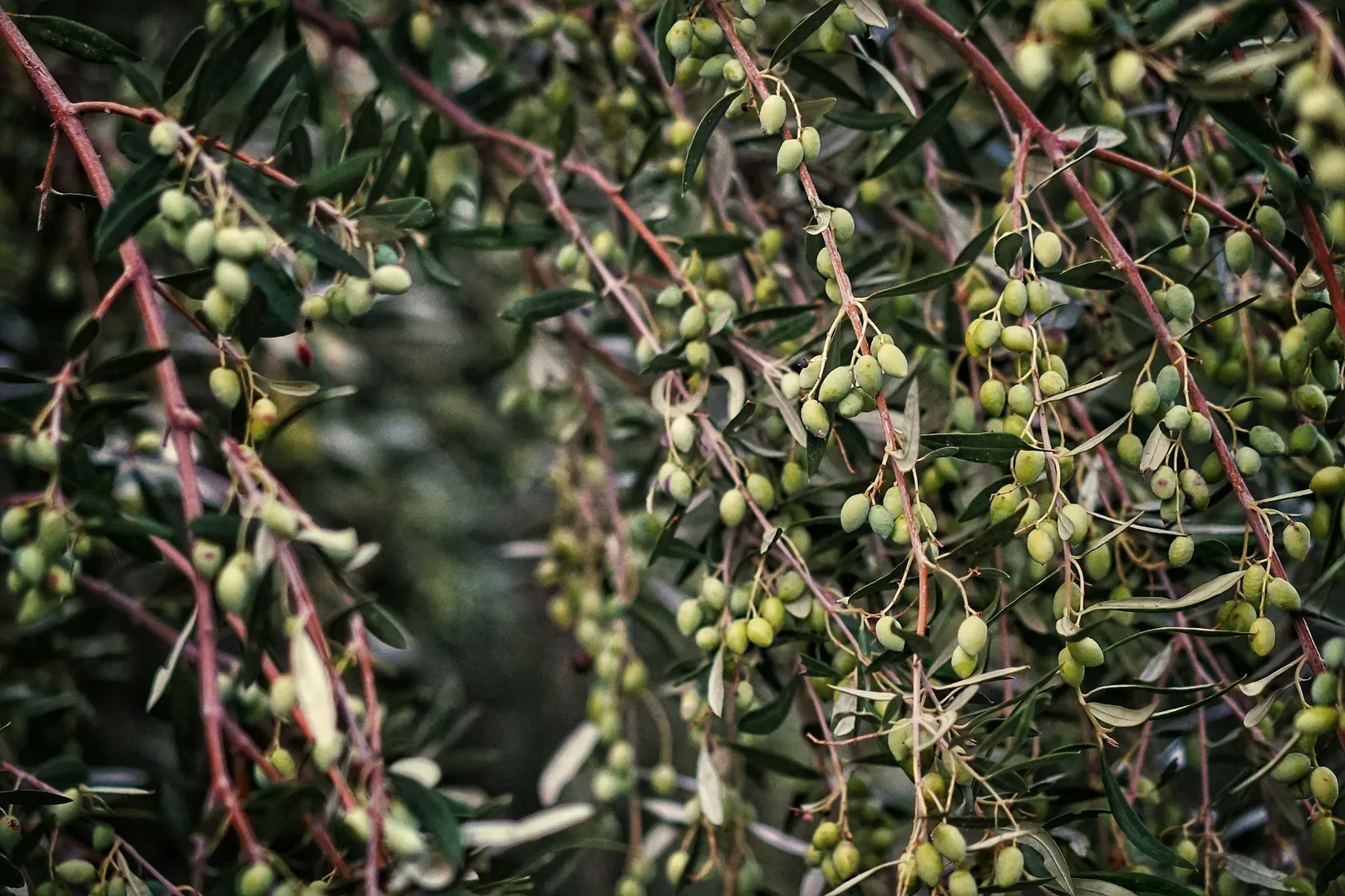
If your olive tree flowers like a snowstorm and then carries what looks like a handful of fruit, that is normal. Only about 1 to 2% of olive flowers usually end up as ripe fruit, and the 2025 review notes that even in the best conditions fruit set rarely exceeds 10% of the perfect flowers. Most flowers and tiny fruits drop within a few weeks of bloom. The tree makes far more flowers than it could ever ripen, and the extra flowers mostly serve to make pollen.
A light crop beyond that normal drop usually has a reason:
- Weather at bloom. Paul Vossen of UC Cooperative Extension lists rain, cold, drought stress and hot, dry wind during flowering as causes of poor pollination. In Sicily a hot scirocco wind in May can dry the flowers out.
- No compatible pollen. A self-sterile variety with no partner nearby.
- An "off" year. Olives are strongly alternate bearing: a heavy crop one year often means few flowers the next.
- Hard pruning or poor growth. Olives flower on the previous year's shoots, so removing them, or a tree too stressed to grow them, means fewer flowers.
- Pests and disease on the flowers or young fruit; see olive tree problems.
What a tree yields in the end, and how much oil that makes, is the subject of how much oil an olive tree produces.
Can you help an olive tree pollinate?
A little, and mostly by planning rather than by doing anything at flowering time.
- Plant a partner. If you have a self-sterile variety and no olives nearby, plant a compatible variety that flowers at the same time, close by and ideally on the side the prevailing wind comes from.
- Keep the tree growing well. Steady water through spring, sensible feeding and light, regular pruning give plenty of flowering shoots and well-formed flowers.
- Gently shake flowering branches on a still, dry day if you have a lone tree in a sheltered garden. It helps release pollen, though with a self-sterile variety it only helps if a compatible variety is flowering nearby.
- Leave the bees alone. They will not make much difference to the olives either way, but olive pollen helps them in spring, so avoid spraying during bloom.
Commercial growers in some hot, dry regions have experimented with blowing collected pollen through orchards to raise fruit set, but that is not something a garden owner needs. For how our trees and our hives fit together through the year, see my first year keeping bees in Sicily and harvesting olive oil in Sicily.
Frequently asked questions
Are olive trees pollinated by bees?
Mainly not. Olive trees are wind pollinated: the flowers release large amounts of light pollen that the breeze carries between trees. Honey bees do visit olive flowers to collect pollen, but olives set fruit without them.
Do olive flowers produce nectar?
Little or none. Olive flowers offer bees pollen rather than nectar, which is why bees collect olive pollen in spring but cannot make a true olive honey.
Can a single olive tree produce olives?
Often, yes, especially where other olive trees grow nearby and their pollen is in the air. A self-sterile variety on its own, far from other olives, may flower well but set little fruit, and a second compatible variety helps.
Is Nocellara del Belice self-pollinating?
No. The International Olive Council lists Nocellara del Belice as self-sterile. It needs pollen from other varieties that flower at the same time, which in the olive country of western Sicily is usually carried in on the wind.
Are olive trees good for bees?
Yes, as a source of spring pollen, which bees use as protein to raise their young. They give bees no nectar, so they do not help them make honey.
Does rain at flowering time stop olives from setting?
It can reduce the set. UC Cooperative Extension lists rain during flowering among the causes of poor pollination, along with cold, drought stress and hot, dry wind, and fewer pollinated flowers means fewer olives. Rain is not the only reason for a poor crop, though: an off year after a heavy crop, or a self-sterile variety with no partner nearby, can do the same.
Are olive trees self-pollinating?
Some are, partly, but many are not. Olive flowers carry both male and female parts, yet many varieties set little or no fruit with their own pollen, and every tree of a named variety is a clone, so it counts as the same plant. Arbequina, long sold as self-fertile, was shown in a 2018 study to be self-incompatible. Even varieties sold as self-fertile tend to crop better with a different variety nearby.
How far apart should olive pollinator trees be?
As close as practical, within the same garden or grove and ideally upwind of the main trees, and the two varieties must flower at the same time. In areas full of olive groves the surrounding trees often do the job anyway.
Sources and small print
- Cuevas J. (2025), Why olive produces many more flowers than fruit, Horticulturae 11(1): 26
- International Olive Council, World Catalogue of Olive Varieties: Nocellara del Belice
- Saumitou-Laprade P. et al. (2017), The genetic architecture of self-incompatibility in olive, Evolutionary Applications
- Sánchez-Estrada A. and Cuevas J. (2018), 'Arbequina' olive is self-incompatible, Scientia Horticulturae 230: 50 to 55
- Vossen P., UC Cooperative Extension: understanding olive oil yield
- Canale A. and Loni A. (2010), Insects visiting olive flowers in a Tuscan olive grove, Redia 92
- RHS: how to grow olives
Flowering dates and pollinator choices vary with variety, altitude and each year's weather, so treat the timings here as a guide.
Credits
Photo: Bertrand Borie, Unsplash Licence, via Unsplash.
Photo: Robert Anasch, Unsplash Licence, via Unsplash.
 The weekly YouTube series