
What is wrong with my olive tree?
Start with where the tree is and what has changed. An olive that has just been moved, repotted, brought indoors, hit by a cold snap or left in a saucer of water is far more likely to be suffering from that than from an exotic disease. Look at the whole tree, then at the leaves (both sides), the shoot tips, the bark and the fruit.
| What you see | Likely cause | What to do |
|---|---|---|
| A few old, inner leaves yellow and drop in spring | Natural leaf replacement | Nothing; new growth replaces them |
| Many leaves yellowing, compost wet, roots smell sour | Overwatering or waterlogging | Water less, improve drainage, raise the pot on feet |
| Dull, curled leaves, brown tips, older leaves falling | Drought or heat stress | Water deeply, then mulch; check the pot is not too small |
| Round dark spots with a yellow halo, then leaf fall | Peacock spot (olive leaf spot) | Rake up fallen leaves, open the canopy, avoid wetting foliage |
| Leaves brown or bronze after a cold spell, bark split | Frost damage | Wait until late spring, then cut back to live growth |
| Holes, chewed tips, webbing on new shoots | Caterpillars, often moth larvae | Identify them; pick off or prune out small infestations |
| White, cotton-wool tufts on shoot tips and flower buds in spring | Olive psyllid, a small sap-sucking insect | Small numbers do little harm; wipe off colonies on a small tree, prune the centre for air flow |
| Sticky leaves, black coating, small brown bumps on twigs | Black scale and sooty mould | Open the canopy, control ants, encourage natural enemies |
| Rough, warty galls on twigs and branches | Olive knot (a bacterial disease) | Cut out galls in dry weather with disinfected tools |
| Whole branches wilt suddenly, dead leaves stay on | Verticillium wilt, or root damage | Prune out dead wood; avoid overwatering and heavy feeding |
| Small marks on fruit, maggots inside, early fruit drop | Olive fruit fly | Pick up fallen fruit, harvest promptly, monitor with traps |
| Leaf scorch and dieback on an imported or Mediterranean tree | Drought, frost or possibly Xylella | Do not move the plant; report it to the plant health authority |
Why are my olive tree leaves turning yellow?
The common causes, roughly in order of how often I would suspect them:
- Natural shedding. Olives are evergreen but not everlasting. The RHS notes that olives naturally shed old leaves in spring as new growth starts. A few yellow leaves from the inside of the tree at that time of year are normal.
- Too much water. Waterlogged roots cannot take up oxygen, and the tree shows it with yellowing leaves, often across the whole canopy. This is the classic problem with olives in pots without drainage, or in heavy clay.
- Peacock spot. If the yellow leaves carry round dark spots, it is the fungal disease covered below.
- Hunger. A tree that has been in the same compost for years can turn pale all over from lack of nitrogen. Yellowing between green veins on new leaves suggests iron or another trace element is not being taken up, which is more common in very alkaline or waterlogged soil.
- Too little light, for example indoors over winter.
Do not reach for fertiliser first. On our citrus I learned that pale leaves are not always hunger: feeding improved the colour but the new growth then exposed a pest problem the feed could not solve.
Why are my olive tree leaves going brown and falling off?
Brown, dry or crisp leaves usually mean the leaves lost water faster than the roots could replace it. The RHS points out that dry conditions, especially in containers, make older leaves deep in the tree fall, and can brown the leaf edges, most obviously on the sunny side. Wind, a heatwave or a pot that is too small for the tree all add to it. Sudden leaf fall after a move, into a house or from a nursery, is usually the tree adjusting to new light and will settle.
The confusing part is that a tree with rotting roots from overwatering also wilts and drops leaves, because damaged roots cannot take up water either. Before you water, check the compost or soil a few centimetres down.
| Sign | Overwatered | Underwatered |
|---|---|---|
| Compost or soil | Wet or soggy, may smell sour | Dry well below the surface, pulling away from the pot |
| Leaves | Yellowing, then dropping, often soft | Dull, curled, brown edges or tips, then dropping |
| Which leaves first | Often all over the tree | Older, inner and lower leaves |
| Roots | Brown, soft, rotting | Firm but dry |
| Fix | Stop watering, improve drainage, repot into gritty compost if roots are rotting | Soak thoroughly, then water whenever the top few cm are dry |
My olive tree care guide covers watering, compost and drainage in detail.
What does frost damage look like on an olive tree?
Frost damage shows up a few days to a few weeks after a cold spell: leaves turn brown, bronze or silvery and dry, shoot tips blacken or wilt, and in a hard frost the bark on young branches can split. Trees in pots and young trees are hit hardest, and frost is far more damaging when the roots are also wet.
Do not prune straight away. Many apparently dead shoots regrow, and the damaged growth shelters the rest of the tree from further frost. Wait until late spring, when the RHS advises cutting back affected stems to new shoots. To check whether a branch is alive, scratch the bark lightly with a thumbnail: green underneath means it is alive, brown and dry means it is dead. A tree with a sound trunk and roots usually recovers, even if it loses most of its leaves.
What are the black spots on olive tree leaves? Peacock spot
Round dark spots on the upper side of olive leaves, often with a yellow or purplish ring around them, are almost certainly peacock spot, also called olive leaf spot, bird's eye spot or olive scab. It is caused by the fungus Venturia oleaginea, long known as Spilocaea oleagina. The ringed spots look like the eye on a peacock's feather. Infected leaves turn yellow and fall early, and a bad attack can strip a tree and weaken it.
Spores spread by rain splash and need wet leaves to infect. In the Mediterranean that means autumn and winter; in the UK the RHS says spring and summer conditions suit it better. Dense, shaded trees that stay damp are the worst affected.
- Rake up and dispose of fallen infected leaves.
- Prune to open the canopy so leaves dry quickly after rain, without pruning so hard that you get a flush of water shoots. My olive pruning guide explains how.
- Water the roots, not the foliage.
The RHS recommends against fungicides for gardeners and notes that none are available to UK home gardeners for olives whose fruit will be eaten. In olive-growing regions, commercial growers commonly use copper-based treatments around the autumn rains. If you consider any treatment, use only products authorised where you live and follow the label and local rules.
What is eating my olive tree leaves?
Holes in the leaves, chewed edges, nibbled shoot tips and fine webbing usually mean caterpillars. That is exactly what I found on our trees in 2026: after the February prune, the flush of soft new growth developed holes, eaten leaf edges, chewed tips, fine webbing and partly skeletonised leaves, along with leaf-rolling insects. I have not identified the species, and I would not guess. The full story is in what I have planted, what has thrived and what has failed.
In Mediterranean olive groves the usual suspects include:
- Olive moth (Prays oleae), a small moth with three generations a year: one mines and eats leaves, one feeds in the flower clusters, and one bores into the young fruit and can make it drop in summer.
- Leaf-feeding moth larvae that web together the young leaves at the tips of fresh shoots, which is typical on young trees and on regrowth after pruning.
A mature tree shrugs off some chewed leaves. On a young tree or a tree rebuilding after hard pruning, it is worth acting: pick off caterpillars and prune out webbed tips on a small tree, and leave birds, wasps and other natural enemies to do their work. Growers sometimes use biological treatments based on Bacillus thuringiensis, which targets caterpillars, where it is authorised. Because I keep bees, I cannot spray anything broad-spectrum near the hives; any treatment on our land is done after dark, once the bees are back in the hive. I wrote about that balance in my first year keeping bees in Sicily.
Why are my olive tree leaves sticky and black? Scale and sooty mould
A sticky film on the leaves and a black, sooty coating that rubs off with a finger means sap-sucking insects are feeding above. On olives the usual culprit is black scale (Saissetia oleae): small brown to black bumps on the twigs and the undersides of leaves, the adults often with a raised H-shaped ridge on the back. They excrete sugary honeydew, and the sooty mould fungus grows on it. The mould does not attack the leaf directly, but it blocks light and weakens the tree over time.
- Prune to open the canopy. UC IPM notes that dense trees are more prone to black scale, and pruning is preferred to spraying.
- Control ants. Ants farm scale insects for their honeydew and protect them from predators; the RHS describes scale insects as a common olive problem.
- Encourage natural enemies: tiny parasitic wasps and ladybirds keep scale down in many gardens.
- Scrape off small colonies by hand on a potted tree. Indoor and greenhouse olives are especially prone.
Once the scale is under control, the sooty mould weathers away with rain or can be wiped off.
Lumps on the branches or branches dying: olive knot and Verticillium wilt
Olive knot is a bacterial disease (Pseudomonas savastanoi) that causes rough, warty galls on twigs, branches and sometimes the trunk. The bacteria enter through wounds: pruning cuts, hail damage, frost cracks and leaf scars, and they spread in rain. Galls can girdle and kill twigs. Cut them out well below the gall, prune only in dry weather, and disinfect tools between cuts and between trees.
Verticillium wilt is a soil fungus (Verticillium dahliae) that blocks the tree's water-conducting tissue. The sign is one or more branches wilting suddenly, often in spring, with the dead leaves staying attached, while the rest of the tree looks fine. There is no cure once a tree is infected. Some trees recover on their own, depending on the strain and the variety; others decline. Prune out the dead wood, avoid heavy watering and heavy nitrogen feeding, and do not plant olives where tomatoes, potatoes, aubergines or melons, all susceptible to the same fungus, have grown.
The variety matters. The International Olive Council's variety catalogue rates my own Nocellara del Belice as very susceptible to olive knot and to peacock spot, and medium in its susceptibility to Verticillium.
What is olive fruit fly?
The olive fruit fly (Bactrocera oleae) is the most damaging pest of olive fruit around the Mediterranean. The female lays eggs just under the skin of the fruit; the maggots tunnel through the flesh, and the fruit can rot or drop early. You see small puncture marks, brown patches and later exit holes. Infested olives make poorer oil, with higher acidity and off flavours, and table olives become unusable. The IOC lists Nocellara del Belice as very susceptible, which is why growers here watch the fruit closely from late summer.
- Monitor with traps from early summer so you know when the flies are active.
- Pick up and destroy fallen and infested fruit, which carries the next generation.
- Harvest promptly rather than leaving fruit on the tree; timing is in when to harvest olives, and what happens to the fruit next in harvesting olive oil in Sicily.
- Some growers use mass trapping or a fine clay coating on the fruit that deters egg laying. Any insecticide must be authorised for olives where you are, applied as the label says, and kept away from bees.
In the UK, where garden olives rarely carry much fruit, olive fruit fly is seldom a concern.
What is Xylella, and how do you report it?
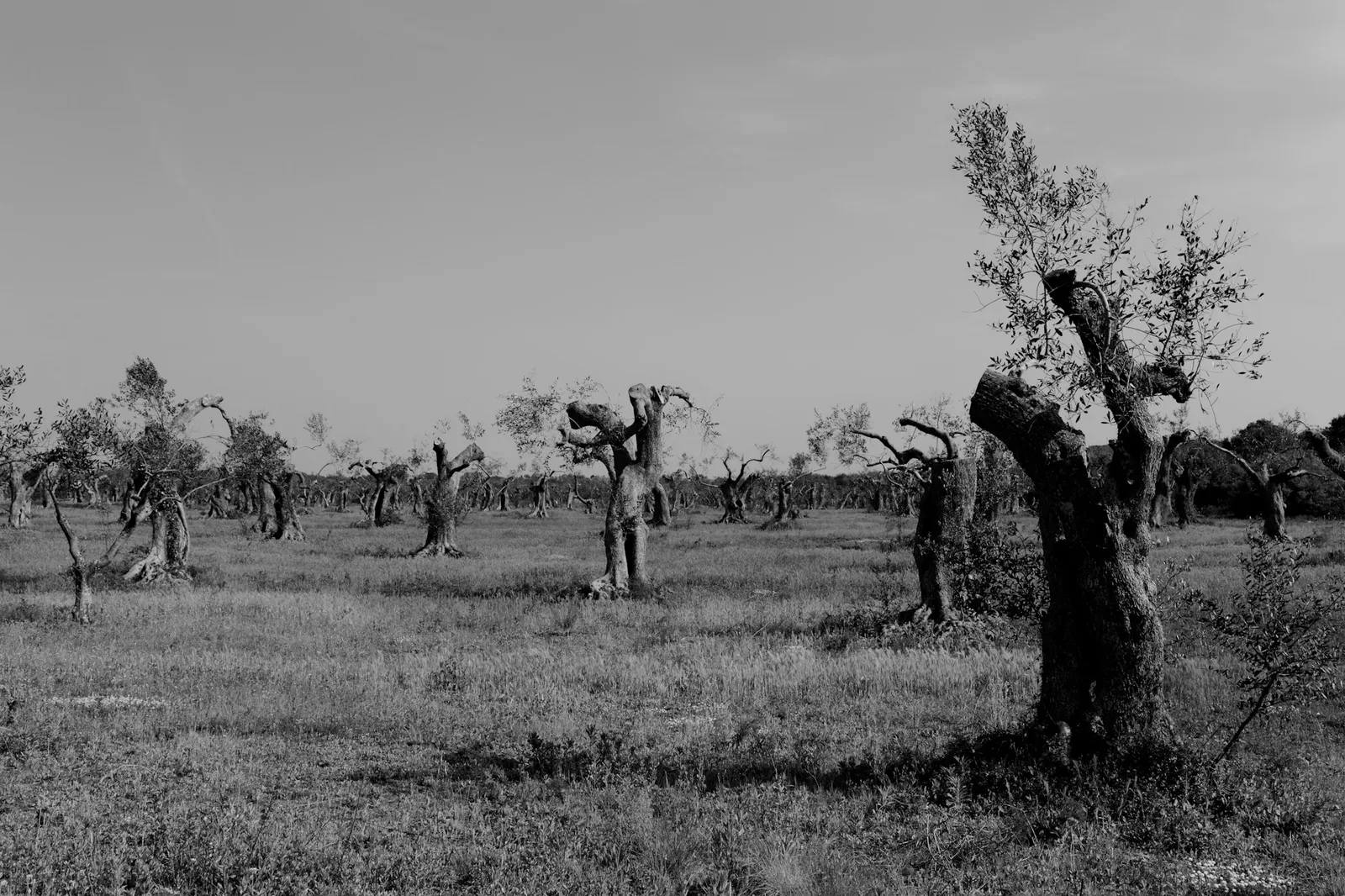
Xylella fastidiosa is a bacterium spread by sap-feeding insects such as the meadow spittlebug. It blocks the tree's water-conducting vessels, causing leaf scorch, wilting, dieback and death. According to EFSA, it was found on olive trees in Puglia in October 2013, the first report in the EU, and has since been detected in France, Spain and Portugal. In Puglia, the subspecies pauca has devastated olive groves, and EFSA says millions of Italian olive trees have died. There is no cure: EFSA has concluded that treatments tried in Puglia can reduce symptoms but do not remove the bacterium from infected plants.
It is an EU quarantine pest and notifiable in the UK and in Italy, which means suspected cases must be reported to the authorities, not treated at home. The difficulty is that its symptoms can look identical to drought or frost damage, so only a laboratory test confirms it.
- In the UK, Defra says it is not known to occur (as of its December 2025 update), and olive is one of the high-risk host plants. The RHS considers plants grown in the UK, or established in a garden for more than five years and previously well, to be low risk; recently imported trees are higher risk. In England and Wales, report suspected cases to the APHA Plant Health and Seeds Inspectorate (0300 1000 313, or the online plant health contact form); in Scotland, to the Scottish Government's Horticulture and Marketing Unit; in Northern Ireland, to DAERA. The UK Plant Health Portal lists the current contacts. Do not move or dispose of the plant, and do not send samples to the RHS.
- In Italy, report suspected cases to the regional plant health service (Servizio Fitosanitario Regionale); in Sicily it sits within the Region's Department of Agriculture. Xylella emergency measures apply across the whole country, and the outbreak areas change: new outbreaks are still being found, including one in Calabria for which an eradication plan was adopted in September 2026. Check the current demarcated areas with the regional service rather than relying on older articles.
The best protection is not bringing it in: buy olive trees from reputable sources with a plant passport, and never bring plants home in your luggage from outbreak areas.
Frequently asked questions
Why is my olive tree losing its leaves in winter?
Usually cold, wet roots, too little light (especially indoors) or frost damage. Olives also drop some old leaves naturally, mostly in spring. Check the compost is not waterlogged, give the tree as much light as possible and protect it from hard frost.
Why are the leaves on my olive tree curling?
Curling, dull leaves are most often a sign of drought or heat stress: the leaf curls to lose less water. Check the soil or compost a few centimetres down and water deeply if it is dry. Curled, distorted new shoots can also point to sap-sucking insects or caterpillars.
What does peacock spot look like?
Round, dark brown or sooty spots on the upper side of the leaf, often with a yellow or purplish ring around them, like the eye on a peacock feather. Infected leaves turn yellow and fall early. It is caused by the fungus Venturia oleaginea and spreads in wet weather.
Can a frost-damaged olive tree recover?
Often, yes. Wait until late spring before cutting anything back, then prune to where new shoots appear. Scratch the bark: green underneath means the branch is alive. A tree with a sound trunk and roots usually regrows, even if it lost most of its leaves.
What is the white fluffy stuff on my olive tree?
In spring it is usually the olive psyllid (Euphyllura olivina), a small sap-sucking insect whose young cover themselves in a white waxy coating on the new shoots, buds and flower clusters. UC IPM notes that trees tolerate low numbers without real harm, though heavy infestations can make flowers and small fruit drop. On a garden tree, wipe or hose off the colonies and prune out crowded growth in the centre to let air through.
Is the black mould on my olive tree harmful?
Sooty mould grows on honeydew from sap-sucking insects, usually black scale. It does not infect the leaf, but it blocks light and weakens the tree. Deal with the insects and any ants farming them, and the mould weathers away.
What do olive fruit fly holes look like?
Small puncture marks on the skin where eggs were laid, often with a brown patch around them, and later larger round exit holes where the larvae left. Cut an affected olive open and you may find a small cream maggot or its tunnels.
Is Xylella in the UK?
Defra states that Xylella fastidiosa is not known to occur in the UK, as of its December 2025 update. It is present in parts of Italy, France, Spain and Portugal. Olive is a high-risk host, so suspected symptoms on imported trees must be reported to the plant health authorities.
Can you cure Xylella in an olive tree?
No. EFSA has concluded that treatments tested in Puglia can reduce symptoms but do not eliminate the bacterium from infected plants. Official control measures focus on removing infected plants and controlling the insects that spread it.
Should I spray my olive tree?
Only after you have identified the problem, and often not at all. Many olive problems are solved by better drainage, watering and pruning. If you do treat, use only products authorised for olives where you live, follow the label and local rules, and protect bees by avoiding spraying while they are flying.
Sources and small print
- Royal Horticultural Society: olive scab (peacock spot)
- Royal Horticultural Society: Xylella fastidiosa
- UK Plant Health Information Portal (Defra): Xylella fastidiosa
- European Food Safety Authority: Xylella fastidiosa
- EPPO Global Database: Xylella fastidiosa
- University of California IPM: olive pests and diseases
- University of California IPM: olive psyllid
This is general guidance; for a firm diagnosis, ask your local plant health service or an agronomist, and always follow local rules on plant protection products.
Credits
Photo: The Now Time, Unsplash Licence, via Unsplash.
Photo: Paolo Chiabrando, Unsplash Licence, via Unsplash.
 The weekly YouTube series