
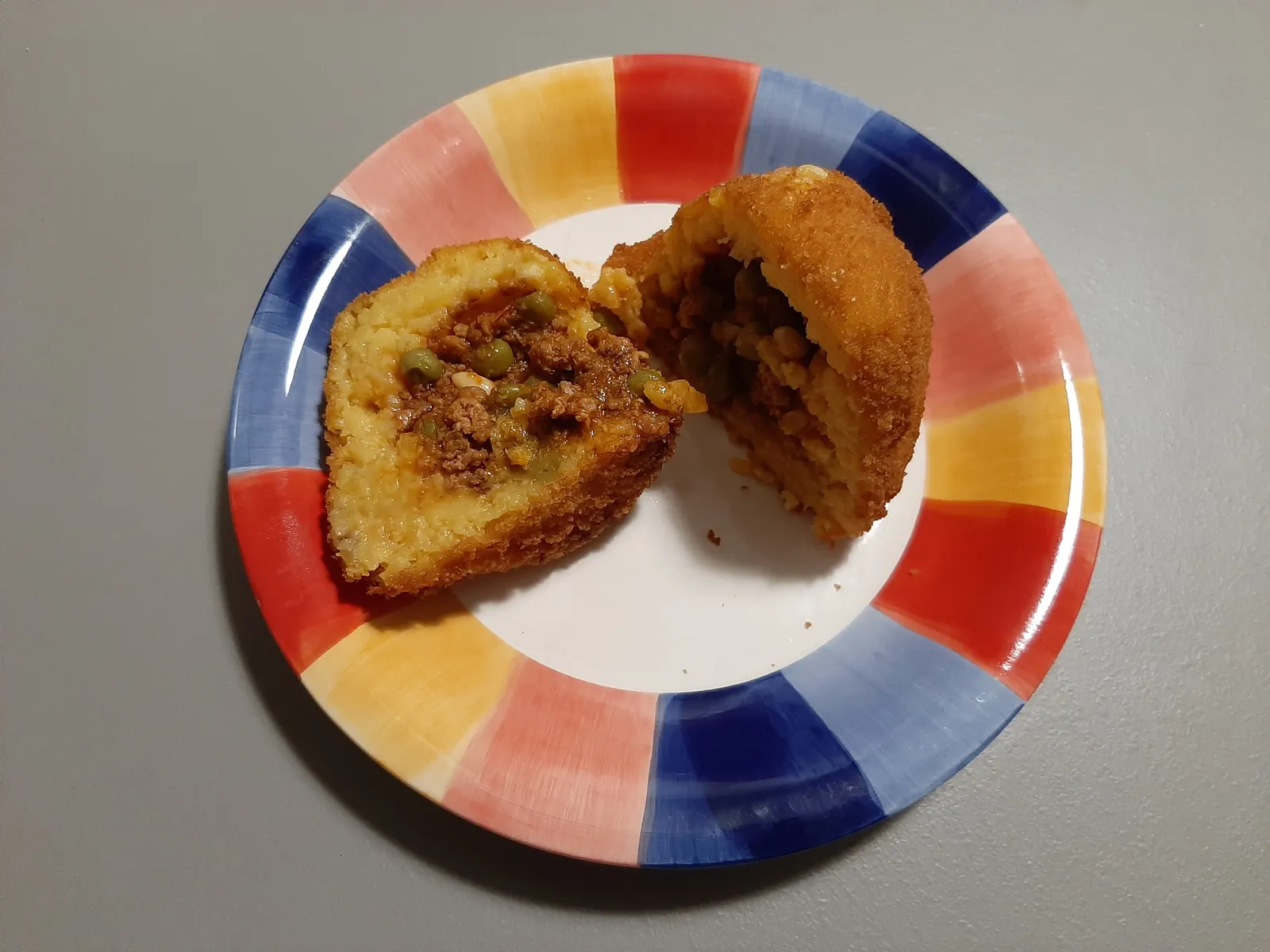
What are arancini?
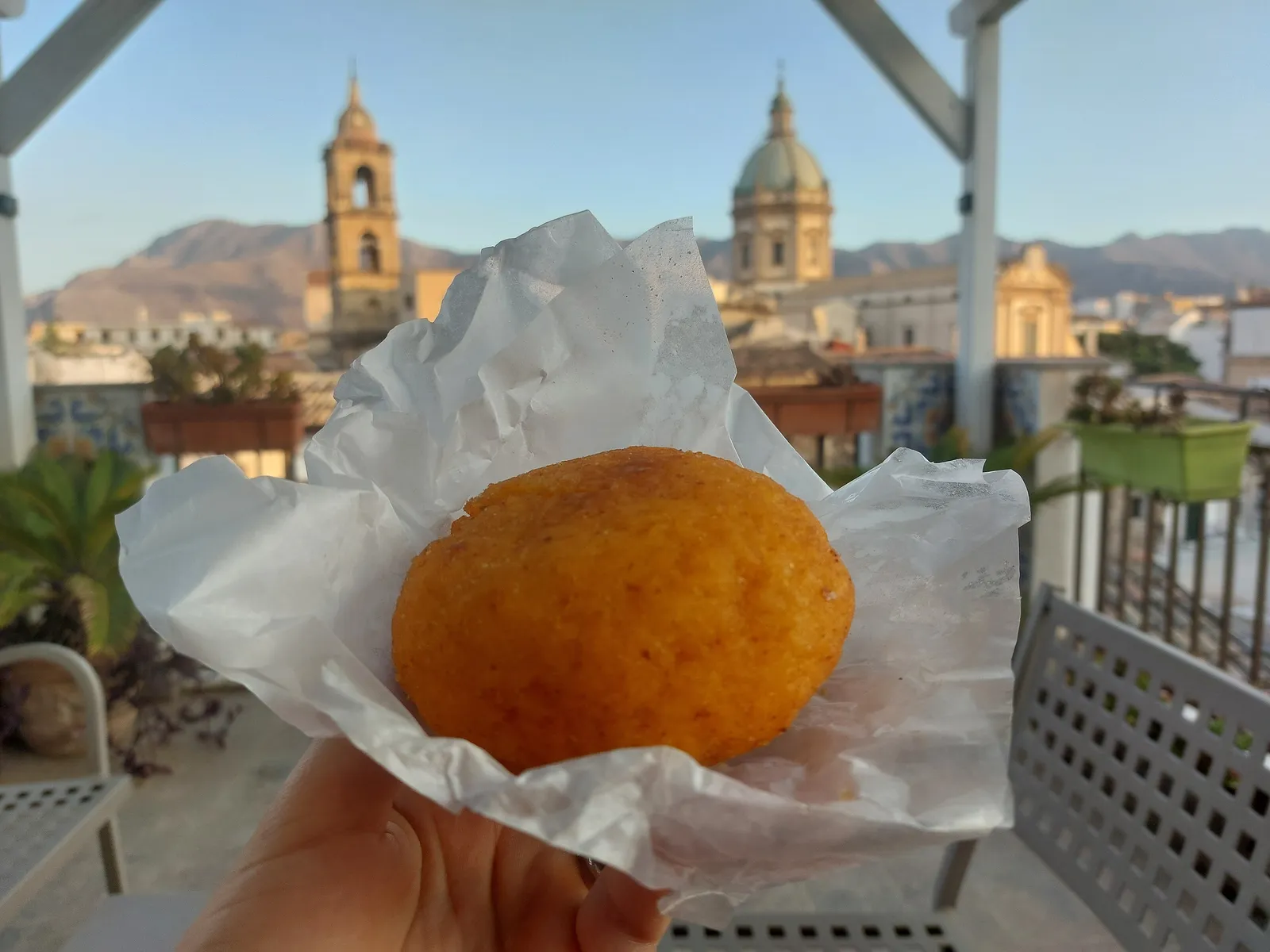
An arancino is a handful of rice, usually cooked with saffron, shaped around a filling, rolled in breadcrumbs and fried until the shell is crisp and golden. A standard one is about 8 to 10 cm (3 to 4 inches) across, which makes it a snack, a lunch on the go or, with two, a meal. In Sicily you buy them at bars, bakeries and fry shops (friggitorie), and you eat them with your hands, usually standing up.
Arancini di riso are on the Italian Ministry of Agriculture's official list of traditional Sicilian food products. My Sicily food guide puts arancine among the street food you should try; this page is the full story of them.
Arancina or arancino: Palermo vs Catania
This is a real, mostly good-humoured argument in Sicily. In 2016 the Accademia della Crusca, the institution that has guarded the Italian language since the 16th century, published an answer. Its findings, in short:
- In western Sicily, centred on Palermo, the word is feminine: arancina, plural arancine. They are round, like the orange they are named after.
- In eastern Sicily, centred on Catania, the word is masculine: arancino, plural arancini. They can be round or pointed, and the point is sometimes said to be inspired by Etna. Around Ragusa and Siracusa, in the east, many people say arancina too.
- Both are correct. The Crusca concluded that each form is right in its own area, and that the masculine has spread across Italy, helped by Andrea Camilleri's 1999 book of Inspector Montalbano stories, Gli arancini di Montalbano.
In English, "arancini" is the name that stuck, and Americans use it for one or many. If you want to sound local, order un'arancina in Palermo and un arancino in Catania. You will be understood either way.
| Palermo and the west | Catania and the east | |
|---|---|---|
| Name | Arancina (feminine) | Arancino (masculine) |
| Plural | Arancine | Arancini |
| Usual shape | Round | Pointed, or round |
| Typical fillings | Ragù with peas; ham and mozzarella (al burro) | Ragù; ham and mozzarella; pistachio; alla norma (eggplant) |
Where do arancini come from?
You will often read that arancini go back to the Arabs, who ruled Sicily in the 9th to 11th centuries and are credited with bringing rice and saffron to the island. It is an attractive story, but the Crusca points out that there is no written trace of arancini before the second half of the 19th century. The earliest Sicilian dictionary to record the word, Biundi's of 1857, describes arancinu as a sweet rice dish.
The word turns up in literature in Federico De Roberto's 1894 novel I Viceré, set in Catania, and, curiously for a Catanese writer, in the feminine form arancine. The feminine arancina entered a dictionary of standard Italian, the Zingarelli, in 1917; the masculine arancino followed in 1942.
So the honest answer is that arancini are a Sicilian creation whose ingredients have a long history on the island, but whose written history only begins in the second half of the 19th century, probably first as a sweet rice dish and soon afterwards as the savoury snack we know.
Types of arancini
Every bar has its own list, and cooks keep inventing new fillings, from mushrooms and sausage to salmon and pesto. These are the ones you will see most often:
| Name | What is inside | Where |
|---|---|---|
| Al ragù (alla carne) | Meat ragù, peas and caciocavallo cheese, in saffron rice | Everywhere; the classic |
| Al burro | Ham and mozzarella, sometimes with béchamel | Everywhere; the other classic |
| Agli spinaci | Spinach | Widely |
| Alla norma | Eggplant, in the style of the pasta alla norma | Catania area, and now widely |
| Al pistacchio | Bronte pistachio | Catania area |
| Al nero di seppia | Rice cooked in squid ink | Here and there |
| Sweet arancine | Made with cocoa and rolled in sugar, or filled with gianduia chocolate cream | Mostly for Santa Lucia, especially around Palermo |
For a first time, have one al ragù and one al burro, then try whatever the bar is proud of. The cheese inside is usually caciocavallo or mozzarella; my guide to Sicilian cheese explains the difference. For the pistachio filling, see my guide to Bronte pistachio.
Santa Lucia: arancine day in Palermo, 13 December
On 13 December, the feast of Santa Lucia, Palermo and Trapani keep a tradition of eating no bread and no pasta. Instead, people eat arancine of every kind, shape and size, sweet ones included, together with panelle, the chickpea fritters, and cuccìa, whole boiled wheat sweetened with ricotta.
The tradition remembers a famine ended by a ship of grain on Santa Lucia's day; my guide to Christmas in Sicily tells that story and covers Santa Lucia's great procession in Siracusa. For cuccìa and the other feast-day sweets, see my guide to Sicilian desserts.
Where to eat arancini in Sicily
You do not need a recommendation to find a good arancino in Sicily: bars, bakeries and fry shops all over the island sell them. A few tips:
- Go where they fry often. A busy bar or fry shop sells them warm from the fryer; a lonely tray at a quiet bar in mid-afternoon is a different thing.
- In Palermo, eat them with the city's other street food: panelle, sfincione and more, all in my Palermo street food guide. My guide to Palermo, Cefalù and Monreale covers the city, and the Palermo town page has the practical details.
- In Catania, look for the pointed arancini and the pistachio and alla norma fillings. My guide to Etna, Taormina, Catania and Siracusa covers the east, and there is a Catania town page too.
How to make arancini at home: a simple recipe
Makes about 12 | Prep about 60 min | Cook about 50 min | Cooling about 2 hours | Source: GialloZafferano
This is a standard recipe, summarised from the well-known Italian recipe site GialloZafferano, not a family secret of mine. It makes about 12 arancini, some al ragù and some al burro, and the main skill is patience: the rice must be completely cold before you shape it.
Ingredients
Rice
- 500 g (about 1 lb 2 oz, about 2 1/2 cups) short-grain Italian rice (the recipe uses vialone nano)
- 1.2 litres (about 5 cups) water
- 1 tablespoon coarse salt
- 0.15 g saffron (a good pinch)
- 30 g (2 tablespoons) butter
- 100 g (3.5 oz) aged caciocavallo, or a firm provolone, grated
Ragù filling
- 150 g (about 5 oz) ground pork
- 200 g (7 oz) tomato passata
- 80 g (3 oz) small peas
- 50 g (2 oz) white onion
- 50 ml (about 3 tablespoons) red wine
- Olive oil, salt and black pepper
- 50 g (2 oz) fresh caciocavallo or provolone, in small cubes
Or the al burro filling
- 120 g (about 4 oz) cooked ham, diced
- 120 g (about 4 oz) mozzarella, diced
Batter and coating
- 200 g (about 1 1/2 cups) flour
- 350 ml (about 1 1/2 cups) water
- A pinch of salt
- 200 g (about 2 cups) dry breadcrumbs
For frying
- About 3 litres (about 3 quarts) vegetable oil
Method
- Make the ragù: soften the chopped onion in olive oil, brown the pork, add the wine and let it evaporate, then add the passata and peas, season, and simmer until thick. Let it cool.
- Boil the rice in the salted water for about 15 minutes, stirring now and then, adding the saffron a few minutes before the end, until the water is absorbed. Off the heat, stir in the butter and grated cheese.
- Spread the rice on a large tray, cover it and leave it to cool completely, a couple of hours at room temperature.
- Take about 120 g (4 oz) of rice, flatten it into a cup in your palm, add a spoonful of ragù and a few cubes of cheese (or ham and mozzarella), close the rice around it and shape it into a ball or a cone.
- Whisk the flour, water and salt into a smooth batter. Dip each ball in it, then roll it in breadcrumbs.
- Fry in plenty of oil at 160 to 170°C (320 to 340°F) until deep golden, and drain on paper towels.
Make them round and call them arancine, or pointed and call them arancini, depending on which side of the island you want to please.
Frequently asked questions
What are arancini?
Arancini are Sicilian fried rice balls: saffron rice shaped around a filling, usually meat ragù with peas and cheese or ham and mozzarella, coated in breadcrumbs and deep fried. They are about 8 to 10 cm (3 to 4 inches) across and are sold at bars, bakeries and fry shops all over Sicily as street food.
Is it arancini or arancina?
Both, depending on where you are. In Palermo and western Sicily the word is feminine, arancina (plural arancine), and they are round. In Catania and eastern Sicily it is masculine, arancino (plural arancini), and they are often pointed. The Accademia della Crusca, Italy's language academy, says both forms are correct in their own area.
How do you keep arancini from falling apart?
Two steps in the standard recipe hold them together. The cooked saffron rice is spread on a tray and left until completely cold, about 2 hours, before you shape it around the filling. Then each ball is dipped in a batter of flour and water before it is rolled in breadcrumbs, which seals it before it goes into oil at 160 to 170°C (320 to 340°F).
What does arancini mean?
Little oranges. The name comes from arancia, the Italian for orange, because of their round shape and golden colour. Arancini is the plural of arancino; the Palermo forms are arancina and arancine.
What is inside arancini?
Rice, usually cooked with saffron and mixed with butter and cheese, around a filling. The two classics are al ragù (meat ragù, peas and caciocavallo) and al burro (ham and mozzarella, sometimes with béchamel). Other fillings include spinach, alla norma (eggplant), Bronte pistachio, mushrooms, sausage, seafood and squid ink.
Why are some arancini pointed?
In eastern Sicily, around Catania, arancini are often made in a cone shape, which is commonly said to recall Mount Etna. In Palermo and the west they are round. The Accademia della Crusca notes the Etna link as a possible inspiration, not a proven one.
Where did arancini originate?
In Sicily. They are often said to go back to the Arab period, when rice and saffron came to the island, but the Accademia della Crusca found no written trace of arancini before the second half of the 19th century, when Sicilian dictionaries first recorded the word.
Why do people eat arancini on Santa Lucia?
On 13 December, the feast of Santa Lucia, Palermo and Trapani traditionally avoid bread and pasta. Arancine of every kind, panelle (chickpea fritters) and cuccìa (boiled wheat with sweet ricotta) take their place.
Sources and small print
- Accademia della Crusca: Si dice arancino o arancina? (Stefania Iannizzotto, 2016)
- Arancino (Italian Wikipedia, for the fillings, size and the Santa Lucia custom)
- Sicilian traditional food products (PAT) (Italian Wikipedia summary of the Ministry's list)
- GialloZafferano: Arancini di riso (the standard recipe summarised above)
Credits
Photo: Ensahequ, CC BY-SA 4.0, via Wikimedia Commons.
Photo: Mediocrity, CC0, via Wikimedia Commons.
 The weekly YouTube series