
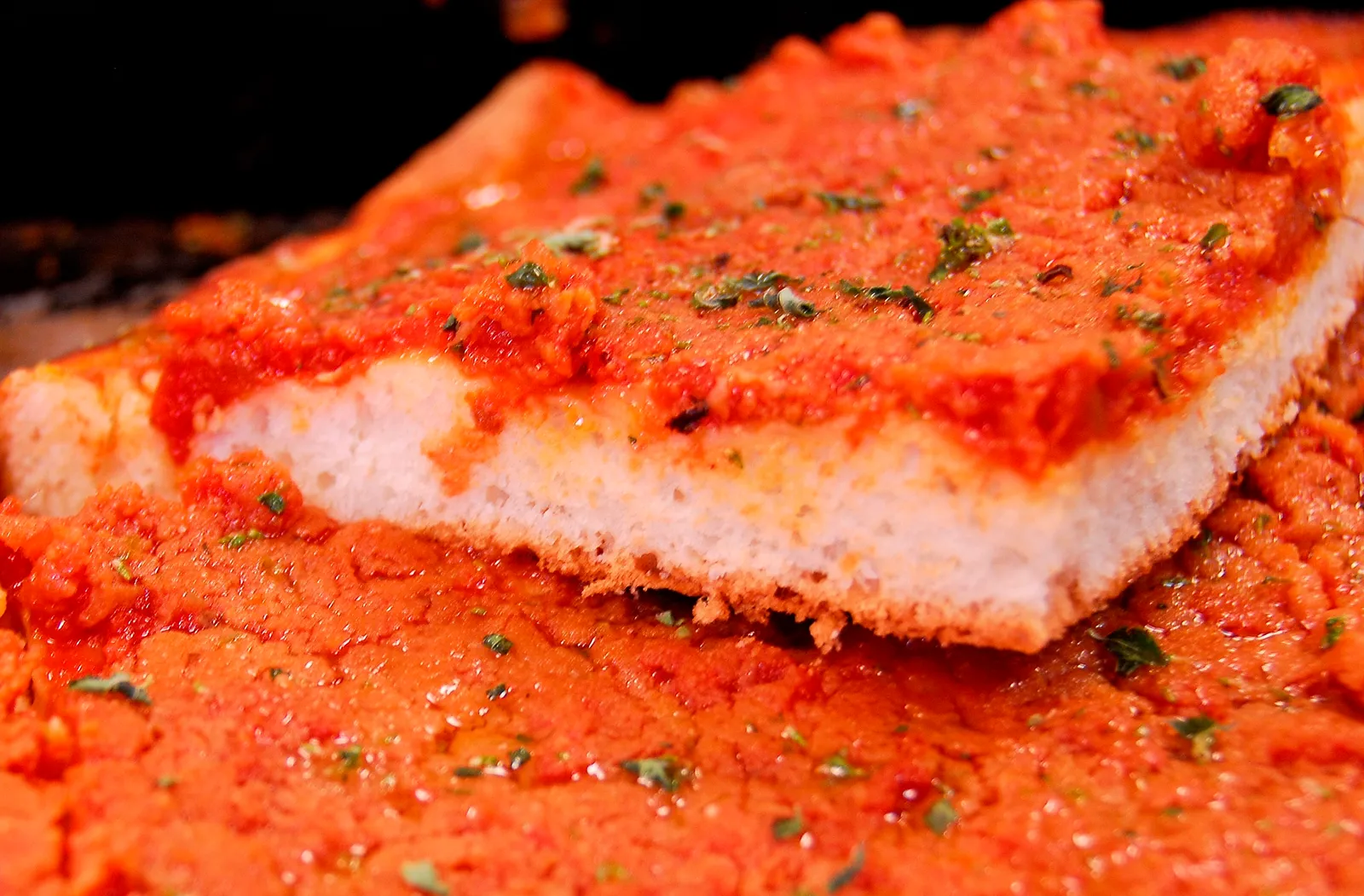
What is Sicilian pizza?
In Sicily, Sicilian pizza is sfincione: a tall, soft, leavened dough, closer to focaccia than to a thin Neapolitan crust, baked in a rectangular pan. The topping is a slowly cooked sauce of onions and tomato, with anchovies, dried oregano, cubes or gratings of caciocavallo cheese and a scattering of breadcrumbs. The cheese is a firm, tangy Sicilian stretched-curd cheese, not mozzarella, and there is much less of it than on an American pie.
The name says what the dough should be like. It is usually traced to the Latin spongia or Greek spóngos, a sponge, the same root as the sfincia, the fried St Joseph's Day pastry; another theory points to an Arabic word for a fried dough fritter. Sfincione is on the Italian Ministry of Agriculture's official list of traditional food products (the PAT list), under Sicily.
My Sicily food guide gives sfincione a short paragraph among the street food. This page is about sfincione alone, and about the American pizzas that came out of it.
Where does sfincione come from?
The usual story is that sfincione was first made by the nuns of the monastery of San Vito in Palermo, as a richer, festive alternative to everyday bread, probably in the 17th or 18th century. It is a story rather than a documented fact, as with many Sicilian convent foods, but it explains why sfincione was long a food for special days: Palermo families still put it on the table on Christmas Eve, and the Region's tourism site lists it among the Christmas foods of the Palermo area.
Today you can buy it all year. It is sold by the slice in bakeries and friggitorie (fry shops), and from the vans of the sfincionari, the sfincione sellers, who drive slowly through Palermo neighbourhoods calling out their wares through a megaphone. It is cheap, filling street food, and it is usually eaten standing up.
Sfincione bianco of Bagheria
Bagheria, the town of aristocratic villas just east of Palermo, makes a white sfincione with no tomato at all: tuma (a young, unsalted sheep's cheese) or fresh ricotta, slowly stewed white onions, salted sardines or anchovies and toasted breadcrumbs on a round, denser base. It is linked to the monsù, the cooks of the Palermo noble families who summered in their Bagheria villas, and it is a Christmas-time food there.
How did sfincione become American Sicilian pizza?
Sicilian immigrants brought sfincione with them to the United States in the late 19th and early 20th centuries. In America it kept the pan and the thick dough but changed almost everything else: the anchovies and onions mostly went, mozzarella arrived in quantity, and the result became the square cheese pie with a crust often more than an inch thick, crisp underneath and airy inside. It is still a fixture of Italian American neighbourhoods across the Northeast and beyond: Massachusetts, Rhode Island, Connecticut, New York, New Jersey, Pennsylvania and Michigan. On the coast of Massachusetts and New Hampshire, a version of it is sold as "beach pizza".
Philadelphia tomato pie
Philadelphia's tomato pie is the closest American relative of sfincione. The Encyclopedia of Greater Philadelphia traces its crust directly to sfincione palermitano. It is baked in rectangular pans, topped with a thick tomato gravy and only a light dusting of Parmesan or Romano, never mozzarella, cut into squares and usually eaten at room temperature, which is also how many Palermitans eat sfincione. It became a staple of South Philadelphia bakeries such as Iannelli's (founded 1910) and Sarcone's (1918). A similar tomato pie has a long history in Utica, New York.
Detroit-style pizza
Detroit-style pizza began in 1946, when Gus Guerra made the first square pizza at Buddy's Rendezvous in Detroit, in steel pans borrowed from the auto plants. Buddy's own history says it was influenced by square Sicilian-style pizza. Today it is very much its own thing, with its crisp, cheesy edges.
Grandma pizza
The other square pie on New York menus is grandma pizza, a style attributed to Long Island. English Wikipedia describes it as a thinner, crisper relative of the Sicilian slice: it is baked in an oiled square or rectangular pan after only a short rest once the dough is stretched, and the cheese often goes on before the tomato sauce. The name recalls the pan pizzas Italian American grandmothers baked at home, without a pizza oven. Sicilian dough is left to rise further in the pan, which gives it its thick, bread-like crust.
| Sfincione (Palermo) | American Sicilian pizza | |
|---|---|---|
| Shape | Rectangular pan, cut in squares | Square or rectangular pan |
| Crust | Thick, soft, spongy | Often over an inch thick, crisp base |
| Sauce | Tomato and slowly cooked onion | Tomato |
| Cheese | Caciocavallo, in small amounts | Mozzarella, plenty of it |
| Also on top | Anchovies, oregano, breadcrumbs | Whatever toppings you order |
| Eaten | Warm or at room temperature | Hot |
What do Sicilians call pizza, then?
This is where American visitors get confused. Order "a pizza" in a Sicilian pizzeria in the evening and you will get a round, wood-fired pizza much like those all over Italy. Sfincione is something else: a bakery and street food, bought by the slice, and mostly in and around Palermo. Elsewhere on the island, the local pan and stuffed breads have other names:
- Scacciata: the Catania area's pie of two layers of dough with a filling between them, which varies from town to town.
- Pizzòlu: a round, stuffed pizza from the province of Siracusa, especially Sortino and Solarino.
- Focaccia messinese: the Messina version, with tomato, cheese, vegetables and anchovies.
If you want the dish that became the American Sicilian slice, ask for sfincione (sfeen-CHO-neh) in a Palermo bakery, not for "Sicilian pizza".
Where to eat sfincione in Sicily
Palermo is the place. Look for it in bakeries (panifici), in the fry shops that also sell arancine and panelle, and around the street markets of the old centre. My guide to Palermo, Cefalù and Monreale covers the city, and if you are in port for a day, my walk from the Palermo cruise terminal passes through the market streets where street food is easiest to find.
- Buy it by the slice. It is sold in squares, to eat standing up or as you walk.
- Don't expect it piping hot. Sfincione is often eaten warm or at room temperature, as tomato pie is in Philadelphia. That is normal, not a sign that it is old.
- December is its season. Around Christmas, families order whole pans of it, and Bagheria's white sfincione appears. My guide to Christmas in Sicily covers the rest of the season's food.
Sfincione sits naturally with the rest of Palermo's street food: try it alongside an arancina, Palermo's round fried rice ball, and finish with something from my guide to Sicilian desserts. For the cheese on top, see my guide to Sicilian cheese.
How to make sfincione at home: a simple recipe
Serves 6 | Prep about 30 min | Rising and resting about 4 hours | Bake about 30 min | Source: Dissapore
This is a standard Palermo recipe, summarised from the Italian food site Dissapore, not a family secret of mine. It serves 6. The dough is soft and needs time: about 3 hours to rise, then another hour in the pan once it is topped.
Ingredients
Dough
- 400 g (about 3 1/4 cups) flour
- 100 g (about 2/3 cup) durum wheat semolina
- 25 g (about 1 oz) fresh yeast, or about 8 g (about 2 1/2 teaspoons) instant or active dry yeast
- 250 ml (about 1 cup) water
- 20 ml (4 teaspoons) oil
- 10 g (about 1 3/4 teaspoons) salt
Onion sauce
- 2 onions
- 5 tablespoons olive oil
- 200 ml (a scant cup) tomato passata
- Dried oregano and salt
Topping
- 200 g (7 oz) caciocavallo, or a firm provolone
- 6 anchovy fillets in oil
- 2 tablespoons breadcrumbs
- Dried oregano
Method
- Mix the flour and semolina, add the crumbled yeast (or the dry yeast) and knead in the water until the dough is soft but not too sticky. Knead in the oil until smooth, then the salt. Cover and leave to rise in the switched-off oven for 3 hours.
- Meanwhile, slice the onions thinly and soften them very gently in the olive oil without letting them colour. Add the passata, salt and oregano and cook until the sauce is thick, not watery.
- Ease the risen dough into a baking pan lined with parchment paper (Dissapore suggests a glass baking dish, for an even thickness), pressing it toward the edges with your fingers without knocking out the air. If it springs back, wait 5 minutes and try again, until it covers the pan.
- Scatter the anchovy fillets over the dough, then about two thirds of the caciocavallo in cubes (grate the rest). Pour over the onion sauce and finish with the breadcrumbs, the grated caciocavallo and oregano.
- Leave to rest for 1 hour, then bake at 250°C (480°F) for 30 minutes.
Dissapore says it keeps for about two days out of the fridge in a sealed bag. Caciocavallo is sold in Italian delis in the United States; a firm provolone is the usual substitute. The anchovies are the part American versions dropped, and they are what makes it taste of Palermo.
Frequently asked questions
What is Sicilian pizza?
In Sicily, Sicilian pizza is sfincione: a thick, soft, sponge-like pizza from Palermo, baked in a rectangular pan and topped with a tomato and onion sauce, anchovies, oregano, breadcrumbs and caciocavallo cheese. In the United States, Sicilian pizza means the square, thick-crust pan pizza with mozzarella that Sicilian immigrants developed from it.
What is the difference between Sicilian pizza and regular pizza?
Regular (Neapolitan or New York) pizza is round, with a thin crust baked directly on the oven floor. Sicilian pizza is baked in a rectangular pan, so the crust is thick, soft inside and crisp underneath, and it is cut into squares. The original Sicilian version, sfincione, also uses onion, anchovies, breadcrumbs and caciocavallo rather than mozzarella.
Is Sicilian pizza the same as sfincione?
American Sicilian pizza comes from sfincione, but they are not the same. Sfincione, from Palermo, has a softer, spongier crust and is topped with a tomato and onion sauce, anchovies, breadcrumbs and a little caciocavallo. The American version kept the pan and the thick crust but dropped most of that topping and added plenty of mozzarella.
What cheese is on sfincione?
Caciocavallo, a firm Sicilian stretched-curd cheese, cubed into the dough and grated on top, in much smaller amounts than the mozzarella on an American pie. Bagheria's white sfincione uses tuma, a young sheep's cheese, or fresh ricotta instead. In the United States, a firm provolone is the usual substitute for caciocavallo.
What is the difference between Sicilian and grandma pizza?
Both are square pan pizzas from Italian American kitchens, but grandma pizza, a style attributed to Long Island, has a thinner, crisper crust. Its dough gets only a short rest in the oiled pan before baking, and the cheese often goes on before the sauce. Sicilian dough is left to rise further, for a thick, bread-like crust: King Arthur Baking puts a grandma pie at about 3/4 inch (2 cm) thick and a Sicilian one at about 1 inch (2.5 cm).
Why is Sicilian pizza square?
Because it is baked in a rectangular pan rather than directly on the floor of the oven, which is also what makes the crust thick and soft. Sfincione in Palermo is baked the same way and sold cut into squares, and Philadelphia tomato pie and Detroit-style pizza are baked in rectangular pans too.
Is Detroit-style pizza Sicilian?
It has Sicilian roots. Detroit-style pizza began in 1946 at Buddy's Rendezvous in Detroit, and Buddy's own history says it was influenced by square Sicilian-style pizza. It is now a distinct style, baked in steel pans with cheese that crisps at the edges.
What is Philadelphia tomato pie?
A thick, spongy, rectangular pizza topped with tomato gravy and a light dusting of Parmesan or Romano, without mozzarella, usually eaten at room temperature. The Encyclopedia of Greater Philadelphia traces its crust to Palermo's sfincione, brought by southern Italian immigrants in the early 20th century.
Where can I eat sfincione in Sicily?
In Palermo, where it is sold by the slice in bakeries, in the fry shops that also sell arancine and panelle, and from the vans of the sfincione sellers who drive through the city's neighbourhoods. Bagheria, just east of Palermo, makes a white version without tomato, especially around Christmas.
How do you pronounce sfincione?
Roughly sfeen-CHO-neh, with the stress on the second syllable. In Sicilian dialect it is sfinciuni (sfeen-CHOO-nee). If you ask for "Sicilian pizza" in Palermo, you are likely to be pointed to a pizzeria, so use the local name.
Sources and small print
- Sfincione (Italian Wikipedia, citing the Ministry's list of traditional food products and Slow Food's dictionary of regional Italian cooking)
- LiveSicilia: sfincione palermitano, history, variants and recipe
- Visit Sicily (Regione Siciliana): Christmas food in Sicily
- The Encyclopedia of Greater Philadelphia: Tomato Pie
- Sicilian pizza (English Wikipedia, for the American style and the regional Sicilian variants)
- Buddy's Pizza: the history of Detroit-style pizza
- Dissapore: sfincione palermitano, a standard recipe (the recipe summarised above)
- King Arthur Baking: How do I bake with fresh yeast? (for the dry yeast equivalent)
- Grandma pizza (English Wikipedia, for the comparison with grandma pizza, citing King Arthur Baking)
Credits
Photo: Rino Porrovecchio, CC BY-SA 2.0, via Wikimedia Commons.
 The weekly YouTube series