
About Bagheria
The town lies on a plain running down to the sea, between Monte Catalfano and the hills inland. Its spine is the Corso Butera, laid out in 1769, crossed by the Corso Umberto I. The villas were country estates, half residence and half farm, and many are now hemmed in or neglected after decades of fast, often unregulated building.
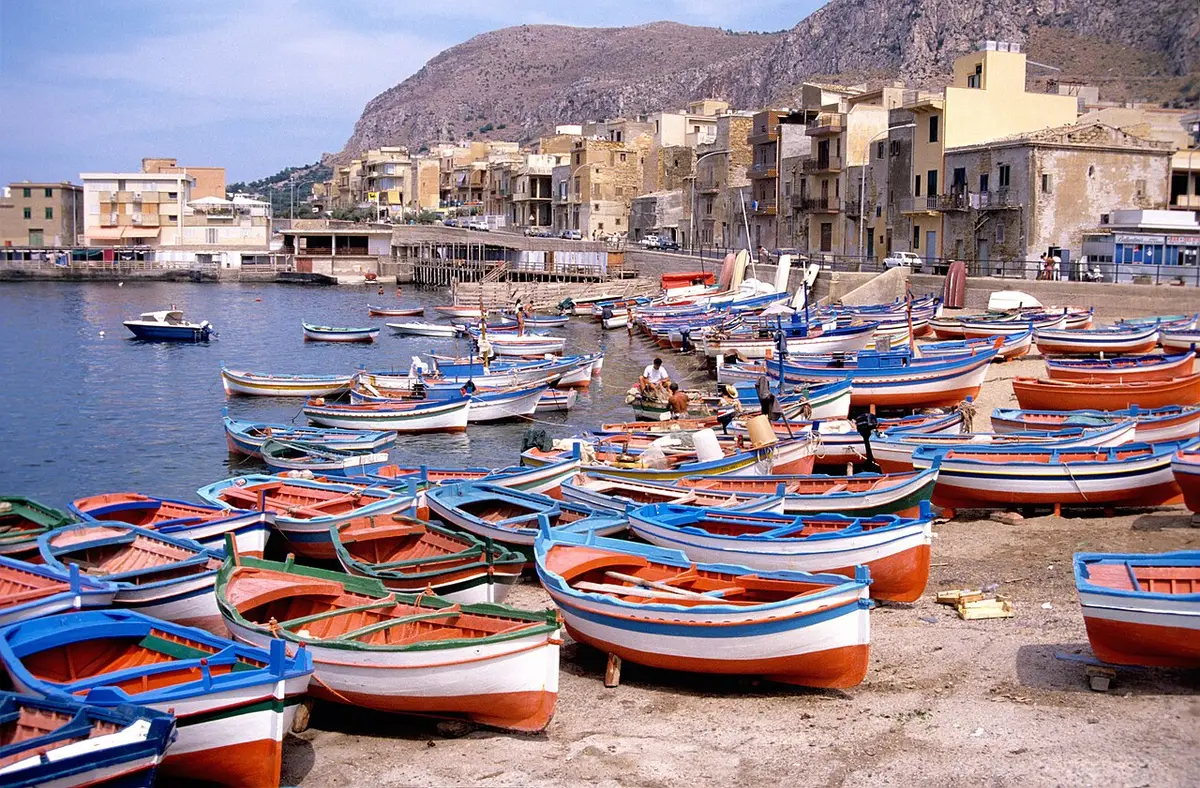
Aspra, the frazione on the shore, is a fishing village with a harbour and an anchovy museum. In the nineteenth century canneries grew up around Punta Aguglia, helped by the railway of 1863. Today the economy is commerce, services and commuting to Palermo.
Living in Bagheria
Bagheria is a working town first, so it stays busy all year. Trains and buses to Palermo fill with commuters, and evenings bring the passeggiata on the Corso. There are five secondary schools, a large public library in Palazzo Cutò and a weekly market. In summer, Aspra becomes the town's beach, and the August feast fills the streets for a week.
The population is broadly stable, with a small foreign community. Bagheria has most of what a family needs day to day, and Palermo, with its university and big shops, is right next door. The drawbacks are traffic, untidy suburbs and a historic centre where fine villas sit next to unfinished buildings.
A short history
People lived on Monte Catalfano in the Bronze Age, and from the sixth century BC a Hellenised native town stood on Monte Porcara, trading with Himera and later Solunto. In the Middle Ages this was the Foresta della Bacharia, farmland and woods; the origin of the name is disputed.
The modern town began in 1658, when Giuseppe Branciforte, Prince of Butera, finished a palace here to escape court life; over his gate he carved O corte a Dio, farewell to the court. The nobility followed, and from the 1710s the Valguarnera, Palagonia, Cattolica and other families built villas, the two finest designed by Tommaso Maria Napoli.
Bagheria became a separate comune in the 1820s, grew with wine and canneries, and was bombed by the Allies in July 1943. After the war it spread fast and often without planning. Its twentieth century is told in Tornatore's film Baarìa and in Dacia Maraini's memoir Bagheria.
Food, festivals and traditions
Aspra lives on the sea, and its museum is devoted to the anchovy. A vine on the town's coat of arms recalls the wine trade of the first settlers, and the Cantori di Bagheria keep alive the old carters' songs.
The patron is Saint Joseph. His official day is 19 March, but Bagheria celebrates him on the first Sunday of August, with a week of shows and fireworks on the Monday night. Aspra honours the Addolorata on 15 September.
Interesting facts about Bagheria
- Goethe visited Villa Palagonia in 1787 and described chairs with legs sawn unevenly so that no one could sit on them.
- The founder of the town carved O corte a Dio, farewell to the court, over the gate of his palace.
- Villa Palagonia appears in Antonioni's L'avventura and in Alberto Lattuada's Mafioso, with Alberto Sordi.
- The railway reached Bagheria in 1863 and helped a food canning industry grow around Punta Aguglia.
House prices in Bagheria
€983average price per m² to buy
€3.72average rent per m² a month
€98,000a 100 m² home at that price
These are the official averages from the Agenzia delle Entrate's property market observatory (OMI) for homes in normal condition across the town's 3 price zones. Prices in Bagheria are above the typical town in Palermo province (€516 per m²) and above the typical Sicilian town (€593 per m²). Detached houses (villini) average about €992 per m².
Why these figures can look low: they come from the values on real sales, which sit below advertised asking prices, and the typical Sicilian town is the middle of all 391 comuni, most of them small inland towns. Island-wide averages quoted on property portals, around €1,100 to €1,300 per m², lean towards the cities and the coast, where most homes are listed. Rents work the same way: listings usually ask well above the official rent figure, often double or more.
Houses that need work, which is most of the cheap ones you see advertised, sell well below these figures. The renovation comes on top, so budget for both.
Work out the return on a let with the rental yield calculator, or see the steps from offer to keys in the buying timeline planner.
Getting there and getting around
| From the centre to | By car | Distance |
|---|---|---|
| Palermo Falcone Borsellino airport (PMO) | 49 minutes | 50 km |
| Trapani Birgi airport (TPS) | 1 hour 48 minutes | 128 km |
| Catania Fontanarossa airport (CTA) | 2 hours 27 minutes | 194 km |
| Comiso airport (CIY) | 3 hours 16 minutes | 214 km |
| Palermo city centre | 20 minutes | 15 km |
| Catania city centre | 2 hours 26 minutes | 195 km |
| Messina, for ferries to the mainland | 2 hours 30 minutes | 212 km |
| Nearest railway station (Bagheria) | 2 minutes | 1 km |
Times are by road on a clear day, worked out from OpenStreetMap. Allow longer in summer and on market days. Bagheria has a railway station close to the centre, which helps for trips to the cities, but most residents still rely on a car, and buses are infrequent on Sundays and in August.
Planning flights and trips? See the Schengen 90/180 calculator if you are from outside the EU.
Everyday life: shops, health and schools
- Hospital with A&E
- Ospedale Buccheri La Ferla, about 15 minutes by car
- Pharmacies in the comune
- 17
- Supermarkets
- 17
- Schools
- State: 23 nursery schools, 11 primary schools, 5 middle schools, 11 secondary schools; plus 14 independent (paritaria)
- Banks and cash machines
- 10
- Cafés and bars
- 41
- Restaurants
- 28
- Full fibre broadband
- 94.6% of addresses
Pharmacies and schools come from the official Ministry of Health and Ministry of Education lists. The other counts are of places mapped in OpenStreetMap inside the comune's boundary, so a small shop or a doctor's surgery can be missing. “Not fully mapped yet” means the volunteer map clearly has gaps here, not that the town has none. For a family doctor (medico di base, what the British call a GP), you register with the local health authority (ASP Palermo) once you are resident.
Free download
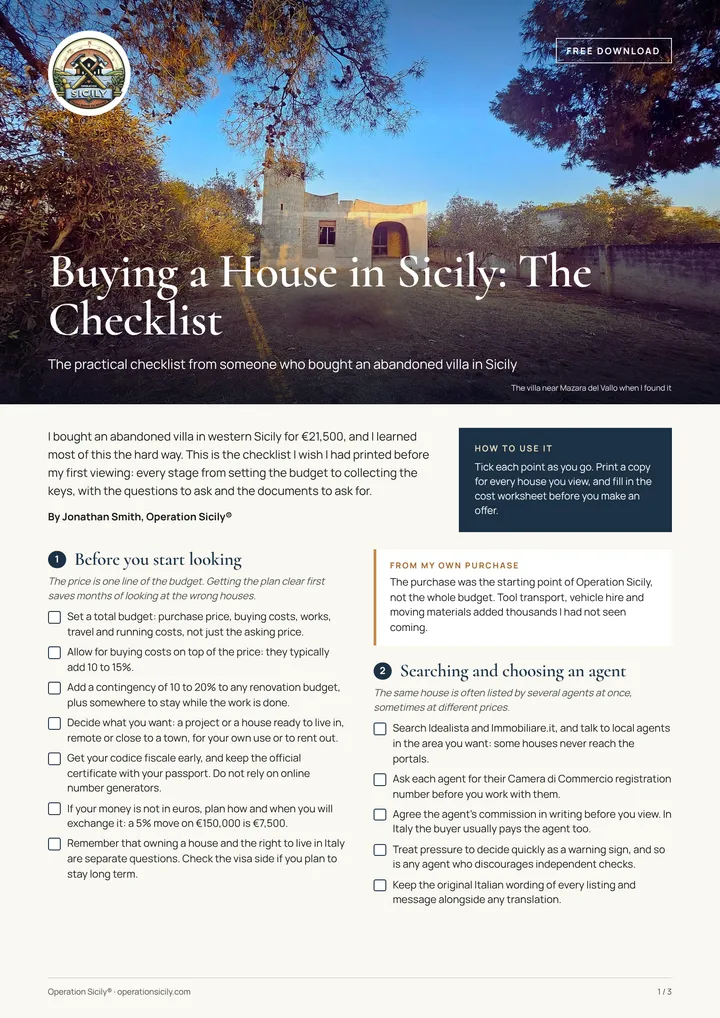
Buying a house in Sicily? Take my checklist.
Every step from budget to keys, the questions to ask at a viewing and the documents to ask for, as a PDF you can print.
Here is your checklist. Download the checklist (PDF)
Weather and climate in Bagheria
32.3°Caverage July high
8°Caverage January low
663 mmrain a year, on about 100 days
35days a year above 30°C
| Month | Average temperature | Rain |
|---|---|---|
| January | 12°C | 91 mm |
| February | 11°C | 78 mm |
| March | 13°C | 69 mm |
| April | 16°C | 50 mm |
| May | 20°C | 23 mm |
| June | 24°C | 19 mm |
| July | 27°C | 7 mm |
| August | 28°C | 13 mm |
| September | 24°C | 57 mm |
| October | 21°C | 84 mm |
| November | 17°C | 81 mm |
| December | 13°C | 90 mm |
Averages for 2015 to 2024. Winters are mild, though stone houses still feel cold without heating. Summers are hot and dry.
See what each month brings in Sicily month by month, or size a solar system with the off-grid solar calculator.
Who lives there
- Population
- 53,100
- Change since 2019
- -1.1%
- Median age
- 42
- Foreign residents
- 676 (1.3%)
- People from Bagheria are called
- bagheresi
Registered residents from abroad include 6 British, 1 American, 12 German, 2 Dutch, 7 French, 5 Belgian, 1 Swiss, 10 Spanish, 10 Polish, 147 Romanian, 10 Albanian and 13 Ukrainian citizens. Most of the rest come from countries outside Europe and the Americas. Others own holiday homes here without registering as residents.
Bagheria lives mainly for its own residents rather than for visitors, with only about 284 tourist beds, so everyday life changes little between summer and winter.
Beaches in Bagheria
Bagheria has one beach in our beach guide, and 3 more named beaches and coves mapped along its coast. 20% of its officially monitored bathing waters were rated excellent in the latest EU assessment.
- Spiaggia dei Francesi sand and pebbles, water good
Things to see and do in and around Bagheria
Villa Palagonia, of 1715, is the one to see first: its garden walls are lined with grotesque figures, musicians and monsters, and inside is a hall of mirrors that appears in Antonioni's L'avventura. Villa Cattolica, of 1736, houses the Guttuso museum, with works the painter gave to his home town. Palazzo Butera, the oldest, and Villa Valguarnera, with its hilltop walk and statue of Urania, are also worth the trip, though not all villas are open.
Palazzo Cutò holds Pietro Piraino's toy museum. The Greek and Roman ruins of Solunto, on Monte Catalfano in neighbouring Santa Flavia, are the best short outing, and Capo Zafferano is close for a swim.
- Villa Palagonia
- Villa Valguarnera
- Palazzo Cutò
- Villa Cattolica
- Palazzo Butera, Branciforti
- Museo Guttuso
- Monte Porcara
- Palazzo Villarosa
- Museo del Giocattolo
- Museum, Osservatorio dell'arte in Sicilia
- Museo del Giocattolo Pietro Piraino
- MUSEUM Osservatorio dell'arte contemporanea in Sicilia
Beaches within the comune include Ipoocampo, Tre Piscine Cala del Cuore, Sarello, Spiaggia dei francesi.
Famous people born in Bagheria include Giuseppe Tornatore (Italian film director and screenwriter); Renato Guttuso (Italian painter); Ignazio Buttitta (Italian poet); Ferdinando Scianna (Italian photographer and journalist); Joe Aiello (Chicago bootlegger).
Earthquake, landslide and flood risk
Bagheria is in seismic zone 2, the second highest of Italy’s four seismic zones. The zone sets the anti-seismic standard for any new building, extension or structural renovation, which affects both the design and the cost. A structural survey is worth paying for before you buy any older building, stone house or flat.
4% of the comune's land is mapped by ISPRA as high or very high landslide hazard, where 0.1% of residents live, and 2.2% of the land could flood in a medium-probability flood (3.2% of residents). Ask for the hazard maps (PAI) for any house you are considering; the comune's technical office or your geometra can check them.
Check what you can build or change with the building permit checker, and keep a margin with the renovation contingency calculator.
The comune: useful details
- Official name
- Comune di Bagheria
- Province
- Palermo (Città metropolitana di Palermo)
- Postcode (CAP)
- 90011
- Dialling code
- 091
- Area
- 29 km²
- Height above sea level
- 76 m
- ISTAT code
- 082006
- Cadastral code
- A546 (used in the codice fiscale of people born here)
- Official website
- comune.bagheria.pa.it
Registering as a resident, paying local taxes and building permits all go through the comune. If you were born abroad, get your Italian tax code first with the codice fiscale calculator.
Nearby towns
Bagheria borders 3 other comuni:
- Ficarazzi €968/m²
- Misilmeri €878/m²
- Santa Flavia €1,217/m²
Towns like Bagheria elsewhere in Sicily
- Trapani (Trapani province)
- Sciacca (Agrigento province)
- Acireale (Catania province)
- Marsala (Trapani province)
- Scicli (Ragusa province)
- Mazara del Vallo (Trapani province)
Bagheria on our lists
- Towns within an hour of Palermo airport
- The best towns for full fibre broadband
- The biggest towns in Sicily
- The best places to live in Sicily
- Where British people live in Sicily
- Cheap seaside towns within an hour of an airport
- The best towns in Sicily for expats
- The best seaside towns in Sicily
See every town in Palermo province (82 comuni), or let Find your town suggest places that match what you want.
Frequently asked questions
Where is Bagheria in Sicily?
Bagheria is in the province of Palermo, about 15 km east of Palermo. The centre sits about 76 metres above sea level and its land runs down to the coast.
What is Bagheria known for?
Goethe visited Villa Palagonia in 1787 and described chairs with legs sawn unevenly so that no one could sit on them. The founder of the town carved O corte a Dio, farewell to the court, over the gate of his palace. Villa Palagonia appears in Antonioni's L'avventura and in Alberto Lattuada's Mafioso, with Alberto Sordi.
Is Bagheria a good place to live?
It depends what you want. A practical fit for those who want a real town with everyday services, quick links to Palermo and the sea at Aspra. The nearest emergency department is about 15 minutes away, and homes average about €983 per m².
How much do houses cost in Bagheria?
Official figures from the Agenzia delle Entrate put homes in Bagheria at about €983 per square metre on average, so a 100 m² home in normal condition would be roughly €98,000. That is above the typical town in the province (€516) and above the typical Sicilian town (€593). Houses needing work sell for less, and the best homes for more.
What is the nearest airport to Bagheria?
Palermo Falcone Borsellino airport is the nearest, about 49 minutes away by car (50 km). Trapani Birgi is about 1 hour 48 minutes away. Times are for a clear road and will be longer in summer traffic.
What is the weather like in Bagheria?
Summers are hot and dry: July afternoons average about 32.3°C, with around 35 days a year above 30°C. Winter nights in January average about 8°C. Rain totals about 663 mm a year, falling mostly between October and March.
How many people live in Bagheria?
53,100 people live in the comune of Bagheria, according to ISTAT. The population fell by 1.1% between 2019 and 2025. Half the residents are older than 42.
Is there a hospital near Bagheria?
The nearest hospital with an emergency department (pronto soccorso) is Ospedale Buccheri La Ferla, about 15 minutes away by car. In an emergency anywhere in Italy, call 112.
Is Bagheria in an earthquake zone?
Bagheria is in seismic zone 2, the second highest of Italy’s four seismic zones. New building and structural work anywhere in Italy must follow anti-seismic rules, and the zone sets how strict they are, so ask your geometra or engineer to check any house you plan to buy or renovate.
Does Bagheria count for the 7% flat tax for pensioners?
No. On the population figure used for the limit, about 53,152 residents, Bagheria is over the 30,000 limit for Italy's 7% flat tax for foreign pensioners. Many smaller towns nearby do qualify. Check the details with our 7% flat tax town checker and a qualified adviser.
Does Bagheria have fast internet?
Yes, for most homes: about 94.6% of addresses in Bagheria can get full fibre (FTTH), according to the communications regulator AGCOM. Check the exact address before you buy.
Can you visit the villas of Bagheria?
Some of them. Villa Palagonia and Villa Cattolica, with the Guttuso museum, are open to visitors; others are private, closed or in poor repair, so check before going.
Credits
Photo: Jpbazard Jean-Pierre Bazard, CC BY-SA 3.0, via Wikimedia Commons.
Figures: ISTAT, Agenzia delle Entrate (OMI), Copernicus ERA5-Land, AGCOM, Dipartimento della Protezione Civile, ISPRA, Ministero della Salute, Ministero dell'Istruzione e del Merito, IndicePA, Open-Meteo, NASA POWER, Wikidata and © OpenStreetMap contributors, with several series gathered by the expatliving-data open data collection. Map boundaries ISTAT via openpolis (CC BY 4.0). Sicily as a whole: 4,787,390 people in 391 comuni.
 The weekly YouTube series