
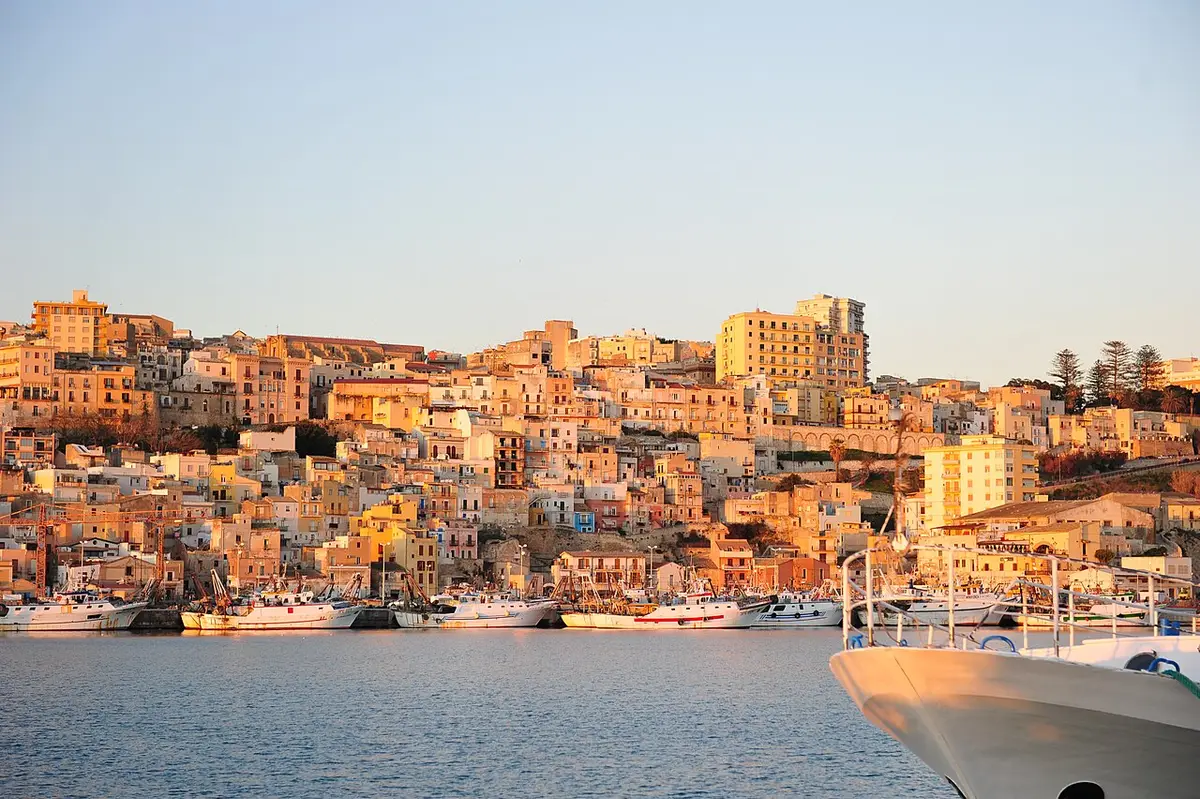
About Sciacca
The old town is built in terraces above the port. Its cathedral, Maria Santissima del Soccorso, was founded in 1108 by Giulietta, daughter of Count Roger, and rebuilt in the seventeenth century; inside are works by the Gagini and a Madonna attributed to Francesco Laurana. Around it stand Santa Margherita, the Carmine, the battlemented Palazzo Steripinto, the ruins of the Luna castle and the baroque Porta Palermo.
Monte Kronio, rising behind the town, gives the springs their heat, and the Grotta Stufa at its summit has yielded important prehistoric finds. On the edge of town, the Castello Incantato is the former farm of the naive artist Filippo Bentivegna, who carved heads into the rock, imagining them as the subjects of his kingdom.
The coast runs for about 33 kilometres. The harbour is home to the second largest fishing fleet in Sicily after Mazara del Vallo, and the town is a major producer of oily fish such as anchovies and sardines. Ceramics are the other great craft.
Living in Sciacca
Sciacca is a lively town all year round and a real summer resort, with plenty of hotels and holiday homes along the coast. The population has dipped only slightly over the last decade, and the town is the hub for a wide area of smaller villages. Its historic thermal baths, however, have been closed since 2015.
Pros: a complete town by the sea, a rich old centre and good fish. Cons: busy summers, untidy outskirts and the closed spa.
A short history
Sicani lived in the area long before the Greeks, and Punic inscriptions have also been found. The Greeks of Selinunte made the place their spa, Thermae Selinuntinae, for its hot sulphurous springs; after Selinunte fell in 409 BC some of its survivors took refuge here. In later Roman times it was called Aquae Labodes.
The Arabs took the town in 840 and left their mark on the quarters and street names, and the Normans took it in 1087, building walls, bastions and castles. In the late Middle Ages the town was torn by the bloody feuds between the Luna and Perollo families, known as the caso di Sciacca, which ended in 1530 and nearly halved the population. In 1553 the town saw off a Franco Ottoman raid; cannons from French ships wrecked offshore are kept in the town hall.
In 1831 an undersea volcano about 48 kilometres off the coast rose to form a small island. Britain, France and the Bourbons all landed and named it, as Graham, Julia and Ferdinandea, before it sank back below the waves five months later.
Food, festivals and traditions
Fish is at the heart of the cooking, especially anchovies and sardines, and the local olive oil, oranges and Vastedda del Belice cheese are protected products. The two classic sweets, said to have been created by nuns, are the ova murina, a crêpe of toasted almonds filled with milk cream, chocolate and candied squash, and cucchiteddi, almond paste shaped like half a spoon and filled with green squash.
The carnival, in the week before Lent, is famous across Sicily for its floats of grotesque papier-mâché figures. The patron, Maria Santissima del Soccorso, is honoured on 2 February and 15 August, when barefoot sailors carry her jewelled statue through the streets, a feast born of a plague in 1626. San Calogero has his feast on the Tuesday after Pentecost.
Interesting facts about Sciacca
- Sciacca is the largest town in the province after Agrigento.
- Its fishing fleet is the second largest in Sicily after Mazara del Vallo's.
- In 1831 the volcanic island of Ferdinandea briefly rose from the sea off its coast.
- The carnival is one of the oldest and best known in Sicily.
House prices in Sciacca
€879average price per m² to buy
€2.92average rent per m² a month
€88,000a 100 m² home at that price
These are the official averages from the Agenzia delle Entrate's property market observatory (OMI) for homes in normal condition across the town's 8 price zones. Prices in Sciacca are above the typical town in Agrigento province (€500 per m²) and above the typical Sicilian town (€593 per m²). Detached houses (villini) average about €919 per m².
Why these figures can look low: they come from the values on real sales, which sit below advertised asking prices, and the typical Sicilian town is the middle of all 391 comuni, most of them small inland towns. Island-wide averages quoted on property portals, around €1,100 to €1,300 per m², lean towards the cities and the coast, where most homes are listed. Rents work the same way: listings usually ask well above the official rent figure, often double or more.
Houses that need work, which is most of the cheap ones you see advertised, sell well below these figures. The renovation comes on top, so budget for both.
Work out the return on a let with the rental yield calculator, or see the steps from offer to keys in the buying timeline planner.
Getting there and getting around
| From the centre to | By car | Distance |
|---|---|---|
| Palermo Falcone Borsellino airport (PMO) | 1 hour 48 minutes | 113 km |
| Trapani Birgi airport (TPS) | 1 hour 51 minutes | 113 km |
| Catania Fontanarossa airport (CTA) | 3 hours 15 minutes | 215 km |
| Comiso airport (CIY) | 3 hours 22 minutes | 176 km |
| Palermo city centre | 1 hour 38 minutes | 96 km |
| Catania city centre | 3 hours 14 minutes | 216 km |
| Messina, for ferries to the mainland | 4 hours 11 minutes | 317 km |
| Nearest motorway or main road junction | 29 minutes | 25 km |
| Nearest railway station (Castelvetrano) | 43 minutes | 37 km |
Times are by road on a clear day, worked out from OpenStreetMap. Allow longer in summer and on market days. Most people living in Sciacca rely on a car; buses link the bigger towns but are infrequent on Sundays and in August.
Planning flights and trips? See the Schengen 90/180 calculator if you are from outside the EU.
Everyday life: shops, health and schools
- Hospital with A&E
- Ospedale Giovanni Paolo II, about 6 minutes by car
- Pharmacies in the comune
- 12
- Supermarkets
- 15
- Schools
- State: 16 nursery schools, 9 primary schools, 4 middle schools, 13 secondary schools; plus 4 independent (paritaria)
- Banks and cash machines
- 6
- Cafés and bars
- 32
- Restaurants
- 49
- Full fibre broadband
- 72.9% of addresses
Pharmacies and schools come from the official Ministry of Health and Ministry of Education lists. The other counts are of places mapped in OpenStreetMap inside the comune's boundary, so a small shop or a doctor's surgery can be missing. “Not fully mapped yet” means the volunteer map clearly has gaps here, not that the town has none. For a family doctor (medico di base, what the British call a GP), you register with the local health authority (ASP Agrigento) once you are resident.
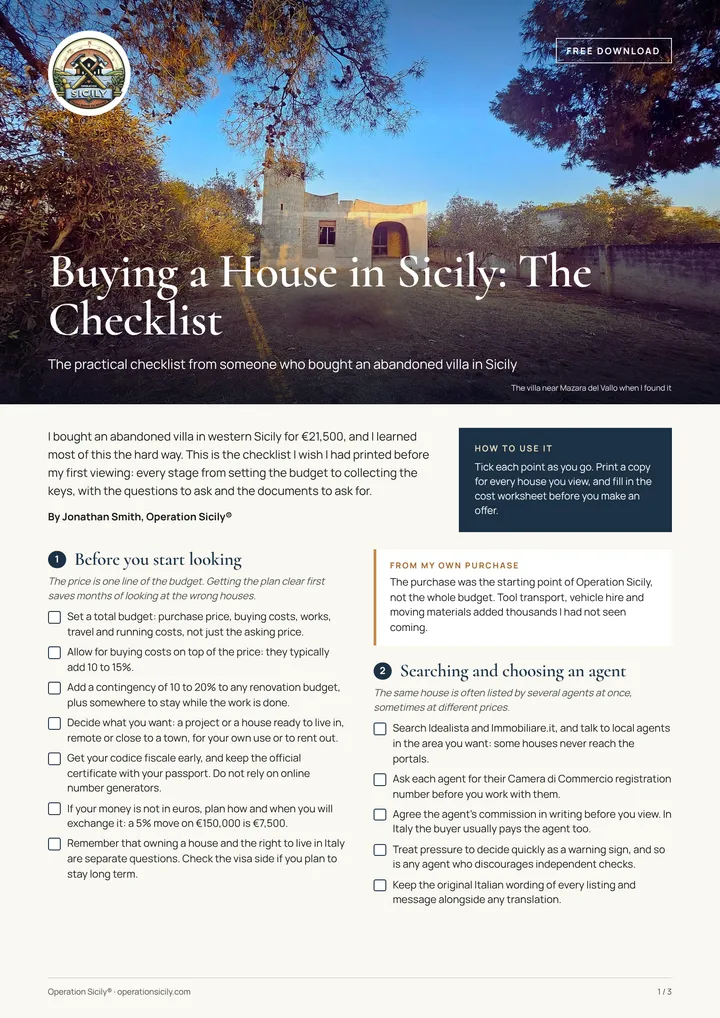
Free download
Buying a house in Sicily? Take my checklist.
Every step from budget to keys, the questions to ask at a viewing and the documents to ask for, as a PDF you can print.
Here is your checklist. Download the checklist (PDF)
Weather and climate in Sciacca
31.7°Caverage July high
8.8°Caverage January low
600 mmrain a year, on about 86 days
21days a year above 30°C
| Month | Average temperature | Rain |
|---|---|---|
| January | 12°C | 80 mm |
| February | 12°C | 71 mm |
| March | 13°C | 65 mm |
| April | 15°C | 46 mm |
| May | 19°C | 23 mm |
| June | 23°C | 16 mm |
| July | 27°C | 6 mm |
| August | 27°C | 10 mm |
| September | 24°C | 49 mm |
| October | 21°C | 78 mm |
| November | 17°C | 79 mm |
| December | 13°C | 76 mm |
Averages for 2015 to 2024. Winters are mild, though stone houses still feel cold without heating. Summers are hot and dry.
See what each month brings in Sicily month by month, or size a solar system with the off-grid solar calculator.
Who lives there
- Population
- 38,576
- Change since 2019
- -2.2%
- Median age
- 45
- Foreign residents
- 863 (2.2%)
- People from Sciacca are called
- saccensi
Registered residents from abroad include 11 British, 8 American, 18 German, 1 Dutch, 17 French, 3 Belgian, 2 Australian, 1 Canadian, 2 Swedish, 3 Spanish, 29 Polish, 202 Romanian, 12 Albanian and 6 Ukrainian citizens. Most of the rest come from countries outside Europe and the Americas. Others own holiday homes here without registering as residents.
Sciacca is a working town first, busy all year round, with about 2,425 tourist beds. Visitors add to the summer crowds without changing the way the place lives.
Beaches in Sciacca
Sciacca has one beach in our beach guide, and 5 more named beaches and coves mapped along its coast. 100% of its officially monitored bathing waters were rated excellent in the latest EU assessment.
- Capo San Marco Beach sand, water excellent
Things to see and do in and around Sciacca
Walk the old town from the cathedral up through the churches and palaces to the Luna castle, then down to the harbour to watch the fishing boats come in. Visit the Castello Incantato and climb Monte Kronio. The beaches lie on both sides of town, and Caltabellotta, Selinunte and Lake Arancio are close.
- Monte Kronio
- Cathedral in Sciacca
- San Calogero
- Castello Incantato
- Piazza del Popolo
- Anime del Purgatorio
- Church of St. Michael
- Church of St. Nicolò La Latina
- Church of St. Margaret
- Santa Maria della Raccomandata
- Palazzo Steripinto, Sciacca
- Santa Maria delle Giummare
- Terme di Sciacca
- Teatro popolare Samonà
Beaches within the comune include Spiaggia Foggia, Spiaggia Lido, Spiaggia Lumia, Spiaggia Maragani.
Famous people born in Sciacca include Giuseppe Mario Bellanca (Italian-American aeroplane designer); Valeria Bilello (Italian actress); Accursio Bentivegna (Italian footballer); Michele Abruzzo (Italian actor); Tommaso Fazello (Italian historian and theologian).
Earthquake, landslide and flood risk
Sciacca is in seismic zone 2, the second highest of Italy’s four seismic zones. The zone sets the anti-seismic standard for any new building, extension or structural renovation, which affects both the design and the cost. A structural survey is worth paying for before you buy any older building, stone house or flat.
0.9% of the comune's land is mapped by ISPRA as high or very high landslide hazard, where 0.7% of residents live, and 1.3% of the land could flood in a medium-probability flood (1% of residents). Ask for the hazard maps (PAI) for any house you are considering; the comune's technical office or your geometra can check them.
Check what you can build or change with the building permit checker, and keep a margin with the renovation contingency calculator.
The comune: useful details
- Official name
- Comune di Sciacca
- Province
- Agrigento (Libero consorzio comunale di Agrigento)
- Postcode (CAP)
- 92019
- Dialling code
- 0925
- Area
- 190 km²
- Height above sea level
- 60 m
- ISTAT code
- 084041
- Cadastral code
- I533 (used in the codice fiscale of people born here)
- Official website
- comune.sciacca.ag.it
Registering as a resident, paying local taxes and building permits all go through the comune. If you were born abroad, get your Italian tax code first with the codice fiscale calculator.
Nearby towns
Sciacca borders 4 other comuni:
- Caltabellotta
- Menfi €677/m²
- Ribera €739/m²
- Sambuca di Sicilia €470/m²
Towns like Sciacca elsewhere in Sicily
- Carini (Palermo province)
- Scicli (Ragusa province)
- Barcellona Pozzo di Gotto (Messina province)
- Bagheria (Palermo province)
- Termini Imerese (Palermo province)
- Trapani (Trapani province)
Sciacca on our lists
- The towns with the mildest winters
- The biggest towns in Sicily
- The best places to live in Sicily
- Where British people live in Sicily
- The best seaside towns in Sicily
See every town in Agrigento province (43 comuni), or let Find your town suggest places that match what you want.
Frequently asked questions
Where is Sciacca in Sicily?
Sciacca is in the province of Agrigento, about 50 km north-west of Agrigento. The centre sits about 60 metres above sea level and its land runs down to the coast.
What is Sciacca known for?
Sciacca is the largest town in the province after Agrigento. Its fishing fleet is the second largest in Sicily after Mazara del Vallo's. In 1831 the volcanic island of Ferdinandea briefly rose from the sea off its coast.
Is Sciacca a good place to live?
It depends what you want. A strong fit for buyers who want a real working town by the sea, with history, good food and everything needed for daily life. The nearest emergency department is about 6 minutes away, and homes average about €879 per m².
How much do houses cost in Sciacca?
Official figures from the Agenzia delle Entrate put homes in Sciacca at about €879 per square metre on average, so a 100 m² home in normal condition would be roughly €88,000. That is above the typical town in the province (€500) and above the typical Sicilian town (€593). Houses needing work sell for less, and the best homes for more.
What is the nearest airport to Sciacca?
Palermo Falcone Borsellino airport is the nearest, about 1 hour 48 minutes away by car (113 km). Trapani Birgi is about 1 hour 51 minutes away. Times are for a clear road and will be longer in summer traffic.
What is the weather like in Sciacca?
Summers are hot and dry: July afternoons average about 31.7°C, with around 21 days a year above 30°C. Winter nights in January average about 8.8°C. Rain totals about 600 mm a year, falling mostly between October and March.
How many people live in Sciacca?
38,576 people live in the comune of Sciacca, according to ISTAT. The population fell by 2.2% between 2019 and 2025. Half the residents are older than 45.
Is there a hospital near Sciacca?
The nearest hospital with an emergency department (pronto soccorso) is Ospedale Giovanni Paolo II, about 6 minutes away by car. In an emergency anywhere in Italy, call 112.
Is Sciacca in an earthquake zone?
Sciacca is in seismic zone 2, the second highest of Italy’s four seismic zones. New building and structural work anywhere in Italy must follow anti-seismic rules, and the zone sets how strict they are, so ask your geometra or engineer to check any house you plan to buy or renovate.
Does Sciacca count for the 7% flat tax for pensioners?
No. On the population figure used for the limit, about 38,387 residents, Sciacca is over the 30,000 limit for Italy's 7% flat tax for foreign pensioners. Many smaller towns nearby do qualify. Check the details with our 7% flat tax town checker and a qualified adviser.
Does Sciacca have fast internet?
Yes, for most homes: about 72.9% of addresses in Sciacca can get full fibre (FTTH), according to the communications regulator AGCOM. Check the exact address before you buy.
Credits
Photo: Tiberio Frascari, CC BY-SA 2.0, via Wikimedia Commons.
Figures: ISTAT, Agenzia delle Entrate (OMI), Copernicus ERA5-Land, AGCOM, Dipartimento della Protezione Civile, ISPRA, Ministero della Salute, Ministero dell'Istruzione e del Merito, IndicePA, Open-Meteo, NASA POWER, Wikidata and © OpenStreetMap contributors, with several series gathered by the expatliving-data open data collection. Map boundaries ISTAT via openpolis (CC BY 4.0). Sicily as a whole: 4,787,390 people in 391 comuni.
 The weekly YouTube series