
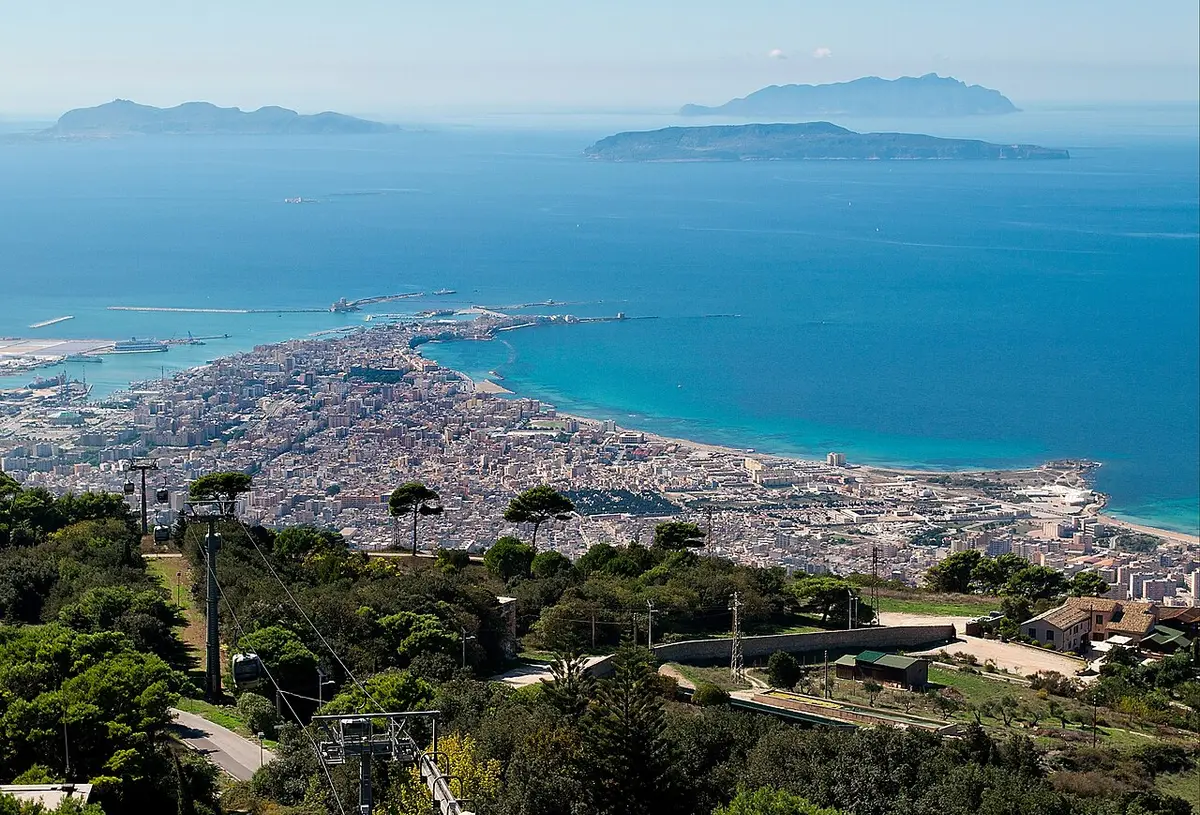
About Trapani
The historic centre runs west along the promontory. The Cathedral of San Lorenzo, with its eighteenth century façade of arches, has a Crucifixion attributed to Van Dyck; the Purgatorio church keeps the twenty groups of the Misteri; Sant'Agostino stands on little Piazza Saturno with a fourteenth century fountain; and San Pietro, in the oldest quarter, has an organ of 1837 with about four thousand pipes. Santa Maria di Gesù holds a glazed terracotta Madonna by Andrea della Robbia, and the Jesuit college now houses the Liceo Ximenes.
Out of the centre, the Basilica of the Annunziata houses the Madonna di Trapani, a revered marble statue, and the Museo Pepoli next door has collections that include the city's famous coral work. The Colombaia fortress sits on its islet in the harbour. The comune also includes the Scoglio Palumbo and the Porcelli rocks with their lighthouses. The economy is services, fishing, marble, salt and, increasingly, tourism.
Living in Trapani
Trapani is a working capital, busy all year with offices, courts, schools, university courses and the port; the urban area, counting Casa Santa, holds around 80,000 people. Summer brings visitors heading for the islands and the beaches, but the city never feels like a resort. Its own population has been slipping slowly.
The advantages: sea on three sides, city beaches, ferries and hydrofoils to the Egadi and Pantelleria, Trapani airport close by and Palermo reachable by motorway. The disadvantages: strong winds much of the year, a modern city that is less attractive than the old centre, and a quieter job market than in Palermo or Catania.
A short history
Trapani was probably founded by the Elymians as the port of Eryx on the mountain above; its Greek name Drepanon means sickle, for the shape of the spit, and myth says it formed from a sickle dropped by Demeter or by Kronos. Virgil makes it the place where Anchises died and Aeneas held funeral games. Carthage fortified it in 260 BC under Hamilcar, moving people down from Eryx, and in 249 BC Adherbal defeated the Roman fleet off the town; Rome took it after the battle of the Egadi in 241 BC and treated it harshly for its loyalty to Carthage.
Under the Arabs and then the Normans, who arrived in 1077, Trapani flourished again as a port on the routes of trade and the crusades. Between the thirteenth and sixteenth centuries it was among the most prosperous cities of the Mediterranean, famous across Europe for its coral carving, and grew rich on salt and tuna. The city was badly bombed in the Second World War and rebuilt around its old centre.
Food, festivals and traditions
Trapani's kitchen looks to Africa as well as Sicily: fish couscous, cuscusu, is the signature, along with busiate with pesto alla trapanese of tomato, almonds, garlic and basil, tuna in many forms, and salt from the pans.
On Good Friday the Processione dei Misteri carries twenty groups of wooden statues of the Passion through the streets for about a day and a night, one of the longest religious processions in Italy. The patron is Sant'Alberto, and the Madonna di Trapani is honoured with her own great feast.
Interesting facts about Trapani
- Drepanon, the city's ancient name, means sickle, after the shape of its promontory.
- The Misteri procession on Good Friday lasts about twenty-four hours.
- Trapani's coral carvers were famous across Europe between the thirteenth and sixteenth centuries.
- The organ of San Pietro, built in 1837, has about four thousand pipes.
House prices in Trapani
€946average price per m² to buy
€3.74average rent per m² a month
€95,000a 100 m² home at that price
These are the official averages from the Agenzia delle Entrate's property market observatory (OMI) for homes in normal condition across the town's 7 price zones. Prices in Trapani are above the typical town in Trapani province (€808 per m²) and above the typical Sicilian town (€593 per m²). Detached houses (villini) average about €1,050 per m².
Why these figures can look low: they come from the values on real sales, which sit below advertised asking prices, and the typical Sicilian town is the middle of all 391 comuni, most of them small inland towns. Island-wide averages quoted on property portals, around €1,100 to €1,300 per m², lean towards the cities and the coast, where most homes are listed. Rents work the same way: listings usually ask well above the official rent figure, often double or more.
Houses that need work, which is most of the cheap ones you see advertised, sell well below these figures. The renovation comes on top, so budget for both.
Work out the return on a let with the rental yield calculator, or see the steps from offer to keys in the buying timeline planner.
Getting there and getting around
| From the centre to | By car | Distance |
|---|---|---|
| Trapani Birgi airport (TPS) | 28 minutes | 16 km |
| Palermo Falcone Borsellino airport (PMO) | 1 hour 16 minutes | 88 km |
| Catania Fontanarossa airport (CTA) | 4 hours 8 minutes | 317 km |
| Comiso airport (CIY) | 4 hours 57 minutes | 337 km |
| Palermo city centre | 1 hour 36 minutes | 110 km |
| Catania city centre | 4 hours 7 minutes | 318 km |
| Messina, for ferries to the mainland | 4 hours 11 minutes | 335 km |
| Nearest railway station (Trapani) | 2 minutes | under 1 km |
Times are by road on a clear day, worked out from OpenStreetMap. Allow longer in summer and on market days. Trapani has a railway station close to the centre, which helps for trips to the cities, but most residents still rely on a car, and buses are infrequent on Sundays and in August.
Planning flights and trips? See the Schengen 90/180 calculator if you are from outside the EU.
Everyday life: shops, health and schools
- Hospital with A&E
- Ospedale Sant'Antonio Abate, about 8 minutes by car
- Pharmacies in the comune
- 23
- Supermarkets
- 20
- Schools
- State: 21 nursery schools, 16 primary schools, 5 middle schools, 15 secondary schools; plus 2 independent (paritaria)
- Banks and cash machines
- 14
- Cafés and bars
- 68
- Restaurants
- 72
- Full fibre broadband
- 90.6% of addresses
Pharmacies and schools come from the official Ministry of Health and Ministry of Education lists. The other counts are of places mapped in OpenStreetMap inside the comune's boundary, so a small shop or a doctor's surgery can be missing. “Not fully mapped yet” means the volunteer map clearly has gaps here, not that the town has none. For a family doctor (medico di base, what the British call a GP), you register with the local health authority (ASP Trapani) once you are resident.
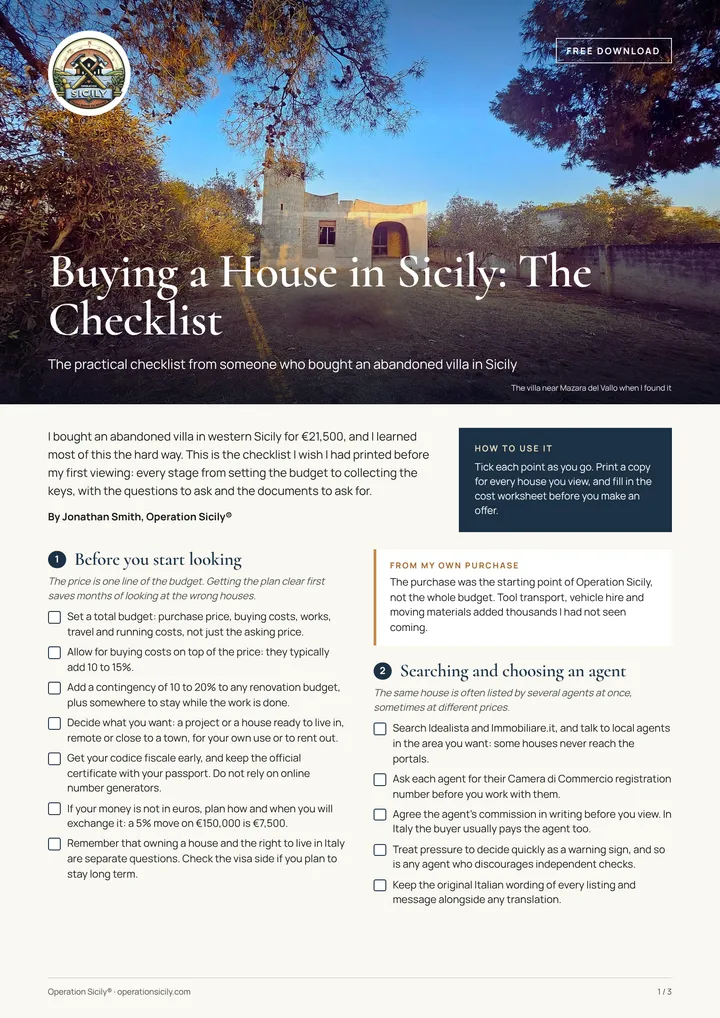
Free download
Buying a house in Sicily? Take my checklist.
Every step from budget to keys, the questions to ask at a viewing and the documents to ask for, as a PDF you can print.
Here is your checklist. Download the checklist (PDF)
Weather and climate in Trapani
31.8°Caverage July high
7.8°Caverage January low
572 mmrain a year, on about 90 days
72days a year above 30°C
| Month | Average temperature | Rain |
|---|---|---|
| January | 13°C | 69 mm |
| February | 12°C | 62 mm |
| March | 14°C | 53 mm |
| April | 16°C | 43 mm |
| May | 19°C | 27 mm |
| June | 23°C | 14 mm |
| July | 26°C | 8 mm |
| August | 27°C | 15 mm |
| September | 24°C | 59 mm |
| October | 21°C | 76 mm |
| November | 18°C | 75 mm |
| December | 14°C | 74 mm |
Averages for 2015 to 2024. Winters are mild, though stone houses still feel cold without heating. Summers are hot and dry.
See what each month brings in Sicily month by month, or size a solar system with the off-grid solar calculator.
Who lives there
- Population
- 54,949
- Change since 2019
- -4.3%, counting Misiliscemi, which became a separate comune in 2021
- Median age
- 46
- Foreign residents
- 2,639 (4.8%)
- People from Trapani are called
- trapanesi
Registered residents from abroad include 2 British, 7 American, 11 German, 2 Dutch, 13 French, 5 Belgian, 2 Swedish, 2 Swiss, 9 Spanish, 24 Polish, 471 Romanian, 16 Albanian and 33 Ukrainian citizens. Most of the rest come from countries outside Europe and the Americas. Others own holiday homes here without registering as residents.
Trapani is a working town first, busy all year round, with about 2,613 tourist beds. Visitors add to the summer crowds without changing the way the place lives.
Beaches in Trapani
Trapani has one beach in our beach guide, and one more named beach or cove mapped along its coast. 100% of its officially monitored bathing waters were rated excellent in the latest EU assessment.
- Mura di Tramontana Beach sand and pebbles
Things to see and do in and around Trapani
Walk the promontory from Piazza Garibaldi to the Torre di Ligny and back along the northern walls, then visit the cathedral, the Purgatorio and the Annunziata with the Museo Pepoli. In the evening, join the passeggiata on Corso Vittorio Emanuele.
South of the city, the salt pans of the Trapani and Paceco reserve, with their windmills, are best at sunset. The cable car climbs to Erice, ferries leave for Favignana, Levanzo and Marettimo, and San Vito Lo Capo, Marsala and Segesta are easy day trips.
- Trapani Cathedral
- Drepana
- Madonna of Trapani
- Riserva naturale orientata Saline di Trapani e Paceco
- Ligny Tower
- Castello di Terra
- Museo Agostino Pepoli
- San Pietro Apostolo
- Villa Margherita
- Sant’Agostino
- Chiesa delle Anime del Purgatorio
- Santa Maria dell'Itria
- Scoglio Palumbo Lighthouse
- Scogli Porcelli lighthouse
Famous people born in Trapani include Antonino Zichichi (Italian nuclear physicist); Roberto Galia (Italian footballer and manager); Albert of Trapani (Italian saint); Virginia Balistrieri (Italian actress); Leonardo Ximenes (Italian mathematician).
Earthquake, landslide and flood risk
Trapani is in seismic zone 2, the second highest of Italy’s four seismic zones. The zone sets the anti-seismic standard for any new building, extension or structural renovation, which affects both the design and the cost. A structural survey is worth paying for before you buy any older building, stone house or flat.
under 0.1% of the comune's land is mapped by ISPRA as high or very high landslide hazard, with no homes in those areas, and no medium-probability flood areas are mapped. Ask for the hazard maps (PAI) for any house you are considering; the comune's technical office or your geometra can check them.
Check what you can build or change with the building permit checker, and keep a margin with the renovation contingency calculator.
The comune: useful details
- Official name
- Comune di Trapani
- Province
- Trapani (Libero consorzio comunale di Trapani)
- Postcode (CAP)
- 91100
- Dialling code
- 0923
- Area
- 179 km²
- Height above sea level
- 3 m
- ISTAT code
- 081021
- Cadastral code
- L331 (used in the codice fiscale of people born here)
- Official website
- comune.trapani.it
Registering as a resident, paying local taxes and building permits all go through the comune. If you were born abroad, get your Italian tax code first with the codice fiscale calculator.
Nearby towns
Trapani borders 7 other comuni:
- Buseto Palizzolo €720/m²
- Calatafimi-Segesta €537/m²
- Erice €917/m²
- Marsala €936/m²
- Misiliscemi €710/m²
- Paceco €773/m²
- Salemi €568/m²
Towns like Trapani elsewhere in Sicily
- Bagheria (Palermo province)
- Sciacca (Agrigento province)
- Termini Imerese (Palermo province)
- Gela (Caltanissetta province)
- Agrigento (Agrigento province)
- Scicli (Ragusa province)
Trapani on our lists
- Towns within an hour of Trapani airport
- The biggest towns in Sicily
- The best places to live in Sicily
- Cheap seaside towns within an hour of an airport
- The best towns in Sicily for expats
- The best seaside towns in Sicily
See every town in Trapani province (25 comuni), or let Find your town suggest places that match what you want.
Frequently asked questions
Where is Trapani in Sicily?
Trapani is in the province of Trapani, 75 km west of Palermo. The centre sits about 3 metres above sea level and its land runs down to the coast.
What is Trapani known for?
Drepanon, the city's ancient name, means sickle, after the shape of its promontory. The Misteri procession on Good Friday lasts about twenty-four hours. Trapani's coral carvers were famous across Europe between the thirteenth and sixteenth centuries.
Is Trapani a good place to live?
It depends what you want. It suits people who want a real city by the sea, with island hopping, an airport nearby and prices well below Palermo. The nearest emergency department is about 8 minutes away, and homes average about €946 per m².
How much do houses cost in Trapani?
Official figures from the Agenzia delle Entrate put homes in Trapani at about €946 per square metre on average, so a 100 m² home in normal condition would be roughly €95,000. That is above the typical town in the province (€808) and above the typical Sicilian town (€593). Houses needing work sell for less, and the best homes for more.
What is the nearest airport to Trapani?
Trapani Birgi airport is the nearest, about 28 minutes away by car (16 km). Palermo Falcone Borsellino is about 1 hour 16 minutes away. Times are for a clear road and will be longer in summer traffic.
What is the weather like in Trapani?
Summers are hot and dry: July afternoons average about 31.8°C, with around 72 days a year above 30°C. Winter nights in January average about 7.8°C. Rain totals about 572 mm a year, falling mostly between October and March.
How many people live in Trapani?
54,949 people live in the comune of Trapani, according to ISTAT. The population fell by 4.3% between 2019 and 2025 (counting Misiliscemi, which became a separate comune in 2021). Half the residents are older than 46.
Is there a hospital near Trapani?
The nearest hospital with an emergency department (pronto soccorso) is Ospedale Sant'Antonio Abate, about 8 minutes away by car. In an emergency anywhere in Italy, call 112.
Is Trapani in an earthquake zone?
Trapani is in seismic zone 2, the second highest of Italy’s four seismic zones. New building and structural work anywhere in Italy must follow anti-seismic rules, and the zone sets how strict they are, so ask your geometra or engineer to check any house you plan to buy or renovate.
Does Trapani count for the 7% flat tax for pensioners?
No. On the population figure used for the limit, about 54,636 residents, Trapani is over the 30,000 limit for Italy's 7% flat tax for foreign pensioners. Many smaller towns nearby do qualify. Check the details with our 7% flat tax town checker and a qualified adviser.
Does Trapani have fast internet?
Yes, for most homes: about 90.6% of addresses in Trapani can get full fibre (FTTH), according to the communications regulator AGCOM. Check the exact address before you buy.
Credits
Photo: Myke Bryan, CC BY 2.0, via Wikimedia Commons.
Figures: ISTAT, Agenzia delle Entrate (OMI), Copernicus ERA5-Land, AGCOM, Dipartimento della Protezione Civile, ISPRA, Ministero della Salute, Ministero dell'Istruzione e del Merito, IndicePA, Open-Meteo, NASA POWER, Wikidata and © OpenStreetMap contributors, with several series gathered by the expatliving-data open data collection. Map boundaries ISTAT via openpolis (CC BY 4.0). Sicily as a whole: 4,787,390 people in 391 comuni.
 The weekly YouTube series