
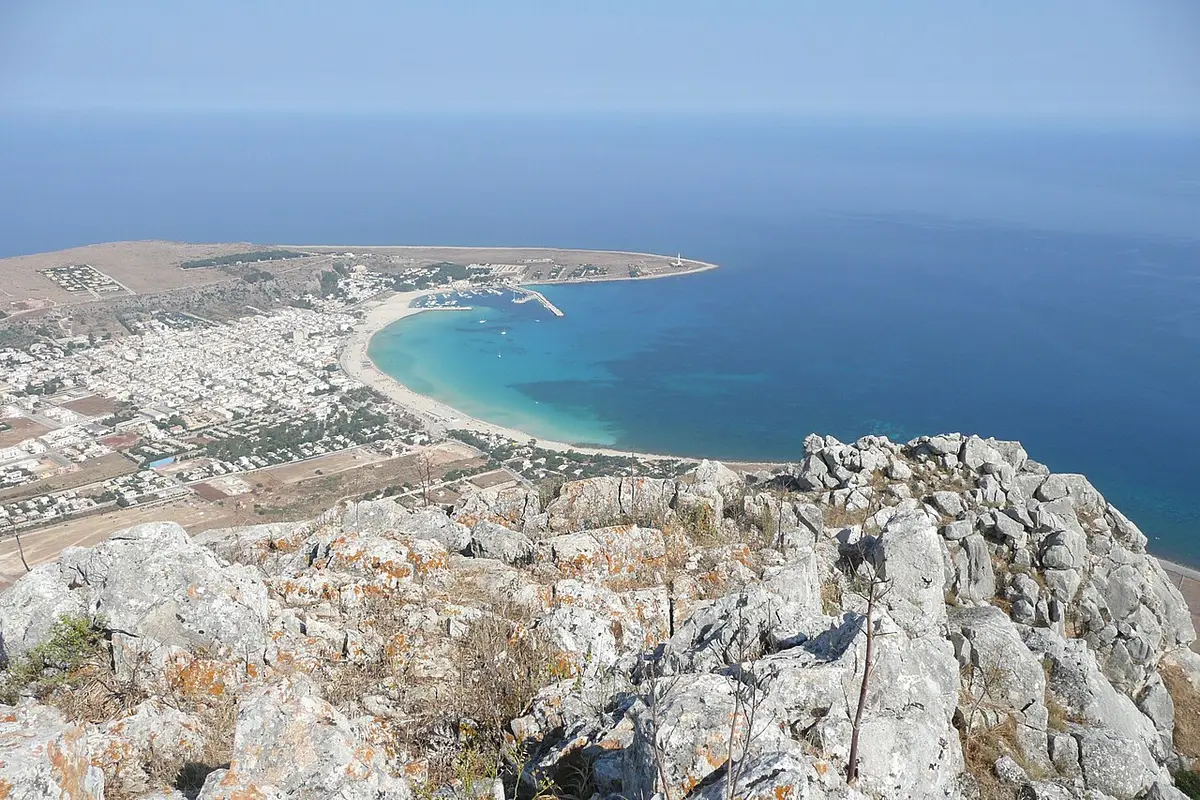
About San Vito Lo Capo
The town grew from the sanctuary, a fourteenth century chapel to San Vito expanded into a fortified pilgrims' lodging in the late fifteenth century. Via Venza, the main street, serves as the town's open-air living room on summer nights. Around the cape stand the lighthouse, the Torre Scieri and Isolidda watchtowers, and the old tonnare of Secco and Cofano.
The comune includes Castelluzzo, with about a thousand people and a long limestone cliff that is one of Europe's best known climbing walls, and Macari, a seaside village on the bay below Monte Cofano. Behind the town spreads the Valle degli Ulivi with centuries-old olive trees. Tourism, farming and fishing are the economy.
Living in San Vito Lo Capo
There are more tourist beds than residents here, which tells you most of what you need to know. From spring to autumn the town is busy, and its events stretch the season to around eight months. In deep winter many restaurants and hotels close and San Vito becomes a small village again. Unusually for western Sicily, the population is growing.
Everyday shops stay open, but for anything bigger people drive to Trapani. On the good side: the beach, the reserve, climbing and a cheerful summer life. On the other: high prices, crowds and traffic in August, a long drive to the cities, and steep, landslide-prone ground around the mountains.
A short history
People lived in the sea caves of the cape in the Palaeolithic, Mesolithic and Neolithic; the Grotta dell'Uzzo is the best known. A small settlement called Conturrana may have stood on a rock near the shore around the fourth century BC.
The cult of San Vito, his nurse Santa Crescenzia and his tutor Modesto drew pilgrims, and the chapel became a fortress as Barbary raids increased. Houses began to appear around it in the early eighteenth century. San Vito remained part of Erice's territory until it became a comune on 17 August 1952; the Roccazzo tower was demolished in 1935 to make way for a military signal station.
Food, festivals and traditions
Couscous is king, cooked with fish in the Trapani way, and since 1998 the last week or so of September has belonged to the Cous Cous Fest, an international festival with a world championship for chefs from countries such as Tunisia, Morocco, Senegal, France and Israel. Busiate with pesto trapanese and the local olive oil are close behind.
The patron, San Vito, is celebrated on 15 June: the afternoon starts with the antenna a mare, a race along a soaped beam over the sea, then the saints arrive by boat at sunset and the statue, covered in ex votos, is carried through town before fireworks. A kite festival lands in May, and summer brings author talks in Via Venza.
Interesting facts about San Vito Lo Capo
- The Cous Cous Fest has been held every September since 1998.
- The cliffs west of town carry around 1,600 bolted climbing routes.
- San Vito became a separate comune only on 17 August 1952, split from Erice.
- On the patron's feast, contestants try to cross a soaped wooden beam over the sea to grab a flag.
House prices in San Vito Lo Capo
€2,250average price per m² to buy
€6.77average rent per m² a month
€225,000a 100 m² home at that price
These are the official averages from the Agenzia delle Entrate's property market observatory (OMI) for homes in normal condition across the town's 5 price zones. Prices in San Vito Lo Capo are above the typical town in Trapani province (€808 per m²) and above the typical Sicilian town (€593 per m²). Detached houses (villini) average about €2,575 per m².
Why these figures can look low: they come from the values on real sales, which sit below advertised asking prices, and the typical Sicilian town is the middle of all 391 comuni, most of them small inland towns. Island-wide averages quoted on property portals, around €1,100 to €1,300 per m², lean towards the cities and the coast, where most homes are listed. Rents work the same way: listings usually ask well above the official rent figure, often double or more.
Houses that need work, which is most of the cheap ones you see advertised, sell well below these figures. The renovation comes on top, so budget for both.
Work out the return on a let with the rental yield calculator, or see the steps from offer to keys in the buying timeline planner.
Getting there and getting around
| From the centre to | By car | Distance |
|---|---|---|
| Trapani Birgi airport (TPS) | 1 hour 17 minutes | 60 km |
| Palermo Falcone Borsellino airport (PMO) | 1 hour 47 minutes | 87 km |
| Catania Fontanarossa airport (CTA) | 4 hours 39 minutes | 316 km |
| Comiso airport (CIY) | 5 hours 28 minutes | 336 km |
| Palermo city centre | 2 hours 6 minutes | 109 km |
| Catania city centre | 4 hours 37 minutes | 317 km |
| Messina, for ferries to the mainland | 4 hours 42 minutes | 334 km |
| Nearest railway station (Castellammare del Golfo) | 1 hour 13 minutes | 47 km |
Times are by road on a clear day, worked out from OpenStreetMap. Allow longer in summer and on market days. Most people living in San Vito Lo Capo rely on a car; buses link the bigger towns but are infrequent on Sundays and in August.
Planning flights and trips? See the Schengen 90/180 calculator if you are from outside the EU.
Everyday life: shops, health and schools
- Hospital with A&E
- Ospedale Sant'Antonio Abate, about 55 minutes by car
- Pharmacies in the comune
- 4
- Supermarkets
- 5
- Schools
- State: 2 nursery schools, 3 primary schools, 1 middle school; plus 1 independent (paritaria)
- Banks and cash machines
- 5
- Cafés and bars
- 17
- Restaurants
- 49
- Full fibre broadband
- 39.6% of addresses
Pharmacies and schools come from the official Ministry of Health and Ministry of Education lists. The other counts are of places mapped in OpenStreetMap inside the comune's boundary, so a small shop or a doctor's surgery can be missing. “Not fully mapped yet” means the volunteer map clearly has gaps here, not that the town has none. For a family doctor (medico di base, what the British call a GP), you register with the local health authority (ASP Trapani) once you are resident.
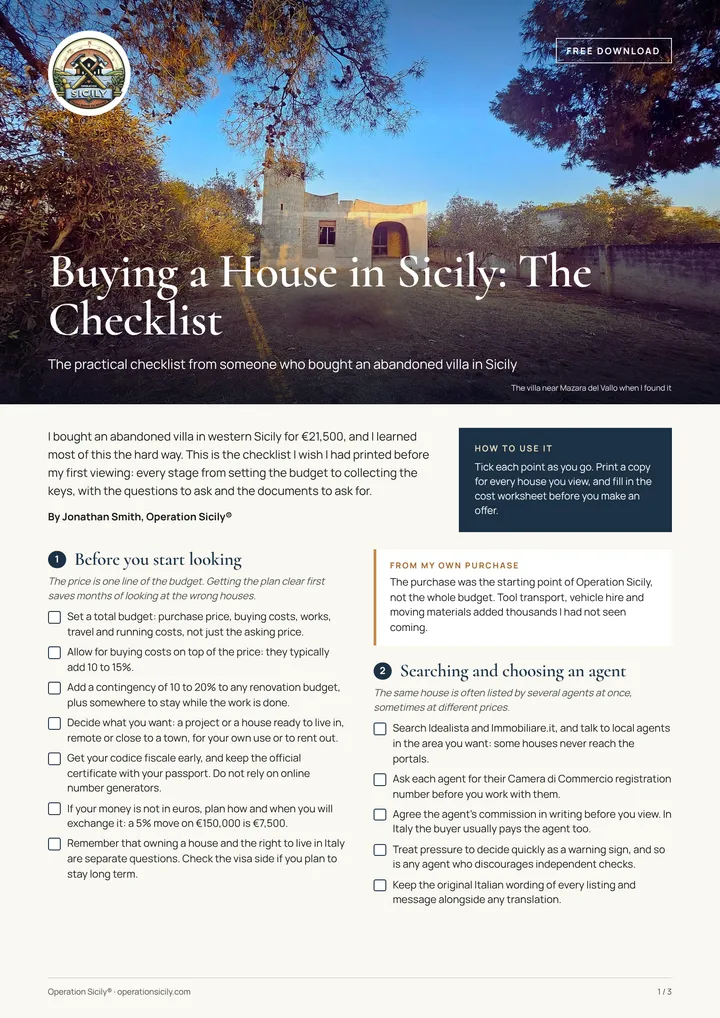
Free download
Buying a house in Sicily? Take my checklist.
Every step from budget to keys, the questions to ask at a viewing and the documents to ask for, as a PDF you can print.
Here is your checklist. Download the checklist (PDF)
Weather and climate in San Vito Lo Capo
31.8°Caverage July high
9.1°Caverage January low
596 mmrain a year, on about 94 days
| Month | Average temperature | Rain |
|---|---|---|
| January | 13°C | 72 mm |
| February | 12°C | 64 mm |
| March | 14°C | 55 mm |
| April | 16°C | 44 mm |
| May | 19°C | 28 mm |
| June | 23°C | 14 mm |
| July | 26°C | 8 mm |
| August | 27°C | 15 mm |
| September | 24°C | 61 mm |
| October | 21°C | 79 mm |
| November | 18°C | 78 mm |
| December | 14°C | 77 mm |
Averages for 2015 to 2024. Winters are mild, though stone houses still feel cold without heating. Summers are hot and dry.
See what each month brings in Sicily month by month, or size a solar system with the off-grid solar calculator.
Who lives there
- Population
- 4,862
- Change since 2019
- +2.4%
- Median age
- 45
- Foreign residents
- 266 (5.5%)
- People from San Vito Lo Capo are called
- sanvitesi
Registered residents from abroad include 3 British, 2 American, 8 German, 4 French, 1 Australian, 1 Canadian, 8 Spanish, 6 Polish, 42 Romanian, 7 Albanian and 2 Ukrainian citizens. Most of the rest come from countries outside Europe and the Americas. Others own holiday homes here without registering as residents.
San Vito Lo Capo is a holiday town, with about 13 tourist beds for every 10 residents. It is busy from June to September and much quieter from November to March, when some hotels, restaurants and beach bars close. Visit in both seasons before you decide.
Beaches in San Vito Lo Capo
San Vito Lo Capo has 9 beaches in our beach guide, and 6 more named beaches and coves mapped along its coast. 100% of its officially monitored bathing waters were rated excellent in the latest EU assessment.
- Bue Marino Beach pebbles, water excellent
- Cala Berretta pebbles
- Cala Capreria pebbles
- Cala dell'Uzzo pebbles
- Cala Marinella rocks
- Cala Tonnarella dell'Uzzo pebbles
- Isulidda Beach rocks and pebbles, water excellent
- Macari Beach sand and pebbles, water excellent
- San Vito Lo Capo Beach fine sand, water excellent
Things to see and do in and around San Vito Lo Capo
Swim from the main beach, then walk or drive to the Zingaro reserve's northern entrance for the coastal path past coves such as Cala Tonnarella dell'Uzzo, where the old tonnara houses a museum of seafaring. Visit the sanctuary and its museum, and the little chapel of Santa Crescenzia outside town.
Climbers have some 1,600 bolted routes on the cliffs west of town, and the October climbing festival draws an international crowd. Macari and the Monte Cofano reserve, Erice and Scopello are close.
- Zingaro Nature Reserve
- San Vito Lo Capo lighthouse
- Bay of Mácari
- Monte Monaco
- Capo San Vito
- Santa Crescenzia
- Sanctuary of San Vito lo Capo
- Museo del Santuario
- Museo dell'Intreccio
- Museo delle Attività Marinare
- Museo della Manna
- Museo della Civiltà Contadina "Pietro Minaudo"
- Museo Naturalistico
Beaches within the comune include Tonnara del Secco, Cala dell'Uzzo, Cala Berretta, Cala Tonnarella dell'Uzzo, Spiaggia Attrezzata per disabili, Cala Grottazza.
Earthquake, landslide and flood risk
San Vito Lo Capo is in seismic zone 2, the second highest of Italy’s four seismic zones. The zone sets the anti-seismic standard for any new building, extension or structural renovation, which affects both the design and the cost. A structural survey is worth paying for before you buy any older building, stone house or flat.
24.8% of the comune's land is mapped by ISPRA as high or very high landslide hazard, where 4.4% of residents live, and no medium-probability flood areas are mapped. Ask for the hazard maps (PAI) for any house you are considering; the comune's technical office or your geometra can check them.
Check what you can build or change with the building permit checker, and keep a margin with the renovation contingency calculator.
The comune: useful details
- Official name
- Comune di San Vito Lo Capo
- Province
- Trapani (Libero consorzio comunale di Trapani)
- Postcode (CAP)
- 91030
- Dialling code
- 0923
- Area
- 60 km²
- Height above sea level
- 6 m
- ISTAT code
- 081020
- Cadastral code
- I407 (used in the codice fiscale of people born here)
- Official website
- comune.sanvitolocapo.tp.it
Registering as a resident, paying local taxes and building permits all go through the comune. If you were born abroad, get your Italian tax code first with the codice fiscale calculator.
Nearby towns
San Vito Lo Capo borders 2 other comuni:
- Castellammare del Golfo €1,251/m²
- Custonaci €910/m²
Towns like San Vito Lo Capo elsewhere in Sicily
- Cefalù (Palermo province)
- Giardini-Naxos (Messina province)
- Taormina (Messina province)
- Capo d'Orlando (Messina province)
- Nizza di Sicilia (Messina province)
- Aci Castello (Catania province)
San Vito Lo Capo on our lists
See every town in Trapani province (25 comuni), or let Find your town suggest places that match what you want.
Frequently asked questions
Where is San Vito Lo Capo in Sicily?
San Vito Lo Capo is in the province of Trapani, about 25 km north-east of Trapani. The centre sits about 6 metres above sea level and its land runs down to the coast.
What is San Vito Lo Capo known for?
The Cous Cous Fest has been held every September since 1998. The cliffs west of town carry around 1,600 bolted climbing routes. San Vito became a separate comune only on 17 August 1952, split from Erice.
Is San Vito Lo Capo a good place to live?
It depends what you want. This is a fine place for beach people, walkers and climbers who love a lively summer and do not mind a quiet, small-town winter at the end of the road. The nearest emergency department is about 55 minutes away, and homes average about €2,250 per m².
How much do houses cost in San Vito Lo Capo?
Official figures from the Agenzia delle Entrate put homes in San Vito Lo Capo at about €2,250 per square metre on average, so a 100 m² home in normal condition would be roughly €225,000. That is above the typical town in the province (€808) and above the typical Sicilian town (€593). Houses needing work sell for less, and the best homes for more.
What is the nearest airport to San Vito Lo Capo?
Trapani Birgi airport is the nearest, about 1 hour 17 minutes away by car (60 km). Palermo Falcone Borsellino is about 1 hour 47 minutes away. Times are for a clear road and will be longer in summer traffic.
What is the weather like in San Vito Lo Capo?
Summers are hot and dry: July afternoons average about 31.8°C. Winter nights in January average about 9.1°C. Rain totals about 596 mm a year, falling mostly between October and March.
How many people live in San Vito Lo Capo?
4,862 people live in the comune of San Vito Lo Capo, according to ISTAT. The population grew by 2.4% between 2019 and 2025. Half the residents are older than 45.
Is there a hospital near San Vito Lo Capo?
The nearest hospital with an emergency department (pronto soccorso) is Ospedale Sant'Antonio Abate, about 55 minutes away by car. In an emergency anywhere in Italy, call 112.
Is San Vito Lo Capo in an earthquake zone?
San Vito Lo Capo is in seismic zone 2, the second highest of Italy’s four seismic zones. New building and structural work anywhere in Italy must follow anti-seismic rules, and the zone sets how strict they are, so ask your geometra or engineer to check any house you plan to buy or renovate.
Does San Vito Lo Capo count for the 7% flat tax for pensioners?
On population, yes: San Vito Lo Capo is a Sicilian town under the 30,000 resident limit for Italy's 7% flat tax for foreign pensioners. The other conditions are about you, not the town. Check the details with our 7% flat tax town checker and a qualified adviser.
Does San Vito Lo Capo have fast internet?
In parts. About 39.6% of addresses in San Vito Lo Capo can get full fibre (FTTH), according to AGCOM. Elsewhere, fibre to the cabinet, fixed wireless or 4G and 5G home broadband fill the gap. Check the exact address before you buy.
Credits
Photo: Filippo Piazza, CC BY-SA 3.0, via Wikimedia Commons.
Figures: ISTAT, Agenzia delle Entrate (OMI), Copernicus ERA5-Land, AGCOM, Dipartimento della Protezione Civile, ISPRA, Ministero della Salute, Ministero dell'Istruzione e del Merito, IndicePA, Open-Meteo, NASA POWER, Wikidata and © OpenStreetMap contributors, with several series gathered by the expatliving-data open data collection. Map boundaries ISTAT via openpolis (CC BY 4.0). Sicily as a whole: 4,787,390 people in 391 comuni.
 The weekly YouTube series