
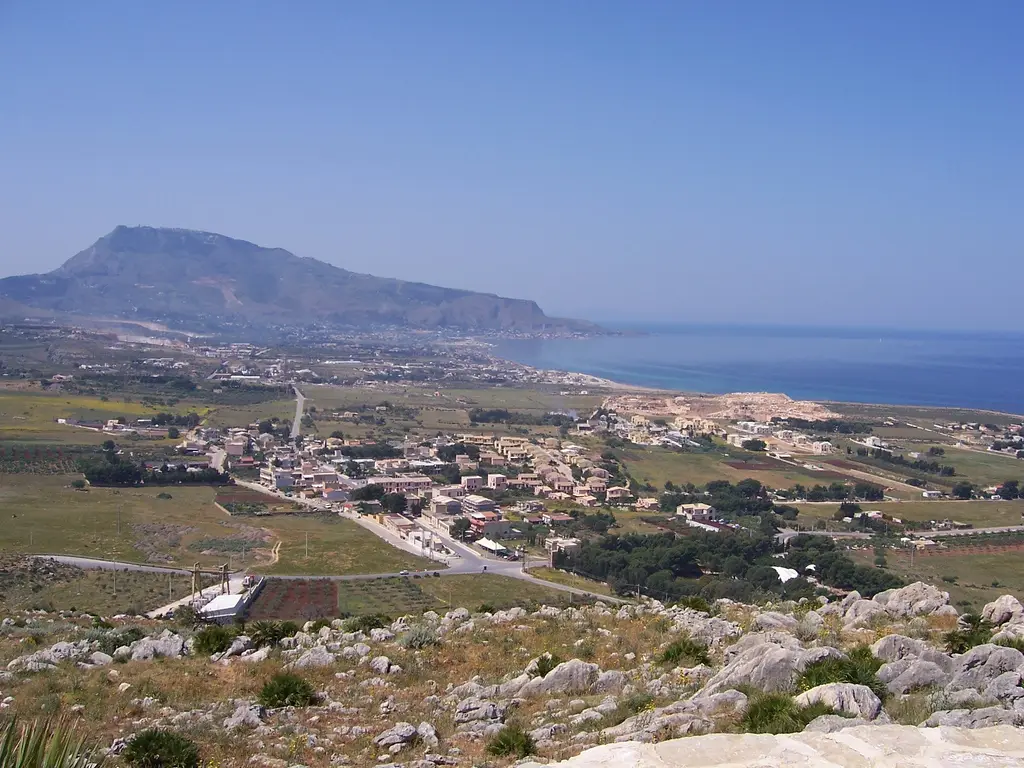
About Custonaci
The marble basin here is often described as the second largest in Europe, with around a hundred active quarries and some fifty processing plants. Its best known stone, Perlato di Sicilia, is a light ivory with flecks of pure calcite, exported widely and much in demand in the Arabian peninsula. Quarrying and stone working remain the backbone of the economy, alongside farming and summer tourism.
The comune is spread across hamlets such as Sperone, Assieni, Purgatorio, Baglio Messina and Scurati, with the seaside village of Cornino on the Tyrrhenian. Part of the territory is in the Monte Cofano nature reserve, and in 2024 Cornino bay was entered in the region's register of fishing villages for its history and its re-enactment of the Madonna's landing. A new open-air art space, the MAC, added sculpture to the town from 2025.
Living in Custonaci
Custonaci lives on stone, not just tourists, so it stays busy outside summer even as Cornino and Macari quieten down. In July and August the coast fills with holiday homes and visitors; the rest of the year the town is local, with a population that is slowly falling but younger than in much of the province. For big shopping and services people use Trapani, with Valderice handy for everyday errands.
On the plus side: sea, mountain walks and a real working community, with prices below the better-known resorts. On the minus side: quarry traffic and dust in parts of the comune, a lot of steep or landslide-prone ground, so survey any plot carefully, and not much nightlife in winter.
A short history
Prehistoric people lived in the caves of Scurati. In 1241 Frederick II granted thirteen uninhabited casali to Monte San Giuliano, today's Erice, and the land as far as Castellammare was shared out as fiefs among Erice's wealthiest families. The area later called the Riviera dei Marmi was organised into estates worked from fortified bagli, among them Baglio Cofano, and a village slowly formed around the sanctuary.
Custonaci was part of Monte San Giuliano until after the Second World War. With its own identity built on marble, it was the first part of the Erice countryside to become an independent comune, on 3 December 1948, followed by Buseto Palizzolo, San Vito Lo Capo and Valderice. In 2016 an Islamic-era fortified granary and two rock monuments nicknamed the Horse of the Sun and the Gate of the Sun were identified on Monte Sparagio.
Food, festivals and traditions
Fish couscous, busiate with pesto trapanese, fresh fish from Cornino and the sweets of the Erice tradition are the local table; the I Sapori del Borgo festival in September is built around sfincia fritters, and the Festa dei Mari at Cornino celebrates the sea. The great feast is that of the Madonna di Custonaci, patroness of the whole Erice area, with a re-enactment of the legendary landing of her painting from a storm-tossed French ship.
Interesting facts about Custonaci
- Custonaci calls itself the international city of marble, with around a hundred working quarries.
- It was the first part of the Erice countryside to become a comune, on 3 December 1948.
- The living nativity in the Grotta Mangiapane has run every Christmas since 1983.
- The Premio Riviera dei Marmi literary prize counted Giuseppe Ungaretti among its 1968 winners.
House prices in Custonaci
€910average price per m² to buy
€3.23average rent per m² a month
€91,000a 100 m² home at that price
These are the official averages from the Agenzia delle Entrate's property market observatory (OMI) for homes in normal condition across the town's 5 price zones. Prices in Custonaci are above the typical town in Trapani province (€808 per m²) and above the typical Sicilian town (€593 per m²). Detached houses (villini) average about €1,375 per m².
Why these figures can look low: they come from the values on real sales, which sit below advertised asking prices, and the typical Sicilian town is the middle of all 391 comuni, most of them small inland towns. Island-wide averages quoted on property portals, around €1,100 to €1,300 per m², lean towards the cities and the coast, where most homes are listed. Rents work the same way: listings usually ask well above the official rent figure, often double or more.
Houses that need work, which is most of the cheap ones you see advertised, sell well below these figures. The renovation comes on top, so budget for both.
Work out the return on a let with the rental yield calculator, or see the steps from offer to keys in the buying timeline planner.
Getting there and getting around
| From the centre to | By car | Distance |
|---|---|---|
| Trapani Birgi airport (TPS) | 47 minutes | 41 km |
| Palermo Falcone Borsellino airport (PMO) | 1 hour 18 minutes | 70 km |
| Catania Fontanarossa airport (CTA) | 4 hours 10 minutes | 299 km |
| Comiso airport (CIY) | 4 hours 59 minutes | 319 km |
| Palermo city centre | 1 hour 38 minutes | 92 km |
| Catania city centre | 4 hours 9 minutes | 299 km |
| Messina, for ferries to the mainland | 4 hours 13 minutes | 316 km |
| Nearest railway station (Trapani) | 24 minutes | 18 km |
Times are by road on a clear day, worked out from OpenStreetMap. Allow longer in summer and on market days. Most people living in Custonaci rely on a car; buses link the bigger towns but are infrequent on Sundays and in August.
Planning flights and trips? See the Schengen 90/180 calculator if you are from outside the EU.
Everyday life: shops, health and schools
- Hospital with A&E
- Ospedale Sant'Antonio Abate, about 24 minutes by car
- Pharmacies in the comune
- 2
- Supermarkets
- 5
- Schools
- State: 1 nursery school, 2 primary schools, 1 middle school
- Banks and cash machines
- Not fully mapped yet
- Cafés and bars
- 12
- Restaurants
- 11
- Full fibre broadband
- 89.9% of addresses
Pharmacies and schools come from the official Ministry of Health and Ministry of Education lists. The other counts are of places mapped in OpenStreetMap inside the comune's boundary, so a small shop or a doctor's surgery can be missing. “Not fully mapped yet” means the volunteer map clearly has gaps here, not that the town has none. For a family doctor (medico di base, what the British call a GP), you register with the local health authority (ASP Trapani) once you are resident.
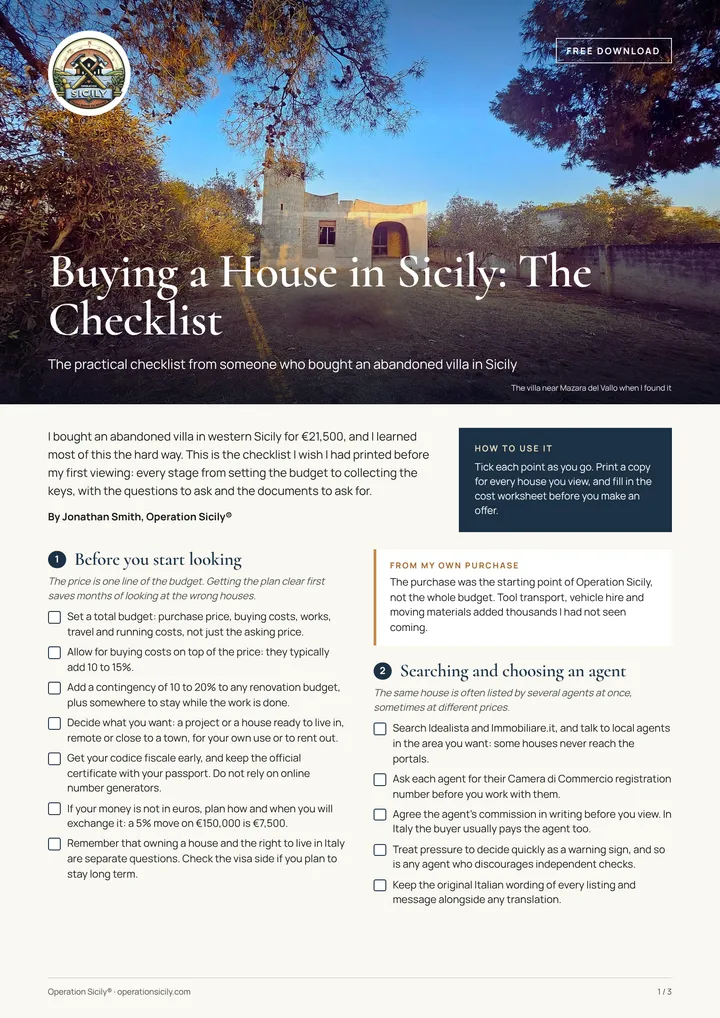
Free download
Buying a house in Sicily? Take my checklist.
Every step from budget to keys, the questions to ask at a viewing and the documents to ask for, as a PDF you can print.
Here is your checklist. Download the checklist (PDF)
Weather and climate in Custonaci
33.7°Caverage July high
8.2°Caverage January low
588 mmrain a year, on about 92 days
73days a year above 30°C
| Month | Average temperature | Rain |
|---|---|---|
| January | 12°C | 71 mm |
| February | 11°C | 64 mm |
| March | 12°C | 55 mm |
| April | 15°C | 44 mm |
| May | 18°C | 28 mm |
| June | 22°C | 14 mm |
| July | 25°C | 8 mm |
| August | 26°C | 15 mm |
| September | 23°C | 61 mm |
| October | 20°C | 78 mm |
| November | 16°C | 77 mm |
| December | 13°C | 76 mm |
Averages for 2015 to 2024. Winters are mild, though stone houses still feel cold without heating. Summers are very hot, so shade, thick walls and air conditioning matter.
See what each month brings in Sicily month by month, or size a solar system with the off-grid solar calculator.
Who lives there
- Population
- 5,260
- Change since 2019
- -3.6%
- Median age
- 44
- Foreign residents
- 217 (4.1%)
- People from Custonaci are called
- custonacioti
Registered residents from abroad include 3 British, 2 American, 1 French, 1 Swedish, 1 Swiss, 1 Polish, 58 Romanian, 1 Albanian and 1 Ukrainian citizens. Most of the rest come from countries outside Europe and the Americas. Others own holiday homes here without registering as residents.
Custonaci sees a fair number of visitors, with about 540 tourist beds, so it is livelier in summer, but it is a working town all year round.
Beaches in Custonaci
Custonaci has one beach in our beach guide, and 2 more named beaches and coves mapped along its coast. 100% of its officially monitored bathing waters were rated excellent in the latest EU assessment.
- Cornino Beach sand and rocks, water excellent
Things to see and do in and around Custonaci
The sanctuary of Maria Santissima di Custonaci, built around 1500 with a fine rose window, holds a fifteenth century panel of the Virgin about to nurse the Child, attributed to the school of Antonello da Messina, crowned by the Vatican Chapter in 1752. The Monte Cofano reserve has a path around the headland past the old tonnara and its tower, with coves for swimming; Macari and Cornino have small beaches and rocky shores.
Each Christmas since 1983 the Grotta Mangiapane at Scurati becomes a living nativity, with villagers reviving old trades in a real cave hamlet, now on Sicily's register of intangible heritage. In August a dawn walk leads to the Islamic granary on Pizzo Monaco. Erice, San Vito Lo Capo and the Zingaro reserve are close.
- Bay of Mácari
- Santuario di Maria Santissima di Custonaci
- Riserva naturale orientata Monte Cofano
- Torre della tonnara di Cofano
- Museo Casa del Pellegrino
Beaches within the comune include Spaggia A' Chianca, Spiaggia Agliareddi.
The quickest beach to reach by car, Spiaggia Seno dell'Arena, is about 24 minutes away.
Earthquake, landslide and flood risk
Custonaci is in seismic zone 2, the second highest of Italy’s four seismic zones. The zone sets the anti-seismic standard for any new building, extension or structural renovation, which affects both the design and the cost. A structural survey is worth paying for before you buy any older building, stone house or flat.
21% of the comune's land is mapped by ISPRA as high or very high landslide hazard, where 2% of residents live, and no medium-probability flood areas are mapped. Ask for the hazard maps (PAI) for any house you are considering; the comune's technical office or your geometra can check them.
Check what you can build or change with the building permit checker, and keep a margin with the renovation contingency calculator.
The comune: useful details
- Official name
- Comune di Custonaci
- Province
- Trapani (Libero consorzio comunale di Trapani)
- Postcode (CAP)
- 91015
- Dialling code
- 0923
- Area
- 71 km²
- Height above sea level
- 186 m
- ISTAT code
- 081007
- Cadastral code
- D234 (used in the codice fiscale of people born here)
- Official website
- comune.custonaci.trapani.it
Registering as a resident, paying local taxes and building permits all go through the comune. If you were born abroad, get your Italian tax code first with the codice fiscale calculator.
Nearby towns
Custonaci borders 4 other comuni:
- Buseto Palizzolo €720/m²
- Castellammare del Golfo €1,251/m²
- San Vito Lo Capo €2,250/m²
- Valderice €956/m²
Towns like Custonaci elsewhere in Sicily
- Santa Lucia del Mela (Messina province)
- Aci Bonaccorsi (Catania province)
- Solarino (Siracusa province)
- Gaggi (Messina province)
- Monforte San Giorgio (Messina province)
- Itala (Messina province)
Custonaci on our lists
See every town in Trapani province (25 comuni), or let Find your town suggest places that match what you want.
Frequently asked questions
Where is Custonaci in Sicily?
Custonaci is in the province of Trapani, about 15 km north-east of Trapani. The centre sits about 186 metres above sea level and its land runs down to the coast.
What is Custonaci known for?
Custonaci calls itself the international city of marble, with around a hundred working quarries. It was the first part of the Erice countryside to become a comune, on 3 December 1948. The living nativity in the Grotta Mangiapane has run every Christmas since 1983.
Is Custonaci a good place to live?
It depends what you want. It suits people who want the clear water of the north-west coast and Monte Cofano's trails without paying San Vito Lo Capo prices or living with its summer crowds. The nearest emergency department is about 24 minutes away, and homes average about €910 per m².
How much do houses cost in Custonaci?
Official figures from the Agenzia delle Entrate put homes in Custonaci at about €910 per square metre on average, so a 100 m² home in normal condition would be roughly €91,000. That is above the typical town in the province (€808) and above the typical Sicilian town (€593). Houses needing work sell for less, and the best homes for more.
What is the nearest airport to Custonaci?
Trapani Birgi airport is the nearest, about 47 minutes away by car (41 km). Palermo Falcone Borsellino is about 1 hour 18 minutes away. Times are for a clear road and will be longer in summer traffic.
What is the weather like in Custonaci?
Summers are very hot: July afternoons average about 33.7°C, with around 73 days a year above 30°C. Winter nights in January average about 8.2°C. Rain totals about 588 mm a year, falling mostly between October and March.
How many people live in Custonaci?
5,260 people live in the comune of Custonaci, according to ISTAT. The population fell by 3.6% between 2019 and 2025. Half the residents are older than 44.
Is there a hospital near Custonaci?
The nearest hospital with an emergency department (pronto soccorso) is Ospedale Sant'Antonio Abate, about 24 minutes away by car. In an emergency anywhere in Italy, call 112.
Is Custonaci in an earthquake zone?
Custonaci is in seismic zone 2, the second highest of Italy’s four seismic zones. New building and structural work anywhere in Italy must follow anti-seismic rules, and the zone sets how strict they are, so ask your geometra or engineer to check any house you plan to buy or renovate.
Does Custonaci count for the 7% flat tax for pensioners?
On population, yes: Custonaci is a Sicilian town under the 30,000 resident limit for Italy's 7% flat tax for foreign pensioners. The other conditions are about you, not the town. Check the details with our 7% flat tax town checker and a qualified adviser.
Does Custonaci have fast internet?
Yes, for most homes: about 89.9% of addresses in Custonaci can get full fibre (FTTH), according to the communications regulator AGCOM. Check the exact address before you buy.
Credits
Photo: iloveagrigento.it, CC BY 2.0, via Wikimedia Commons.
Figures: ISTAT, Agenzia delle Entrate (OMI), Copernicus ERA5-Land, AGCOM, Dipartimento della Protezione Civile, ISPRA, Ministero della Salute, Ministero dell'Istruzione e del Merito, IndicePA, Open-Meteo, NASA POWER, Wikidata and © OpenStreetMap contributors, with several series gathered by the expatliving-data open data collection. Map boundaries ISTAT via openpolis (CC BY 4.0). Sicily as a whole: 4,787,390 people in 391 comuni.
 The weekly YouTube series