
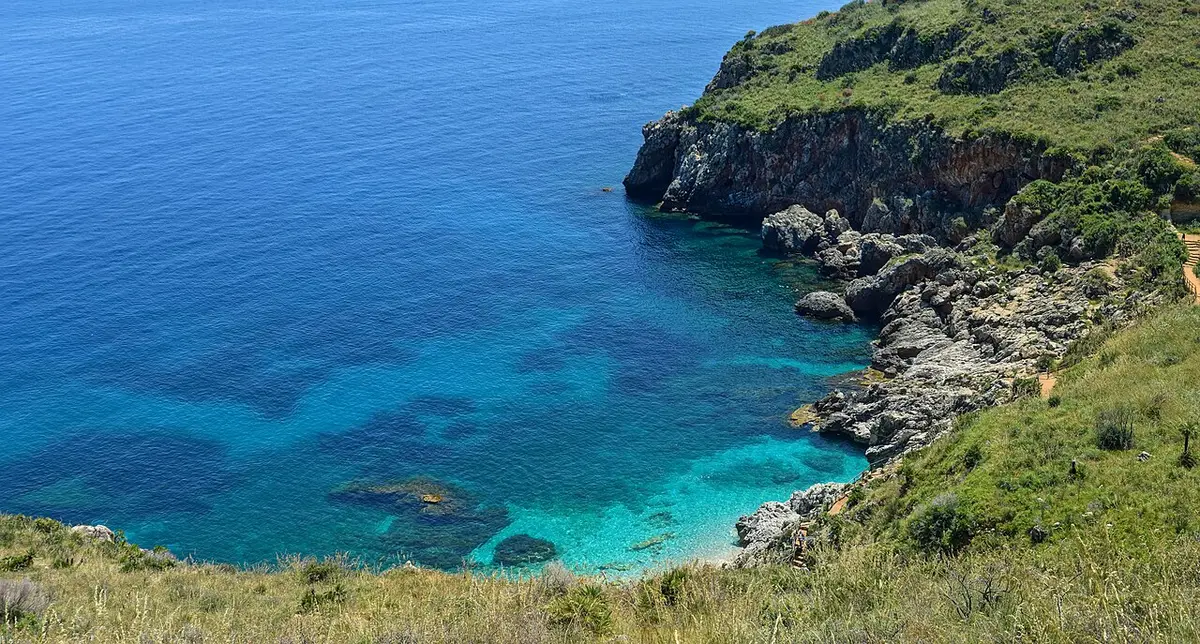
About Cala Capreria
Coming in from the southern gate of the Zingaro, between Scopello and the reserve, Capreria is the first place you can swim. It lies about 1.4 kilometres along the coastal path, and the cove is really two small pebble beaches either side of the headland of Punta Capreria.
The pebbles are white and the water over them a strong blue, with rocks plunging straight in on both sides. The bottom is rocky and the sea deepens quickly. On windy days waves can make it rough, as it faces the open Gulf of Castellammare.
Near the southern entrance is the reserve's natural history museum and visitor centre, worth a look on the way in.
How to get to Cala Capreria
From Castellammare del Golfo take the SS187 towards Trapani and follow signs for Scopello, then through Guidaloca and past the Tonnara di Scopello to the large car park at the reserve's southern entrance.
From the gate, follow the coastal path north. There is a steep stretch, especially tiring in the midday heat, and the final descent to the pebbles needs care.
About 1.4 kilometres along the coastal path from the southern entrance of the Zingaro reserve near Scopello, with a steep stretch and a careful descent.
By car, Cala Capreria is about 1 hour 3 minutes from Palermo Falcone Borsellino airport and 1 hour 14 minutes from Trapani Birgi airport.
Tips for visiting Cala Capreria
- Arrive early, as the cove is small and fills up quickly.
- Bring water shoes and a thick towel; umbrellas are not allowed.
- Look round the natural history museum near the southern gate.
- If Capreria is packed, Cala Mazzo di Sciacca just outside the reserve has a kiosk and is easier to reach.
What is there
- No lidos or sunbed hire; little or no free beach.
- Inside the Riserva naturale orientata dello Zingaro: follow the reserve’s rules on access, fires, dogs and taking sand or shells.
- Toilets or showers mapped within 400 metres.
Facts about Cala Capreria
- Capreria is the first cove reached from the Zingaro's southern entrance, about 1.4 kilometres along the path.
- It is actually two small pebble beaches, one on each side of Punta Capreria.
- The reserve's natural history museum is near the southern gate.
- The Zingaro coastal path is about seven kilometres long and takes around two hours end to end.
San Vito Lo Capo: the town
San Vito Lo Capo is a beach town of about 4,850 people at the tip of the cape that closes the Gulf of Castellammare to the west, with a three-kilometre curve of pale sand under Monte Monaco and the Zingaro reserve on its eastern side. Read our guide to living in San Vito Lo Capo: house prices, the weather month by month, the nearest hospital and airports, history and food.
Beaches near Cala Capreria
- Cala Mazzo di Sciacca Castellammare del Golfo, 1 km, rocks and pebbles
- Cala Berretta San Vito Lo Capo, 2 km, pebbles
- Cala Marinella San Vito Lo Capo, 2 km, rocks
- Cala dell'Uzzo San Vito Lo Capo, 3 km, pebbles
- Cala Tonnarella dell'Uzzo San Vito Lo Capo, 4 km, pebbles
- Guidaloca Beach Castellammare del Golfo, 5 km, pebbles
- Macari Beach San Vito Lo Capo, 8 km, sand and pebbles
- Bue Marino Beach San Vito Lo Capo, 8 km, pebbles
Frequently asked questions
Is Cala Capreria good for families?
It is the easiest Zingaro cove to reach from the Scopello side, so it suits families who can manage a walk of about 1.4 kilometres each way. Bear in mind the steep stretch, the lack of shade and the pebbly, quickly deepening water.
Is Cala Capreria sandy?
No. Both little beaches are white pebbles, and the seabed is rocky. Water shoes help a lot, and you will want a thick towel or mat.
Where do you park for Cala Capreria?
At the large car park by the southern entrance of the Zingaro reserve, beyond Scopello and the Tonnara. From there you buy your ticket and walk north along the coastal path.
Featured in
Credits
Photo: The Cosmonaut, CC BY-SA 4.0, via Wikimedia Commons.
Written from 5 or more independent sources and checked. Figures: bathing water quality from the European Environment Agency (EU Bathing Water Directive), drive times and facilities from © OpenStreetMap contributors, map boundaries ISTAT via openpolis (CC BY 4.0).
Before you go: the latest sampling results and any bathing bans are on the Ministry of Health's Portale Acque, and local notices on the comune of San Vito Lo Capo's website.
 The weekly YouTube series