
About Marsala
The old town is entered through Porta Garibaldi and Porta Nuova. At its heart stands the Chiesa Madre of San Tommaso di Canterbury, of Norman origin and rebuilt as a cathedral in the seventeenth century, with an organ of 4,317 pipes. The former Benedictine monastery of San Pietro now houses the library, a civic museum with a Garibaldi section, and study centres for Phoenician, Punic and Roman history; the Carmine convent is an art gallery, and the Museo degli Arazzi holds Flemish wall hangings.
On the cape, the Baglio Anselmi archaeological museum shows the Punic ship of Marsala, raised from the sea, and finds from Lilybaeum, whose excavated quarter lies alongside. The wine bagli line the shore south of the centre. North, the Stagnone reserve shelters the island of Mozia among salt pans and shallow water, one of Europe's favourite kitesurfing lagoons. Until 1980 Marsala also included Petrosino.
Living in Marsala
Marsala is a working city first, so life does not stop when summer ends: schools, markets, offices and the fish market keep it busy all year, while the coast and lagoon fill with visitors in summer. The population is slowly falling but large, and there is a sizeable Romanian community. With Trapani airport nearby and the services of a large town, few people need to go elsewhere.
The pluses: a beautiful centre, sea on two sides, wine culture and prices moderate for the coast. The minuses: a very spread-out comune where a car is essential outside the centre, summer wind and heat, and some unplanned building along the contrade.
A short history
In 397 BC Dionysius I of Syracuse destroyed the Phoenician island city of Motya; survivors moved to the cape and built Lilybaeum, the city that looks towards Libya. Its walls, up to ten metres high, held off Pyrrhus of Epirus in 278 BC, the one city he could not take in Sicily. Rome gained it after the First Punic War in 241 BC and made it a leading Mediterranean port; Cicero, quaestor here in 76 and 75 BC, called it splendidissima urbs.
The Arabs called it Marsa Ali or Marsa Allah, the port of Ali or of God, the source of the modern name. In 1773 the English merchant John Woodhouse began shipping the local wine to England, and Ingham, Whitaker and later Florio built great wine houses on the shore. On 11 May 1860 Garibaldi and the Thousand landed here, beginning the campaign that united Italy.
Food, festivals and traditions
Marsala wine, from dry vergine to sweet, is in every kitchen and many desserts. Fish is excellent: the fish market near the port, couscous, busiate and the salt of the Stagnone pans.
Holy Week is the great event: on Maundy Thursday hundreds of townspeople in costume re-enact the Passion through the streets, a tradition that draws visitors from across Sicily.
Interesting facts about Marsala
- John Woodhouse began shipping Marsala wine to England in 1773.
- Garibaldi's Thousand landed at Marsala on 11 May 1860.
- Lilybaeum was the only city Pyrrhus failed to take during his Sicilian campaign.
- The cathedral is dedicated to Saint Thomas of Canterbury, and its organ has 4,317 pipes.
House prices in Marsala
€936average price per m² to buy
€3.51average rent per m² a month
€94,000a 100 m² home at that price
These are the official averages from the Agenzia delle Entrate's property market observatory (OMI) for homes in normal condition across the town's 7 price zones. Prices in Marsala are above the typical town in Trapani province (€808 per m²) and above the typical Sicilian town (€593 per m²). Detached houses (villini) average about €1,265 per m².
Why these figures can look low: they come from the values on real sales, which sit below advertised asking prices, and the typical Sicilian town is the middle of all 391 comuni, most of them small inland towns. Island-wide averages quoted on property portals, around €1,100 to €1,300 per m², lean towards the cities and the coast, where most homes are listed. Rents work the same way: listings usually ask well above the official rent figure, often double or more.
Houses that need work, which is most of the cheap ones you see advertised, sell well below these figures. The renovation comes on top, so budget for both.
Work out the return on a let with the rental yield calculator, or see the steps from offer to keys in the buying timeline planner.
Getting there and getting around
| From the centre to | By car | Distance |
|---|---|---|
| Trapani Birgi airport (TPS) | 34 minutes | 19 km |
| Palermo Falcone Borsellino airport (PMO) | 1 hour 36 minutes | 103 km |
| Catania Fontanarossa airport (CTA) | 4 hours 28 minutes | 332 km |
| Comiso airport (CIY) | 4 hours 47 minutes | 253 km |
| Palermo city centre | 1 hour 56 minutes | 125 km |
| Catania city centre | 4 hours 27 minutes | 333 km |
| Messina, for ferries to the mainland | 4 hours 31 minutes | 350 km |
| Nearest motorway or main road junction (SS115 Marsala, Trapani) | 18 minutes | 14 km |
| Nearest railway station (Marsala) | 3 minutes | 2 km |
Times are by road on a clear day, worked out from OpenStreetMap. Allow longer in rush hour and in summer. Marsala has its own city buses, and coaches and trains link it to the rest of Sicily, though a car makes the countryside and smaller towns much easier to reach.
Planning flights and trips? See the Schengen 90/180 calculator if you are from outside the EU.
Everyday life: shops, health and schools
- Hospital with A&E
- Ospedale Paolo Borsellino, about 10 minutes by car
- Pharmacies in the comune
- 23
- Supermarkets
- 28
- Schools
- State: 40 nursery schools, 32 primary schools, 7 middle schools, 10 secondary schools; plus 9 independent (paritaria)
- Banks and cash machines
- 12
- Cafés and bars
- 47
- Restaurants
- 55
- Full fibre broadband
- 53.1% of addresses
Pharmacies and schools come from the official Ministry of Health and Ministry of Education lists. The other counts are of places mapped in OpenStreetMap inside the comune's boundary, so a small shop or a doctor's surgery can be missing. “Not fully mapped yet” means the volunteer map clearly has gaps here, not that the town has none. For a family doctor (medico di base, what the British call a GP), you register with the local health authority (ASP Trapani) once you are resident.
Free download
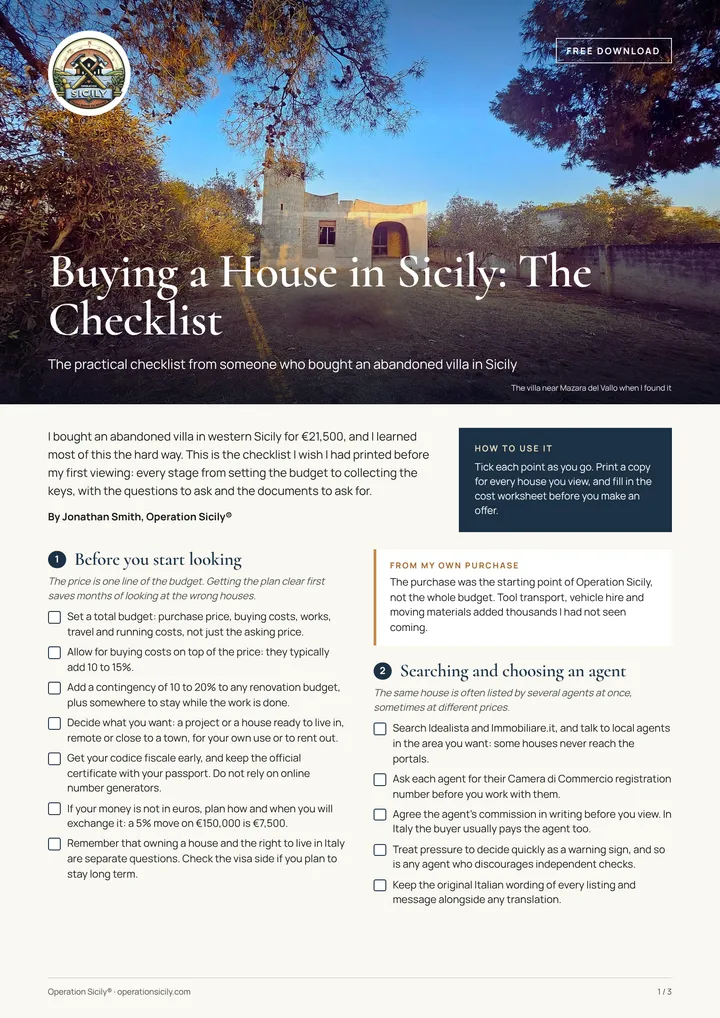
Buying a house in Sicily? Take my checklist.
Every step from budget to keys, the questions to ask at a viewing and the documents to ask for, as a PDF you can print.
Here is your checklist. Download the checklist (PDF)
Weather and climate in Marsala
31.2°Caverage July high
10.3°Caverage January low
570 mmrain a year, on about 83 days
48days a year above 30°C
| Month | Average temperature | Rain |
|---|---|---|
| January | 13°C | 69 mm |
| February | 12°C | 62 mm |
| March | 14°C | 53 mm |
| April | 16°C | 42 mm |
| May | 19°C | 27 mm |
| June | 23°C | 14 mm |
| July | 26°C | 8 mm |
| August | 27°C | 14 mm |
| September | 24°C | 59 mm |
| October | 21°C | 75 mm |
| November | 18°C | 74 mm |
| December | 14°C | 73 mm |
Averages for 2015 to 2024. Winters are mild, though stone houses still feel cold without heating. Summers are hot and dry.
See what each month brings in Sicily month by month, or size a solar system with the off-grid solar calculator.
Who lives there
- Population
- 79,571
- Change since 2019
- -1.9%
- Median age
- 45
- Foreign residents
- 4,598 (5.8%)
- People from Marsala are called
- marsalesi
Registered residents from abroad include 13 British, 5 American, 37 German, 3 Dutch, 34 French, 5 Belgian, 2 Irish, 2 Canadian, 4 Swiss, 21 Spanish, 36 Polish, 1,012 Romanian, 5 Albanian and 32 Ukrainian citizens. Most of the rest come from countries outside Europe and the Americas. Others own holiday homes here without registering as residents.
Marsala is a working town first, busy all year round, with about 2,606 tourist beds. Visitors add to the summer crowds without changing the way the place lives.
Beaches in Marsala
Marsala has 2 beaches in our beach guide. 100% of its officially monitored bathing waters were rated excellent in the latest EU assessment.
- Lido Signorino Beach fine sand, water excellent
- San Teodoro Beach fine sand, water excellent
Things to see and do in and around Marsala
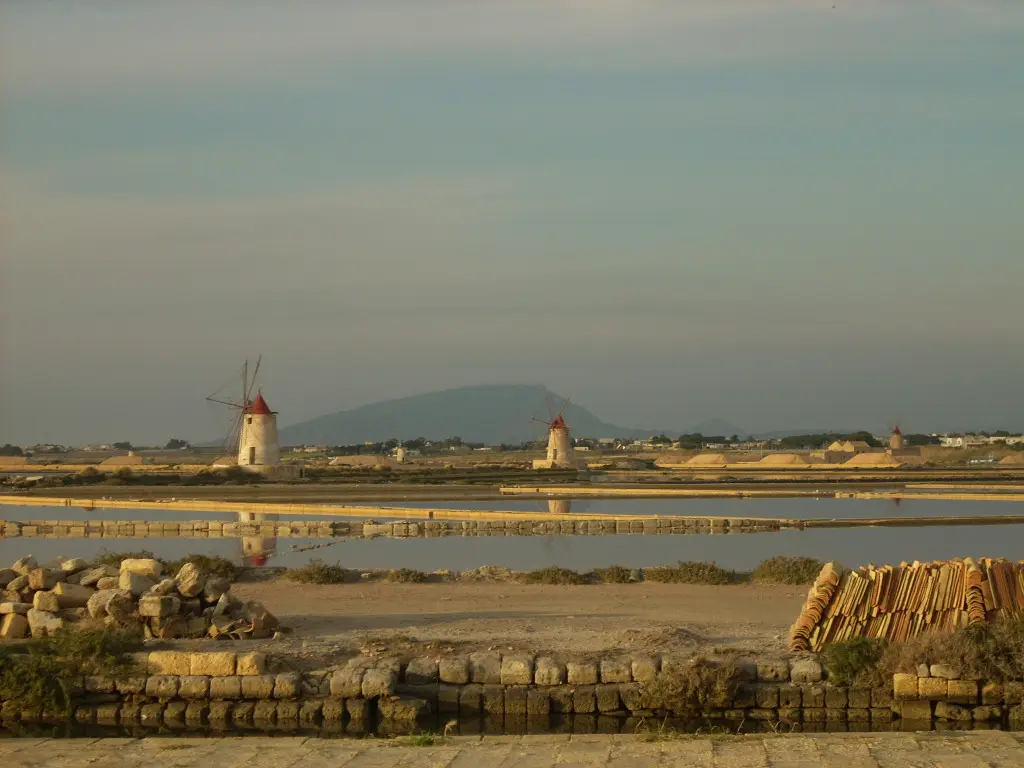
Walk the centre at dusk, from Porta Garibaldi to the cathedral. See the Punic ship at Baglio Anselmi and the Lilybaeum excavations, then take a tasting at one of the historic cellars. At the Stagnone, cross by boat to Mozia, where the Whitaker museum holds the marble Youth of Motya, and stay for sunset over the salt pans and windmills.
The southern beaches run on towards Petrosino, and San Teodoro sits at the north end of the lagoon. Ferries and hydrofoils run to the Egadi Islands, and Trapani, Erice, Mazara and Selinunte are close.
- Mozia
- Lilibaeum
- Riserva naturale regionale delle Isole dello Stagnone di Marsala
- Marsala Cathedral
- Museo Archeologico Giuseppe Whitaker
- Baglio Anselmi museum
- Villa Cavallotti
- Stagnone Lagoon
- Porta Garibaldi
- Convento del Carmine
- Museo degli Arazzi
- Marsala lighthouse
- Complesso monumentale di San Pietro
- Chiesa delle Anime del Purgatorio Santi Sebastiano e Fabiano
Beaches within the comune include San Teodoro.
Famous people born in Marsala include Alborosie (Italian-Jamaican musician, singer, record producer and beatmaker); Pasquale Marino (Italian football manager).
Earthquake, landslide and flood risk
Marsala is in seismic zone 2, the second highest of Italy’s four seismic zones. The zone sets the anti-seismic standard for any new building, extension or structural renovation, which affects both the design and the cost. A structural survey is worth paying for before you buy any older building, stone house or flat.
0.2% of the comune's land is mapped by ISPRA as high or very high landslide hazard, where 1.2% of residents live, and 0.9% of the land could flood in a medium-probability flood (0.6% of residents). Ask for the hazard maps (PAI) for any house you are considering; the comune's technical office or your geometra can check them.
Check what you can build or change with the building permit checker, and keep a margin with the renovation contingency calculator.
The comune: useful details
- Official name
- Comune di Marsala
- Province
- Trapani (Libero consorzio comunale di Trapani)
- Postcode (CAP)
- 91025
- Dialling code
- 0923
- Area
- 243 km²
- Height above sea level
- 3 m
- ISTAT code
- 081011
- Cadastral code
- E974 (used in the codice fiscale of people born here)
- Official website
- comune.marsala.tp.it
Registering as a resident, paying local taxes and building permits all go through the comune. If you were born abroad, get your Italian tax code first with the codice fiscale calculator.
Nearby towns
Marsala borders 5 other comuni:
- Mazara del Vallo €780/m²
- Misiliscemi €710/m²
- Petrosino €825/m²
- Salemi €568/m²
- Trapani €946/m²
Towns like Marsala elsewhere in Sicily
- Bagheria (Palermo province)
- Gela (Caltanissetta province)
- Messina (Messina province)
- Sciacca (Agrigento province)
- Siracusa (Siracusa province)
- Termini Imerese (Palermo province)
Marsala on our lists
- Towns within an hour of Trapani airport
- The towns with the mildest winters
- The biggest towns in Sicily
- The best places to live in Sicily
- Where British people live in Sicily
- Cheap seaside towns within an hour of an airport
- The best towns in Sicily for expats
- The best seaside towns in Sicily
See every town in Trapani province (25 comuni), or let Find your town suggest places that match what you want.
Frequently asked questions
Where is Marsala in Sicily?
Marsala is in the province of Trapani, about 25 km south of Trapani. The centre sits about 3 metres above sea level and its land runs down to the coast.
What is Marsala known for?
John Woodhouse began shipping Marsala wine to England in 1773. Garibaldi's Thousand landed at Marsala on 11 May 1860. Lilybaeum was the only city Pyrrhus failed to take during his Sicilian campaign.
Is Marsala a good place to live?
It depends what you want. It suits anyone who wants a real city with year-round life by the sea, at a manageable size and with Trapani airport close by. The nearest emergency department is about 10 minutes away, and homes average about €936 per m².
How much do houses cost in Marsala?
Official figures from the Agenzia delle Entrate put homes in Marsala at about €936 per square metre on average, so a 100 m² home in normal condition would be roughly €94,000. That is above the typical town in the province (€808) and above the typical Sicilian town (€593). Houses needing work sell for less, and the best homes for more.
What is the nearest airport to Marsala?
Trapani Birgi airport is the nearest, about 34 minutes away by car (19 km). Palermo Falcone Borsellino is about 1 hour 36 minutes away. Times are for a clear road and will be longer in summer traffic.
What is the weather like in Marsala?
Summers are hot and dry: July afternoons average about 31.2°C, with around 48 days a year above 30°C. Winter nights in January average about 10.3°C. Rain totals about 570 mm a year, falling mostly between October and March.
How many people live in Marsala?
79,571 people live in the comune of Marsala, according to ISTAT. The population fell by 1.9% between 2019 and 2025. Half the residents are older than 45.
Is there a hospital near Marsala?
The nearest hospital with an emergency department (pronto soccorso) is Ospedale Paolo Borsellino, about 10 minutes away by car. In an emergency anywhere in Italy, call 112.
Is Marsala in an earthquake zone?
Marsala is in seismic zone 2, the second highest of Italy’s four seismic zones. New building and structural work anywhere in Italy must follow anti-seismic rules, and the zone sets how strict they are, so ask your geometra or engineer to check any house you plan to buy or renovate.
Does Marsala count for the 7% flat tax for pensioners?
No. On the population figure used for the limit, about 79,521 residents, Marsala is over the 30,000 limit for Italy's 7% flat tax for foreign pensioners. Many smaller towns nearby do qualify. Check the details with our 7% flat tax town checker and a qualified adviser.
Does Marsala have fast internet?
Yes, for most homes: about 53.1% of addresses in Marsala can get full fibre (FTTH), according to the communications regulator AGCOM. Check the exact address before you buy.
Is Marsala good for kitesurfing?
Yes. The shallow, sheltered water of the Stagnone lagoon, with steady winds, makes it one of the best known kitesurfing spots in Europe, with several schools around the lagoon in summer.
Credits
Photo: Rapidash95 at Italian Wikipedia, Public domain, via Wikimedia Commons.
Figures: ISTAT, Agenzia delle Entrate (OMI), Copernicus ERA5-Land, AGCOM, Dipartimento della Protezione Civile, ISPRA, Ministero della Salute, Ministero dell'Istruzione e del Merito, IndicePA, Open-Meteo, NASA POWER, Wikidata and © OpenStreetMap contributors, with several series gathered by the expatliving-data open data collection. Map boundaries ISTAT via openpolis (CC BY 4.0). Sicily as a whole: 4,787,390 people in 391 comuni.
 The weekly YouTube series