
About Siracusa
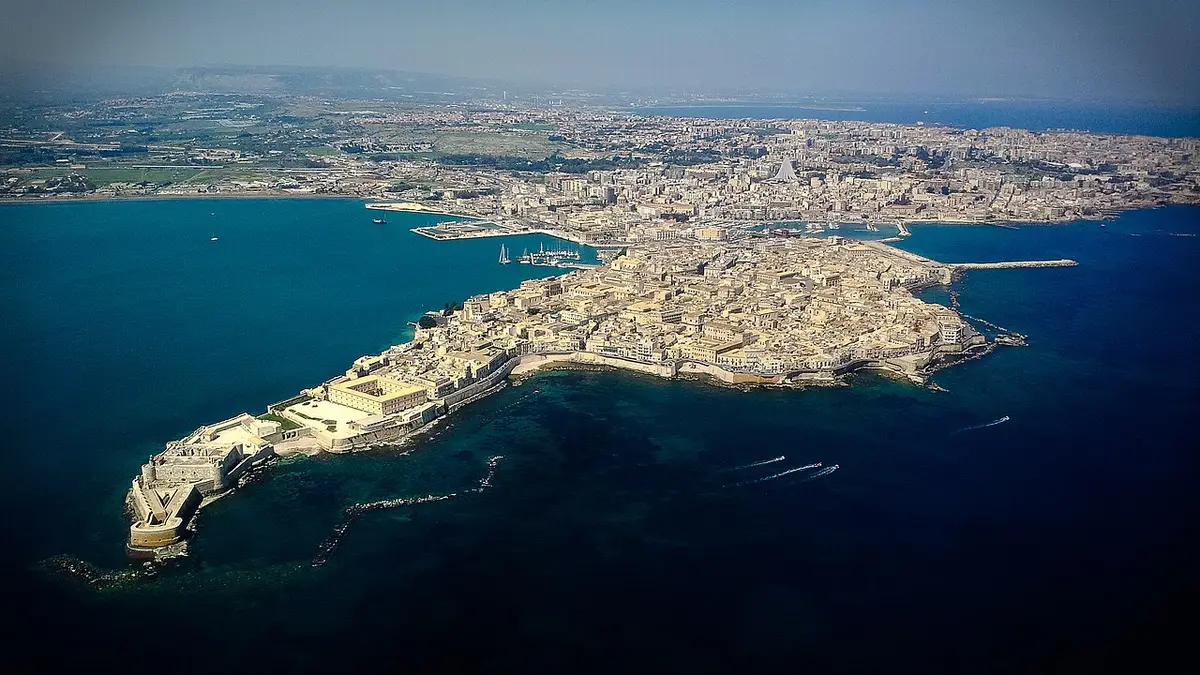
Ortigia is joined to the mainland by bridges. At its centre, Piazza Duomo is one of the finest squares in Italy, and the cathedral is literally built into a Doric temple of Athena, whose columns you can see in the walls. Nearby are the papyrus-fringed Fountain of Arethusa, the ruins of the Temple of Apollo, the oldest Doric temple in Sicily dedicated to that god, the Castello Maniace on the point, the Palazzo Bellomo regional gallery, and the old Jewish quarter of the Giudecca with its Byzantine-era miqweh, often described as the largest and oldest Jewish ritual bath in Europe.
On the mainland the Neapolis archaeological park holds the Greek theatre, the Roman amphitheatre, the Altar of Hieron and the Ear of Dionysius, the cave given its name by Caravaggio during his stay here. The Paolo Orsi museum is one of the great archaeological museums of Europe, and the Euryalus castle, built by Dionysius I, stands at Belvedere on the plateau above. The city's buildings are of soft Iblei limestone, the pietra giuggiulena, which gives Siracusa its pale gold colour.
The comune is large, with the frazioni of Belvedere and Cassibile, and a string of seaside districts to the south such as Plemmirio, Arenella, Ognina and Fontane Bianche. The economy mixes public administration, tourism, farming and the petrochemical district to the north; Siracusa is the leading lemon-growing area in Italy, with the Limone di Siracusa protected by PGI.
Living in Siracusa
Siracusa is a real city, with a university presence, courts, a large port, railway and coach links, and every kind of shop and service; Catania, with its airport and bigger shopping, is up the motorway. Ortigia is very popular with visitors and buyers, so the island centre is busy and expensive for much of the year, with many homes let to tourists. The mainland quarters are where most residents live, and they stay much the same through the seasons. The population is slowly declining.
Everyday life has real pleasures: the morning market on Ortigia, the evening walk along the seafront, swimming off the rocks below the old town and long summer evenings at the beaches south of the city. Many residents prefer the coastal districts such as Fontane Bianche or the hills of Belvedere for more space.
On the downside, traffic and parking are hard work, Ortigia is crowded in August and has limited access for cars, some outer districts are drab, and the petrochemical coast to the north is not a pleasant sight. The whole area is in Italy's highest earthquake zone, so look carefully at older buildings.
A short history
People lived around the bay long before the Greeks, but Siracusa begins in 733 BC, by Thucydides' reckoning, when Corinthian colonists led by Archias landed on Ortigia and drove out the Sicels. The colony grew fast and became one of the largest cities of the classical world, ruled by tyrants such as Gelon, Hieron and Dionysius. In 413 BC it destroyed the great Athenian expedition sent against it. Archimedes, born here, organised the defence when Rome besieged the city, and died when it fell in 212 BC.
Under Rome and Byzantium it remained the leading city of Sicily. Saint Lucy was martyred here, and the emperor Constans II made Siracusa his capital from 663 to 668. Its fall to the Arabs in 878 ended its primacy, which passed to Palermo. Under the Normans it became a county, and under Spanish rule Ortigia was turned into a fortress.
The earthquake of 1693 led to the baroque rebuilding that shapes Ortigia today. In 1943 the armistice between Italy and the Allies was signed at Cassibile, in the comune's territory. The petrochemical district rose to the north after the war, the Madonna delle Lacrime sanctuary was inaugurated by Pope John Paul II in 1994, and in 2005 Siracusa and the necropolis of Pantalica became a UNESCO World Heritage Site.
Food, festivals and traditions
Siracusa has been arguing about food for a long time: Mithaecus, who lived here in the fifth century BC, wrote what is considered the first cookery book of the Western world. Today the table is all about the sea, with fish, sea urchins and pasta with anchovies and toasted breadcrumbs, and about the land: Siracusa lemons, new potatoes, Monti Iblei olive oil, Nero d'Avola and the sweet Moscato di Siracusa.
The patron, Saint Lucy, is celebrated from 13 December with a procession of her silver statue through the city, which returns to the cathedral a week later for the Ottava. Since 1927 a young woman chosen in Sweden has joined the procession dressed in white, a link behind the city's twinning with Stockholm. A second feast, Santa Lucia delle quaglie, on the first Sunday of May, recalls May 1646, when a dove flew into the church of Santa Lucia and a ship loaded with grain arrived to end a famine.
Interesting facts about Siracusa
- Siracusa was founded by Corinthian colonists in 733 BC, according to Thucydides.
- The cathedral incorporates the columns of a Greek temple of Athena.
- The emperor Constans II made Siracusa the capital of the Byzantine Empire from 663 to 668.
- The armistice between Italy and the Allies in 1943 was signed at Cassibile, within the comune.
- Classical drama has been staged in the Greek theatre by the INDA since its founding in 1914.
House prices in Siracusa
€1,230average price per m² to buy
€5.54average rent per m² a month
€123,000a 100 m² home at that price
These are the official averages from the Agenzia delle Entrate's property market observatory (OMI) for homes in normal condition across the town's 15 price zones. Prices in Siracusa are above the typical town in Siracusa province (€690 per m²) and above the typical Sicilian town (€593 per m²). Detached houses (villini) average about €1,199 per m².
Why these figures can look low: they come from the values on real sales, which sit below advertised asking prices, and the typical Sicilian town is the middle of all 391 comuni, most of them small inland towns. Island-wide averages quoted on property portals, around €1,100 to €1,300 per m², lean towards the cities and the coast, where most homes are listed. Rents work the same way: listings usually ask well above the official rent figure, often double or more.
Houses that need work, which is most of the cheap ones you see advertised, sell well below these figures. The renovation comes on top, so budget for both.
Work out the return on a let with the rental yield calculator, or see the steps from offer to keys in the buying timeline planner.
Getting there and getting around
| From the centre to | By car | Distance |
|---|---|---|
| Catania Fontanarossa airport (CTA) | 53 minutes | 63 km |
| Comiso airport (CIY) | 1 hour 46 minutes | 90 km |
| Palermo Falcone Borsellino airport (PMO) | 3 hours 45 minutes | 290 km |
| Trapani Birgi airport (TPS) | 4 hours 43 minutes | 368 km |
| Palermo city centre | 3 hours 15 minutes | 258 km |
| Catania city centre | 55 minutes | 66 km |
| Messina, for ferries to the mainland | 2 hours | 159 km |
| Nearest motorway or main road junction (Siracusa sud) | 11 minutes | 8 km |
| Nearest railway station (Siracusa) | 2 minutes | 1 km |
Times are by road on a clear day, worked out from OpenStreetMap. Allow longer in rush hour and in summer. Siracusa has its own city buses, and coaches and trains link it to the rest of Sicily, though a car makes the countryside and smaller towns much easier to reach.
Planning flights and trips? See the Schengen 90/180 calculator if you are from outside the EU.
Everyday life: shops, health and schools
- Hospital with A&E
- Ospedale Umberto I, about 3 minutes by car
- Pharmacies in the comune
- 37
- Supermarkets
- 41
- Schools
- State: 43 nursery schools, 31 primary schools, 16 middle schools, 30 secondary schools; plus 31 independent (paritaria)
- Banks and cash machines
- 44
- Cafés and bars
- 232
- Restaurants
- 282
- Full fibre broadband
- 72.8% of addresses
Pharmacies and schools come from the official Ministry of Health and Ministry of Education lists. The other counts are of places mapped in OpenStreetMap inside the comune's boundary, so a small shop or a doctor's surgery can be missing. “Not fully mapped yet” means the volunteer map clearly has gaps here, not that the town has none. For a family doctor (medico di base, what the British call a GP), you register with the local health authority (ASP Siracusa) once you are resident.
Free download
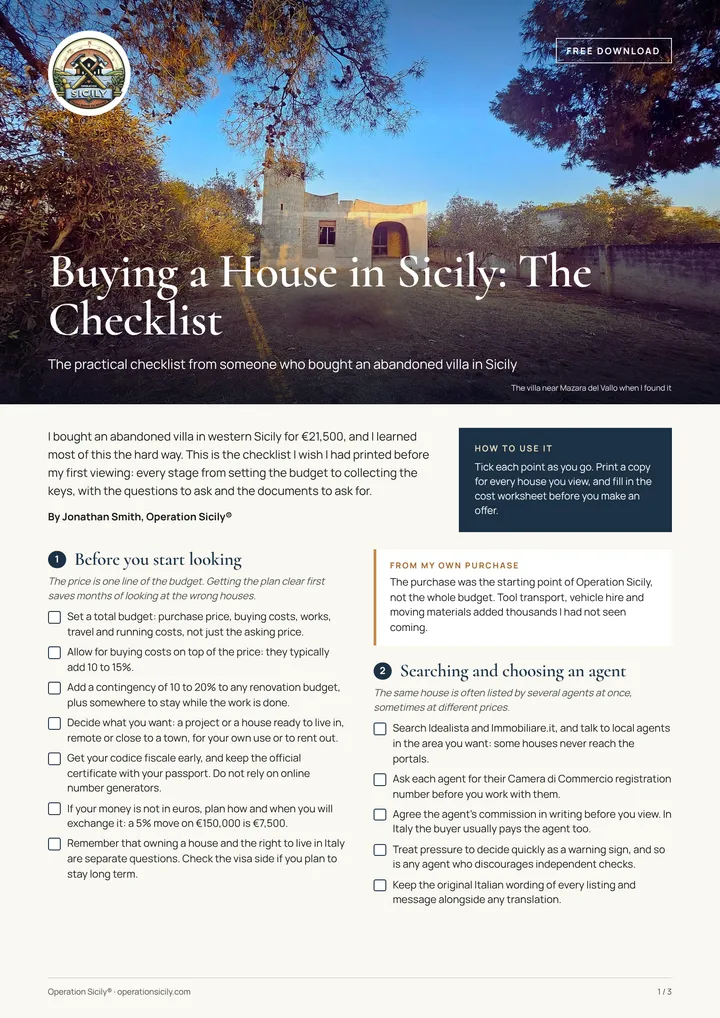
Buying a house in Sicily? Take my checklist.
Every step from budget to keys, the questions to ask at a viewing and the documents to ask for, as a PDF you can print.
Here is your checklist. Download the checklist (PDF)
Weather and climate in Siracusa
34.6°Caverage July high
7.5°Caverage January low
542 mmrain a year, on about 74 days
41days a year above 30°C
| Month | Average temperature | Rain |
|---|---|---|
| January | 11°C | 70 mm |
| February | 11°C | 62 mm |
| March | 13°C | 48 mm |
| April | 16°C | 31 mm |
| May | 20°C | 13 mm |
| June | 26°C | 9 mm |
| July | 29°C | 4 mm |
| August | 29°C | 9 mm |
| September | 25°C | 54 mm |
| October | 21°C | 70 mm |
| November | 17°C | 87 mm |
| December | 13°C | 82 mm |
Averages for 2015 to 2024. Winters are mild, though stone houses still feel cold without heating. Summers are very hot, so shade, thick walls and air conditioning matter.
See what each month brings in Sicily month by month, or size a solar system with the off-grid solar calculator.
Who lives there
- Population
- 115,776
- Change since 2019
- -3.3%
- Median age
- 45
- Foreign residents
- 6,218 (5.4%)
- People from Siracusa are called
- siracusani
Registered residents from abroad include 63 British, 39 American, 47 German, 18 Dutch, 53 French, 21 Belgian, 5 Irish, 2 Australian, 11 Canadian, 6 Swedish, 10 Swiss, 45 Spanish, 280 Polish, 440 Romanian, 46 Albanian and 73 Ukrainian citizens. Most of the rest come from countries outside Europe and the Americas. Others own holiday homes here without registering as residents.
Siracusa is a working city first, busy all year round, with about 10,638 tourist beds. Visitors add to the summer crowds without changing the way the place lives.
Beaches in Siracusa
Siracusa has 6 beaches in our beach guide, and 6 more named beaches and coves mapped along its coast. 100% of its officially monitored bathing waters were rated excellent in the latest EU assessment.
- Arenella Beach fine sand, water excellent
- Cala Rossa, Ortigia pebbles, water excellent
- Fontane Bianche Beach fine sand, water excellent
- Forte Vigliena Swimming Platform rocks, water excellent
- Ognina rocks, water excellent
- Pillirina Beach sand and rocks, water excellent
Things to see and do in and around Siracusa
Give Ortigia time: Piazza Duomo early in the morning, the cathedral, the Fountain of Arethusa at sunset, the Giudecca and the Castello Maniace. Look out for two great paintings: Caravaggio's Burial of Saint Lucy of 1608 and Antonello da Messina's Annunciation of 1474. On the mainland, spend a morning in the Neapolis park and an afternoon in the Paolo Orsi museum, then visit the catacombs of San Giovanni.
Each summer season the Istituto Nazionale del Dramma Antico, founded in 1914, stages Greek tragedies and comedies in the theatre where they were first performed. The Plemmirio marine reserve is good for snorkelling and diving, the beaches of Arenella and Fontane Bianche are close, and Noto, Pantalica, Vendicari and the Anapo valley are easy day trips.
- Ortygia
- Cathedral of Syracuse
- Ear of Dionysius
- Castello Maniace
- Greek Theatre of Syracuse
- Source of Arethusa
- Museo archeologico regionale Paolo Orsi
- Temple of Apollo
- Roman amphitheatre of Syracuse
- Neapolis
- Madonna delle Lacrime Sanctuary
- Temple of Athena
- Palazzo Beneventano del Bosco
- Castello Eurialo
Beaches within the comune include Spiaggia della Pillirina, Arenella, Spiaggia di Fontane Bianche, Spiaggia del Minareto, Spiaggia di Punta Carrozza, Spiaggia Punta del Pero.
Famous people born in Siracusa include Stephen III (pope); Saint Lucy (saint from Italy); Dionysius I of Syracuse (Greek tyrant of Syracuse); Hiero II of Syracuse (3rd-century BC Sicilian Greek ruler); Elio Vittorini (Italian writer and novelist).
Earthquake, landslide and flood risk
Siracusa is in seismic zone 1, the highest of Italy’s four seismic zones. The zone sets the anti-seismic standard for any new building, extension or structural renovation, which affects both the design and the cost. A structural survey is worth paying for before you buy any older building, stone house or flat.
2.4% of the comune's land is mapped by ISPRA as high or very high landslide hazard, where 0.3% of residents live, and 8.6% of the land could flood in a medium-probability flood (6.8% of residents). Ask for the hazard maps (PAI) for any house you are considering; the comune's technical office or your geometra can check them.
Check what you can build or change with the building permit checker, and keep a margin with the renovation contingency calculator.
The comune: useful details
- Official name
- Comune di Siracusa
- Province
- Siracusa (Libero consorzio comunale di Siracusa)
- Postcode (CAP)
- 96100
- Dialling code
- 0931
- Area
- 204 km²
- Height above sea level
- 17 m
- ISTAT code
- 089017
- Cadastral code
- I754 (used in the codice fiscale of people born here)
- Official website
- comune.siracusa.it
Registering as a resident, paying local taxes and building permits all go through the comune. If you were born abroad, get your Italian tax code first with the codice fiscale calculator.
Nearby towns
Siracusa borders 8 other comuni:
- Avola €690/m²
- Canicattini Bagni €723/m²
- Floridia €809/m²
- Melilli €798/m²
- Noto €868/m²
- Palazzolo Acreide €769/m²
- Priolo Gargallo €678/m²
- Solarino €657/m²
Towns like Siracusa elsewhere in Sicily
- Catania (Catania province)
- Milazzo (Messina province)
- Marsala (Trapani province)
- Messina (Messina province)
- Trapani (Trapani province)
- Bagheria (Palermo province)
Siracusa on our lists
- Towns within an hour of Catania airport
- The biggest towns in Sicily
- The best places to live in Sicily
- Where British people live in Sicily
- Cheap seaside towns within an hour of an airport
- The best towns in Sicily for expats
- The best seaside towns in Sicily
See every town in Siracusa province (21 comuni), or let Find your town suggest places that match what you want.
Frequently asked questions
Where is Siracusa in Sicily?
Siracusa is in the province of Siracusa, 206 km south-east of Palermo. The centre sits about 17 metres above sea level and its land runs down to the coast.
What is Siracusa known for?
Siracusa was founded by Corinthian colonists in 733 BC, according to Thucydides. The cathedral incorporates the columns of a Greek temple of Athena. The emperor Constans II made Siracusa the capital of the Byzantine Empire from 663 to 668.
Is Siracusa a good place to live?
It depends what you want. Anyone who wants proper city life by the sea, with culture, good food, schools and services, and is happy to trade some calm for an endlessly interesting place. The nearest emergency department is about 3 minutes away, and homes average about €1,230 per m².
How much do houses cost in Siracusa?
Official figures from the Agenzia delle Entrate put homes in Siracusa at about €1,230 per square metre on average, so a 100 m² home in normal condition would be roughly €123,000. That is above the typical town in the province (€690) and above the typical Sicilian town (€593). Houses needing work sell for less, and the best homes for more.
What is the nearest airport to Siracusa?
Catania Fontanarossa airport is the nearest, about 53 minutes away by car (63 km). Comiso is about 1 hour 46 minutes away. Times are for a clear road and will be longer in summer traffic.
What is the weather like in Siracusa?
Summers are very hot: July afternoons average about 34.6°C, with around 41 days a year above 30°C. Winter nights in January average about 7.5°C. Rain totals about 542 mm a year, falling mostly between October and March.
How many people live in Siracusa?
115,776 people live in the comune of Siracusa, according to ISTAT. The population fell by 3.3% between 2019 and 2025. Half the residents are older than 45.
Is there a hospital near Siracusa?
The nearest hospital with an emergency department (pronto soccorso) is Ospedale Umberto I, about 3 minutes away by car. In an emergency anywhere in Italy, call 112.
Is Siracusa in an earthquake zone?
Siracusa is in seismic zone 1, the highest of Italy’s four seismic zones. New building and structural work anywhere in Italy must follow anti-seismic rules, and the zone sets how strict they are, so ask your geometra or engineer to check any house you plan to buy or renovate.
Does Siracusa count for the 7% flat tax for pensioners?
No. On the population figure used for the limit, about 115,515 residents, Siracusa is over the 30,000 limit for Italy's 7% flat tax for foreign pensioners. Many smaller towns nearby do qualify. Check the details with our 7% flat tax town checker and a qualified adviser.
Does Siracusa have fast internet?
Yes, for most homes: about 72.8% of addresses in Siracusa can get full fibre (FTTH), according to the communications regulator AGCOM. Check the exact address before you buy.
Is it better to live on Ortigia or the mainland in Siracusa?
Ortigia is beautiful and walkable but busy with visitors, tight on parking and in high demand. The mainland has more space, easier parking and lower costs, and the coastal districts to the south put the beaches on your doorstep. Many people rent in both before deciding.
Credits
Photo: Agostino Artnoir Sella, CC BY-SA 2.0, via Wikimedia Commons.
Figures: ISTAT, Agenzia delle Entrate (OMI), Copernicus ERA5-Land, AGCOM, Dipartimento della Protezione Civile, ISPRA, Ministero della Salute, Ministero dell'Istruzione e del Merito, IndicePA, Open-Meteo, NASA POWER, Wikidata and © OpenStreetMap contributors, with several series gathered by the expatliving-data open data collection. Map boundaries ISTAT via openpolis (CC BY 4.0). Sicily as a whole: 4,787,390 people in 391 comuni.
 The weekly YouTube series