
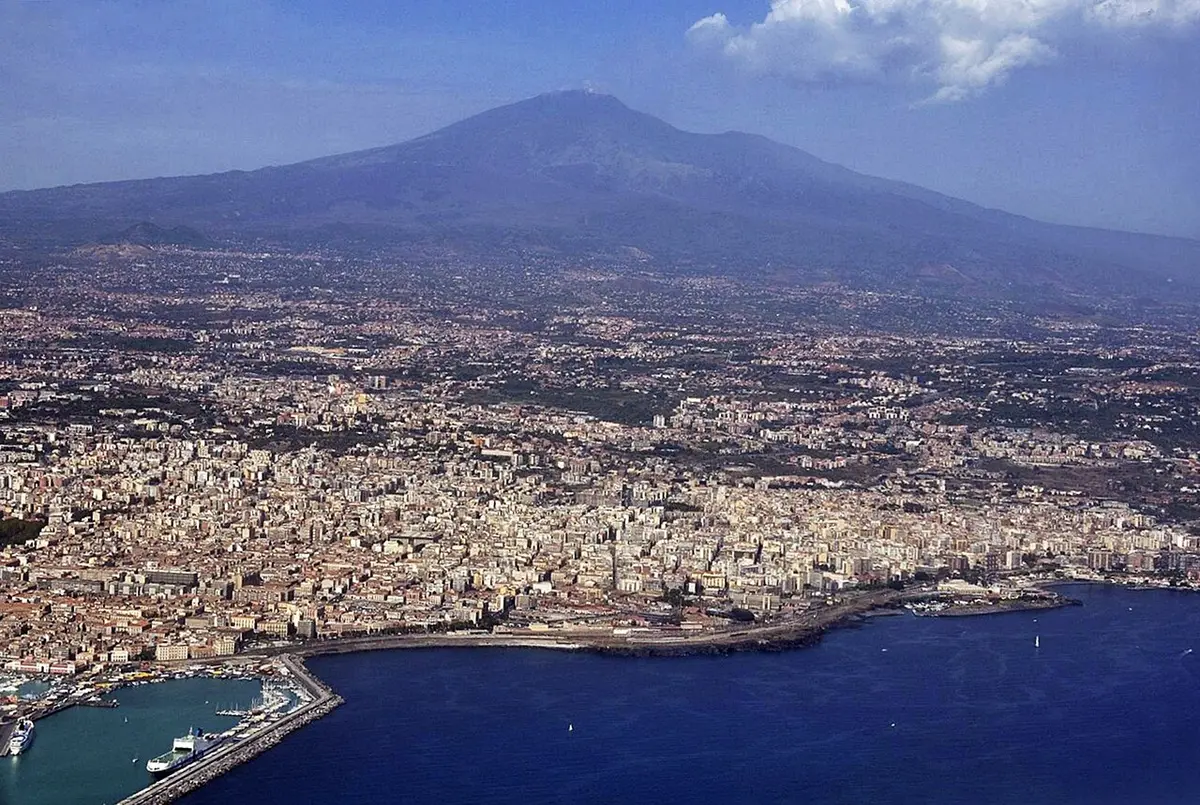
About Catania
Life in the centre turns on Piazza del Duomo, where the cathedral of Sant'Agata faces the Palazzo degli Elefanti and the city's symbol, u Liotru, a lava stone elephant carrying an obelisk, assembled into a fountain by Giovanni Battista Vaccarini in 1736. From here Via Etnea runs straight for about 3 km to the Tondo Gioeni, framed by the volcano, past Piazza Università, the Collegiata and the Villa Bellini gardens.
The city is a patchwork of quarters. Via dei Crociferi packs four churches into about 200 metres and is often called the finest street of eighteenth century Catania. The old fishing village of Ognina keeps its little harbour, Porto Ulisse, and the 2016 Best LibertyCity award recognised the city's wealth of Art Nouveau buildings.
Living in Catania
Catania is the commercial and logistical centre of eastern Sicily. The University of Catania, founded in 1434, has more than 56,000 students, and STMicroelectronics and the high tech offices of the Etna Valley sit alongside chemical, pharmaceutical and farming businesses. The metro is being extended towards the airport and Misterbianco.
About one resident in twenty is a foreign citizen, Romanians most of all. Evenings centre on Piazza Duomo, Piazza Università and Piazza Bellini, and the drinks kiosks, a city institution since 1896, serve seltz al limone e sale. The pros: every service, constant cultural life, beaches and Etna close by. The cons: traffic, noise and long, hot summers.
A short history
Greek settlers from Naxos founded Katane in 729 or 728 BC. Hieron I of Siracusa renamed it Aitna in 476 BC, and under Rome it became an Augustan colony with a theatre, an odeon and an amphitheatre. The Arabs called it Madinat al Fil, the City of the Elephant, after the lava statue that still stands in the main square.
The Normans took Catania in 1071, Frederick II built the Castello Ursino, and under the Aragonese kings it was capital of the kingdom. The lava of 1669 wrapped around the castle and pushed the shoreline about 800 metres out to sea, and the earthquake of January 1693 levelled the city. It was rebuilt with broad straight streets planned by the Duke of Camastra and baroque churches and palaces by Vaccarini and others.
The composer Vincenzo Bellini was born here in 1801 and the novelist Giovanni Verga in 1840. In the 1960s rapid growth earned Catania the nickname Milano del Sud.
Food, festivals and traditions
La Pescheria, the fish market beside Piazza del Duomo, and the Fera 'o Luni in Piazza Carlo Alberto are loud, colourful and part of everyday life. Street food is serious here: arancini shaped like little cones of Etna, cipollina, crispelle with ricotta or anchovies and horse meat grilled at the roadside arrusti e mancia stalls.
Pasta alla Norma, with fried aubergine, tomato and ricotta salata, takes its name from Bellini's opera. In summer there is granita. For Sant'Agata, from 3 to 5 February, the pastry shops fill with cassatelle and olivette, while the saint's reliquary bust, made in 1376, is carried through the streets.
Interesting facts about Catania
- The University of Catania, founded in 1434 by Alfonso V, is the oldest in Sicily.
- Catania is the only Sicilian city with a metro, opened in 1999.
- The baroque centre joined the UNESCO World Heritage list in 2002 with seven other towns of the Val di Noto.
- Catania to Rome is the busiest domestic air route in Italy.
House prices in Catania
€1,279average price per m² to buy
€4.54average rent per m² a month
€128,000a 100 m² home at that price
These are the official averages from the Agenzia delle Entrate's property market observatory (OMI) for homes in normal condition across the town's 24 price zones. Prices in Catania are above the typical town in Catania province (€665 per m²) and above the typical Sicilian town (€593 per m²). Detached houses (villini) average about €1,594 per m².
Why these figures can look low: they come from the values on real sales, which sit below advertised asking prices, and the typical Sicilian town is the middle of all 391 comuni, most of them small inland towns. Island-wide averages quoted on property portals, around €1,100 to €1,300 per m², lean towards the cities and the coast, where most homes are listed. Rents work the same way: listings usually ask well above the official rent figure, often double or more.
Houses that need work, which is most of the cheap ones you see advertised, sell well below these figures. The renovation comes on top, so budget for both.
Work out the return on a let with the rental yield calculator, or see the steps from offer to keys in the buying timeline planner.
Getting there and getting around
| From the centre to | By car | Distance |
|---|---|---|
| Catania Fontanarossa airport (CTA) | 12 minutes | 7 km |
| Comiso airport (CIY) | 1 hour 39 minutes | 95 km |
| Palermo Falcone Borsellino airport (PMO) | 3 hours 7 minutes | 240 km |
| Trapani Birgi airport (TPS) | 4 hours 5 minutes | 318 km |
| Palermo city centre | 2 hours 38 minutes | 208 km |
| Messina, for ferries to the mainland | 1 hour 18 minutes | 96 km |
| Nearest motorway or main road junction (Mercato Ortofrutticolo) | 6 minutes | 3 km |
| Nearest railway station (Stesicoro) | 5 minutes | 2 km |
Times are by road on a clear day, worked out from OpenStreetMap. Allow longer in rush hour and in summer. Catania has a metro line, city buses and trains along the coast and round Etna, though a car makes the countryside and smaller towns much easier to reach.
Planning flights and trips? See the Schengen 90/180 calculator if you are from outside the EU.
Everyday life: shops, health and schools
- Hospital with A&E
- Ospedale Garibaldi Centro, about 6 minutes by car
- Pharmacies in the comune
- 101
- Supermarkets
- 101
- Schools
- State: 109 nursery schools, 94 primary schools, 41 middle schools, 68 secondary schools; plus 67 independent (paritaria)
- Banks and cash machines
- 88
- Cafés and bars
- 427
- Restaurants
- 354
- Full fibre broadband
- 90.3% of addresses
Pharmacies and schools come from the official Ministry of Health and Ministry of Education lists. The other counts are of places mapped in OpenStreetMap inside the comune's boundary, so a small shop or a doctor's surgery can be missing. “Not fully mapped yet” means the volunteer map clearly has gaps here, not that the town has none. For a family doctor (medico di base, what the British call a GP), you register with the local health authority (ASP Catania) once you are resident.
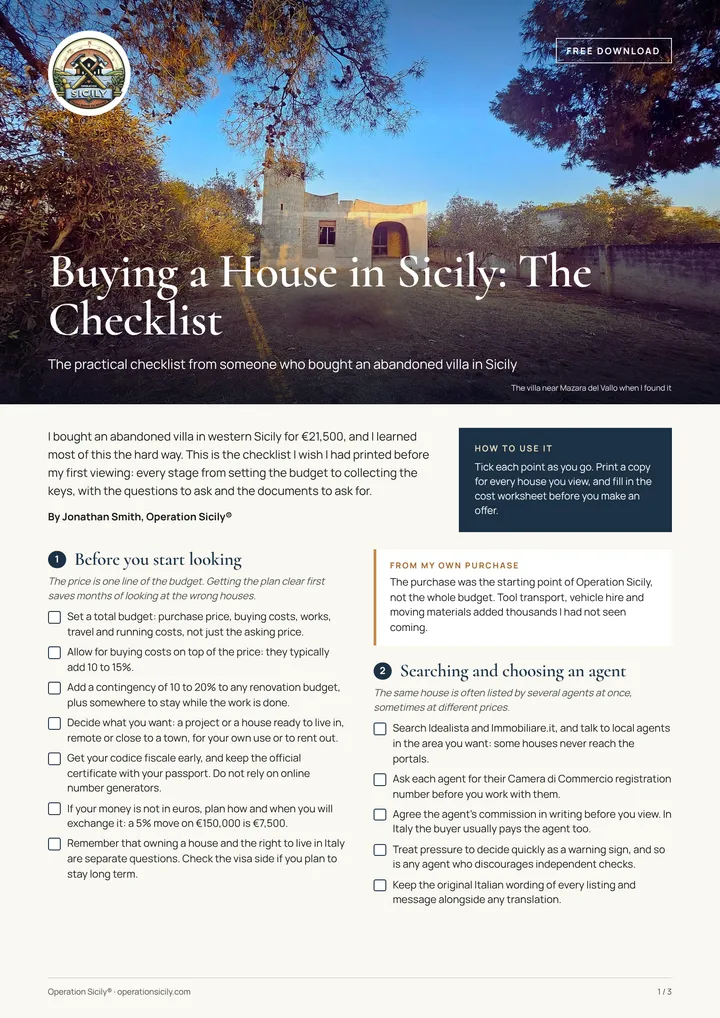
Free download
Buying a house in Sicily? Take my checklist.
Every step from budget to keys, the questions to ask at a viewing and the documents to ask for, as a PDF you can print.
Here is your checklist. Download the checklist (PDF)
Weather and climate in Catania
34.4°Caverage July high
6.5°Caverage January low
565 mmrain a year, on about 79 days
87days a year above 30°C
| Month | Average temperature | Rain |
|---|---|---|
| January | 11°C | 69 mm |
| February | 11°C | 63 mm |
| March | 14°C | 53 mm |
| April | 17°C | 37 mm |
| May | 21°C | 16 mm |
| June | 26°C | 13 mm |
| July | 30°C | 7 mm |
| August | 30°C | 11 mm |
| September | 25°C | 55 mm |
| October | 21°C | 72 mm |
| November | 16°C | 86 mm |
| December | 12°C | 82 mm |
Averages for 2015 to 2024. Winters are cool and damp, and you will want heating for three or four months. Summers are very hot, so shade, thick walls and air conditioning matter.
See what each month brings in Sicily month by month, or size a solar system with the off-grid solar calculator.
Who lives there
- Population
- 298,054
- Change since 2019
- +0.1%
- Median age
- 44
- Foreign residents
- 14,908 (5%)
- People from Catania are called
- catanesi
- Patron saint
- Agatha of Sicily
Registered residents from abroad include 47 British, 69 American, 74 German, 9 Dutch, 88 French, 8 Belgian, 8 Irish, 3 Australian, 5 Canadian, 8 Swedish, 14 Swiss, 76 Spanish, 235 Polish, 1,962 Romanian, 94 Albanian and 271 Ukrainian citizens. Most of the rest come from countries outside Europe and the Americas. Others own holiday homes here without registering as residents.
Catania is a working city first, busy all year round, with about 8,820 tourist beds. Visitors add to the summer crowds without changing the way the place lives.
Beaches in Catania
Catania has 3 beaches in our beach guide, and one more named beach or cove mapped along its coast. 53% of its officially monitored bathing waters were rated excellent in the latest EU assessment.
- La Playa di Catania fine sand, water sufficient
- Oasi del Simeto Beach sand, water excellent
- San Giovanni Li Cuti Beach sand and rocks, water poor
Things to see and do in and around Catania
Start with the cathedral and the Badia di Sant'Agata, then walk to the Roman theatre and Odeon and look down into the amphitheatre in Piazza Stesicoro, about 10 metres below the street. The Monastero dei Benedettini di San Nicolò l'Arena now belongs to the university, and the Castello Ursino houses the civic museum. Bellini's birthplace is a museum, and so is Verga's house.
See an opera at the Teatro Massimo Bellini, opened in 1890. Have an evening drink by the black sand cove of San Giovanni li Cuti, swim from the lidos on the long sands of the Plaja, and look for birds in the Oasi del Simeto reserve near the river mouth.
- Catania Cathedral
- Castello Ursino
- Teatro Massimo Bellini
- Basilica della Collegiata
- Elephant Fountain
- San Benedetto, Catania
- Monastery of San Nicolò l'Arena
- Badia di Sant'Agata
- Roman amphitheatre of Catania
- Palazzo Biscari
- Roman Theatre of Catania
- Piazza del Duomo
- Palazzo degli Elefanti
- San Giuliano
Beaches within the comune include Spiaggia nera di San Giovanni Li Cuti, Spiaggetta Lognina.
Famous people born in Catania include Vincenzo Bellini (Italian opera composer); Agatha of Sicily (Christian saint and martyress); Giovanni Verga (Italian writer); Ettore Majorana (Italian physicist); Pietro Anastasi (Italian association football player).
Earthquake, landslide and flood risk
Catania is in seismic zone 2, the second highest of Italy’s four seismic zones. The zone sets the anti-seismic standard for any new building, extension or structural renovation, which affects both the design and the cost. A structural survey is worth paying for before you buy any older building, stone house or flat.
0.2% of the comune's land is mapped by ISPRA as high or very high landslide hazard, where 0.2% of residents live, and 50.2% of the land could flood in a medium-probability flood (3.3% of residents). Ask for the hazard maps (PAI) for any house you are considering; the comune's technical office or your geometra can check them.
Check what you can build or change with the building permit checker, and keep a margin with the renovation contingency calculator.
The comune: useful details
- Official name
- Comune di Catania
- Province
- Catania (Città metropolitana di Catania)
- Postcode (CAP)
- 95121 to 95131
- Dialling code
- 095
- Area
- 181 km²
- Height above sea level
- 7 m
- ISTAT code
- 087015
- Cadastral code
- C351 (used in the codice fiscale of people born here)
- Official website
- comune.catania.it
Registering as a resident, paying local taxes and building permits all go through the comune. If you were born abroad, get your Italian tax code first with the codice fiscale calculator.
Nearby towns
Catania borders 12 other comuni:
- Aci Castello €1,468/m²
- Belpasso €774/m²
- Carlentini €759/m²
- Gravina di Catania €1,023/m²
- Lentini €628/m²
- Mascalucia €978/m²
- Misterbianco €839/m²
- Motta Sant'Anastasia €779/m²
- San Gregorio di Catania €1,208/m²
- San Pietro Clarenza €795/m²
- Sant'Agata li Battiati €1,115/m²
- Tremestieri Etneo €1,085/m²
Towns like Catania elsewhere in Sicily
- Palermo (Palermo province)
- Siracusa (Siracusa province)
- Messina (Messina province)
- Milazzo (Messina province)
- Marsala (Trapani province)
- Trapani (Trapani province)
Catania on our lists
- Towns within an hour of Catania airport
- The biggest towns in Sicily
- The best places to live in Sicily
- Where British people live in Sicily
- Cheap seaside towns within an hour of an airport
- The best towns in Sicily for expats
- The best seaside towns in Sicily
See every town in Catania province (58 comuni), or let Find your town suggest places that match what you want.
Frequently asked questions
Where is Catania in Sicily?
Catania is in the province of Catania, 166 km south-east of Palermo. The centre sits about 7 metres above sea level and its land runs down to the coast.
What is Catania known for?
The University of Catania, founded in 1434 by Alfonso V, is the oldest in Sicily. Catania is the only Sicilian city with a metro, opened in 1999. The baroque centre joined the UNESCO World Heritage list in 2002 with seven other towns of the Val di Noto.
Is Catania a good place to live?
It depends what you want. People who want a real city with culture, nightlife, students and flights, with Etna and the sea on the same horizon. The nearest emergency department is about 6 minutes away, and homes average about €1,279 per m².
How much do houses cost in Catania?
Official figures from the Agenzia delle Entrate put homes in Catania at about €1,279 per square metre on average, so a 100 m² home in normal condition would be roughly €128,000. That is above the typical town in the province (€665) and above the typical Sicilian town (€593). Houses needing work sell for less, and the best homes for more.
What is the nearest airport to Catania?
Catania Fontanarossa airport is the nearest, about 12 minutes away by car (7 km). Comiso is about 1 hour 39 minutes away. Times are for a clear road and will be longer in summer traffic.
What is the weather like in Catania?
Summers are very hot: July afternoons average about 34.4°C, with around 87 days a year above 30°C. Winter nights in January average about 6.5°C. Rain totals about 565 mm a year, falling mostly between October and March.
How many people live in Catania?
298,054 people live in the comune of Catania, according to ISTAT. The population stayed about the same between 2019 and 2025. Half the residents are older than 44.
Is there a hospital near Catania?
The nearest hospital with an emergency department (pronto soccorso) is Ospedale Garibaldi Centro, about 6 minutes away by car. In an emergency anywhere in Italy, call 112.
Is Catania in an earthquake zone?
Catania is in seismic zone 2, the second highest of Italy’s four seismic zones. New building and structural work anywhere in Italy must follow anti-seismic rules, and the zone sets how strict they are, so ask your geometra or engineer to check any house you plan to buy or renovate.
Does Catania count for the 7% flat tax for pensioners?
No. On the population figure used for the limit, about 296,984 residents, Catania is over the 30,000 limit for Italy's 7% flat tax for foreign pensioners. Many smaller towns nearby do qualify. Check the details with our 7% flat tax town checker and a qualified adviser.
Does Catania have fast internet?
Yes, for most homes: about 90.3% of addresses in Catania can get full fibre (FTTH), according to the communications regulator AGCOM. Check the exact address before you buy.
Credits
Photo: stefan_fotos from Leipzig, Germany, CC BY-SA 2.0, via Wikimedia Commons.
Figures: ISTAT, Agenzia delle Entrate (OMI), Copernicus ERA5-Land, AGCOM, Dipartimento della Protezione Civile, ISPRA, Ministero della Salute, Ministero dell'Istruzione e del Merito, IndicePA, Open-Meteo, NASA POWER, Wikidata and © OpenStreetMap contributors, with several series gathered by the expatliving-data open data collection. Map boundaries ISTAT via openpolis (CC BY 4.0). Sicily as a whole: 4,787,390 people in 391 comuni.
 The weekly YouTube series