
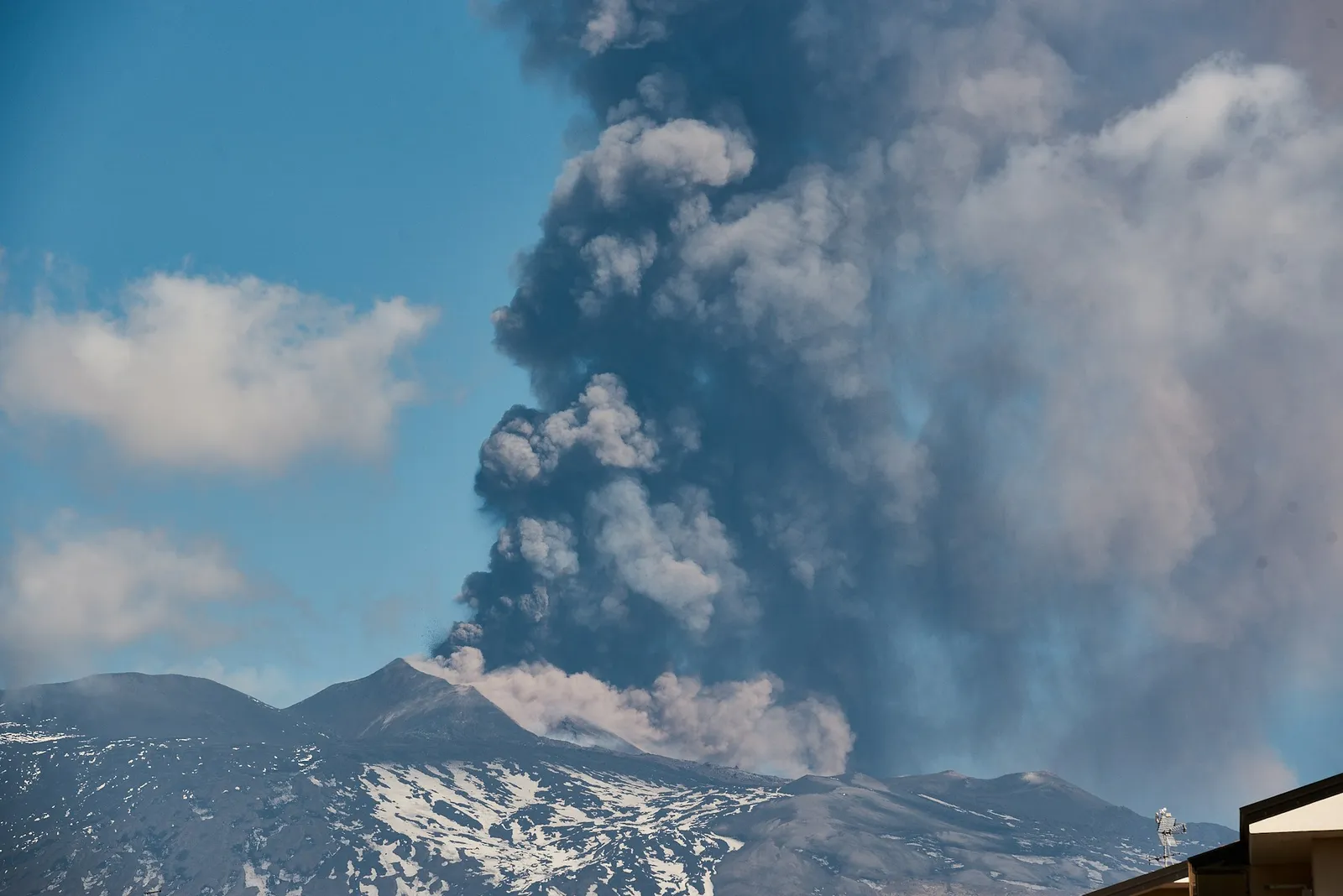
Where to check, in order
- Your airline's app, website or booking. This is the only place that tells you whether your flight is going, delayed, diverted or cancelled, and it is where rebooking and refunds are offered. Make sure the airline has your mobile number and email, because changes are often sent by text or email first.
- Catania airport's official website, aeroporto.catania.it. Its departures and arrivals boards show what is actually landing and taking off, and its news page carries the airport's notices when ash restricts operations. If the English page shows nothing, look at the Italian version too. Every one of those notices ends the same way: check the status of your flight with your airline.
- INGV's Etna Observatory, ct.ingv.it, for what the volcano is doing: its volcanic activity statements and the list of VONA aviation notices with their colour codes. These tell you whether ash is being produced. They do not tell you whether your flight will go.
- Do not cancel your booking yourself, or simply stay away, to be on the safe side. If you cancel, you usually get back only what your fare rules allow, which on many cheap tickets is little or nothing; if you stay away and the flight goes, the ticket is lost. The refund, the new flight and the care described below come when the airline cancels or delays the flight, so wait for its decision, then choose.
You will also find unofficial Etna and flight tracker sites and apps. Some are useful for a quick picture, but they are not official, they can lag or go blank at exactly the moment you need them, and none of them can confirm your flight. Use them for context, never for the decision to set off to the airport or not.
If you are flying from the UK, the Foreign Office's travel advice for Italy gives the same advice for eruptions: check with your travel provider or with Catania airport.
If your flight is cancelled, delayed or diverted
Cancelled
The airline must offer you the choice between a refund and another flight to your destination (at the earliest opportunity, or a later date that suits you). Pick the one that fits your trip; once you choose, you lose the other option. If the next available flight is days away, ask whether the airline can route you through Palermo, Comiso or another airport, or on another carrier.
Delayed
Stay airside if you have already checked in, keep an eye on the airline's app, and do not leave the airport on a hunch that the flight will be cancelled. If the delay reaches five hours and you no longer want to travel, you can choose not to fly and take a refund instead.
Diverted to Palermo, Comiso, Trapani or Lamezia Terme
When Catania cannot take arrivals, flights are often sent to Palermo, Comiso or Trapani, and sometimes across the Strait of Messina to Lamezia Terme in Calabria. If your flight lands somewhere else, the airline still has to get you to Catania. When that airport is far away, as Palermo, Trapani and Lamezia Terme are, the European Commission's guidance treats the diversion like a cancellation, so you can ask to be taken on to Catania at the airline's expense or take a refund instead, and the airline must look after you while you wait. In practice airlines usually lay on coaches. Ask the airline staff at the arrival airport before you make your own arrangements, and if you do have to pay, keep every receipt.
If you end up making your own way back to Catania:
- From Palermo airport, take the Prestia e Comandè airport bus or the Trinacria Express train into Palermo Centrale. SAIS Autolinee coaches to Catania, which also stop at Catania airport, leave from the bus terminal by Palermo Centrale station. Trenitalia also runs trains from Palermo to Catania. Late-evening trains on the airport line, and trains on the Palermo to Catania line, are sometimes replaced by buses during engineering works, so the coach is often the simpler choice. Check times with each operator, because they change. My guide to Sicily without a car has more on the trains and buses from Palermo airport.
- From Comiso, the airport's own bus page lists the coach companies that serve it. Direct public services from Comiso to Catania are limited, so the airline's own coach is usually the better bet.
- From Lamezia Terme, the way back means crossing the Strait of Messina by ferry, so insist on the airline's coach or on being re-routed to Catania by air rather than making your own way.
- During long closures, the Regione Siciliana has in the past added extra coaches and trains between the other airports and Catania, and allowed diverted passengers onto some trains free with their flight ticket. Do not count on it, but look at the airport's and the Region's announcements if you are stuck.
If you have a hire car booked at Catania airport, tell the rental company as soon as you know about a diversion or a long delay. The airline is unlikely to pay for a missed pick-up, though travel insurance may.
One more thing to know: Comiso is covered by the same ash procedure as Catania, so with the wind in the wrong direction it can be affected too. Do not assume a booking into Comiso is a guaranteed way round the problem.
Your rights: EU261, UK261 and why ash usually means no compensation
Flights leaving Catania, or any EU airport, on any airline are covered by EU Regulation 261/2004, as are flights into the EU on an EU airline. Flights leaving the UK on any airline, or arriving in the UK on a UK or EU airline, are covered by the UK version of the same rules, known as UK261. The two work almost the same way.
| Right | Does it apply when the cause is volcanic ash? |
|---|---|
| Fixed compensation (€250 to €600 under EU261, £220 to £520 under UK261, by distance) | Usually no. Ash and the airspace closures it causes count as extraordinary circumstances outside the airline's control. |
| Choice of refund or a new flight if cancelled | Yes |
| Care while you wait: meals and refreshments, a way to make calls or send messages, a hotel and transport to it if you are stuck overnight | Yes. UK261 sets no time or money limit. EU261 sets none either, but once the revised EU rules apply, airlines may cap hotel nights at three when the cause is outside their control, as ash is. |
| Refund if a delay reaches five hours and you decide not to travel | Yes |
The key case is McDonagh v Ryanair (C-12/11), decided by the EU Court of Justice after the Icelandic ash cloud closed much of European airspace. The Court agreed that a volcanic eruption closing airspace is an extraordinary circumstance, which is what frees airlines from fixed compensation, but ruled that the airline still had to provide care for the whole time passengers were stranded, with no limit in time or money. If the airline fails to provide care, you can claim back what you reasonably had to spend yourself.
The EU has since adopted a revision of these rules. Once it applies, an airline will be able to limit hotel accommodation to three nights when the disruption comes from extraordinary circumstances such as ash, though not for people with a disability or reduced mobility, pregnant women, infants, unaccompanied children or anyone needing specific medical help, as long as the airline knows. Until then McDonagh stands, and UK261 is not affected.
Keep receipts and keep it reasonable
If the airline does not hand out meal vouchers or book you a hotel, arrange it yourself and claim it back. Keep every receipt and the airline's cancellation or delay message. The UK Civil Aviation Authority is clear that luxury hotels and alcohol are unlikely to be refunded, so book what a sensible person would.
Claim from the airline first. If it refuses, in the UK you take it to the dispute resolution scheme the airline belongs to or, if it belongs to none, to the CAA; in the EU, to the national enforcement body of the country where the problem happened, which for Italian airports is ENAC.
Three different things: the eruption, the airport, your flight
Headlines tend to blur these together, which is why a dramatic photo of Etna can send people into a panic about a flight that is running perfectly normally. It helps to keep them apart.
| What is happening | What it means for flights | Who decides |
|---|---|---|
| Etna is erupting: lava flows, glowing summit, small puffs of ash | Often nothing. An eruption with no ash in the airspace brings no flight restrictions at all. | INGV, the national volcano institute, reports what the volcano is doing |
| Ash is in the airspace or on the runway | Parts of the airspace around Catania close, the number of arrivals an hour is cut, or the airport closes for a time while ash is cleared | ENAC, the Italian civil aviation authority, with the air traffic service ENAV and the airport operator SAC |
| Your flight | Goes, is delayed, is diverted to another airport or is cancelled | Your airline, and only your airline |
So the question to ask is never just "is Etna erupting?" It is "is there ash where planes fly, and what has my airline done about my flight?"
How the airport decides: ash, sectors and arrivals per hour
Catania has a long-standing procedure for Etna, set out by ENAC in a circular that covers Catania, Comiso and Reggio Calabria airports and the airspace around them. In outline it works like this.
The volcano observatory raises the alarm
The Etna Observatory of INGV (the Osservatorio Etneo, in Catania) watches the volcano round the clock and sends aviation notices called VONA (Volcano Observatory Notice for Aviation). Each carries a colour code used by volcano observatories worldwide: green means normal, yellow means unrest, orange means heightened unrest or an eruption with no or minor ash, and red means an eruption with significant ash in the atmosphere, or one expected imminently. On Etna, yellow (little or no ash beyond the summit) is common and does not restrict flights on its own; orange and red are the codes that matter for flights. The notices go to air traffic control, the airport, ENAC and the Volcanic Ash Advisory Centre in Toulouse, which tracks and forecasts where the ash cloud will go.
Only the sectors under the ash close
The controlled airspace around Catania is divided into sectors. When an eruption puts ash into that airspace, the sectors downwind of the volcano are closed and the rest stays usable. A crisis unit chaired by ENAC's airport directorate for eastern Sicily, with ENAV and the airport, decides which sectors close and whether the airport itself needs limits. The airport then announces it, typically along the lines of "sector closed, arrivals reduced to six an hour".
That is why the result is so often partial rather than a full shutdown: fewer arrivals an hour, some flights held or diverted, and departures sometimes carrying on while arrivals are limited. Which way the wind blows matters as much as how big the eruption looks.
Ash on the runway
The other trigger is ash falling on the airport itself. Ash on the runway and aprons has to be swept and cleaned, and the runway can be closed until that is done. This is when you see the airport stop all arrivals and departures for some hours.
Your airline still makes its own call
Even when the airport is open, each airline decides whether to fly according to its own safety procedures for volcanic ash. Two flights at the same time can end up with different outcomes, which is another reason the airline is the only source that can answer for your flight.
Package holidays and travel insurance
If you booked a package
If your flight and hotel were sold together as a package, the organiser is responsible for every part of it, so they, not you, have to sort out a new flight or alternative arrangements. Under the EU Package Travel Directive and the UK Package Travel Regulations, if unavoidable and extraordinary circumstances (such as an ash closure) mean the organiser cannot get you home as planned, the organiser must pay for necessary accommodation, of an equivalent standard where possible, for up to three nights per traveller, or longer where the air passenger rules give more. That limit does not apply to people with reduced mobility and anyone travelling with them, pregnant women, unaccompanied children or anyone needing specific medical help, as long as the organiser was told at least 48 hours before the holiday began. The airline's own duty to look after you still applies as well. If an eruption at your destination would significantly affect the holiday before it starts, you can cancel the package and get a full refund, though without extra compensation.
Travel insurance
Policies vary a great deal on volcanic ash and travel disruption. Before you book, or as soon as Etna is in the news, read the travel disruption section of your policy: whether ash is covered at all, what it pays for (extra nights, missed connections, unused hotel nights), and whether it matters when you bought the policy. Insurance usually pays for things the airline does not, so claim from the airline first and keep proof of what it did and did not pay.
Already in Sicily: is it safe to be in Catania or Taormina during an eruption?
For visitors on the coast, an eruption is usually a spectacle rather than a danger. The practical nuisance is ash. Italy's national Civil Protection Department says ash fall, even over long periods, is not a serious health risk, but the finest ash can irritate the airways and eyes. Its advice during ash fall:
- stay indoors with the windows shut if you can, or wear a dust mask and, if possible, dust goggles when you go out, especially if you have asthma or another lung or heart condition, and with children and older people;
- if ash gets in your eyes, do not rub them; rinse them with plenty of water;
- drive with extra care on roads covered in ash, and avoid riding scooters and motorbikes;
- wash fruit and vegetables that have ash on them before eating them.
The US Geological Survey and the International Volcanic Health Hazard Network both advise wearing glasses rather than contact lenses in ash, because grains trapped under a lens can scratch the eye. If you wear lenses, pack your glasses for an eastern Sicily trip.
When heavy ash falls, local councils, Catania included, have issued their own temporary orders, such as a 30 km/h speed limit or a ban on scooters, motorbikes and bicycles, so follow what the comune and the police say. The Foreign Office's advice is the same: follow the instructions of the local authorities.
Etna summit tours
Access to the high slopes is controlled, and it changes with the volcano. The mayors of the comuni around the summit, such as Nicolosi on the south side and Linguaglossa on the north, issue ordinances that set where people can go, following the regional Civil Protection's alert procedures; when the alert level rises, whole areas can be closed, and entering them is a criminal offence. Excursions in the summit area are only allowed with licensed alpine or volcanological guides. If you have a tour booked, check with your guide the day before and on the morning itself, and expect it to be moved or shortened at short notice. My eastern Sicily guide covers the routes, the cable car and visiting Etna in calmer times.
How often does this happen?
Etna is Europe's largest active volcano and, in INGV's words, among the most active volcanoes in the world. It is also more explosive than its old reputation for gentle lava flows suggests: the summit eruptions of 1995 to 2001 produced around 150 lava fountains, and those of 2011 to 2015 more than 40, most of them sending up tall columns of gas and ash.
Disruption at Catania tends to come in clusters. When the volcano is in a lively phase, ash can restrict the airport several times over a few weeks, usually for hours at a time but sometimes on and off for several days; then it can go quiet for months. A single busy episode can cancel or divert hundreds of flights, while many eruptions pass without a single flight changing. Nobody can tell you months ahead whether your dates will be affected, which is why the useful thing is to know how to check and what you are owed.
For planning, Catania is still the natural airport for the east of the island and for staying in Catania or Taormina. If your trip has a fixed connection you cannot miss, such as a cruise departure or a wedding, leaving a spare day at the end is the simplest protection.
Frequently asked questions
Does an Etna eruption close Catania airport?
Not usually. Many eruptions have no effect on flights at all. The airport is only affected when ash drifts into the airspace around Catania or falls on the runway, and even then the usual first step is to close the affected airspace sectors and cut the number of arrivals an hour. A full closure happens when ash on the runway has to be cleared or the ash cloud covers the approach.
Where can I check if Catania airport is open?
Check your airline's app or website first, because only the airline can confirm your flight. For the airport as a whole, the official site aeroporto.catania.it has live departures and arrivals boards and posts notices on its news page when ash restricts operations. INGV's Etna Observatory site, ct.ingv.it, tells you what the volcano is doing, not whether your flight will go.
Will I get compensation if my flight is cancelled because of Etna?
Usually not the fixed compensation (€250 to €600 under EU261, £220 to £520 under UK261), because volcanic ash counts as an extraordinary circumstance under both. You are still entitled to a refund or a new flight, and to care while you wait: meals, refreshments and, if you are stuck overnight, a hotel and transport to it. The EU Court of Justice confirmed in McDonagh v Ryanair that this care has no time or money limit. Once the revised EU rules apply, airlines will be able to cap hotel nights at three in cases like this, with exceptions for some passengers; UK261 keeps no limit.
What happens if my Catania flight is diverted to Palermo or Comiso?
The airline still has to get you to Catania, and it usually lays on coaches. If the airport you land at is far from Catania, as Palermo is, you can take a refund instead if you no longer want to travel. Ask the airline staff on arrival before making your own plans. If you do have to pay for a coach or train to Catania, keep the receipts and claim the cost back from the airline.
Is it safe to visit Catania or Taormina while Etna is erupting?
For visitors on the coast, usually yes. The main nuisance is ash. Italy's Civil Protection Department advises staying indoors with windows shut during heavy ash fall, or wearing a dust mask and goggles outside, not rubbing your eyes, driving carefully and avoiding scooters. Wear glasses rather than contact lenses, and follow any instructions from the local authorities.
Can I still go up Etna during an eruption?
Sometimes, but only where the local ordinances allow it. The mayors of the towns around the summit set access limits that follow the regional Civil Protection's alert levels, summit excursions need a licensed guide, and areas can be closed at short notice. Check with your guide the day before and on the day.
Does travel insurance cover Etna ash disruption?
It depends entirely on the policy. Read the travel disruption section to see whether volcanic ash is covered and what it pays for. Claim what the airline owes you from the airline first, and use insurance for the costs the airline does not cover.
Sources and small print
- ENAC, Circular GEN-04C, operations at Catania, Comiso and Reggio Calabria airports during Etna eruptions: enac.gov.it
- INGV Osservatorio Etneo: VONA aviation notices, volcanic activity statements and its page on Etna
- Catania airport (SAC): flight information and news
- European Commission, Your Europe: air passenger rights and package travel
- EU Court of Justice, McDonagh v Ryanair, C-12/11
- European Commission, interpretative guidelines on Regulation 261/2004 (diverted flights are in section 3.2.4)
- Regulation (EU) 2026/2202, the revision of the EU air passenger rules: eur-lex.europa.eu
- UK Civil Aviation Authority: cancellations, delays and what to do if your claim is rejected
- The Package Travel and Linked Travel Arrangements Regulations 2018, regulation 15
- Dipartimento della Protezione Civile, what to do during volcanic ash fall (in Italian)
- US Geological Survey, volcanic ash and the eyes
- Foreign, Commonwealth and Development Office, Italy travel advice
This page explains how the system works; it does not show live airport or volcano status. Passenger rights depend on your route, airline and booking, so check your own case with the airline, the CAA or the relevant national enforcement body.
Credits
Photo: Piermanuele Sberni, Unsplash Licence, via Unsplash.
 The weekly YouTube series