
The honest picture: what works without a car, and what does not
We live near Mazara del Vallo in the far west, and out here a car is simply how life works. I have said as much in my guide to driving in Sicily, and I stand by it for the countryside. But Sicily's big coastal towns are a different story. They are joined by trains and coaches that run all day, and in their old centres a car is more of a burden than a help.
What works well without a car:
- the north coast between Palermo and Cefalù, by regional train in under an hour;
- the east coast between Catania and Taormina, by train or direct coach;
- Catania to Siracusa, and Catania airport to Siracusa or Taormina, by direct coach;
- Palermo to Trapani, and Palermo to Catania, by coach;
- half-day trips by city bus, such as Palermo to Monreale or Mondello;
- the Egadi Islands from Trapani by hydrofoil.
What does not:
- the interior: hill towns inland are often served by a handful of buses a day, timed around school runs, with nothing back in the evening;
- agriturismi and country houses, which are usually kilometres from the nearest stop on unlit roads;
- many of the best beaches, which are coves at the end of a track rather than town beaches by a station;
- Sundays and public holidays, when many coach routes thin out or stop altogether;
- my own corner of the west beyond Trapani, where the towns are spread across open farmland.
So the question is not really whether you can see Sicily without a car. It is where you book, so that the trains and buses come to you.
Where to stay in Sicily without a car: the bases that work
A good car-free base has three things: a station or coach stop you can walk to with a suitcase, enough to see on foot for several days, and frequent connections to at least one good day trip. These five towns, and Trapani in the west, have all three. Whichever you choose, book a place in the centre and check the walk from the station on a map before you pay, because the old centres are cobbled, often hilly and closed to most traffic.
Palermo
The best-connected base on the island: a train from the airport, trains along the north coast, and coaches to Trapani, Agrigento and Catania from the terminal beside the station on Via Tommaso Fazello. From Palermo Centrale it is about a kilometre, 12 to 15 minutes on foot, up Via Maqueda to the Quattro Canti at the heart of the old city, so anywhere between the two is ideal. More on the city itself is in my Palermo and the north guide and the Palermo town page.
Cefalù
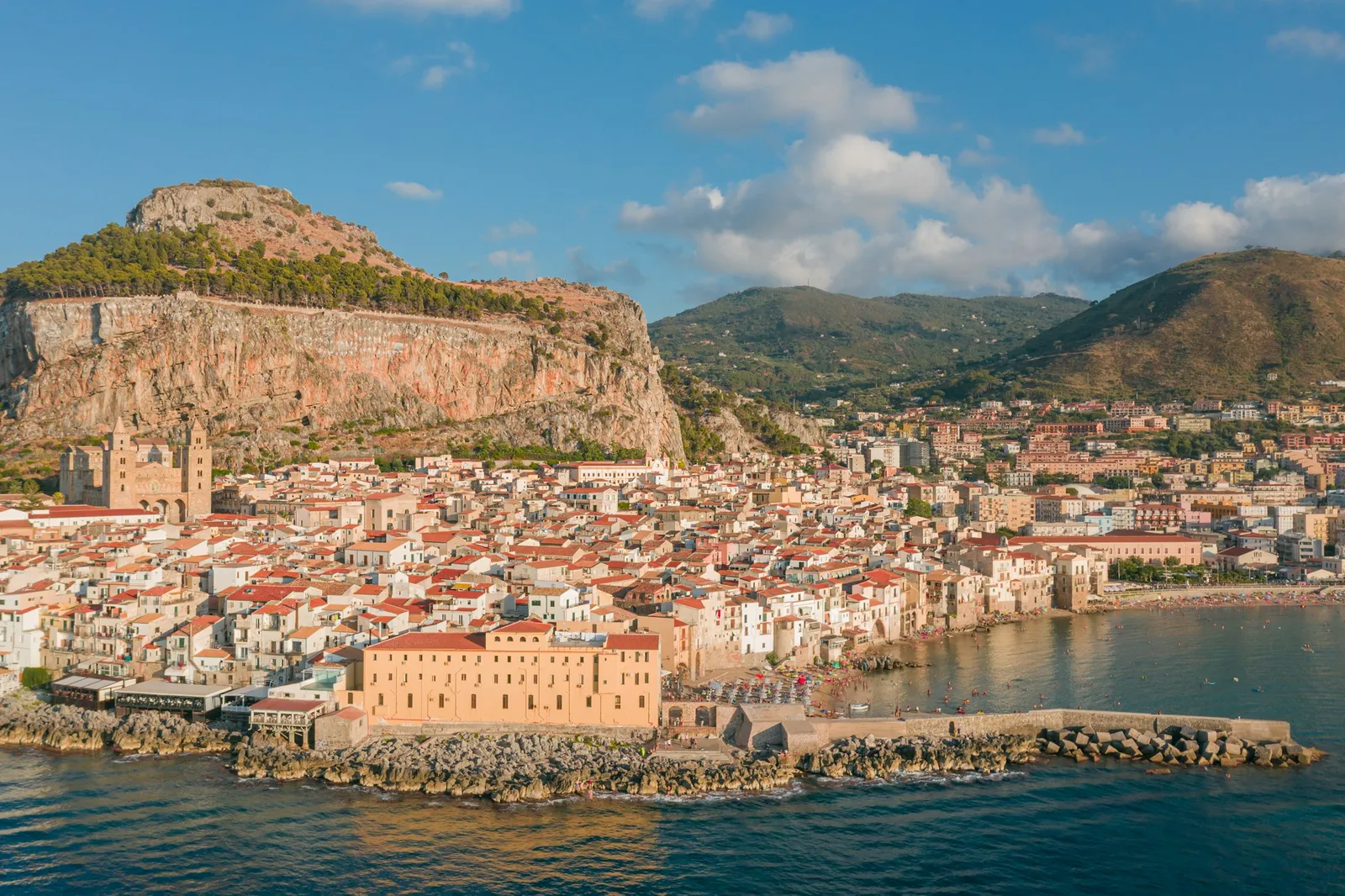
Cefalù is the easiest beach base on the island without a car. The station sits on the edge of the newer town: the main beach is about 550 metres away, under ten minutes on foot, and the cathedral in the heart of the old town about 900 metres, roughly 12 to 15 minutes with luggage. The old town is largely pedestrian, so a place near the seafront or the station side is easier than one tucked up the lanes under the Rocca. Trains to Palermo take 40 minutes to an hour. See the Cefalù town page and Cefalù beach.
Catania
The hub of the east. The Alibus runs from the airport to the central station and the centre, the station is about 1.4 kilometres, 15 to 20 minutes on foot, from Piazza Duomo, and the coaches to Taormina, Siracusa, Palermo and Agrigento leave from stops a short walk from the station. It is also the only easy way up Etna without a car: AST runs one bus a day from the station square to the Rifugio Sapienza on the south side, up in the morning and back in the late afternoon. More in my eastern Sicily guide.
Taormina
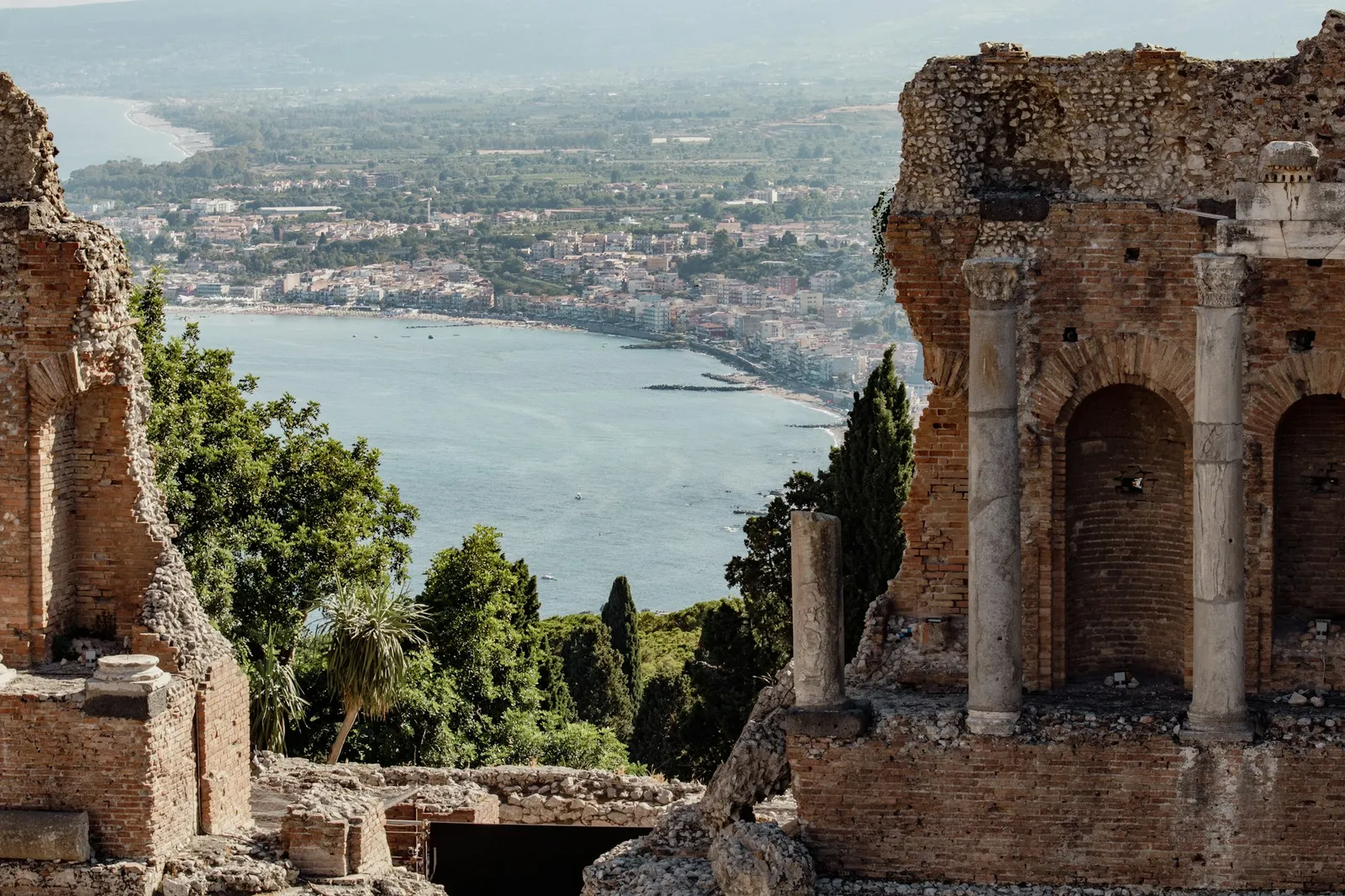
Taormina works without a car, but its station does not. Taormina-Giardini station is at sea level, below the town, and the walk up is about 35 minutes on a steep path, not something to do with a case. Interbus buses run from the stop outside the station up to the bus terminal on Via Luigi Pirandello in about ten minutes, and from there it is a short, level walk to Porta Messina and Corso Umberto. Better still, Etna Trasporti runs a direct coach from Catania airport to that same terminal in about an hour and a half, so you never touch the station. To reach the beaches at Mazzarò and Isola Bella, take the cable car down; it closes for a few weeks of maintenance most winters, with a replacement bus.
Siracusa
Stay in Ortigia, the island old town. Interbus coaches from Catania airport take about 70 minutes to the bus station beside Siracusa railway station. From there Ortigia is about 1.9 kilometres, 20 to 25 minutes on foot over the bridge, which is fine with a backpack and tiring with a heavy case, so a taxi is worth it for the first and last journey.
Trapani, if you want the west
Trapani is the one western base I would suggest without a car. Segesta coaches run from beside Palermo Centrale, and from Palermo airport, to Trapani in about an hour and a half, roughly every hour through the day. From Trapani the hydrofoil to Favignana takes about 20 minutes and the cable car climbs to Erice, as I cover in things to do in Trapani. Beyond the city, though, the west is car country, and that includes Mazara del Vallo.
| Base | Arrive by | Station to centre | Easy day trips | Watch out for |
|---|---|---|---|---|
| Palermo | Train or bus from Palermo airport | About 1 km, 12 to 15 minutes | Monreale, Mondello, Cefalù | Big, busy city; cobbles with luggage |
| Cefalù | Train from Palermo, 40 to 60 minutes | Beach under 10 minutes, cathedral 12 to 15 | Castelbuono, Palermo | Few buses inland on Sundays |
| Catania | Alibus from Catania airport | About 1.4 km, 15 to 20 minutes | Taormina, Siracusa, Etna | Only one Etna bus a day |
| Taormina | Direct coach from Catania airport | Station is below the town: take the bus up | Isola Bella, Catania | Steep, crowded in summer, pricey |
| Siracusa | Coach from Catania airport, about 70 minutes | About 1.9 km to Ortigia, 20 to 25 minutes | Catania, Noto by coach | Long walk with a heavy case |
| Trapani | Coach from Palermo, about 90 minutes | About 1.4 km to the old town seafront, 15 to 20 minutes | Favignana, Erice | The wider west needs a car |
Getting from the airports
Palermo airport (Falcone Borsellino)
Two good options. The train leaves from the station below the terminal: Trenitalia regional trains take about an hour to Palermo Centrale, one or two an hour. They stop on the way at Palermo Notarbartolo, a little over half an hour from the airport, which is the stop for Via Libertà and Politeama. Late in the evening, engineering works sometimes swap the last trains for buses, so check the Trenitalia app on the day.
The Prestia e Comandè airport bus runs every 30 minutes, along Via Libertà, past Politeama and down Via Roma, ending beside Palermo Centrale about 50 minutes later. It is often the better choice if you are staying near Politeama or Via Libertà. For Cefalù, take either into Palermo and change to the coast train.
Catania airport (Fontanarossa)
The AMTS Alibus leaves from outside arrivals every 25 minutes, from early morning to after midnight, for the central station and the city centre. The ticket costs about €4, bought on board by cash or card, and it is also valid on other city buses for 90 minutes; check before you go.
Catania is also the island's coach hub, and several companies leave straight from the airport: Etna Trasporti to Giardini Naxos and Taormina, Interbus to Siracusa and Noto, SAIS Autolinee to Palermo and Messina, SAIS Trasporti to Agrigento, and AST to the towns of the south east such as Modica and Scicli. There is also a railway station, Catania Aeroporto Fontanarossa, linked to the terminal by a short AMTS shuttle bus, with trains towards Catania and Taormina. For Siracusa the Interbus coach from the terminal is quicker, and the railway to Siracusa is sometimes closed for months at a time for works, with buses instead.
If Etna is erupting when you are due to fly, my guide to Etna eruptions and Catania flights explains how the airport is affected and where to check your flight.
Trapani airport
If you fly into Trapani, AST buses run into Trapani itself, and Autoservizi Salemi coaches run to Marsala and to Palermo. For Cefalù, Palermo airport is the far easier arrival.
How the trains and buses work
Trains
Almost all the trains you will use are Trenitalia regionals. Tickets are sold in the Trenitalia app and website, at station machines and at ticket offices. A paper ticket must be stamped in the small validating machine on the platform before you board, and it is then valid for four hours. A digital regional ticket bought in the app is tied to the train you choose, and you can change the time as often as you like up to that train's departure. If you miss that train without changing the ticket first, it is not valid on the next one, so a paper ticket is safer on a day with a tight connection.
Coaches
Sicily's coaches are run by a handful of companies, each with its own routes, tickets and website, which is the part that confuses visitors. The ones you are most likely to meet:
- AST: routes across the island, including the daily Etna bus from Catania and buses from Trapani airport into Trapani.
- SAIS Autolinee: Palermo to Catania (about two and a half hours, often quicker than the train) and Messina.
- SAIS Trasporti: Catania to Agrigento, and the Madonie towns above Cefalù, including Castelbuono.
- Interbus and Etna Trasporti: the east, including Taormina, Giardini Naxos and Siracusa.
- Cuffaro: Palermo to Agrigento.
- Segesta: Palermo and Palermo airport to Trapani.
- Autoservizi Salemi: Trapani airport to Marsala and Palermo.
Buy tickets on the company's website or app, or at its ticket office, before the day where you can; on some routes you can also pay the driver. Check the departure stop when you buy, as it is not always the bus station. City buses (AMAT in Palermo, AMTS in Catania) are separate again, and the operators' apps are the easiest way to buy.
Sundays and holidays
Timetables are split into feriale (Monday to Saturday) and festivo (Sundays and public holidays). Trains still run on the main lines on a Sunday, less often, but many coach routes shrink to a few runs or none, and the small inland routes are often built around the school day. The rule I would follow: do the city on foot on a Sunday, and keep any bus day trip for a weekday. If a holiday such as Easter Monday or 15 August falls in your week, treat it as a Sunday.
Strikes and engineering works
Transport strikes in Italy are announced in advance and listed on the Ministry of Transport's strike calendar. On strike days, regional trains are guaranteed from 6am to 9am and 6pm to 9pm on weekdays, and from 7am to 10am and 6pm to 9pm on holidays; outside those hours, expect cancellations. Planned works sometimes replace trains with buses, especially in the evening, so look at the Trenitalia app the day before any journey that matters, such as the one to your flight.
A seven-day Palermo and Cefalù itinerary without a car
This is the week I would suggest to anyone flying into Palermo without a car: four nights in Palermo, two in Cefalù, one change of hotel, and no journey longer than about an hour apart from getting to and from the airport. If the week includes a Sunday, put it on day 4 or 5 (the beach or the train to Cefalù), never on day 2, 3 or 6.
- Day 1, arrive in Palermo. Train or Prestia e Comandè bus from the airport, about an hour either way. Walk to your room and spend the evening on Via Maqueda and around the Quattro Canti.
- Day 2, Palermo on foot. The cathedral, the Norman Palace and the Palatine Chapel (check the times with the Fondazione Federico II, which runs it), and the Ballarò market, best in the morning. Everything here is within a 20 minute walk.
- Day 3, Monreale. AMAT bus 389 leaves from Piazza Indipendenza, beside the Norman Palace, roughly every half hour and takes 30 to 40 minutes. It ends in Monreale a few minutes' walk from the cathedral. A day ticket, about €3.50, covers the return; buy it before you board, because the driver sells only single tickets, for a little more and in coins. The cathedral closes from 12:45 to 2pm, so aim to be there by 11am, and be back in Palermo for the afternoon. The 389 has been cut short or suspended at short notice in the past, so check the AMAT site the day before, for the fares too; a taxi is the fallback.
- Day 4, Mondello or a slow day. AMAT bus 806 runs from Piazza Crispi, on Via Libertà about ten minutes' walk north of Politeama, to Mondello beach in about half an hour, with extra buses in summer. Out of beach season, keep the day for the parts of Palermo you missed.
- Day 5, train to Cefalù. Regional trains from Palermo Centrale take 40 minutes to an hour, roughly every hour through the day. Walk to your room, then to the cathedral, and finish on the beach at sunset.
- Day 6, Castelbuono. SAIS Trasporti buses climb to Castelbuono, a hill town in the Madonie with a castle and a good square, in about 20 to 30 minutes. There are only a few buses a day, few or none on Sundays, and the last one back can leave in the late afternoon, so check the return times before you go. If the times do not suit, walk up the Rocca behind Cefalù instead, or take a beach day.
- Day 7, home. Train back to Palermo and on to the airport by train or bus. Allow at least two and a half hours from Cefalù to the terminal, more if your flight is in the evening, when works can replace trains with buses.
The tempting day trip I would leave out
Agrigento and the Valley of the Temples. On paper it works: trains from Palermo Centrale take about two hours, every hour or two, and city buses from Agrigento station reach the temples in about ten minutes. In practice you spend four and a half to five hours travelling for three hours among the ruins, in a place where the heat on the ridge is hard work by midday. It deserves a night of its own, and I cover it in my Agrigento guide. Taormina and Etna are a similar trap from this side of the island; they belong to a week based in Catania.
If you fly into Catania: a week in the east
If you land in Catania, I would turn the plan round and spend the week on the east coast: two nights in Taormina, three in Catania and two in Siracusa, staying in Ortigia. The Etna Trasporti coach runs straight from Catania airport up to Taormina in about an hour and a half, and the same company runs coaches back down the coast from Taormina to Catania. In Catania, give one day to Etna on the AST bus and one to the city. Then take the Interbus coach to Siracusa, with Noto as a day trip by coach. To fly home, Interbus coaches run from Siracusa straight to Catania airport in about 70 minutes. Keep the Noto day and the moves between towns off Sundays, when coaches are thin.
If you only have three or four days
Stay in Palermo only, and do Monreale and Cefalù as day trips. Cefalù is an easy day by train, as long as you check the last train back.
If you have two weeks
Add the east: SAIS coach from Palermo to Catania in about two and a half hours, then a few nights each in Taormina and Siracusa, and fly home from Catania. My Sicily itineraries page has the driving versions to compare.
Island hopping without a car
The islands are among the easiest parts of Sicily to see without a car, because you would leave the car behind anyway. From Trapani, Liberty Lines hydrofoils reach Favignana in about 20 minutes. For the Aeolian Islands the main port is Milazzo, on the north east coast, and there are seasonal hydrofoils from Palermo. Timetables change with the seasons and the weather, so book on the operator's site. My island hopping guide covers all three groups.
Who a car-free trip suits, and who should hire a car
A car-free trip suits you if:
- you want cities, cathedrals, food and a town beach more than remote coves;
- you are happy to base yourself in two or three places and travel between them on weekdays;
- you would rather not drive in Palermo or Catania, which I would avoid anyway.
Hire a car, even for part of the trip, if:
- you have your heart set on an agriturismo, a vineyard stay or a villa in the countryside;
- you want the hill towns of the interior, the nature reserves or the wilder beaches;
- you are travelling with small children and a lot of luggage, or in the heat of July and August, when long waits at bus stops are hard work.
A sensible middle way is a few car-free days in a city at the start, then a car collected in town for the countryside, rather than one from the airport on day one.
Frequently asked questions
Can you see Sicily without a car?
Yes, if you base yourself in coastal towns on the train and coach lines, such as Palermo, Cefalù, Catania, Taormina and Siracusa. The interior, most countryside agriturismi and many of the best beaches are hard to reach by public transport, and services are much thinner on Sundays and holidays.
Do you need a car in Sicily?
Not if your trip is about the cities and the coast. Palermo, Cefalù, Catania, Taormina and Siracusa are joined by trains and coaches, and in their old centres a car is more burden than help. You do need one for agriturismi, the hill towns of the interior, most nature reserves and the wilder beaches, and in the far west where we live. A few car-free days in a city, then a car collected in town for the countryside, is a good middle way.
Where should I stay in Sicily without a car?
Palermo and Cefalù are the easiest pair for a first week, with a train between them in under an hour. For the east, use Catania as the transport hub, Taormina for the views and Siracusa for Ortigia. Book within an easy walk of the station or coach stop.
Is Taormina good without a car?
Yes, as long as you know the station is at sea level below the town. Take the Interbus bus from outside Taormina-Giardini station up to the bus terminal on Via Pirandello, about ten minutes, or take the direct Etna Trasporti coach from Catania airport, about an hour and a half. The town itself is best on foot.
Can you get to the Valley of the Temples in Agrigento by public transport?
Yes. Regional trains from Palermo Centrale reach Agrigento Centrale in about two hours, and city buses from outside the station run to the archaeological park in about ten minutes. SAIS Trasporti coaches also run from Catania. As a day trip from Palermo it is long, so a night in Agrigento is better.
How do I get from Palermo airport to Cefalù without a car?
Take the train or the Prestia e Comandè bus from the airport into Palermo, about an hour, then a regional train along the coast to Cefalù, 40 minutes to an hour. Allow about two and a half hours in all, including the change.
Do buses and trains run on Sundays in Sicily?
Trains run on the main lines on Sundays and holidays, but less often. Many coach routes run only a few times or not at all, especially to inland towns, so plan bus day trips for weekdays and check the festivo timetable.
Can you get to Mount Etna without a car?
Yes, from Catania. AST runs one bus a day from the square outside Catania Centrale station to the Rifugio Sapienza on the south side, up in the morning and back in the late afternoon, taking about two hours each way. Check the times with AST before you go.
Sources and small print
- Trenitalia: regional trains, tickets and guaranteed trains during strikes
- Trenitalia: Agrigento and the Valley of the Temples by train and bus
- Prestia e Comandè (Palermo airport bus)
- Catania airport: buses and AMTS Alibus
- AMAT Palermo routes and timetables and tickets
- Trapani airport: buses
- Coach companies: AST, SAIS Autolinee, SAIS Trasporti, Interbus, Etna Trasporti, Cuffaro, Segesta, Autoservizi Salemi
- ASM Taormina: Taormina to Mazzarò cable car
- Liberty Lines (hydrofoils)
- Ministry of Infrastructure and Transport: transport strike calendar
Journey times and frequencies are typical weekday figures and change with the seasons; always check the operator's timetable for your day.
Credits
Photo: Henrique Ferreira, Unsplash Licence, via Unsplash.
Photo: Stepan Dudycha, Unsplash Licence, via Unsplash.
 The weekly YouTube series