
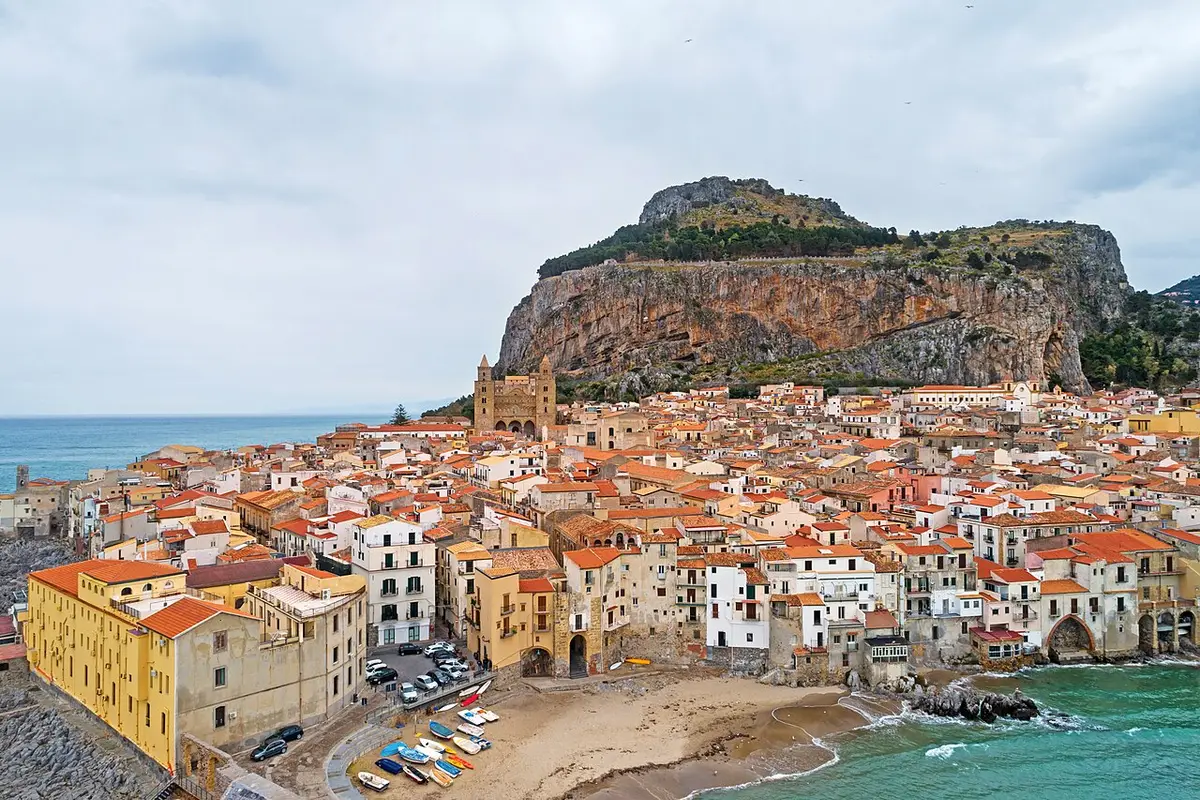
About Cefalù
The medieval centre lies at the foot of La Rocca, still ringed in large part by megalithic walls of the late fifth century BC. Corso Ruggero runs past the Osterio Magno, the Ventimiglia seat, to Piazza del Duomo. On Via Vittorio Emanuele a stone stair leads into the medieval wash house, where water still flows from twenty-two cast-iron spouts before running out to the sea.
Outside the walls the town has spread over the narrow plain and up the hillsides. The comune has about 30 km of coast, long beaches alternating with coves and cliffs, and includes Gibilmanna and Sant'Ambrogio in the hills. The marina at Presidiana holds fishing boats and, in summer, boats to the Aeolian Islands.
Living in Cefalù
Cefalù has a very large number of tourist beds for its size, and the year has two speeds. From spring to autumn the old town is busy day and night and the beach is packed in August. In winter many holiday flats and some restaurants close and the town returns to its residents, an older population that is slowly shrinking, with a small foreign community.
Daily life is easy: shops, schools and the station on the Palermo to Messina line, with the A20 motorway close. The pluses are sea and mountains in one place and good transport. The minuses are summer crowds and traffic, and steep streets on the edge of town, part of which lies in mapped landslide zones.
A short history
People used the caves on the rock in prehistory. A native town was walled in the fifth century BC, and the dolmen-like Temple of Diana stands over a cistern of the ninth century BC. The Greeks called it Kephaloidion, from the word for head. Syracuse took it in 307 BC, Rome in 254 BC, and the Arabs in 858 after a long siege.
The Normans arrived in 1063, and in 1131 Roger II refounded the town by the sea. Legend says he built the cathedral to thank the Saviour for surviving a storm, though its fortress-like form suggests politics too. He meant to be buried there, but Frederick II later took his porphyry sarcophagi to Palermo.
From the fifteenth century Cefalù belonged to its bishops. In the eighteenth century it joined the Grand Tour, and Claude Monet visited in 1884. In the early 1920s the occultist Aleister Crowley set up his Abbey of Thelema here, until Mussolini's government expelled him in 1923.
Food, festivals and traditions
Fish has always been central; the fishermen were once the town's economic backbone, and you still see their boats beached at the old harbour. During the octave of Corpus Domini, children carried cucciddati, ring-shaped loaves from the first wheat of the year, shouting Viva u pani.
The great feast is the Santissimo Salvatore, 2 to 6 August, ending with the 'ntinna a mari, when fishermen try to grab a flag at the end of a greased pole over the sea. The Immacolata is the official patron, and on New Year's Eve children wait for 'a vecchia strina, who brings presents or coal.
Interesting facts about Cefalù
- Roger II intended to be buried in Cefalù cathedral, but his porphyry sarcophagi were taken to Palermo.
- The medieval wash house is fed by twenty-two cast-iron spouts, fifteen of them shaped as lions' heads.
- Aleister Crowley's Abbey of Thelema operated in Cefalù until Mussolini's government expelled him in 1923.
House prices in Cefalù
€2,675average price per m² to buy
€6.03average rent per m² a month
€268,000a 100 m² home at that price
These are the official averages from the Agenzia delle Entrate's property market observatory (OMI) for homes in normal condition across the town's 3 price zones. Prices in Cefalù are above the typical town in Palermo province (€516 per m²) and above the typical Sicilian town (€593 per m²). Detached houses (villini) average about €1,906 per m².
Why these figures can look low: they come from the values on real sales, which sit below advertised asking prices, and the typical Sicilian town is the middle of all 391 comuni, most of them small inland towns. Island-wide averages quoted on property portals, around €1,100 to €1,300 per m², lean towards the cities and the coast, where most homes are listed. Rents work the same way: listings usually ask well above the official rent figure, often double or more.
Houses that need work, which is most of the cheap ones you see advertised, sell well below these figures. The renovation comes on top, so budget for both.
Work out the return on a let with the rental yield calculator, or see the steps from offer to keys in the buying timeline planner.
Getting there and getting around
| From the centre to | By car | Distance |
|---|---|---|
| Palermo Falcone Borsellino airport (PMO) | 1 hour 26 minutes | 100 km |
| Catania Fontanarossa airport (CTA) | 2 hours 20 minutes | 179 km |
| Trapani Birgi airport (TPS) | 2 hours 24 minutes | 178 km |
| Comiso airport (CIY) | 3 hours 9 minutes | 199 km |
| Palermo city centre | 56 minutes | 68 km |
| Catania city centre | 2 hours 18 minutes | 180 km |
| Messina, for ferries to the mainland | 2 hours 1 minute | 162 km |
| Nearest railway station (Cefalù) | 4 minutes | 1 km |
Times are by road on a clear day, worked out from OpenStreetMap. Allow longer in summer and on market days. Cefalù has a railway station close to the centre, which helps for trips to the cities, but most residents still rely on a car, and buses are infrequent on Sundays and in August.
Planning flights and trips? See the Schengen 90/180 calculator if you are from outside the EU.
Everyday life: shops, health and schools
- Hospital with A&E
- Fondazione Giglio, about 6 minutes by car
- Pharmacies in the comune
- 4
- Supermarkets
- 6
- Schools
- State: 5 nursery schools, 3 primary schools, 1 middle school, 10 secondary schools; plus 3 independent (paritaria)
- Banks and cash machines
- 11
- Cafés and bars
- 31
- Restaurants
- 55
- Full fibre broadband
- 80.9% of addresses
Pharmacies and schools come from the official Ministry of Health and Ministry of Education lists. The other counts are of places mapped in OpenStreetMap inside the comune's boundary, so a small shop or a doctor's surgery can be missing. “Not fully mapped yet” means the volunteer map clearly has gaps here, not that the town has none. For a family doctor (medico di base, what the British call a GP), you register with the local health authority (ASP Palermo) once you are resident.
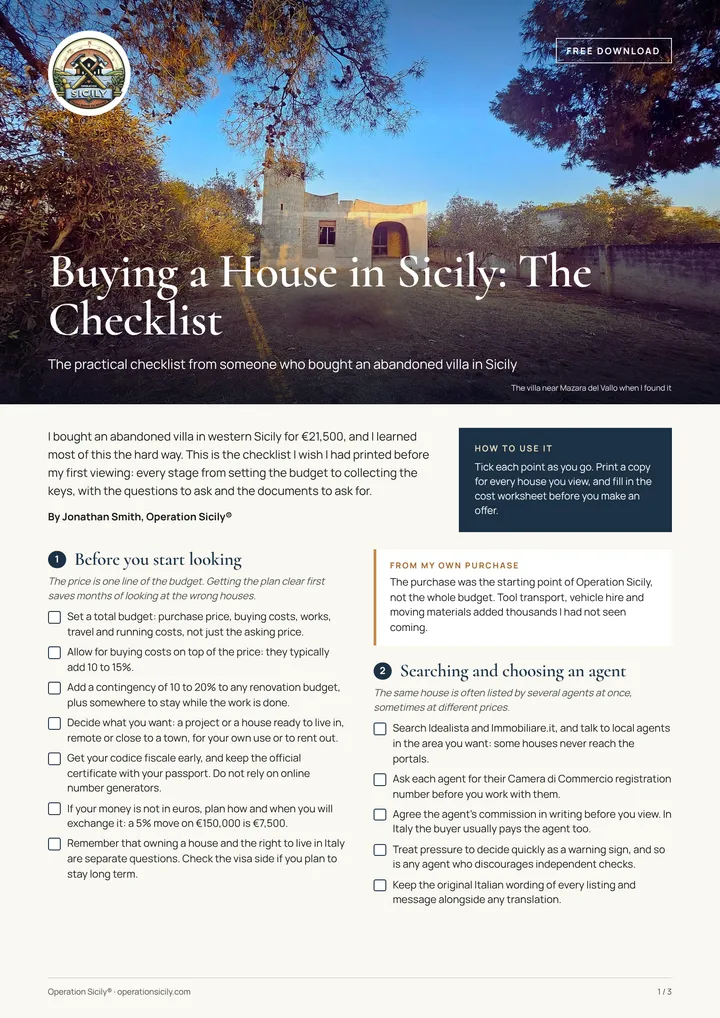
Free download
Buying a house in Sicily? Take my checklist.
Every step from budget to keys, the questions to ask at a viewing and the documents to ask for, as a PDF you can print.
Here is your checklist. Download the checklist (PDF)
Weather and climate in Cefalù
32.7°Caverage July high
9.6°Caverage January low
671 mmrain a year, on about 102 days
| Month | Average temperature | Rain |
|---|---|---|
| January | 12°C | 92 mm |
| February | 12°C | 79 mm |
| March | 14°C | 70 mm |
| April | 17°C | 51 mm |
| May | 20°C | 23 mm |
| June | 25°C | 19 mm |
| July | 28°C | 7 mm |
| August | 28°C | 13 mm |
| September | 25°C | 57 mm |
| October | 21°C | 85 mm |
| November | 17°C | 82 mm |
| December | 13°C | 91 mm |
Averages for 2015 to 2024. Winters are mild, though stone houses still feel cold without heating. Summers are hot and dry.
See what each month brings in Sicily month by month, or size a solar system with the off-grid solar calculator.
Who lives there
- Population
- 13,874
- Change since 2019
- -1.6%
- Median age
- 49
- Foreign residents
- 480 (3.5%)
Registered residents from abroad include 17 British, 3 American, 15 German, 8 Dutch, 19 French, 4 Belgian, 2 Irish, 1 Australian, 1 Canadian, 2 Swedish, 5 Swiss, 4 Spanish, 9 Polish, 116 Romanian, 40 Albanian and 23 Ukrainian citizens. Most of the rest come from countries outside Europe and the Americas. Others own holiday homes here without registering as residents.
Cefalù is a holiday town, with about 5 tourist beds for every 10 residents. It is busy from June to September and much quieter from November to March, when some hotels, restaurants and beach bars close. Visit in both seasons before you decide.
Beaches in Cefalù
Cefalù has 6 beaches in our beach guide, and one more named beach or cove mapped along its coast. 82% of its officially monitored bathing waters were rated excellent in the latest EU assessment.
- Caldura Beach pebbles, water excellent
- Capo Playa Beach sand and pebbles, water excellent
- Cefalù Beach fine sand, water good
- Mazzaforno Beach sand and pebbles, water excellent
- Sant'Ambrogio Beach sand and pebbles, water excellent
- Settefrati Beach sand and pebbles, water excellent
Things to see and do in and around Cefalù
The Duomo, begun at Pentecost 1131, is the essential visit: the apse mosaic of Christ Pantocrator, made by Byzantine craftsmen by 1145, and the cloister with paired columns and carved capitals, among the finest medieval sculpture in Sicily. The Museo Mandralisca holds Antonello da Messina's Portrait of an Unknown Man, ancient coins and a large shell collection.
Climb La Rocca for the Temple of Diana and the view, swim from the town beach, and drive up to the Gibilmanna sanctuary. Castelbuono, Gratteri and the Madonie peaks are close.
- Cefalù Cathedral
- Sanctuary of Gibilmanna
- Abbey of Thelema
- Museo Mandralisca
- Purgatorio
- Lighthouse of Cefalù
- Town hall of Cefalù
- Museo Frà Gianmaria da Tusa
- Immacolatella
- Santa Maria d'Itria
- Chiesa della Santissima Annunziata
- Maria Santissima della Catena
- San Sebastiano
- Santa Oliva
Famous people born in Cefalù include Giacomo del Duca (Italian painter, architect, and sculptor); Giovanni Bernardino Azzolini (Italian painter).
Earthquake, landslide and flood risk
Cefalù is in seismic zone 2, the second highest of Italy’s four seismic zones. The zone sets the anti-seismic standard for any new building, extension or structural renovation, which affects both the design and the cost. A structural survey is worth paying for before you buy any older building, stone house or flat.
17.7% of the comune's land is mapped by ISPRA as high or very high landslide hazard, where 21% of residents live, and 0.4% of the land could flood in a medium-probability flood (5.9% of residents). Ask for the hazard maps (PAI) for any house you are considering; the comune's technical office or your geometra can check them.
Check what you can build or change with the building permit checker, and keep a margin with the renovation contingency calculator.
The comune: useful details
- Official name
- Comune di Cefalù
- Province
- Palermo (Città metropolitana di Palermo)
- Postcode (CAP)
- 90015
- Dialling code
- 0921
- Area
- 66 km²
- Height above sea level
- 16 m
- ISTAT code
- 082027
- Cadastral code
- C421 (used in the codice fiscale of people born here)
- Official website
- comune.cefalu.pa.it
Registering as a resident, paying local taxes and building permits all go through the comune. If you were born abroad, get your Italian tax code first with the codice fiscale calculator.
Nearby towns
Cefalù borders 5 other comuni:
- Castelbuono €649/m²
- Gratteri €478/m²
- Isnello €478/m²
- Lascari €920/m²
- Pollina €868/m²
Towns like Cefalù elsewhere in Sicily
- Taormina (Messina province)
- San Vito Lo Capo (Trapani province)
- Giardini-Naxos (Messina province)
- Capo d'Orlando (Messina province)
- Gibellina (Trapani province)
- Aci Castello (Catania province)
Cefalù on our lists
- The towns with the mildest winters
- The best places to live in Sicily
- The best places to retire in Sicily
- Where British people live in Sicily
- The best seaside towns in Sicily
See every town in Palermo province (82 comuni), or let Find your town suggest places that match what you want.
Frequently asked questions
Where is Cefalù in Sicily?
Cefalù is in the province of Palermo, about 60 km east of Palermo. The centre sits about 16 metres above sea level and its land runs down to the coast.
What is Cefalù known for?
Roger II intended to be buried in Cefalù cathedral, but his porphyry sarcophagi were taken to Palermo. The medieval wash house is fed by twenty-two cast-iron spouts, fifteen of them shaped as lions' heads. Aleister Crowley's Abbey of Thelema operated in Cefalù until Mussolini's government expelled him in 1923.
Is Cefalù a good place to live?
It depends what you want. Ideal for people who want a beautiful, sociable seaside town with good train links and mountains behind, and who will share it with visitors. The nearest emergency department is about 6 minutes away, and homes average about €2,675 per m².
How much do houses cost in Cefalù?
Official figures from the Agenzia delle Entrate put homes in Cefalù at about €2,675 per square metre on average, so a 100 m² home in normal condition would be roughly €268,000. That is above the typical town in the province (€516) and above the typical Sicilian town (€593). Houses needing work sell for less, and the best homes for more.
What is the nearest airport to Cefalù?
Palermo Falcone Borsellino airport is the nearest, about 1 hour 26 minutes away by car (100 km). Catania Fontanarossa is about 2 hours 20 minutes away. Times are for a clear road and will be longer in summer traffic.
What is the weather like in Cefalù?
Summers are hot and dry: July afternoons average about 32.7°C. Winter nights in January average about 9.6°C. Rain totals about 671 mm a year, falling mostly between October and March.
How many people live in Cefalù?
13,874 people live in the comune of Cefalù, according to ISTAT. The population fell by 1.6% between 2019 and 2025. Half the residents are older than 49.
Is there a hospital near Cefalù?
The nearest hospital with an emergency department (pronto soccorso) is Fondazione Giglio, about 6 minutes away by car. In an emergency anywhere in Italy, call 112.
Is Cefalù in an earthquake zone?
Cefalù is in seismic zone 2, the second highest of Italy’s four seismic zones. New building and structural work anywhere in Italy must follow anti-seismic rules, and the zone sets how strict they are, so ask your geometra or engineer to check any house you plan to buy or renovate.
Does Cefalù count for the 7% flat tax for pensioners?
On population, yes: Cefalù is a Sicilian town under the 30,000 resident limit for Italy's 7% flat tax for foreign pensioners. The other conditions are about you, not the town. Check the details with our 7% flat tax town checker and a qualified adviser.
Does Cefalù have fast internet?
Yes, for most homes: about 80.9% of addresses in Cefalù can get full fibre (FTTH), according to the communications regulator AGCOM. Check the exact address before you buy.
Is Cefalù worth visiting in winter?
Yes, if you want the cathedral, the lanes and La Rocca without crowds. Many holiday rentals and some restaurants close, but the town stays lived in, and trains to Palermo run all year.
Credits
Photo: Ludvig14, CC BY-SA 4.0, via Wikimedia Commons.
Figures: ISTAT, Agenzia delle Entrate (OMI), Copernicus ERA5-Land, AGCOM, Dipartimento della Protezione Civile, ISPRA, Ministero della Salute, Ministero dell'Istruzione e del Merito, IndicePA, Open-Meteo, NASA POWER, Wikidata and © OpenStreetMap contributors, with several series gathered by the expatliving-data open data collection. Map boundaries ISTAT via openpolis (CC BY 4.0). Sicily as a whole: 4,787,390 people in 391 comuni.
 The weekly YouTube series