
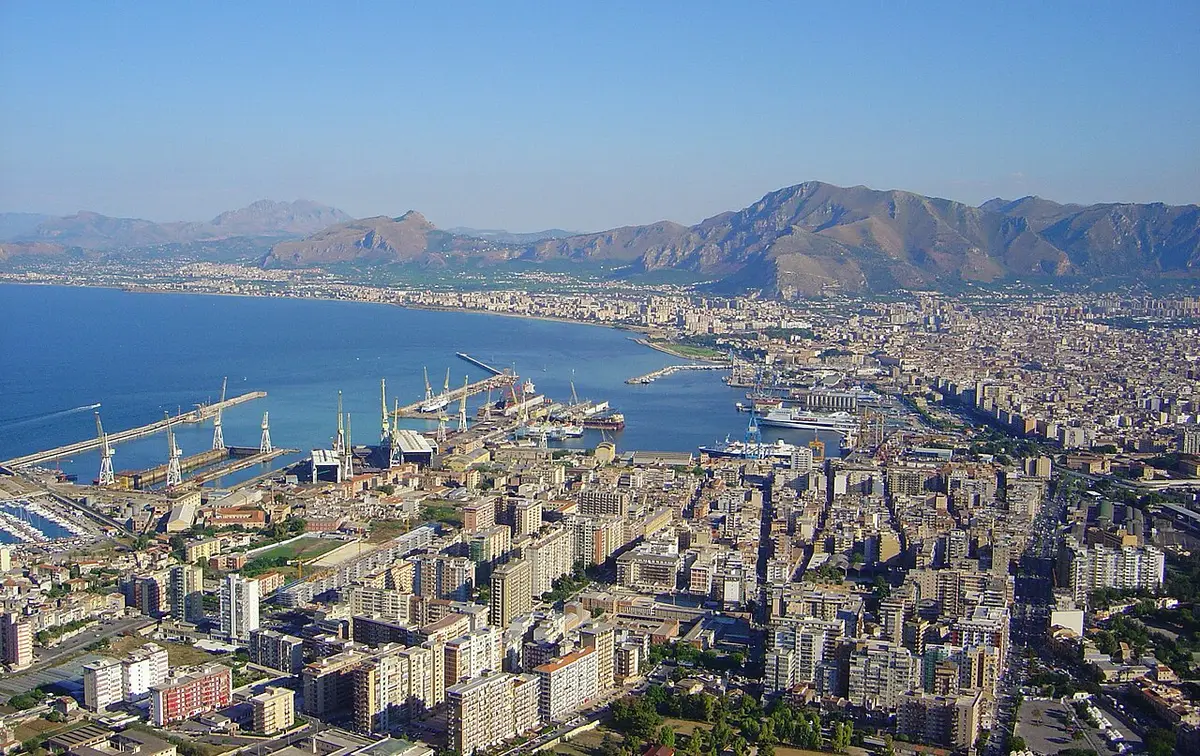
About Palermo
Via Maqueda and the Cassaro cross at the Quattro Canti and divide the historic centre into the Kalsa, the Loggia, Seralcadio and the Albergheria. Each has its own character, and three have famous markets: Ballarò, the Capo and the Vucciria. North of the old walls the newer city takes over, with the Teatro Massimo, opened in 1897, the Politeama and the boulevards of Via Libertà.
The city fills the Conca d'Oro, hemmed in by the Palermo mountains and opening onto its gulf. Monte Pellegrino rises at the northern end, with the sanctuary of Santa Rosalia in a cave near the top, and beyond it lies Mondello with its sandy bay. Palermo is the seat of the regional government, a university city and a major port.
Living in Palermo
Palermo is a working city, not a resort: busy all year, with visitors a layer on top rather than the whole story. The population is slowly falling, but the foreign community is large and varied. Quarters differ hugely, from restored palazzi in the Kalsa to modern apartment blocks in the north and villas towards Mondello.
Everything is on hand: theatres, the university, ferries to the mainland and motorways to the rest of Sicily, with Mondello and the Capo Gallo coast for summer swimming. The drawbacks are traffic and parking, noise in the old centre, long hot summers and low-lying streets that flood in heavy storms.
A short history
People lived here in the Mesolithic, as the Addaura cave drawings on Monte Pellegrino show. The Phoenicians founded a harbour settlement, Ziz, one of their three chief Sicilian towns; it became Greek Panormos and then Roman Panormus.
Arab forces took the city in 831 and made it the capital of Sicily for the first time, as Balarm; they planted the citrus groves that gave the Conca d'Oro its name. Roger I captured it in 1072, and from 1130 it was the capital of the Norman Kingdom of Sicily, whose rulers built the Palatine Chapel, the Martorana and the Zisa.
The Sicilian Vespers broke out here in 1282. Spanish rule followed from 1479, then the Bourbons, and the city rose again in 1848. Allied bombing in 1942 and 1943 destroyed the harbour quarters. After decades marked by the mafia, the murders of the judges Giovanni Falcone and Paolo Borsellino in 1992 provoked a strong civic response. The Arab-Norman monuments joined the UNESCO list in 2015, and Palermo was Italian Capital of Culture in 2018.
Food, festivals and traditions
Street food is a way of life: arancine, panelle, crocchè, sfincione and pani câ meusa, a bun of fried veal spleen and lung. At home people cook caponata, pasta con le sarde, anelletti al forno and sarde a beccafico, and the pastry shops live on ricotta, in cannoli and cassate.
The year turns on Saint Rosalia, credited with freeing the city from plague in 1624 after her remains were found on Monte Pellegrino. The Festino on 14 July brings a great procession through the centre and fireworks, and her feast day is 15 July.
Interesting facts about Palermo
- From about 1050 to the nineteenth century Palermo was consistently among the most populous cities of western Europe.
- The Conca d'Oro, the golden basin, was named in Arab times after the citrus groves the Arabs introduced.
- Saint Rosalia has been the city's patron since 1624, replacing several older patron saints.
- Palermo was Italian Capital of Culture in 2018.
House prices in Palermo
€1,370average price per m² to buy
€4.60average rent per m² a month
€137,000a 100 m² home at that price
These are the official averages from the Agenzia delle Entrate's property market observatory (OMI) for homes in normal condition across the town's 49 price zones. Prices in Palermo are above the typical town in Palermo province (€516 per m²) and above the typical Sicilian town (€593 per m²). Detached houses (villini) average about €1,544 per m².
Why these figures can look low: they come from the values on real sales, which sit below advertised asking prices, and the typical Sicilian town is the middle of all 391 comuni, most of them small inland towns. Island-wide averages quoted on property portals, around €1,100 to €1,300 per m², lean towards the cities and the coast, where most homes are listed. Rents work the same way: listings usually ask well above the official rent figure, often double or more.
Houses that need work, which is most of the cheap ones you see advertised, sell well below these figures. The renovation comes on top, so budget for both.
Work out the return on a let with the rental yield calculator, or see the steps from offer to keys in the buying timeline planner.
Getting there and getting around
| From the centre to | By car | Distance |
|---|---|---|
| Palermo Falcone Borsellino airport (PMO) | 35 minutes | 31 km |
| Trapani Birgi airport (TPS) | 1 hour 33 minutes | 110 km |
| Catania Fontanarossa airport (CTA) | 2 hours 44 minutes | 207 km |
| Comiso airport (CIY) | 3 hours 33 minutes | 227 km |
| Catania city centre | 2 hours 42 minutes | 208 km |
| Messina, for ferries to the mainland | 2 hours 46 minutes | 224 km |
| Nearest motorway or main road junction | 9 minutes | 6 km |
| Nearest railway station (Palermo Centrale) | 4 minutes | 1 km |
Times are by road on a clear day, worked out from OpenStreetMap. Allow longer in rush hour and in summer. Palermo has its own city buses, and coaches and trains link it to the rest of Sicily, though a car makes the countryside and smaller towns much easier to reach.
Planning flights and trips? See the Schengen 90/180 calculator if you are from outside the EU.
Everyday life: shops, health and schools
- Hospital with A&E
- Policlinico Paolo Giaccone, about 6 minutes by car
- Pharmacies in the comune
- 193
- Supermarkets
- 161
- Schools
- State: 281 nursery schools, 164 primary schools, 74 middle schools, 105 secondary schools; plus 203 independent (paritaria)
- Banks and cash machines
- 113
- Cafés and bars
- 412
- Restaurants
- 433
- Full fibre broadband
- 91% of addresses
Pharmacies and schools come from the official Ministry of Health and Ministry of Education lists. The other counts are of places mapped in OpenStreetMap inside the comune's boundary, so a small shop or a doctor's surgery can be missing. “Not fully mapped yet” means the volunteer map clearly has gaps here, not that the town has none. For a family doctor (medico di base, what the British call a GP), you register with the local health authority (ASP Palermo) once you are resident.
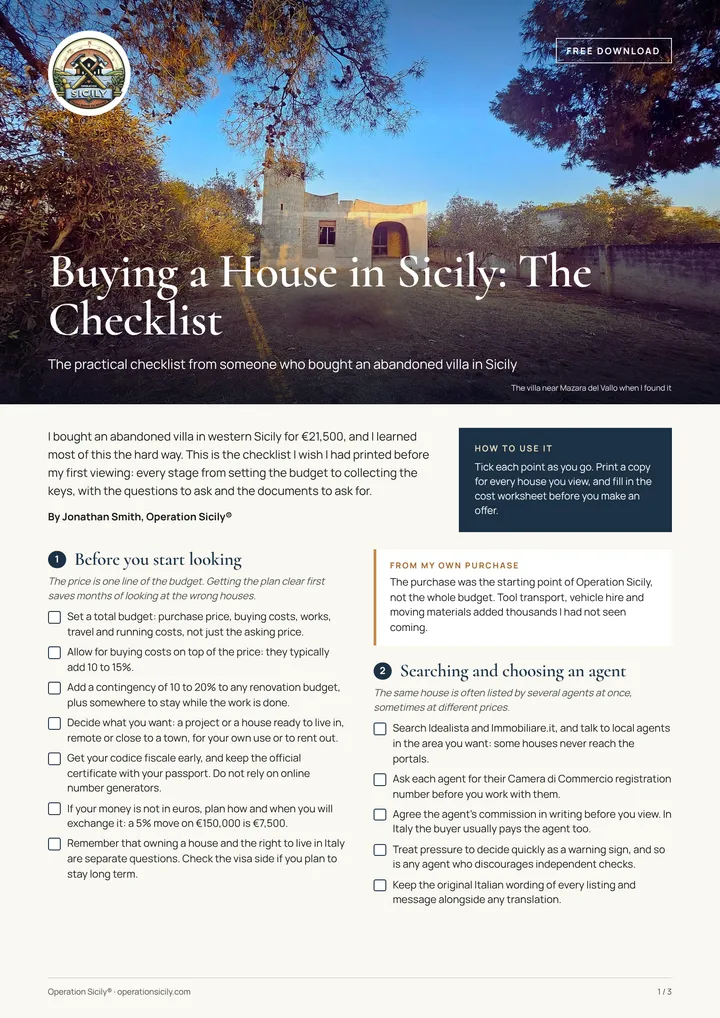
Free download
Buying a house in Sicily? Take my checklist.
Every step from budget to keys, the questions to ask at a viewing and the documents to ask for, as a PDF you can print.
Here is your checklist. Download the checklist (PDF)
Weather and climate in Palermo
32.5°Caverage July high
6.8°Caverage January low
665 mmrain a year, on about 99 days
36days a year above 30°C
| Month | Average temperature | Rain |
|---|---|---|
| January | 12°C | 91 mm |
| February | 12°C | 80 mm |
| March | 13°C | 69 mm |
| April | 16°C | 52 mm |
| May | 20°C | 25 mm |
| June | 24°C | 17 mm |
| July | 27°C | 7 mm |
| August | 28°C | 12 mm |
| September | 24°C | 57 mm |
| October | 21°C | 85 mm |
| November | 17°C | 81 mm |
| December | 13°C | 89 mm |
Averages for 2015 to 2024. Winters are cool and damp, and you will want heating for three or four months. Summers are hot and dry.
See what each month brings in Sicily month by month, or size a solar system with the off-grid solar calculator.
Who lives there
- Population
- 628,693
- Change since 2019
- -3.7%
- Median age
- 44
- Foreign residents
- 25,948 (4.1%)
- People from Palermo are called
- palermitani
- Patron saint
- Saint Rosalia
Registered residents from abroad include 111 British, 63 American, 116 German, 20 Dutch, 121 French, 22 Belgian, 18 Irish, 4 Australian, 6 Canadian, 11 Swedish, 13 Swiss, 133 Spanish, 256 Polish, 2,502 Romanian, 68 Albanian and 352 Ukrainian citizens. Most of the rest come from countries outside Europe and the Americas. Others own holiday homes here without registering as residents.
Palermo is a working city first, busy all year round, with about 13,896 tourist beds. Visitors add to the summer crowds without changing the way the place lives.
Beaches in Palermo
Palermo has 5 beaches in our beach guide, and one more named beach or cove mapped along its coast. 55% of its officially monitored bathing waters were rated excellent in the latest EU assessment.
- Addaura rocks, water excellent
- Capo Gallo rocks and pebbles, water excellent
- Mondello Beach fine sand, water good
- Sferracavallo rocks, water excellent
- Vergine Maria Beach sand and pebbles, water excellent
Things to see and do in and around Palermo
Follow the Arab-Norman trail: the Palatine Chapel in the Palazzo dei Normanni, the cathedral, San Giovanni degli Eremiti, the Martorana, San Cataldo and the Zisa. Add the baroque of Piazza Pretoria, the Quattro Canti and Giacomo Serpotta's stucco oratories, and book an evening at the Teatro Massimo.
Walk the markets in the morning, climb Monte Pellegrino to the sanctuary, or spend the afternoon at Mondello. Monreale, the Capo Gallo reserve and the villas of Bagheria are easy half-day trips.
- Palermo Cathedral
- Cappella Palatina
- Teatro Massimo Vittorio Emanuele
- Martorana
- Palazzo dei Normanni
- Chiesa di San Cataldo
- San Giovanni degli Eremiti
- Catacombe dei Cappuccini
- Zisa Palace
- Quattro Canti
- Teatro Politeama
- Grotta dell'Addaura
- Church of the Gesù
- Natoli Palace
Beaches within the comune include Spiaggia di Vergine Maria, Spiaggia dell'Arenella.
Famous people born in Palermo include Sergio Mattarella (president of Italy); Mario Balotelli (Italian association football player); Sergius I (pope); Agatho (pope); Salvatore Schillaci (Italian association football player).
Earthquake, landslide and flood risk
Palermo is in seismic zone 2, the second highest of Italy’s four seismic zones. The zone sets the anti-seismic standard for any new building, extension or structural renovation, which affects both the design and the cost. A structural survey is worth paying for before you buy any older building, stone house or flat.
12.8% of the comune's land is mapped by ISPRA as high or very high landslide hazard, where 0.9% of residents live, and 6.4% of the land could flood in a medium-probability flood (7% of residents). Ask for the hazard maps (PAI) for any house you are considering; the comune's technical office or your geometra can check them.
Check what you can build or change with the building permit checker, and keep a margin with the renovation contingency calculator.
The comune: useful details
- Official name
- Comune di Palermo
- Province
- Palermo (Città metropolitana di Palermo)
- Postcode (CAP)
- 90128
- Dialling code
- 091
- Area
- 160 km²
- Height above sea level
- 14 m
- ISTAT code
- 082053
- Cadastral code
- G273 (used in the codice fiscale of people born here)
- Official website
- comune.palermo.it
Registering as a resident, paying local taxes and building permits all go through the comune. If you were born abroad, get your Italian tax code first with the codice fiscale calculator.
Nearby towns
Palermo borders 8 other comuni:
- Altofonte €637/m²
- Belmonte Mezzagno €493/m²
- Ficarazzi €968/m²
- Isola delle Femmine €1,099/m²
- Misilmeri €878/m²
- Monreale €970/m²
- Torretta €558/m²
- Villabate €1,015/m²
Towns like Palermo elsewhere in Sicily
- Catania (Catania province)
- Siracusa (Siracusa province)
- Messina (Messina province)
- Milazzo (Messina province)
- Marsala (Trapani province)
- Aci Castello (Catania province)
Palermo on our lists
- Towns within an hour of Palermo airport
- The best towns for full fibre broadband
- The biggest towns in Sicily
- Where British people live in Sicily
- The best towns in Sicily for expats
- The best seaside towns in Sicily
See every town in Palermo province (82 comuni), or let Find your town suggest places that match what you want.
Frequently asked questions
Where is Palermo in Sicily?
Palermo is in the province of Palermo, 166 km north-west of Catania. The centre sits about 14 metres above sea level and its land runs down to the coast.
What is Palermo known for?
From about 1050 to the nineteenth century Palermo was consistently among the most populous cities of western Europe. The Conca d'Oro, the golden basin, was named in Arab times after the citrus groves the Arabs introduced. Saint Rosalia has been the city's patron since 1624, replacing several older patron saints.
Is Palermo a good place to live?
It depends what you want. Anyone who wants proper city life in Sicily, with culture every night of the week, a big international community and the sea and mountains on the edge of town. The nearest emergency department is about 6 minutes away, and homes average about €1,370 per m².
How much do houses cost in Palermo?
Official figures from the Agenzia delle Entrate put homes in Palermo at about €1,370 per square metre on average, so a 100 m² home in normal condition would be roughly €137,000. That is above the typical town in the province (€516) and above the typical Sicilian town (€593). Houses needing work sell for less, and the best homes for more.
What is the nearest airport to Palermo?
Palermo Falcone Borsellino airport is the nearest, about 35 minutes away by car (31 km). Trapani Birgi is about 1 hour 33 minutes away. Times are for a clear road and will be longer in summer traffic.
What is the weather like in Palermo?
Summers are hot and dry: July afternoons average about 32.5°C, with around 36 days a year above 30°C. Winter nights in January average about 6.8°C. Rain totals about 665 mm a year, falling mostly between October and March.
How many people live in Palermo?
628,693 people live in the comune of Palermo, according to ISTAT. The population fell by 3.7% between 2019 and 2025. Half the residents are older than 44.
Is there a hospital near Palermo?
The nearest hospital with an emergency department (pronto soccorso) is Policlinico Paolo Giaccone, about 6 minutes away by car. In an emergency anywhere in Italy, call 112.
Is Palermo in an earthquake zone?
Palermo is in seismic zone 2, the second highest of Italy’s four seismic zones. New building and structural work anywhere in Italy must follow anti-seismic rules, and the zone sets how strict they are, so ask your geometra or engineer to check any house you plan to buy or renovate.
Does Palermo count for the 7% flat tax for pensioners?
No. On the population figure used for the limit, about 626,273 residents, Palermo is over the 30,000 limit for Italy's 7% flat tax for foreign pensioners. Many smaller towns nearby do qualify. Check the details with our 7% flat tax town checker and a qualified adviser.
Does Palermo have fast internet?
Yes, for most homes: about 91% of addresses in Palermo can get full fibre (FTTH), according to the communications regulator AGCOM. Check the exact address before you buy.
Credits
Photo: Xerones, CC BY 2.0, via Wikimedia Commons.
Figures: ISTAT, Agenzia delle Entrate (OMI), Copernicus ERA5-Land, AGCOM, Dipartimento della Protezione Civile, ISPRA, Ministero della Salute, Ministero dell'Istruzione e del Merito, IndicePA, Open-Meteo, NASA POWER, Wikidata and © OpenStreetMap contributors, with several series gathered by the expatliving-data open data collection. Map boundaries ISTAT via openpolis (CC BY 4.0). Sicily as a whole: 4,787,390 people in 391 comuni.
 The weekly YouTube series