
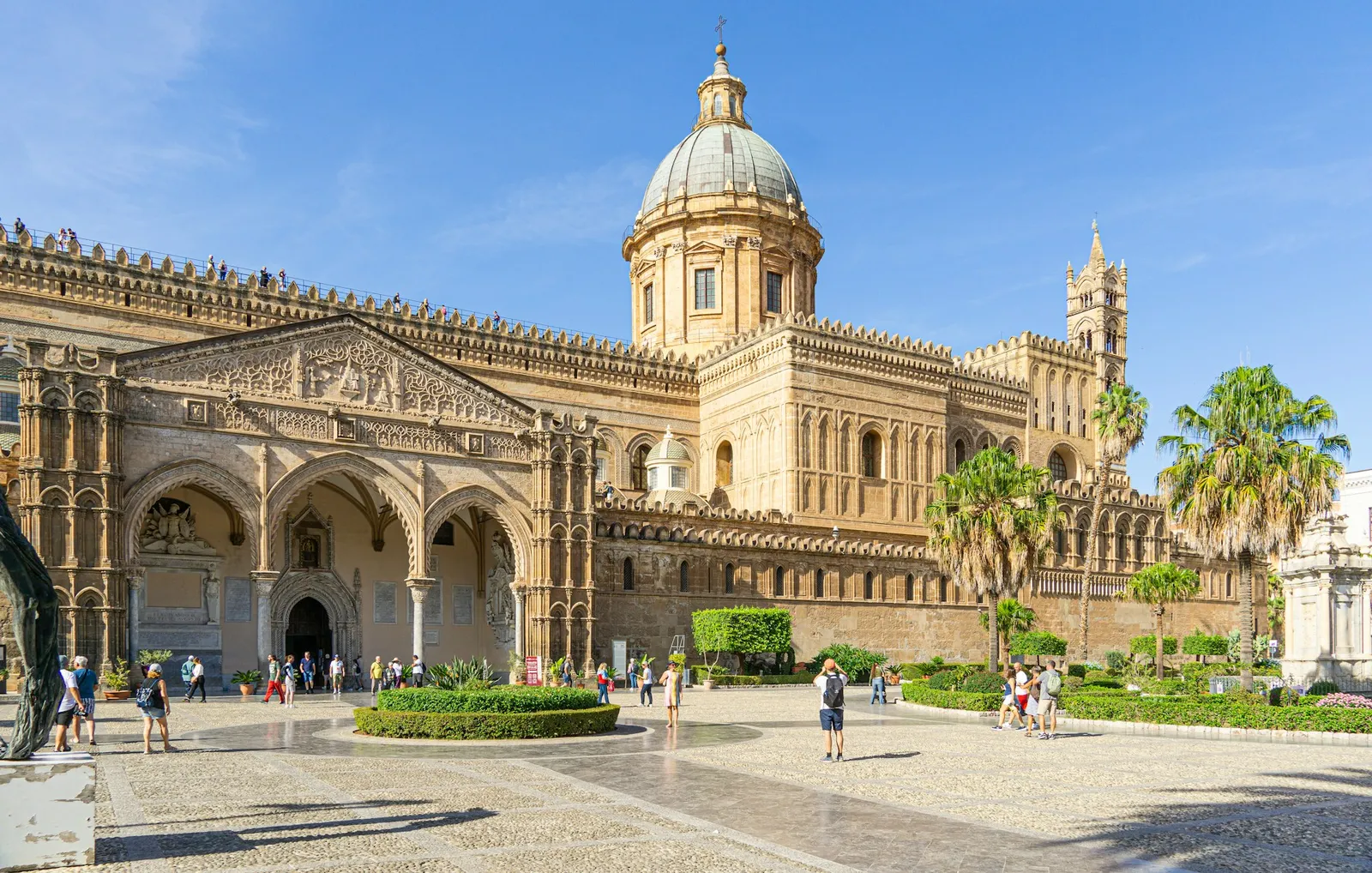
Where cruise ships dock in Palermo
Cruise ships in Palermo berth in the city port, which sits right against the centre. The cruise terminal is the old Stazione Marittima on the Molo Vittorio Veneto, rebuilt inside by the port authority (AdSP del Mare di Sicilia Occidentale) as the Palermo Cruise Terminal. The port authority also lists the Sammuzzo quay and the Molo Piave as cruise berths, so on a busy day your ship may be a little further along the harbour.
Whichever berth you are on, you come out on to Via Francesco Crispi, the busy road that runs along the harbour. From the terminal building to the street is a few minutes on foot; from the further quays allow 10 to 15 minutes, and look out for the shuttle bus inside the port if your ship tells you one is running.
Distances on foot from the cruise terminal, measured on walking routes:
- Teatro Massimo: about 1.3 km, 15 to 20 minutes
- Quattro Canti, the centre of the old town: about 1.8 km, 20 to 25 minutes
- The Cathedral: about 2.3 km, 25 to 30 minutes
- Palazzo dei Normanni and the Palatine Chapel: about 2.7 km, 30 to 35 minutes
Those are steady walking times at about 5 km an hour. With crowds, crossings and photo stops, add a quarter.
The walk: stop by stop, with walking times
The route makes a loop: out past the opera house and through the Capo market to the Cathedral, along the main street to the crossroads at the heart of the old town, and back. It runs in this order because the Martorana and San Cataldo do not open until 9 or 10am, while the market and the Cathedral are open early. Leave the port, cross Via Francesco Crispi and walk inland up Via Cavour, which brings you out at Piazza Verdi.
- Teatro Massimo (15 to 20 minutes from the terminal). Italy's largest opera house, on Piazza Verdi. The outside and the steps take five minutes. Guided tours run every day from 9:30am, last about 40 minutes and are offered in English; the standard tour covers the auditorium and the main halls, not the stage. If you want one, it fits best on the way back.
- The Capo market (about 5 minutes from Teatro Massimo, into the market streets around Via Porta Carini). One of the city's old street markets, with food stalls and fry stands. Allow 15 minutes, longer if you stop to eat.
- The Cathedral (about 8 minutes, south through the market streets). Free to enter the church; the treasury, crypt, royal tombs and roof walk are a separate ticket and open from 9:30am. Allow 30 minutes for the church, an hour with the roof.
- Quattro Canti (about 7 minutes, east along Corso Vittorio Emanuele). The four curved Baroque corners where Corso Vittorio Emanuele crosses Via Maqueda. Free, and best seen from the middle of each pavement rather than the road.
- Piazza Pretoria (1 minute, just round the corner on Via Maqueda). The marble fountain known as the Fountain of Shame. You can see it from the square at any time.
- The Martorana and San Cataldo (1 to 2 minutes, up the steps into Piazza Bellini). Two Norman era churches side by side: the Martorana, with its gold Byzantine mosaics, and San Cataldo, with its three red domes. Each has a small ticket. Allow 30 to 40 minutes for both.
Back to the ship: from Piazza Bellini, return to Quattro Canti, walk up Via Maqueda to Teatro Massimo and then down Via Cavour to the port, the way you came out. That is about 2.1 km, or 25 minutes.
The extension: Palatine Chapel and Ballarò
If you have six hours or more ashore, add two stops between the Cathedral (step 3) and Quattro Canti (step 4):
- Palazzo dei Normanni and the Palatine Chapel (about 6 minutes from the Cathedral, west along Corso Vittorio Emanuele towards Porta Nuova; follow the signs to the visitor entrance). I think the Palatine Chapel is the single best place in Sicily to see the Arab, Byzantine and Norman mix that makes Palermo what it is. Allow 60 to 90 minutes including the ticket queue. Parts of the chapel are sometimes screened off for mosaic restoration, and the palace can close at short notice for parliamentary business, so check the Fondazione Federico II's notices that morning.
- Ballarò market (about 10 minutes from the palace). Usually called the oldest of the city's markets, running along Via Ballarò between Piazza Casa Professa and Piazza del Carmine. A good place for lunch on your feet.
From Ballarò, walk about 5 minutes north to Quattro Canti and finish the loop from step 4. Palazzo dei Normanni is the furthest point of the whole route, about 2.7 km and 30 to 35 minutes from the terminal; if you are behind time there, skip Ballarò and the Martorana and walk straight back to the ship.
Timing it: the short loop and the long day
These are timings from the moment you step off the ship, Monday to Saturday. They include the walking, the visits and a short stop for food, but not queues at the gangway. Work back from your all-aboard time and aim to be at the port gate at least 45 minutes before it; ships do not wait for independent passengers.
| Stop | Short loop: allow 4 hours ashore | With the extension: allow 6 hours ashore |
|---|---|---|
| Leave the terminal | 0:00 | 0:00 |
| Teatro Massimo (outside) | 0:20 | 0:20 |
| Capo market | 0:25 to 0:40 | 0:25 to 0:40 |
| Cathedral | 0:50 to 1:25 | 0:50 to 1:25 |
| Palazzo dei Normanni and Palatine Chapel | skip | 1:30 to 2:50 |
| Ballarò market and lunch | skip | 3:00 to 3:45 |
| Quattro Canti and Piazza Pretoria | 1:30 to 1:45 | 3:50 to 4:05 |
| Martorana and San Cataldo | 1:50 to 2:30 | 4:05 to 4:45 |
| Back at the ship | about 3:00 | about 5:10 |
Add your 45 minute margin to the last row: that is where the four hours for the short loop and the six hours for the extension come from. Both the Martorana and San Cataldo open at 10am (San Cataldo at 9am from November to February), so if you are off the ship before about 8:15, take your time at the market and the Cathedral and reach Piazza Bellini after they open.
If you want the 40 minute tour inside Teatro Massimo, add about 50 minutes to your time ashore. Tours start at 9:30am, so it fits best at the end, as you pass the theatre on the way back to the ship.
If you get off the ship late
On the short loop, walk through the Capo market without stopping; that saves about 15 minutes. If you are later still, see the Martorana and skip San Cataldo, whose interior is bare stone, so it is the easier of the two to miss. On the long day, if time is tight, choose the Palatine Chapel over Ballarò, and over the Cathedral roof.
What is closed on Sundays, Mondays and during services
Palermo's sights mostly open every day, but Sunday mornings are the problem: several of the churches on this route are working churches first. These are the usual hours published by the comune's tourism office and the sites themselves. They change with the season and for festivals, so check the official pages before you go.
| Sight | Monday to Saturday | Sunday | Ticket |
|---|---|---|---|
| Teatro Massimo tours | Daily from 9:30am; last tour 6:20pm in summer, 5:20pm in winter | Open | About €14 |
| Martorana | 10am to 6:30pm (6pm in winter) | From 1pm only | About €4 |
| San Cataldo | 10am to 6pm (9am to 5pm November to February); closed 1:30 to 2pm | Same hours | About €2.50 |
| Cathedral (church) | 7am to 7pm | Masses in the morning; visits usually noon to 1pm and 4pm to 5:30pm | Free |
| Cathedral treasury, crypt and roof | From 9:30am; shorter hours in winter | Shorter hours | Separate ticket |
| Palatine Chapel | 8:30am to 4:30pm (last entry) | 8:30am to 12:30pm (last entry); closed 9:30 to 11am | About €14.50; about €10 on Tuesday and Wednesday, without the Royal Apartments |
| Royal Apartments (Palazzo dei Normanni) | Not open to visitors on Tuesday and Wednesday | Open | In the full ticket |
| Ballarò market | 7am to 7:30pm | Mornings only | Free |
- Sunday: the Martorana is only open to visitors from 1pm, the Palatine Chapel shuts from 9:30 to 11am and the whole palace stops letting people in at 12:30pm. Go to Palazzo dei Normanni first, either early enough to be in the chapel before 9:30am or between 11am and the 12:30pm last entry, see the Cathedral from noon, and leave the Martorana for the afternoon.
- Midweek: the Royal Apartments upstairs in Palazzo dei Normanni are not part of the visit on Tuesday and Wednesday (the palace is also the seat of the Sicilian regional parliament). The Palatine Chapel and the Royal Gardens stay open and the ticket is cheaper.
- Monday: none of the sights on this route closes on a Monday, which is not true of every Italian city.
- During Mass or a wedding, visits stop in the Cathedral and the Martorana. The Martorana belongs to the Greek Byzantine rite Eparchy of Piana degli Albanesi, so its services are not the ones you may be used to.
What to wear in the churches
Cover your shoulders and knees for every church on this route, including the Palatine Chapel. In summer a light scarf or shirt in your bag solves it; shorts above the knee and vest tops are the usual reason people are turned away at the door. Inside, keep your voice down and do not take photos during a service.
Getting back to the ship on time
The walk back is downhill and easy, but the old town is a maze and it is easy to lose 15 minutes looking for the right street. Two rules help: know the time you must start back before you leave the ship, and check the clock against the timing table at the Cathedral (and at the palace on the long day). If you are behind, cut a stop rather than rush the walk back. Check too whether the ship keeps local time; if it does not, set your watch to ship's time before you go ashore.
- From Piazza Bellini (the Martorana and San Cataldo): about 25 minutes on foot, by Via Maqueda and Teatro Massimo.
- From the Cathedral: 25 to 30 minutes.
- From Palazzo dei Normanni: 30 to 35 minutes, the longest walk back on this route.
- From Ballarò: about 25 minutes.
- From Teatro Massimo: 15 to 20 minutes.
Taxis
If your feet give up, a licensed Palermo taxi is white, with a TAXI sign on the roof and the comune's licence number on the door. Take one from a taxi rank or call one of the city's radio taxi cooperatives, and ask for the meter or agree the fare before you set off. Do not get into a car with someone who approaches you on the quay or in the street offering a ride. Traffic around Via Crispi can be slow when several ships are in, so a taxi is not always faster than walking from Teatro Massimo.
Practical things: cash, toilets, heat and pickpockets
Cash and cards
Ticket offices, cafés and most shops take cards. Market stalls and street food stands are much happier with cash, and small notes and coins make life easier, so bring €20 to €30 in change for food and church tickets. There are cash machines in the centre if you run short.
Toilets
Use the one on the ship or in the terminal before you leave. In town, public toilets are few; the realistic answer is a café, where you buy a coffee or a bottle of water and ask. Paid sights are another chance.
Heat in summer
From June to September Palermo can be very hot by late morning, and the stone streets hold the heat. Start walking as soon as you are allowed off, carry water, wear a hat and save the indoor sights (the Palatine Chapel, the Cathedral) for the middle of the day. The narrow streets of the markets are shadier than the wide ones. In August the city is at its hottest; my Sicily in August guide has the temperatures and what to pack.
Pickpockets in the markets
Palermo is a safe city to walk around by day. The thing to watch is ordinary pickpocketing in the crowded places: the markets, Quattro Canti and anywhere people stop to take photos. Keep your phone in a front pocket, your bag closed and in front of you, and only bring the cards you need for the day. I have written about safety across the island, without the scare stories, in is Sicily safe.
Street food to try on the way
The markets on this route are where Palermo's street food lives, so plan to eat standing up rather than booking a table. What to look for:
- Arancine: in Palermo they are round, and called arancine rather than arancini.
- Pane con le panelle: chickpea flour fritters in a soft roll, often with crocchè (potato croquettes).
- Sfincione: Palermo's thick, soft pizza with tomato, onion, anchovies and breadcrumbs, sold by the slice.
- Pane con la milza: spleen in a bun, Palermo's most famous and most confrontational street food.
- A cannolo or a granita to finish, from a pastry shop rather than a stall.
The Capo market, on both routes, and Ballarò, on the long one, both have fry stands. My Sicily food guide goes into what each dish is and what to skip.
Monreale: a separate option, and is it realistic on a port day?
Monreale Cathedral, in the hills just inland of Palermo, is lined with some 6,000 square metres of gold mosaic, and plenty of cruise passengers want to see it. It is realistic on a port day, but only instead of most of the walk above, not as well as it.
- Getting there by bus: Palermo's city bus company AMAT runs line 389 from Piazza Indipendenza, right beside Palazzo dei Normanni, up to Monreale. The line has been suspended at short notice more than once, so check that it is running on the AMAT site or at the stop before you rely on it. A single ticket costs about €1.40 from a ticket outlet or the AMAT app and is valid for 90 minutes, so you need two, or a day ticket for about €3.50. The driver sells single tickets only when it is safe to, for about €1.80, and you need the coins ready.
- Getting there by taxi: simpler from the port, and worth it if there are three or four of you. Allow 30 to 45 minutes each way, more in heavy traffic.
- Opening hours: the cathedral is usually open Monday to Saturday 9am to 12:45pm and 2pm to 4:45pm, so it closes over lunch. On Sundays and holidays it is only open to visitors in the afternoon (2pm to 5pm) because of morning Masses. The cloister next door has its own ticket (about €8) and stays open over lunch from Monday to Saturday, but on Sundays and holidays it closes at 1pm, before the cathedral opens to visitors.
- Time: allow about four hours from the port and back, including the cathedral and the cloister.
As a rule of thumb: if you have eight hours or more ashore on a weekday morning, Monreale and a shortened walk (Quattro Canti, the Martorana and the Cathedral) fit. With less time, or on a Sunday, stay in Palermo; the Palatine Chapel gives you the same Norman gold within walking distance of the ship. I cover Monreale and Cefalù in more detail in my Palermo, Cefalù and Monreale guide.
Frequently asked questions
Can you walk from the Palermo cruise port to the city centre?
Yes. The cruise terminal is on the Molo Vittorio Veneto, right on the edge of the centre. Teatro Massimo is about 1.3 km away, roughly 15 to 20 minutes on foot, and the Cathedral about 2.3 km, roughly 25 to 30 minutes. The route is flat or gently uphill on the way out and downhill on the way back.
Do cruise ships tender in Palermo?
Normally no. Palermo has quays long and deep enough for big modern cruise ships, so ships tie up alongside in the city port, at the cruise terminal on the Molo Vittorio Veneto or a nearby quay, and you walk off on to Via Francesco Crispi. If your ship is on one of the further quays, allow 10 to 15 minutes to reach the street.
Is Palermo safe for cruise passengers?
Yes, by day the old town is a safe place to walk. The thing to watch is ordinary pickpocketing in crowded places such as the markets and Quattro Canti: keep your phone in a front pocket and your bag closed in front of you, and only bring the cards you need. Use licensed white taxis, never a ride offered on the quay.
Is Palermo worth a shore excursion or should you do it yourself?
For the city itself, doing it yourself works well: the main sights are on a loop of about 6 km from the terminal and none usually needs booking ahead. A ship tour makes more sense for Monreale or Cefalù if you are nervous about timing, because the ship waits for its own excursions and not for independent passengers.
What is closed on Sundays in Palermo?
On Sundays the Martorana only opens to visitors from 1pm, the Palatine Chapel closes from 9:30 to 11am and the whole Palazzo dei Normanni complex takes its last visitors at 12:30pm. The Cathedral has Masses through the morning and usually opens to visitors from noon, the Ballarò market is a morning affair, and Monreale Cathedral is only open to visitors in the afternoon.
How long do you need in Palermo from a cruise ship?
Allow about four hours ashore for the short loop on foot (Teatro Massimo, the Capo market, the Cathedral, Quattro Canti, Piazza Pretoria and the Martorana): it takes about three, and you want to be back at the port gate 45 minutes before all-aboard. Six hours or more lets you add the Palatine Chapel and lunch in Ballarò market. Allow eight hours or more if you want to fit Monreale in as well.
What should I wear to visit churches in Palermo?
Cover your shoulders and knees for all the churches, including the Palatine Chapel and the Cathedral. A light scarf or shirt in your bag is enough on a hot day. Visits stop during Mass and other services.
Can I get to Monreale from the Palermo cruise port?
Yes, by taxi or by AMAT city bus line 389 from Piazza Indipendenza, near Palazzo dei Normanni. The bus has had short suspensions, so check it is running first. Allow about four hours there and back, and remember the cathedral closes over lunch on weekdays and is only open to visitors in the afternoon on Sundays.
Do I need cash in Palermo?
Ticket offices, cafés and most shops take cards, but market stalls and street food stands much prefer cash. Bring €20 to €30 in small notes and coins for food and church tickets.
Sources and small print
- AdSP del Mare di Sicilia Occidentale, the port authority, on the cruise terminal and cruise berths
- Comune di Palermo tourism office, opening hours and prices of the main sights
- Fondazione Federico II, hours, tickets and closures for Palazzo dei Normanni and the Palatine Chapel
- Cattedrale di Palermo, visiting hours, Mass times and the monumental area
- Teatro Massimo, guided tours
- AMAT Palermo, city buses, tickets and line 389 to Monreale
- Italia.it, the national tourism portal, for Ballarò market hours
Walking times are measured on walking routes at an even pace and rounded. Opening hours and prices change with the season and for festivals and services, so check the official sites before you go.
Credits
Photo: Vincenzo Inzone, Unsplash Licence, via Unsplash.
 The weekly YouTube series