
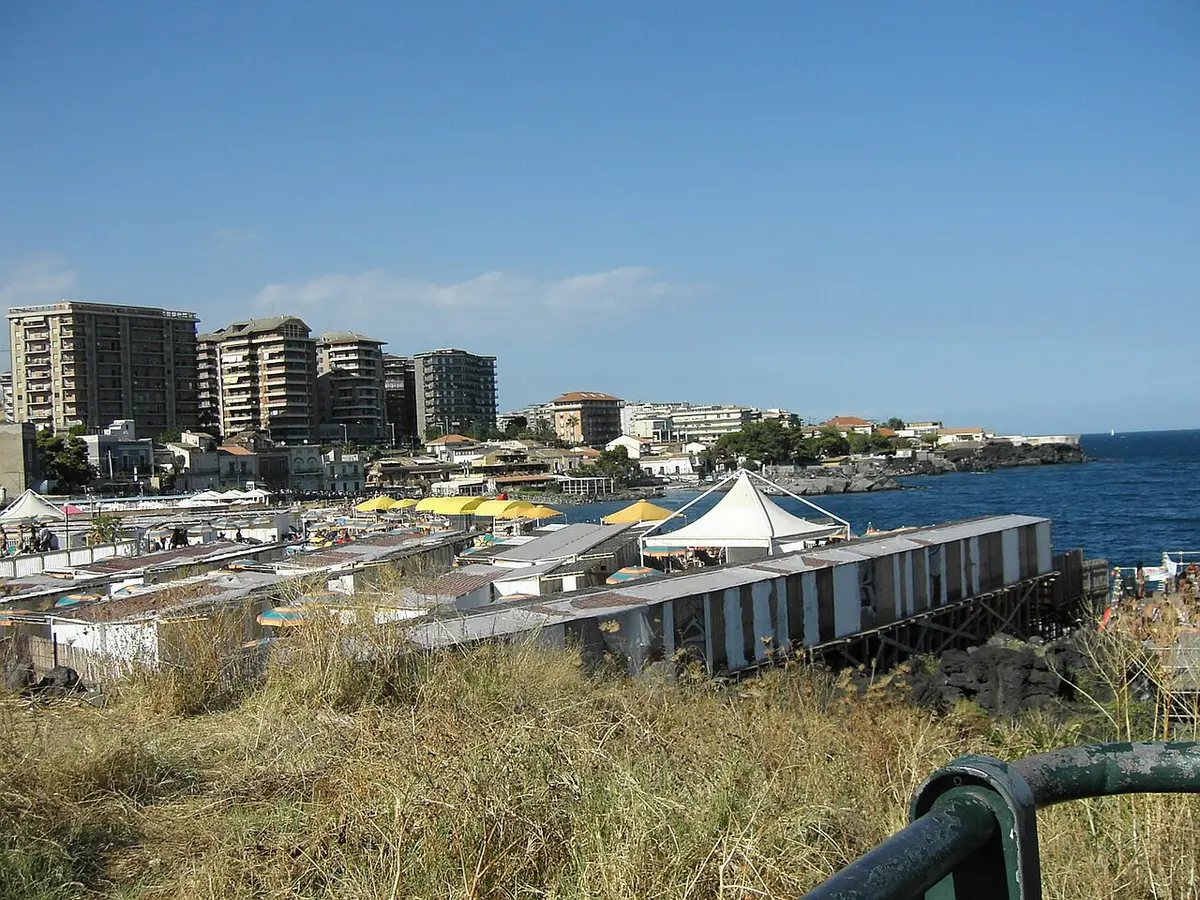
About San Giovanni Li Cuti Beach
San Giovanni Li Cuti is a small fishing quarter on the eastern seafront of Catania, between the centre and Ognina. Its beach is a pocket of black volcanic sand set among lava reefs, next to a harbour used only by small fishing boats. In Sicilian, li cuti means the lava rocks worn by the sea, and that is what surrounds you here: the sand is small and the rest of the shore is dark rock.
The whole coast here was shaped by lava flows that reached the sea in the Middle Ages. The beach is free, and each summer the city adds walkways, steps, showers, changing cabins and toilets. The water deepens fast and in places you get in by stepping or jumping off the lava, so bring sea shoes.
Be ready for the beach to look different from one year to the next. Winter storms have more than once thrown boulders over the sand and buried it, and the city has had to bring in diggers to clear it before summer. It is also not the quietest place: the bars and venues around the square stay busy on summer nights, and the seafront terraces of Piazza Europa above are a favourite place for an evening walk.
How to get to San Giovanni Li Cuti Beach
The beach is on the Catania seafront north of the centre, below Piazza Europa, where the seafront road runs past the old fishing quarter. Parking in the narrow streets around it is difficult in summer, so most people walk, cycle or take a city bus along the seafront.
From the Galatea metro station you can walk down to the sea. From the beach a walk north along the lava seafront takes you on to Ognina.
Reached on foot from the seafront road beside the little fishing harbour, with steps and a ramp down to the sand.
By car, San Giovanni Li Cuti Beach is about 13 minutes from Catania Fontanarossa airport and 1 hour 40 minutes from Comiso airport.
Tips for visiting San Giovanni Li Cuti Beach
- Wear sea shoes; the entry is partly over sharp lava rock.
- Go on a weekday morning if you want a patch of sand; it is tiny and fills fast.
- Stay for the evening when the bars around the beach and Piazza Europa come alive.
- Not ideal for small children, as the water gets deep quickly.
- After stormy weather check whether the sand has been covered with rocks before making a special trip.
What is there
- No lidos or sunbed hire, with a free public stretch.
- 12 public car parks mapped within 600 metres; in July and August they fill early.
Water quality at San Giovanni Li Cuti Beach
The nearest official monitoring point, San Giovanni Li Cuti, was rated poor for bathing in the 2025 season under the EU Bathing Water Directive; it has varied over the years (2025 poor, 2024 poor, 2023 sufficient, 2022 poor, 2021 poor). A poor rating means samples failed the EU standard, so check the signs on the beach and the comune’s bathing notices before you swim.
- 2025Poor
- 2024Poor
- 2023Sufficient
- 2022Poor
- 2021Poor
- 2020Poor
- 2019Poor
- 2018Sufficient
Ratings run from excellent through good and sufficient to poor, and are set from four seasons of samples taken through each bathing season by the Italian health authorities and reported to the European Environment Agency.
Facts about San Giovanni Li Cuti Beach
- Li cuti in Sicilian refers to sea worn lava rocks, the name of this stretch of coast.
- The beach covers only about 400 square metres of black volcanic sand beside a small solarium.
- Lava flows of the Middle Ages, including one in 1381, reached the sea along this part of Catania.
- The harbour beside the beach is used only by small fishing boats.
Catania: the town
Catania is Sicily's second city, a busy port of about 298,000 people between Etna and the Ionian Sea, rebuilt in baroque style and dark lava stone after the earthquake of 1693. Read our guide to living in Catania: house prices, the weather month by month, the nearest hospital and airports, history and food.
Beaches near San Giovanni Li Cuti Beach
- La Playa di Catania Catania, 5 km, fine sand
- Aci Castello Aci Castello, 5 km, rocks
- Aci Trezza Aci Castello, 6 km, rocks
- Capo Mulini Acireale, 9 km, rocks
- Santa Maria la Scala Acireale, 12 km, rocks and pebbles
- Santa Tecla Acireale, 14 km, rocks
- Oasi del Simeto Beach Catania, 14 km, sand
- Pozzillo Beach Acireale, 17 km, rocks and pebbles
Frequently asked questions
Is San Giovanni Li Cuti beach really black sand?
Yes. It is one of the few places in Catania with genuine black volcanic sand, though the sandy part is small, about 400 square metres. The rest of the shore is black lava rock, and you often get into the sea from the rocks.
Is San Giovanni Li Cuti beach free?
Yes, it is a free public beach. In summer the city installs walkways, steps, showers, changing cabins and toilets. There are no sunbeds to rent on the sand itself, so bring a towel and something for shade.
Is Li Cuti a good beach for children?
Not especially. The water deepens quickly and the entry is partly over sharp lava, so it suits confident swimmers. Families with small children usually go south of the city to the shallow sandy water of the Playa instead.
How do you get to San Giovanni Li Cuti from the centre of Catania?
It is on the seafront north of the centre, below Piazza Europa. You can walk down from the Galatea metro station or take a bus along the seafront. Driving is possible, but parking nearby is hard in summer.
Is the water clean at San Giovanni Li Cuti Beach?
The nearest official monitoring point, San Giovanni Li Cuti, was rated poor for bathing in the 2025 season under the EU Bathing Water Directive; it has varied over the years (2025 poor, 2024 poor, 2023 sufficient, 2022 poor, 2021 poor). A poor rating means samples failed the EU standard, so check the signs on the beach and the comune’s bathing notices before you swim. Ratings are based on samples taken through the bathing season and checked for bacteria from sewage. After heavy rain, water near river mouths can be cloudy for a day or two.
Featured in
Credits
Photo: kajikawa, CC BY 3.0, via Wikimedia Commons.
Written from 5 or more independent sources and checked. Figures: bathing water quality from the European Environment Agency (EU Bathing Water Directive), drive times and facilities from © OpenStreetMap contributors, map boundaries ISTAT via openpolis (CC BY 4.0).
Before you go: the latest sampling results and any bathing bans are on the Ministry of Health's Portale Acque, and local notices on the comune of Catania's website.
 The weekly YouTube series