
About Aci Castello
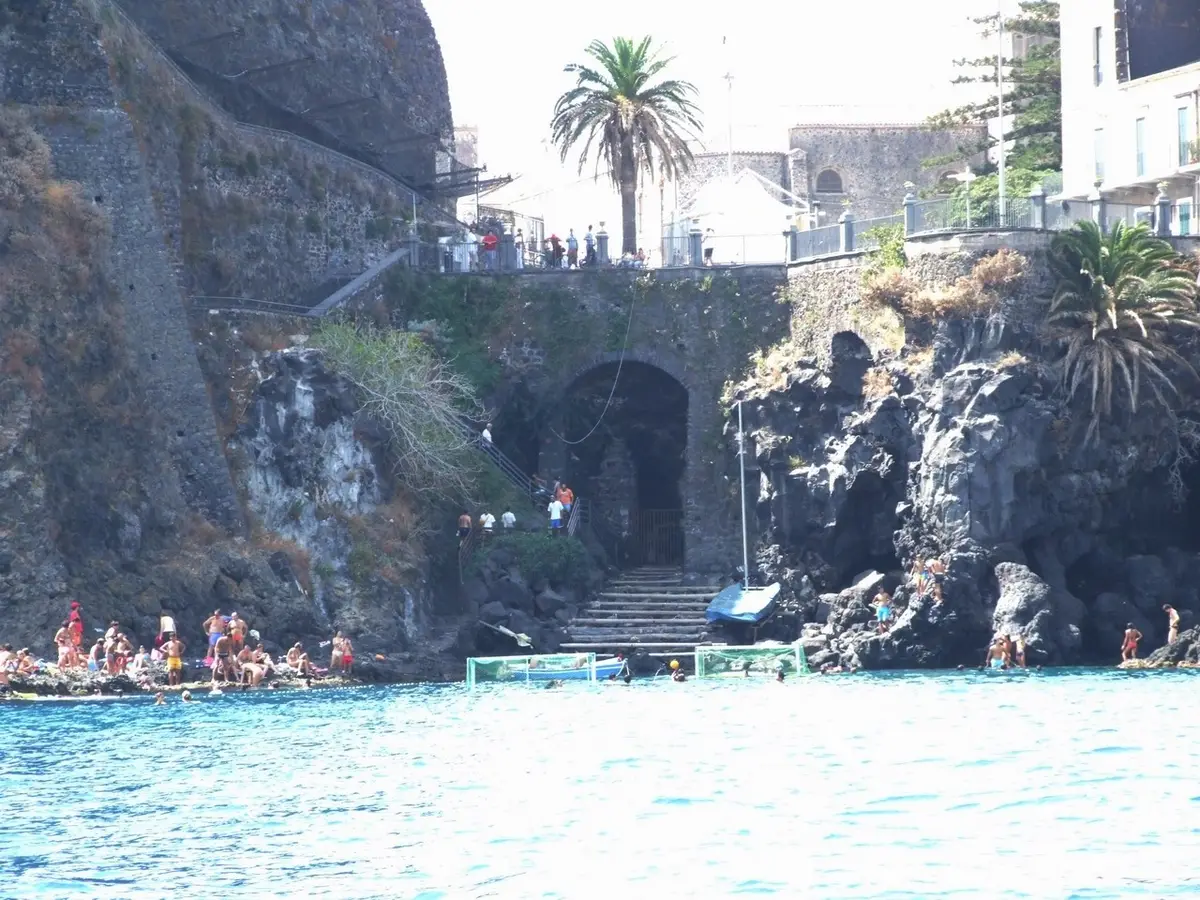
The village of Aci Castello is named after its castle, a Norman fortress of black lava stone perched on a crag of volcanic rock that rises straight out of the sea. Inside is the town's civic museum with archaeological and natural history finds. Around it, the coast is entirely dark basalt, shaped by Etna's ancient eruptions and by the waves, and this is where Catanesi come to swim from the rocks.
Below the castle and along the seafront the lava forms a bumpy but broad plateau, and there are concrete steps, small public platforms and ladders to get into the sea. The water deepens almost immediately, which makes for good swimming and snorkelling among the rocks, but it is no place for toddlers or weak swimmers. Several lidos along this coast build wooden decks over the rocks and rent out sunbeds, so you can choose between a free rock and a deckchair.
The honest drawbacks: the rock is hot, sharp and uneven, there is no shade on the free stretches, and when the wind blows from the east the sea breaks over the platforms and swimming becomes unsafe. In August the best flat rocks are taken by late morning.
How to get to Aci Castello
From Catania follow the seafront north through Ognina and Cannizzaro, or take the SS114 and turn down to the coast. Parking is around Piazza Castello at the foot of the castle and along the seafront; it is paid in summer and fills early at weekends.
AMTS city buses run from Catania along the coast to Aci Castello and Aci Trezza, and regional AST buses also stop here.
Steps lead down from the seafront to flat lava rocks and public platforms, with ladders into deep water.
By car, Aci Castello is about 22 minutes from Catania Fontanarossa airport and 1 hour 49 minutes from Comiso airport.
Tips for visiting Aci Castello
- Bring proper water shoes and a thick mat or cushion for the rocks.
- Do not swim when waves are breaking over the platforms; the rocks are slippery and sharp.
- Arrive early in summer to claim a flat spot on the free rocks.
- Pair a swim with a visit to the castle and its museum.
- Snorkel along the rock edge, where the lava drops away into clear water.
What is there
- Lidos with sunbeds and umbrellas to rent, with a free public stretch.
- A public car park mapped within 600 metres; in July and August they fill early.
Water quality at Aci Castello
The nearest official monitoring point, Immiss. L.Gomare Scardamiano 50m. Nord, was rated excellent for bathing in the 2025 season under the EU Bathing Water Directive, as it has been in each of the last 11 seasons.
- 2025Excellent
- 2024Excellent
- 2023Excellent
- 2022Excellent
- 2021Excellent
- 2020Excellent
- 2019Excellent
- 2018Excellent
Ratings run from excellent through good and sufficient to poor, and are set from four seasons of samples taken through each bathing season by the Italian health authorities and reported to the European Environment Agency.
Facts about Aci Castello
- The castle was built by the Normans in black lava stone on a volcanic crag above the sea.
- The castle houses the town's civic museum, with archaeological and natural history collections.
- Aci Castello is about 10 kilometres from the centre of Catania.
- The coast here is basalt lava, formed by ancient eruptions of Etna and shaped by the Ionian Sea.
Aci Castello: the town
Aci Castello is a seaside town of about 17,700 people on the lava coast just north of Catania, with a Norman castle on a black rock above the sea and the fishing village of Aci Trezza facing the Cyclops sea stacks. Read our guide to living in Aci Castello: house prices, the weather month by month, the nearest hospital and airports, history and food.
Beaches near Aci Castello
- Aci Trezza Aci Castello, 1 km, rocks
- Capo Mulini Acireale, 3 km, rocks
- San Giovanni Li Cuti Beach Catania, 5 km, sand and rocks
- Santa Maria la Scala Acireale, 7 km, rocks and pebbles
- Santa Tecla Acireale, 9 km, rocks
- La Playa di Catania Catania, 10 km, fine sand
- Pozzillo Beach Acireale, 12 km, rocks and pebbles
- Praiola Beach Riposto, 14 km, pebbles
Frequently asked questions
Is there a sandy beach at Aci Castello?
No. The shore at Aci Castello is black lava rock, with very little sand. People swim from flat rock shelves, small public platforms and ladders, or from lidos that build wooden decks over the rocks. For sand, go south to the Playa di Catania.
Is Aci Castello good for swimming?
For confident swimmers, yes. The water is clear and deepens straight away, which is also good for snorkelling along the rocks. It is not suitable for small children, and on days with an easterly swell the sea breaks over the rocks and you should stay out.
How do you get from Catania to Aci Castello by bus?
AMTS city buses run from Catania along the coast road to Aci Castello and on to Aci Trezza, and regional AST buses stop here too. By car it is a short drive north along the seafront, with paid parking around the castle in summer.
Do I need water shoes at Aci Castello?
Yes. The lava rock is sharp, uneven and very hot in the afternoon sun, and the ladders and steps can be slippery. Water shoes make getting in and out of the sea much safer and more comfortable.
Is the water clean at Aci Castello?
The nearest official monitoring point, Immiss. L.Gomare Scardamiano 50m. Nord, was rated excellent for bathing in the 2025 season under the EU Bathing Water Directive, as it has been in each of the last 11 seasons. Ratings are based on samples taken through the bathing season and checked for bacteria from sewage. After heavy rain, water near river mouths can be cloudy for a day or two.
Featured in
Credits
Photo: gnuckx, CC BY 2.0, via Wikimedia Commons.
Written from 5 or more independent sources and checked. Figures: bathing water quality from the European Environment Agency (EU Bathing Water Directive), drive times and facilities from © OpenStreetMap contributors, map boundaries ISTAT via openpolis (CC BY 4.0).
Before you go: the latest sampling results and any bathing bans are on the Ministry of Health's Portale Acque, and local notices on the comune of Aci Castello's website.
 The weekly YouTube series