
About Mascalucia
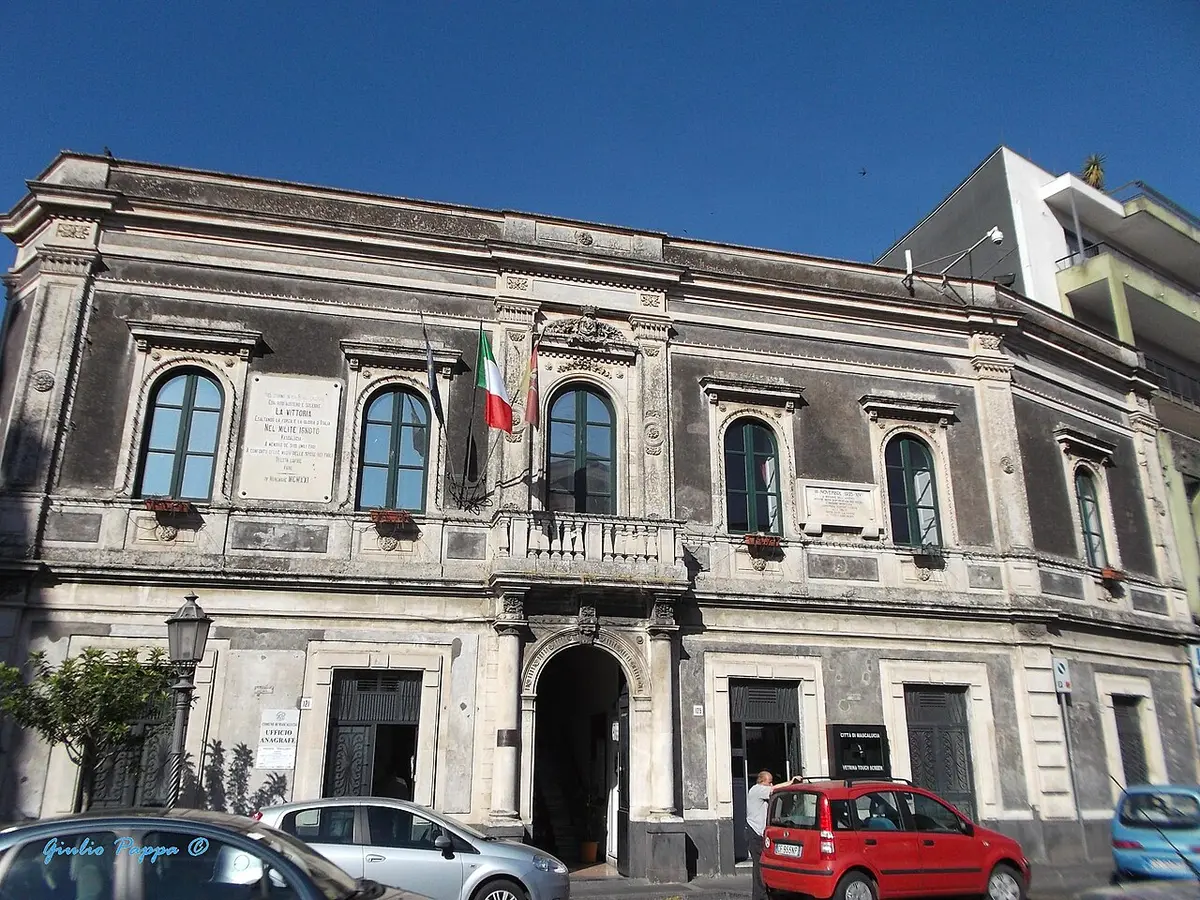
The centre holds the seventeenth-century church of San Vito, one of the town's two main churches, and the nineteenth-century former town hall facing it, once also a Bourbon prison. Mascalucia has around forty small street shrines; the largest, in the Sciara quarter, carries a plaque thanking Saint Vitus and Saint Agatha's veil for sparing the town from the lava of 1669. The frazione of Massannunziata, a separate comune until 1839, has the church of the Santissima Trinità of 1683 and the pilgrimage sanctuary of the Madonna della Sciara at Mompilieri.
Building boomed from the late 1960s, much of it unplanned, especially around Massannunziata. Green spaces include the Monte Ciraulo park and the Trinità-Manenti park, which hosts summer events.
Living in Mascalucia
Mascalucia is still growing, as it has for decades: between 1981 and 1991 its population rose by more than 86 per cent, the fastest in the Catania hinterland. There is almost no tourism, so it is a year-round community of commuters, families and schools, with a weekly market and plenty of everyday shops.
Catania's offices, university and big shopping are a short drive down the hill, and Etnapolis is not far. The pros: gardens, slightly fresher air, Etna and the city both close. The cons: traffic on the roads into Catania, sprawl and some poorly planned building, little historic character, and parts of the territory that fall in flood-risk zones after heavy rain.
A short history
Tradition says a village called Ombria stood here in the eighth century BC, and Roman farms dotted the area, with a villa likely at Trinità. The name may come from a Latin term for a gift estate, or from Masca di Santa Lucia, as sixteenth-century documents call it. In the Norman era it belonged to the bishop of Catania, and later to the city.
In 1645 the banker Giovanni Andrea Massa bought it at auction, and in 1651 it became a duchy of the Branciforte. The lava of 1669 buried part of the territory and sent many people to Catania, where with refugees from Misterbianco they founded the Borgo quarter; the earthquake of 1693 killed 53. Mascalucia became a comune in 1819, and in 1835 the Etna road from Catania through Mascalucia to Nicolosi opened.
On 3 August 1943 townspeople rose against looting German troops in one of the first anti-German revolts in Italy. From the late 1960s mass migration from Catania transformed the town.
Food, festivals and traditions
Mascalucia eats as the Etna villages do: wine from small vineyards and Catania's arancini, granita and pastries. The patron, Saint Vitus, proclaimed in 1771 in place of Saint Nicholas of Bari, is celebrated in June.
Interesting facts about Mascalucia
- Between 1981 and 1991 Mascalucia's population grew by 86.8 per cent.
- Refugees from Mascalucia and Misterbianco founded Catania's Borgo quarter after the 1669 eruption.
- Saint Vitus has been the town's patron since 1771.
- Massannunziata was a separate comune until 1839.
House prices in Mascalucia
€978average price per m² to buy
€3.55average rent per m² a month
€98,000a 100 m² home at that price
These are the official averages from the Agenzia delle Entrate's property market observatory (OMI) for homes in normal condition across the town's 3 price zones. Prices in Mascalucia are above the typical town in Catania province (€665 per m²) and above the typical Sicilian town (€593 per m²). Detached houses (villini) average about €1,145 per m².
Why these figures can look low: they come from the values on real sales, which sit below advertised asking prices, and the typical Sicilian town is the middle of all 391 comuni, most of them small inland towns. Island-wide averages quoted on property portals, around €1,100 to €1,300 per m², lean towards the cities and the coast, where most homes are listed. Rents work the same way: listings usually ask well above the official rent figure, often double or more.
Houses that need work, which is most of the cheap ones you see advertised, sell well below these figures. The renovation comes on top, so budget for both.
Work out the return on a let with the rental yield calculator, or see the steps from offer to keys in the buying timeline planner.
Getting there and getting around
| From the centre to | By car | Distance |
|---|---|---|
| Catania Fontanarossa airport (CTA) | 23 minutes | 19 km |
| Comiso airport (CIY) | 1 hour 43 minutes | 103 km |
| Palermo Falcone Borsellino airport (PMO) | 3 hours 13 minutes | 248 km |
| Trapani Birgi airport (TPS) | 4 hours 11 minutes | 326 km |
| Palermo city centre | 2 hours 44 minutes | 216 km |
| Catania city centre | 14 minutes | 10 km |
| Messina, for ferries to the mainland | 1 hour 13 minutes | 92 km |
| Nearest motorway or main road junction (Gravina) | 9 minutes | 8 km |
| Nearest railway station (Cibali) | 11 minutes | 10 km |
Times are by road on a clear day, worked out from OpenStreetMap. Allow longer in summer and on market days. Most people living in Mascalucia rely on a car; buses link the bigger towns but are infrequent on Sundays and in August.
Planning flights and trips? See the Schengen 90/180 calculator if you are from outside the EU.
Everyday life: shops, health and schools
- Hospital with A&E
- Ospedale Gaspare Rodolico, about 11 minutes by car
- Pharmacies in the comune
- 9
- Supermarkets
- 8
- Schools
- State: 8 nursery schools, 7 primary schools, 3 middle schools, 2 secondary schools; plus 1 independent (paritaria)
- Banks and cash machines
- 5
- Cafés and bars
- 13
- Restaurants
- 12
- Full fibre broadband
- 76.9% of addresses
Pharmacies and schools come from the official Ministry of Health and Ministry of Education lists. The other counts are of places mapped in OpenStreetMap inside the comune's boundary, so a small shop or a doctor's surgery can be missing. “Not fully mapped yet” means the volunteer map clearly has gaps here, not that the town has none. For a family doctor (medico di base, what the British call a GP), you register with the local health authority (ASP Catania) once you are resident.
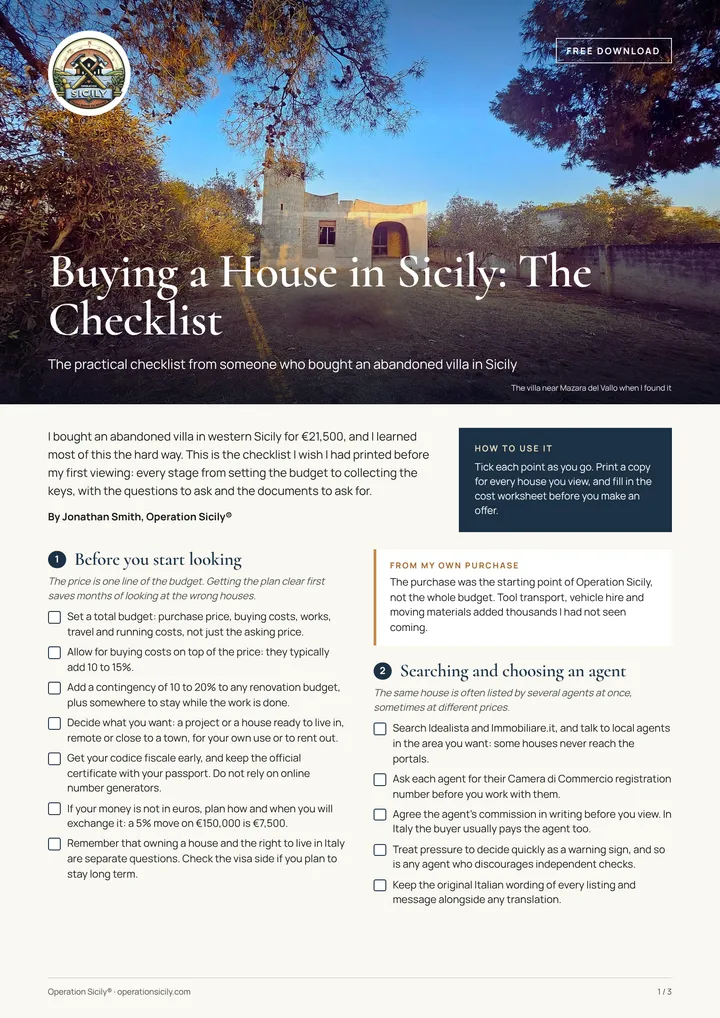
Free download
Buying a house in Sicily? Take my checklist.
Every step from budget to keys, the questions to ask at a viewing and the documents to ask for, as a PDF you can print.
Here is your checklist. Download the checklist (PDF)
Weather and climate in Mascalucia
31.5°Caverage July high
4.6°Caverage January low
724 mmrain a year, on about 110 days
45days a year above 30°C
| Month | Average temperature | Rain |
|---|---|---|
| January | 8°C | 89 mm |
| February | 8°C | 81 mm |
| March | 11°C | 67 mm |
| April | 14°C | 48 mm |
| May | 18°C | 21 mm |
| June | 23°C | 17 mm |
| July | 27°C | 9 mm |
| August | 27°C | 15 mm |
| September | 23°C | 70 mm |
| October | 18°C | 93 mm |
| November | 14°C | 110 mm |
| December | 10°C | 106 mm |
Averages for 2015 to 2024. Winters are cool and damp, and you will want heating for three or four months. Summers are hot and dry.
See what each month brings in Sicily month by month, or size a solar system with the off-grid solar calculator.
Who lives there
- Population
- 32,130
- Change since 2019
- +4.2%
- Median age
- 42
- Foreign residents
- 368 (1.1%)
- People from Mascalucia are called
- mascaluciesi
Registered residents from abroad include 2 British, 17 American, 5 German, 3 Dutch, 3 French, 1 Irish, 1 Australian, 1 Canadian, 2 Swedish, 1 Swiss, 8 Spanish, 13 Polish, 67 Romanian, 27 Albanian and 13 Ukrainian citizens. Most of the rest come from countries outside Europe and the Americas.
Mascalucia lives mainly for its own residents rather than for visitors, with only about 118 tourist beds, so everyday life changes little between summer and winter.
Beaches near Mascalucia
- San Giovanni Li Cuti Beach Catania, 8 km, sand and rocks, water poor
- Aci Castello Aci Castello, 9 km, rocks, water excellent
- Aci Trezza Aci Castello, 10 km, rocks, water sufficient
- La Playa di Catania Catania, 11 km, fine sand, water sufficient
Things to see and do in and around Mascalucia
Visit the Madonna della Sciara sanctuary at Mompilieri, in an area buried by the lava of 1669, and follow the trail of street shrines. Nicolosi, the Monti Rossi and the road up to the southern craters of Etna are just above the town, and Catania's baroque centre is a short drive below.
- San Vito martire
- Santuario della Madonna della Sciara
- Santa Maria della Consolazione
The quickest beach to reach by car, Spiaggetta Lognina, is about 16 minutes away.
Famous people born in Mascalucia include Pietro Frosini (Italian musician).
Earthquake, landslide and flood risk
Mascalucia is in seismic zone 2, the second highest of Italy’s four seismic zones. The zone sets the anti-seismic standard for any new building, extension or structural renovation, which affects both the design and the cost. A structural survey is worth paying for before you buy any older building, stone house or flat.
ISPRA maps no high landslide hazard areas in the comune, and 7% of the land could flood in a medium-probability flood (4.8% of residents). Ask for the hazard maps (PAI) for any house you are considering; the comune's technical office or your geometra can check them.
Check what you can build or change with the building permit checker, and keep a margin with the renovation contingency calculator.
The comune: useful details
- Official name
- Comune di Mascalucia
- Province
- Catania (Città metropolitana di Catania)
- Postcode (CAP)
- 95030
- Dialling code
- 095
- Area
- 16 km²
- Height above sea level
- 420 m
- ISTAT code
- 087024
- Cadastral code
- F005 (used in the codice fiscale of people born here)
- Official website
- comune.mascalucia.ct.it
Registering as a resident, paying local taxes and building permits all go through the comune. If you were born abroad, get your Italian tax code first with the codice fiscale calculator.
Nearby towns
Mascalucia borders 7 other comuni:
- Belpasso €774/m²
- Catania €1,279/m²
- Gravina di Catania €1,023/m²
- Nicolosi €793/m²
- Pedara €975/m²
- San Pietro Clarenza €795/m²
- Tremestieri Etneo €1,085/m²
Towns like Mascalucia elsewhere in Sicily
- Monreale (Palermo province)
- Modica (Ragusa province)
- Alcamo (Trapani province)
- Ragusa (Ragusa province)
- Castelvetrano (Trapani province)
- Canicattì (Agrigento province)
Mascalucia on our lists
See every town in Catania province (58 comuni), or let Find your town suggest places that match what you want.
Frequently asked questions
Where is Mascalucia in Sicily?
Mascalucia is in the province of Catania, about 8 km north of Catania. The centre sits about 420 metres above sea level.
What is Mascalucia known for?
Between 1981 and 1991 Mascalucia's population grew by 86.8 per cent. Refugees from Mascalucia and Misterbianco founded Catania's Borgo quarter after the 1669 eruption. Saint Vitus has been the town's patron since 1771.
Is Mascalucia a good place to live?
It depends what you want. Families who want a house with a garden between the city and the volcano, and who accept driving as part of daily life. The nearest emergency department is about 11 minutes away, and homes average about €978 per m².
How much do houses cost in Mascalucia?
Official figures from the Agenzia delle Entrate put homes in Mascalucia at about €978 per square metre on average, so a 100 m² home in normal condition would be roughly €98,000. That is above the typical town in the province (€665) and above the typical Sicilian town (€593). Houses needing work sell for less, and the best homes for more.
What is the nearest airport to Mascalucia?
Catania Fontanarossa airport is the nearest, about 23 minutes away by car (19 km). Comiso is about 1 hour 43 minutes away. Times are for a clear road and will be longer in summer traffic.
What is the weather like in Mascalucia?
Summers are hot and dry: July afternoons average about 31.5°C, with around 45 days a year above 30°C. Winter nights in January average about 4.6°C. Rain totals about 724 mm a year, falling mostly between October and March.
How many people live in Mascalucia?
32,130 people live in the comune of Mascalucia, according to ISTAT. The population grew by 4.2% between 2019 and 2025. Half the residents are older than 42.
Is there a hospital near Mascalucia?
The nearest hospital with an emergency department (pronto soccorso) is Ospedale Gaspare Rodolico, about 11 minutes away by car. In an emergency anywhere in Italy, call 112.
Is Mascalucia in an earthquake zone?
Mascalucia is in seismic zone 2, the second highest of Italy’s four seismic zones. New building and structural work anywhere in Italy must follow anti-seismic rules, and the zone sets how strict they are, so ask your geometra or engineer to check any house you plan to buy or renovate.
Does Mascalucia count for the 7% flat tax for pensioners?
It is close. The population figure used for the limit puts Mascalucia at about 32,124 residents, against the 30,000 limit for Italy's 7% flat tax for foreign pensioners, so the exact ISTAT figure for the year that applies to you decides it. Check the details with our 7% flat tax town checker and a qualified adviser.
Does Mascalucia have fast internet?
Yes, for most homes: about 76.9% of addresses in Mascalucia can get full fibre (FTTH), according to the communications regulator AGCOM. Check the exact address before you buy.
Credits
Photo: Giulio Pappa, CC BY-SA 3.0, via Wikimedia Commons.
Figures: ISTAT, Agenzia delle Entrate (OMI), Copernicus ERA5-Land, AGCOM, Dipartimento della Protezione Civile, ISPRA, Ministero della Salute, Ministero dell'Istruzione e del Merito, IndicePA, Open-Meteo, NASA POWER, Wikidata and © OpenStreetMap contributors, with several series gathered by the expatliving-data open data collection. Map boundaries ISTAT via openpolis (CC BY 4.0). Sicily as a whole: 4,787,390 people in 391 comuni.
 The weekly YouTube series