
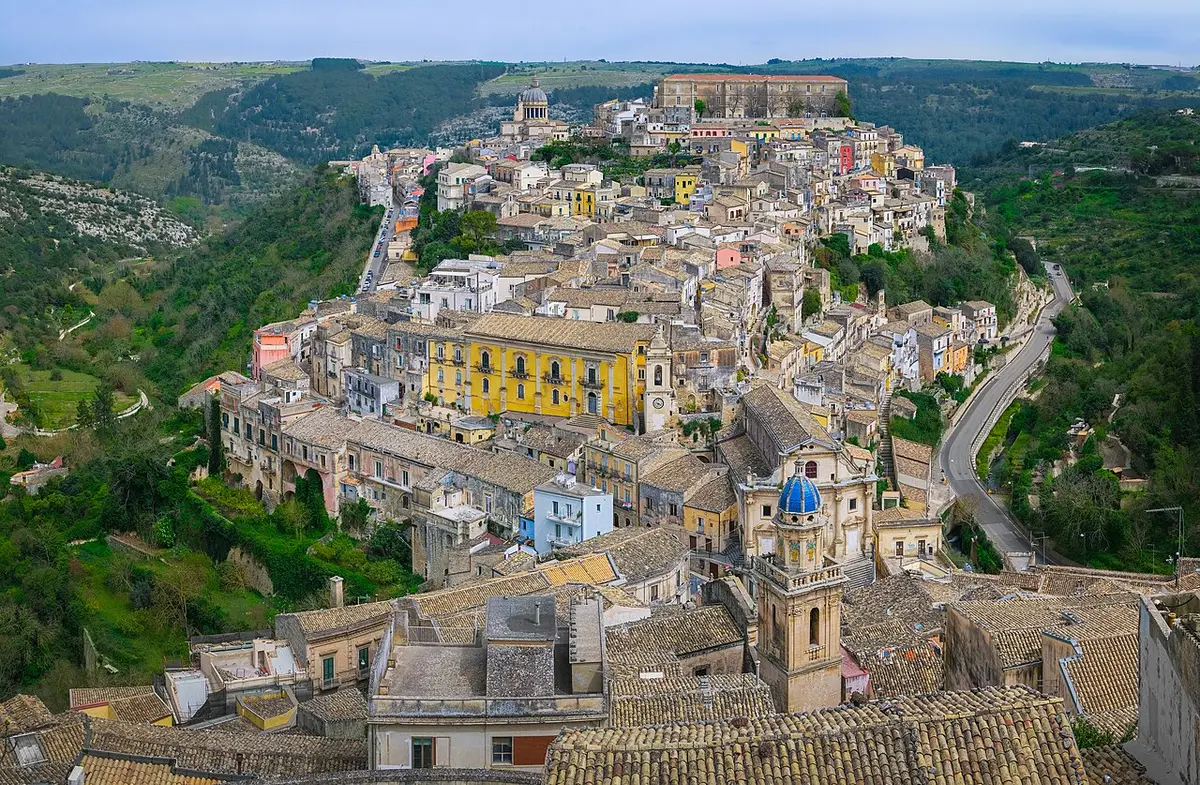
About Ragusa
Ibla keeps its medieval street plan: lanes and stairways lead to the cathedral of San Giorgio, Rosario Gagliardi's masterpiece, raised above its piazza, and on to the Giardino Ibleo at the eastern end. Palazzo Zacco, Palazzo Battaglia, Santa Maria dell'Itria with its tiled dome and the stairway of Santa Maria delle Scale link the two towns. Ragusa Superiore has the cathedral of San Giovanni Battista and most of the city's shops and offices.
The comune is the third largest in Sicily by area, running from Monte Arcibessi, at about 906 metres, to some 15 km of coast with sandy beaches and rocky stretches. The Iblei countryside around it is a patchwork of dry-stone walls, carobs and olives, with the Irminio river dammed to form Lago Santa Rosalia. The nineteenth century Castello di Donnafugata stands in the countryside to the south-west.
Living in Ragusa
Ragusa is busy all year as a capital, with courts, offices, schools and the main services of the province, and its population is growing, unusual for Sicily. In summer the focus shifts to Marina di Ragusa, which fills with residents' families and visitors; Ibla is lively with tourists for much of the year. There is a large Albanian community, along with Romanian and other foreign residents.
Pros: an attractive, orderly city with good services, beautiful old quarters, beaches within the comune and Comiso airport nearby. Cons: it is spread out and car-dependent, the upper town is plain, Ibla's steep lanes are hard work, and winters on the plateau are cooler than on the coast.
A short history
Settlement goes back to the Castelluccio culture of the Early Bronze Age. Ibla has long been linked with Hybla Heraea, a Sicel town, though its site is unproven. After Greek, Roman and Byzantine rule, the Arabs took Ragusa in 848; under the Normans it became a county seat for Geoffrey, son of Count Roger, and later part of the County of Modica.
The earthquake of 1693 almost destroyed the city and killed more than 5,000 people. Some families rebuilt on the old site at Ibla, others founded a new town on the plateau, and the rivalry lasted until the two separate comuni were reunited in 1926. Ragusa became a provincial capital in 1927, and on 25 June 2002 its baroque monuments were listed by UNESCO with the other towns of the Val di Noto. The astronomer Giovan Battista Hodierna was born here in 1597.
Food, festivals and traditions
Ragusa's table is among the best in Sicily: Ragusano DOP, a stretched cow's milk cheese aged in rectangular blocks, scacce folded with tomato and cheese, impanate pies, pork, ricotta pastries and the honey of the Iblei.
The patron, San Giovanni Battista, is celebrated in late August in the upper town, while Ibla honours San Giorgio with its own feast and procession.
Interesting facts about Ragusa
- Ragusa is the southernmost provincial capital in Italy.
- Ragusa Ibla and the upper town were separate comuni until 1926.
- The 1693 earthquake killed more than 5,000 people in Ragusa.
- It is the third largest comune in Sicily by area.
House prices in Ragusa
€973average price per m² to buy
€4.55average rent per m² a month
€97,000a 100 m² home at that price
These are the official averages from the Agenzia delle Entrate's property market observatory (OMI) for homes in normal condition across the town's 8 price zones. Prices in Ragusa are above the typical town in Ragusa province (€804 per m²) and above the typical Sicilian town (€593 per m²). Detached houses (villini) average about €1,355 per m².
Why these figures can look low: they come from the values on real sales, which sit below advertised asking prices, and the typical Sicilian town is the middle of all 391 comuni, most of them small inland towns. Island-wide averages quoted on property portals, around €1,100 to €1,300 per m², lean towards the cities and the coast, where most homes are listed. Rents work the same way: listings usually ask well above the official rent figure, often double or more.
Houses that need work, which is most of the cheap ones you see advertised, sell well below these figures. The renovation comes on top, so budget for both.
Work out the return on a let with the rental yield calculator, or see the steps from offer to keys in the buying timeline planner.
Getting there and getting around
| From the centre to | By car | Distance |
|---|---|---|
| Comiso airport (CIY) | 34 minutes | 23 km |
| Catania Fontanarossa airport (CTA) | 1 hour 40 minutes | 101 km |
| Palermo Falcone Borsellino airport (PMO) | 4 hours 11 minutes | 281 km |
| Trapani Birgi airport (TPS) | 5 hours 9 minutes | 360 km |
| Palermo city centre | 3 hours 41 minutes | 250 km |
| Catania city centre | 1 hour 42 minutes | 105 km |
| Messina, for ferries to the mainland | 2 hours 47 minutes | 198 km |
| Nearest motorway or main road junction | 10 minutes | 7 km |
| Nearest railway station (Ragusa) | 4 minutes | 2 km |
Times are by road on a clear day, worked out from OpenStreetMap. Allow longer in rush hour and in summer. Ragusa has its own city buses, and coaches and trains link it to the rest of Sicily, though a car makes the countryside and smaller towns much easier to reach.
Planning flights and trips? See the Schengen 90/180 calculator if you are from outside the EU.
Everyday life: shops, health and schools
- Hospital with A&E
- Ospedale Maria Paternò Arezzo, about 5 minutes by car
- Pharmacies in the comune
- 24
- Supermarkets
- 32
- Schools
- State: 31 nursery schools, 18 primary schools, 8 middle schools, 16 secondary schools; plus 14 independent (paritaria)
- Banks and cash machines
- 24
- Cafés and bars
- 83
- Restaurants
- 117
- Full fibre broadband
- 92.9% of addresses
Pharmacies and schools come from the official Ministry of Health and Ministry of Education lists. The other counts are of places mapped in OpenStreetMap inside the comune's boundary, so a small shop or a doctor's surgery can be missing. “Not fully mapped yet” means the volunteer map clearly has gaps here, not that the town has none. For a family doctor (medico di base, what the British call a GP), you register with the local health authority (ASP Ragusa) once you are resident.
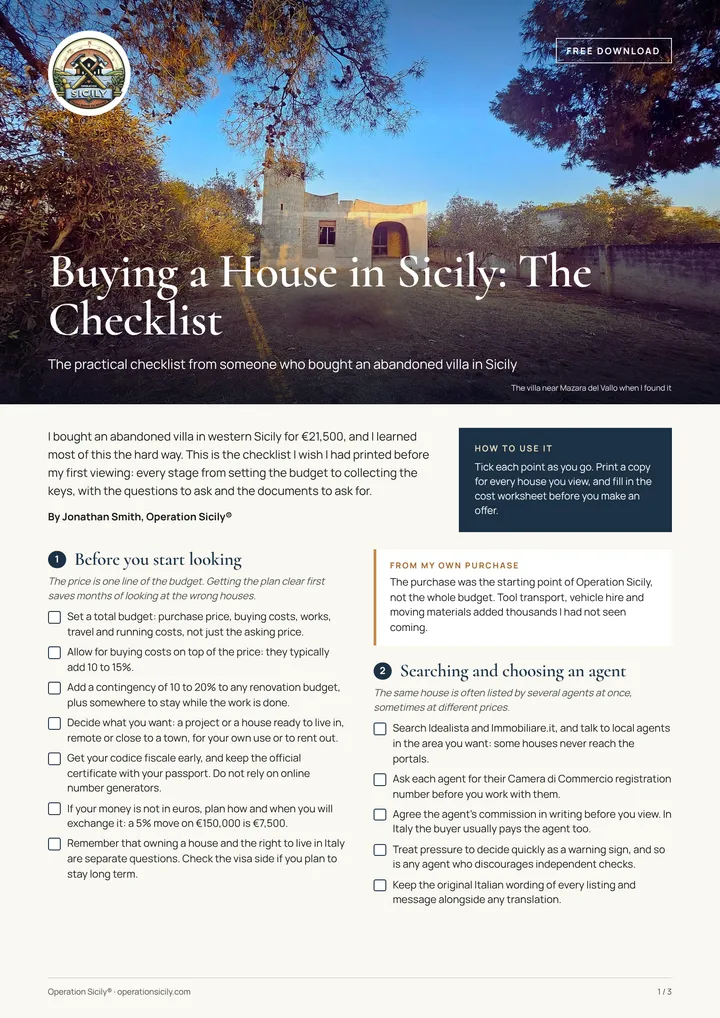
Free download
Buying a house in Sicily? Take my checklist.
Every step from budget to keys, the questions to ask at a viewing and the documents to ask for, as a PDF you can print.
Here is your checklist. Download the checklist (PDF)
Weather and climate in Ragusa
31.3°Caverage July high
5.8°Caverage January low
498 mmrain a year, on about 82 days
37days a year above 30°C
| Month | Average temperature | Rain |
|---|---|---|
| January | 8°C | 65 mm |
| February | 8°C | 57 mm |
| March | 10°C | 44 mm |
| April | 13°C | 29 mm |
| May | 17°C | 12 mm |
| June | 22°C | 8 mm |
| July | 26°C | 4 mm |
| August | 26°C | 8 mm |
| September | 22°C | 50 mm |
| October | 18°C | 65 mm |
| November | 13°C | 80 mm |
| December | 9°C | 76 mm |
Averages for 2015 to 2024. At 520 metres, Ragusa is cooler than the coast. Winters are cool and damp, and you will want heating for three or four months. Summers are hot and dry.
See what each month brings in Sicily month by month, or size a solar system with the off-grid solar calculator.
Who lives there
- Population
- 73,878
- Change since 2019
- +3.5%
- Median age
- 46
- Foreign residents
- 7,124 (9.6%)
- People from Ragusa are called
- ragusani
Registered residents from abroad include 22 British, 13 American, 28 German, 8 Dutch, 28 French, 3 Belgian, 2 Irish, 1 Australian, 9 Canadian, 5 Swedish, 3 Swiss, 22 Spanish, 134 Polish, 921 Romanian, 2,239 Albanian and 86 Ukrainian citizens. Most of the rest come from countries outside Europe and the Americas. Others own holiday homes here without registering as residents.
Ragusa is a working town first, busy all year round, with about 7,445 tourist beds. Visitors add to the summer crowds without changing the way the place lives.
Beaches in Ragusa
Ragusa has 5 beaches in our beach guide, and one more named beach or cove mapped along its coast. 92% of its officially monitored bathing waters were rated excellent in the latest EU assessment. It flies the Blue Flag this season.
- Irminio River Beach fine sand, water excellent
- Kamarina Beach fine sand, water excellent
- Marina di Ragusa Beach fine sand, water excellent
- Punta Braccetto Beach sand and rocks
- Randello Beach fine sand, water excellent
Things to see and do in and around Ragusa
Walk down into Ibla by the stepped lanes from the upper town, visit San Giorgio and the Giardino Ibleo, and stay for an evening meal in the piazza. The Museo Archeologico Ibleo holds finds from Kamarina and Scornavacche, and the cathedral museum and the Donnafugata castle, with its park, make good half-days.
Marina di Ragusa has a long promenade and sandy beaches, and the reserve at the mouth of the Irminio is close. Modica, Scicli, Chiaramonte Gulfi and Punta Secca are within easy reach.
- Ragusa Cathedral
- Donnafugata Castle
- Duomo of San Giorgio
- Santa Maria dell'Itria, Ragusa
- San Filippo Neri, Ragusa
- Santa Maria dei Miracoli, Ragusa
- Santa Maria delle Scale
- Chiesa del Purgatorio
- San Giuseppe, Ragusa
- Torre Cabrera
- Grotta Delle Trabacche
- Palazzo Battaglia, Ragusa
- Palazzo Zacco
- San Francesco all'Immacolata
The quickest beach to reach by car, Spiaggia Donnalucata, is about 39 minutes away.
Famous people born in Ragusa include Giovan Battista Hodierna (Italian astronomer); Damiano Caruso (Italian road racing cyclist); Loredana Cannata (Italian actress); Maria Occhipinti (Italian anarchist, activist and writer); Maria Schininà (nun).
Earthquake, landslide and flood risk
Ragusa is in seismic zone 1, the highest of Italy’s four seismic zones. The zone sets the anti-seismic standard for any new building, extension or structural renovation, which affects both the design and the cost. A structural survey is worth paying for before you buy any older building, stone house or flat.
2% of the comune's land is mapped by ISPRA as high or very high landslide hazard, where 0.6% of residents live, and under 0.1% of the land could flood in a medium-probability flood. Ask for the hazard maps (PAI) for any house you are considering; the comune's technical office or your geometra can check them.
Check what you can build or change with the building permit checker, and keep a margin with the renovation contingency calculator.
The comune: useful details
- Official name
- Comune di Ragusa
- Province
- Ragusa (Libero consorzio comunale di Ragusa)
- Postcode (CAP)
- 97100
- Dialling code
- 0932
- Area
- 437 km²
- Height above sea level
- 520 m
- ISTAT code
- 088009
- Cadastral code
- H163 (used in the codice fiscale of people born here)
- Official website
- comune.ragusa.it
Registering as a resident, paying local taxes and building permits all go through the comune. If you were born abroad, get your Italian tax code first with the codice fiscale calculator.
Nearby towns
Ragusa borders 9 other comuni:
- Chiaramonte Gulfi €653/m²
- Comiso €638/m²
- Giarratana €613/m²
- Modica €993/m²
- Monterosso Almo €625/m²
- Rosolini €693/m²
- Santa Croce Camerina €947/m²
- Scicli €914/m²
- Vittoria €862/m²
Towns like Ragusa elsewhere in Sicily
- Mascalucia (Catania province)
- Monreale (Palermo province)
- Caltanissetta (Caltanissetta province)
- Alcamo (Trapani province)
- Belpasso (Catania province)
- San Giovanni la Punta (Catania province)
Ragusa on our lists
- The best towns for full fibre broadband
- The biggest towns in Sicily
- Where British people live in Sicily
See every town in Ragusa province (12 comuni), or let Find your town suggest places that match what you want.
Frequently asked questions
Where is Ragusa in Sicily?
Ragusa is in the province of Ragusa, 179 km south-east of Palermo. The centre sits about 520 metres above sea level and its land runs down to the coast.
What is Ragusa known for?
Ragusa is the southernmost provincial capital in Italy. Ragusa Ibla and the upper town were separate comuni until 1926. The 1693 earthquake killed more than 5,000 people in Ragusa.
Is Ragusa a good place to live?
It depends what you want. It suits people who want the services of a provincial capital, extraordinary architecture and the beach in one comune. The nearest emergency department is about 5 minutes away, and homes average about €973 per m².
How much do houses cost in Ragusa?
Official figures from the Agenzia delle Entrate put homes in Ragusa at about €973 per square metre on average, so a 100 m² home in normal condition would be roughly €97,000. That is above the typical town in the province (€804) and above the typical Sicilian town (€593). Houses needing work sell for less, and the best homes for more.
What is the nearest airport to Ragusa?
Comiso airport is the nearest, about 34 minutes away by car (23 km). Catania Fontanarossa is about 1 hour 40 minutes away. Times are for a clear road and will be longer in summer traffic.
What is the weather like in Ragusa?
Summers are hot and dry: July afternoons average about 31.3°C, with around 37 days a year above 30°C. Winter nights in January average about 5.8°C. Rain totals about 498 mm a year, falling mostly between October and March.
How many people live in Ragusa?
73,878 people live in the comune of Ragusa, according to ISTAT. The population grew by 3.5% between 2019 and 2025. Half the residents are older than 46.
Is there a hospital near Ragusa?
The nearest hospital with an emergency department (pronto soccorso) is Ospedale Maria Paternò Arezzo, about 5 minutes away by car. In an emergency anywhere in Italy, call 112.
Is Ragusa in an earthquake zone?
Ragusa is in seismic zone 1, the highest of Italy’s four seismic zones. New building and structural work anywhere in Italy must follow anti-seismic rules, and the zone sets how strict they are, so ask your geometra or engineer to check any house you plan to buy or renovate.
Does Ragusa count for the 7% flat tax for pensioners?
No. On the population figure used for the limit, about 74,122 residents, Ragusa is over the 30,000 limit for Italy's 7% flat tax for foreign pensioners. Many smaller towns nearby do qualify. Check the details with our 7% flat tax town checker and a qualified adviser.
Does Ragusa have fast internet?
Yes, for most homes: about 92.9% of addresses in Ragusa can get full fibre (FTTH), according to the communications regulator AGCOM. Check the exact address before you buy.
Credits
Photo: Chris Down, CC BY 4.0, via Wikimedia Commons.
Figures: ISTAT, Agenzia delle Entrate (OMI), Copernicus ERA5-Land, AGCOM, Dipartimento della Protezione Civile, ISPRA, Ministero della Salute, Ministero dell'Istruzione e del Merito, IndicePA, Open-Meteo, NASA POWER, Wikidata and © OpenStreetMap contributors, with several series gathered by the expatliving-data open data collection. Map boundaries ISTAT via openpolis (CC BY 4.0). Sicily as a whole: 4,787,390 people in 391 comuni.
 The weekly YouTube series