
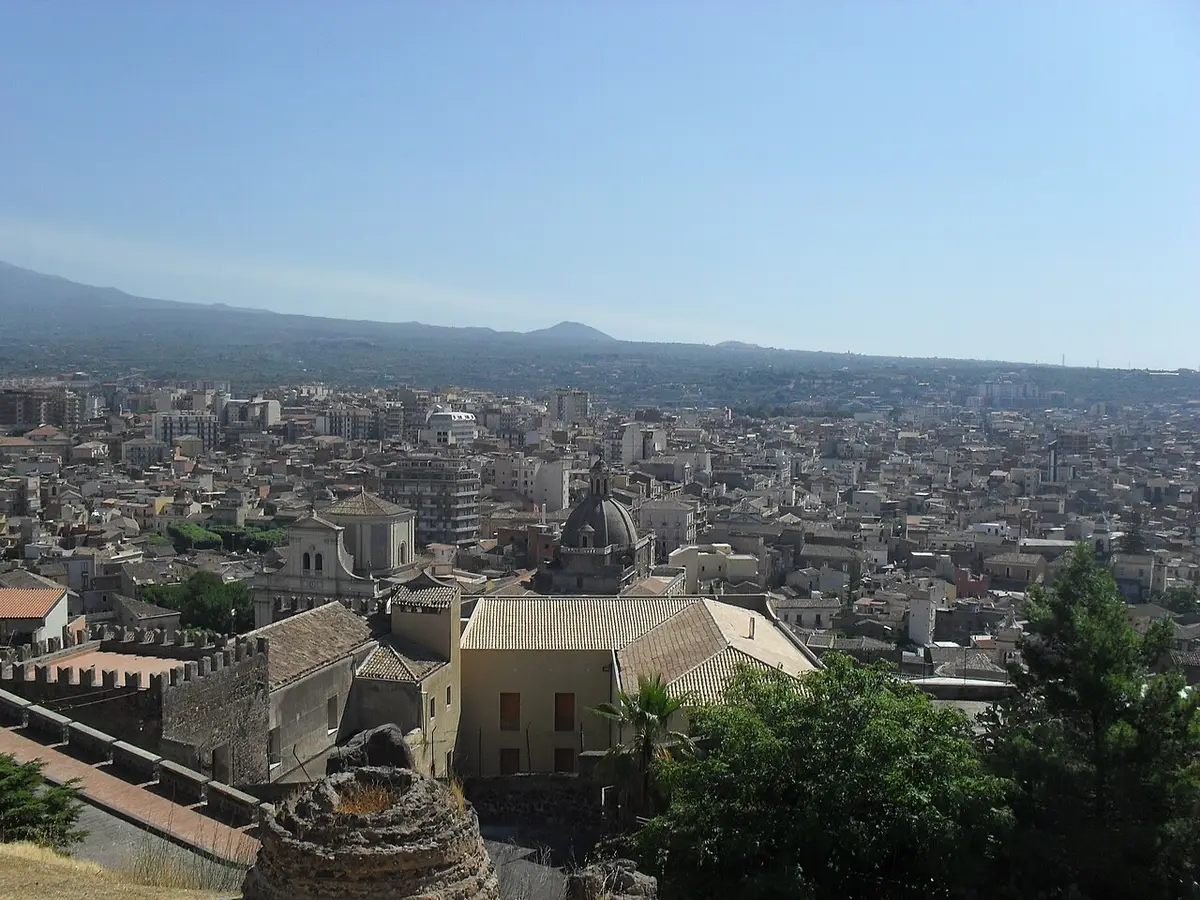
About Paternò
The Norman castle, built for Count Roger in 1072 and much altered in the early fourteenth century, is a rectangular donjon like those raised in France and England in the same years. On the same hill stand Santa Maria dell'Alto, begun in 1072 and finished around 1342, the former convent of San Francesco of 1346, and the monumental cemetery of 1887; the matrice stairway of about 1782 leads up to the Porta del Borgo, once the main entrance to the town. Three of the nine Norman gates survive.
Down in the lower town are dozens of churches, among them Santa Maria della Valle di Josaphat, founded in 1090 by Countess Adelaide del Vasto, and Santa Barbara, dedicated to the patron. Palazzo Alessi of 1787 is the town hall, and the Giardino Moncada is the main park. The Salinelle, small mud volcanoes, bubble on the edge of town, and the Ponte Barca oasis on the Simeto is a protected site for birds.
Living in Paternò
Paternò is a real town rather than a resort, with very little tourism and a slowly falling population. The old centre has emptied as people moved to newer districts, from 30,000 residents in 1950 to 18,000 in 1995, and much post-war building was disorderly, though the planned Ardizzone quarter to the north has good services and green space.
The Circumetnea station is on the east side of town, and two mainline stations, Sferro and Gerbini, lie on the Palermo to Catania railway to the south. Official reports point to problems of crime, including organised crime, and high unemployment, so it pays to get to know individual neighbourhoods before buying.
The pros: low costs, a full range of shops and schools, a long history and the countryside close by. The cons: a run-down historic core, traffic, summer heat on the plain and limited job opportunities.
A short history
The hill was home to the Sicel town of Hybla Gereatis, and nearby Inessa was renamed Aitna after refugees from Katane settled there; both fell to Hieron I of Siracusa around 460 BC and later came under Rome. The Arabs called the place Batarnù. After the Norman conquest Roger I built the keep, and the town flourished.
In 1302 Frederick III placed Paternò in the Camera Reginale, the dower of the queens of Sicily, and he died here in 1337. The Moncada bought it in 1456 and became princes of Paternò in 1565, ruling until feudalism ended in 1812. On 17 May 1860 the town rose against the Bourbons, and Garibaldi visited in 1864.
Allied bombing between 14 July and 2 August 1943 destroyed about 80 per cent of the town. Ragalna, once part of the comune, became independent in 1985.
Food, festivals and traditions
Paternò is in the Arancia Rossa di Sicilia IGP area. The traditional dish is frog, and eel is also eaten. Christmas brings the luna, a half moon pastry filled with dried figs, honey, candied citrus, nuts and cinnamon; Paternò's cassatelle are two biscuits filled with cream and iced, often with a treble clef.
Saint Barbara, the patron, is celebrated for a week up to 4 December, with candle towers called varette leading her float, and again on 27 May and 27 July. Saint Vincent is the co-patron.
Interesting facts about Paternò
- King Frederick III of Sicily died in Paternò in 1337.
- The astronaut Luca Parmitano was born in Paternò.
- The Paternò Treasure, silver vessels of the fourth century BC found near the castle in 1909, is now largely in Berlin.
- Local speech is nicknamed allarunchiata, from larunchia, the Sicilian word for frog.
House prices in Paternò
€710average price per m² to buy
€2.55average rent per m² a month
€71,000a 100 m² home at that price
These are the official averages from the Agenzia delle Entrate's property market observatory (OMI) for homes in normal condition across the town's 4 price zones. Prices in Paternò are close to the typical town in Catania province (€665 per m²) and above the typical Sicilian town (€593 per m²). Detached houses (villini) average about €645 per m².
Why these figures can look low: they come from the values on real sales, which sit below advertised asking prices, and the typical Sicilian town is the middle of all 391 comuni, most of them small inland towns. Island-wide averages quoted on property portals, around €1,100 to €1,300 per m², lean towards the cities and the coast, where most homes are listed. Rents work the same way: listings usually ask well above the official rent figure, often double or more.
Houses that need work, which is most of the cheap ones you see advertised, sell well below these figures. The renovation comes on top, so budget for both.
Work out the return on a let with the rental yield calculator, or see the steps from offer to keys in the buying timeline planner.
Getting there and getting around
| From the centre to | By car | Distance |
|---|---|---|
| Catania Fontanarossa airport (CTA) | 30 minutes | 26 km |
| Comiso airport (CIY) | 1 hour 50 minutes | 107 km |
| Palermo Falcone Borsellino airport (PMO) | 3 hours 6 minutes | 230 km |
| Trapani Birgi airport (TPS) | 4 hours 4 minutes | 308 km |
| Palermo city centre | 2 hours 37 minutes | 198 km |
| Catania city centre | 22 minutes | 21 km |
| Messina, for ferries to the mainland | 1 hour 27 minutes | 111 km |
| Nearest motorway or main road junction (Paternò) | 6 minutes | 3 km |
| Nearest railway station (Paternò) | 4 minutes | 2 km |
Times are by road on a clear day, worked out from OpenStreetMap. Allow longer in summer and on market days. Paternò has a railway station close to the centre, which helps for trips to the cities, but most residents still rely on a car, and buses are infrequent on Sundays and in August.
Planning flights and trips? See the Schengen 90/180 calculator if you are from outside the EU.
Everyday life: shops, health and schools
- Hospital with A&E
- Ospedale Santissimo Salvatore, about 3 minutes by car
- Pharmacies in the comune
- 14
- Supermarkets
- 20
- Schools
- State: 20 nursery schools, 12 primary schools, 4 middle schools, 7 secondary schools; plus 10 independent (paritaria)
- Banks and cash machines
- 16
- Cafés and bars
- 35
- Restaurants
- 15
- Full fibre broadband
- 88.1% of addresses
Pharmacies and schools come from the official Ministry of Health and Ministry of Education lists. The other counts are of places mapped in OpenStreetMap inside the comune's boundary, so a small shop or a doctor's surgery can be missing. “Not fully mapped yet” means the volunteer map clearly has gaps here, not that the town has none. For a family doctor (medico di base, what the British call a GP), you register with the local health authority (ASP Catania) once you are resident.
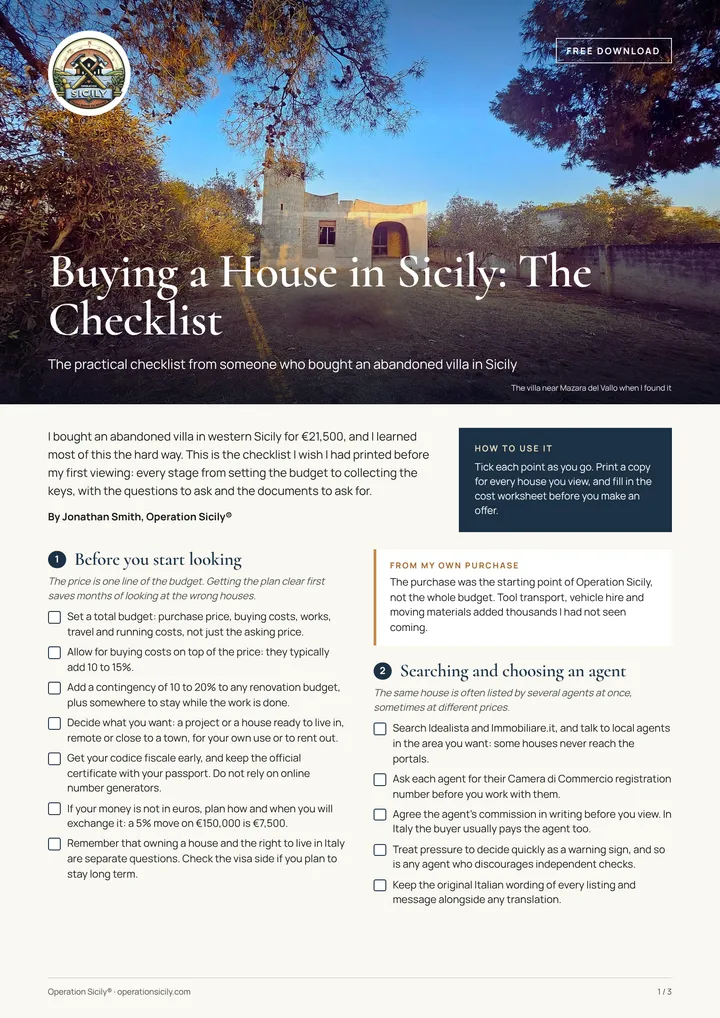
Free download
Buying a house in Sicily? Take my checklist.
Every step from budget to keys, the questions to ask at a viewing and the documents to ask for, as a PDF you can print.
Here is your checklist. Download the checklist (PDF)
Weather and climate in Paternò
34.6°Caverage July high
5°Caverage January low
502 mmrain a year, on about 75 days
95days a year above 30°C
| Month | Average temperature | Rain |
|---|---|---|
| January | 10°C | 61 mm |
| February | 10°C | 56 mm |
| March | 12°C | 47 mm |
| April | 15°C | 33 mm |
| May | 19°C | 15 mm |
| June | 25°C | 12 mm |
| July | 28°C | 6 mm |
| August | 28°C | 10 mm |
| September | 24°C | 49 mm |
| October | 20°C | 64 mm |
| November | 15°C | 76 mm |
| December | 11°C | 73 mm |
Averages for 2015 to 2024. Winters are cool and damp, and you will want heating for three or four months. Summers are very hot, so shade, thick walls and air conditioning matter.
See what each month brings in Sicily month by month, or size a solar system with the off-grid solar calculator.
Who lives there
- Population
- 44,744
- Change since 2019
- -4%
- Median age
- 41
- Foreign residents
- 984 (2.2%)
- People from Paternò are called
- paternesi
Registered residents from abroad include 2 American, 14 German, 5 French, 3 Spanish, 23 Polish, 473 Romanian, 54 Albanian and 21 Ukrainian citizens. Most of the rest come from countries outside Europe and the Americas.
Paternò lives mainly for its own residents rather than for visitors, with only about 122 tourist beds, so everyday life changes little between summer and winter.
Beaches near Paternò
- La Playa di Catania Catania, 19 km, fine sand, water sufficient
- San Giovanni Li Cuti Beach Catania, 19 km, sand and rocks, water poor
- Aci Castello Aci Castello, 22 km, rocks, water excellent
- Aci Trezza Aci Castello, 23 km, rocks, water sufficient
Things to see and do in and around Paternò
Climb the Collina storica for the castle, Santa Maria dell'Alto and the view over the Simeto valley. The civic museum named after Gaetano Savasta has an archaeological section in the former Bourbon prison and a farm life section in the old slaughterhouse; the Galleria d'Arte Moderna and the Casa Museo del Cantastorie, devoted to the town's ballad singers, complete the set.
Walk out to the Salinelle mud volcanoes, the Roman bridge at Pietralunga and the archaeological area of Poggio Cocola. The carnival, officially founded in 1868, is the oldest in the province after Acireale's, with flower decked floats and dancing in the squares.
- Castello Normanno
- Santa Barbara
- Church of St.Catherine of Alexandria
- Santa Maria della Valle di Iosaphat
- Museo civico Gaetano Savasta
- Santuario Santa Maria della Consolazione, Paternò
- Santissima Annunziata
- Quattro Canti
- Poira Castle
- Piazza Indipendenza
- Piazza Vittorio Veneto
- Poggio Cocola
- Madonna dell'Itria
- Madonna delle Grazie
The quickest beach to reach by car, Spiaggia nera di San Giovanni Li Cuti, is about 25 minutes away.
Famous people born in Paternò include Luca Parmitano (Italian astronaut); Francesco Coco (Italian footballer); Ignazio Benito Maria La Russa (Italian politician); Eleanor of Sicily (Queen of Aragon); Margareth Madè (Italian actress).
Earthquake, landslide and flood risk
Paternò is in seismic zone 2, the second highest of Italy’s four seismic zones. The zone sets the anti-seismic standard for any new building, extension or structural renovation, which affects both the design and the cost. A structural survey is worth paying for before you buy any older building, stone house or flat.
0.3% of the comune's land is mapped by ISPRA as high or very high landslide hazard, where under 0.1% of residents live, and 11% of the land could flood in a medium-probability flood (0.1% of residents). Ask for the hazard maps (PAI) for any house you are considering; the comune's technical office or your geometra can check them.
Check what you can build or change with the building permit checker, and keep a margin with the renovation contingency calculator.
The comune: useful details
- Official name
- Comune di Paternò
- Province
- Catania (Città metropolitana di Catania)
- Postcode (CAP)
- 95047
- Dialling code
- 095
- Area
- 143 km²
- Height above sea level
- 225 m
- ISTAT code
- 087033
- Cadastral code
- G371 (used in the codice fiscale of people born here)
- Official website
- comune.paterno.ct.it
Registering as a resident, paying local taxes and building permits all go through the comune. If you were born abroad, get your Italian tax code first with the codice fiscale calculator.
Nearby towns
Paternò borders 7 other comuni:
- Belpasso €774/m²
- Biancavilla €712/m²
- Castel di Iudica €340/m²
- Centuripe €544/m²
- Ragalna €680/m²
- Ramacca €405/m²
- Santa Maria di Licodia €618/m²
Towns like Paternò elsewhere in Sicily
- Comiso (Ragusa province)
- Partinico (Palermo province)
- Ribera (Agrigento province)
- Alcamo (Trapani province)
- Rosolini (Siracusa province)
- Carlentini (Siracusa province)
Paternò on our lists
- Towns within an hour of Catania airport
- The biggest towns in Sicily
- The best towns in Sicily for expats
See every town in Catania province (58 comuni), or let Find your town suggest places that match what you want.
Frequently asked questions
Where is Paternò in Sicily?
Paternò is in the province of Catania, about 15 km west of Catania. The centre sits about 225 metres above sea level.
What is Paternò known for?
King Frederick III of Sicily died in Paternò in 1337. The astronaut Luca Parmitano was born in Paternò. The Paternò Treasure, silver vessels of the fourth century BC found near the castle in 1909, is now largely in Berlin.
Is Paternò a good place to live?
It depends what you want. Buyers who want a large, affordable town with every service, orange country around it and Catania within reach. The nearest emergency department is about 3 minutes away, and homes average about €710 per m².
How much do houses cost in Paternò?
Official figures from the Agenzia delle Entrate put homes in Paternò at about €710 per square metre on average, so a 100 m² home in normal condition would be roughly €71,000. That is close to the typical town in the province (€665) and above the typical Sicilian town (€593). Houses needing work sell for less, and the best homes for more.
What is the nearest airport to Paternò?
Catania Fontanarossa airport is the nearest, about 30 minutes away by car (26 km). Comiso is about 1 hour 50 minutes away. Times are for a clear road and will be longer in summer traffic.
What is the weather like in Paternò?
Summers are very hot: July afternoons average about 34.6°C, with around 95 days a year above 30°C. Winter nights in January average about 5°C. Rain totals about 502 mm a year, falling mostly between October and March.
How many people live in Paternò?
44,744 people live in the comune of Paternò, according to ISTAT. The population fell by 4.1% between 2019 and 2025. Half the residents are older than 41.
Is there a hospital near Paternò?
The nearest hospital with an emergency department (pronto soccorso) is Ospedale Santissimo Salvatore, about 3 minutes away by car. In an emergency anywhere in Italy, call 112.
Is Paternò in an earthquake zone?
Paternò is in seismic zone 2, the second highest of Italy’s four seismic zones. New building and structural work anywhere in Italy must follow anti-seismic rules, and the zone sets how strict they are, so ask your geometra or engineer to check any house you plan to buy or renovate.
Does Paternò count for the 7% flat tax for pensioners?
No. On the population figure used for the limit, about 44,502 residents, Paternò is over the 30,000 limit for Italy's 7% flat tax for foreign pensioners. Many smaller towns nearby do qualify. Check the details with our 7% flat tax town checker and a qualified adviser.
Does Paternò have fast internet?
Yes, for most homes: about 88.1% of addresses in Paternò can get full fibre (FTTH), according to the communications regulator AGCOM. Check the exact address before you buy.
Credits
Photo: Normangreek, CC BY-SA 3.0, via Wikimedia Commons.
Figures: ISTAT, Agenzia delle Entrate (OMI), Copernicus ERA5-Land, AGCOM, Dipartimento della Protezione Civile, ISPRA, Ministero della Salute, Ministero dell'Istruzione e del Merito, IndicePA, Open-Meteo, NASA POWER, Wikidata and © OpenStreetMap contributors, with several series gathered by the expatliving-data open data collection. Map boundaries ISTAT via openpolis (CC BY 4.0). Sicily as a whole: 4,787,390 people in 391 comuni.
 The weekly YouTube series