
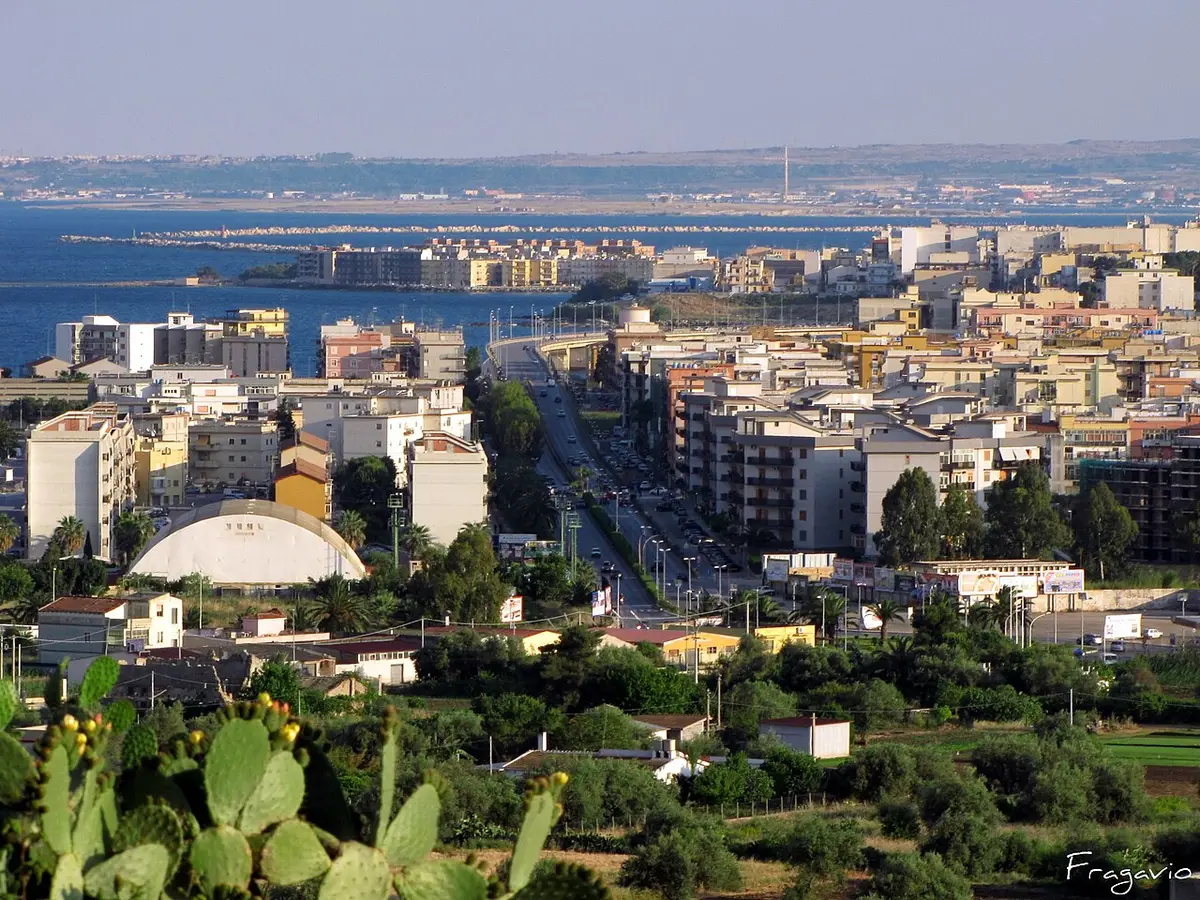
About Augusta
The old town of Augusta is an island in the literal sense. In the sixteenth century the Spanish cut through the isthmus that joined it to the mainland, and today you cross either by the modern bridge named after Frederick II or by the older one marked by the arch of Porta Spagnola. Inside is a tight grid of late baroque streets rebuilt after the 1693 earthquake, with Piazza Duomo, the town hall that houses the Museo della Piazzaforte, and the Swabian castle at the northern tip, which served as a prison from 1890 until late in the twentieth century.
The town has two harbours, the Porto Megarese and the Porto Xifonio, and the wide roadstead between them is what made Augusta important in every century. Out in the bay stand the sea forts built against Turkish raids, among them the Torre Avalos on its own islet. The old salt pans at the edge of town are now a protected wetland.
Since the first refinery opened in 1949, the coast between Augusta, Melilli and Priolo has been the Siracusa petrochemical district, and much of the local economy still depends on it. Fishing and salt, once the mainstays, have faded. Brucoli, a few kilometres north, is the town's seaside side, with a small fortress at the mouth of its inlet and holiday homes along the low cliffs, and further north the hamlet of Agnone Bagni has a long sandy beach looking towards Etna.
Living in Augusta
Augusta is a working town first. There are few tourist beds for its size, so life in the island centre carries on much the same in January as in August; the summer change is felt mostly in Brucoli and Agnone, which fill with families from Siracusa and Catania and go quiet in winter. The population has held roughly steady while most of the province shrinks, helped by jobs at the port, the industrial zone and the navy.
Everyday shopping, schools and weekly markets are all in town, and there is a railway station on the Siracusa to Catania line. For the bigger shops, the university and the airport, people look to Catania to the north or Siracusa to the south.
On the plus side: sea all round, a lively old centre, prices well below Siracusa and good links. Against it: the petrochemical plants dominate the southern shore, parts of the island centre are run down, and the town is in Italy's highest earthquake zone, so check any old building carefully. Augusta has also run a one-euro homes scheme, aimed at bringing life back to empty houses in the old centre.
A short history
The bay was settled long before the town. A few kilometres south lie the ruins of Megara Hyblaea, one of the oldest Greek colonies in Sicily, founded in the eighth century BC and later destroyed by its rival Siracusa. On the peninsula itself there seems to have been only a small settlement, perhaps the Xiphonia mentioned by ancient writers.
Augusta as a town begins in 1232, when the emperor Frederick II of Swabia founded Augusta Veneranda and built a great castle on its northern promontory. Loyal to the Swabians, it was razed under the Angevins, joined the Sicilian Vespers in 1282 and passed to the Aragonese crown. It was held as a fief by the Moncada counts until 1560, when the Spanish crown took it back and fortified it against Turkish raids, cutting the isthmus and building the forts Garcia, Vittoria and Avalos.
In 1675 the harbour saw the battle of Augusta between the French and a Dutch and Spanish fleet. On 9 and 11 January 1693 the great earthquake of the Val di Noto flattened the town, which was rebuilt in late baroque style. In the twentieth century Augusta became a naval and seaplane base; it was bombed in 1943 and taken by British troops on 13 July during the Allied landings. The first refinery in 1949 began the industrial era that still shapes the town.
Food, festivals and traditions
Augusta's cooking is fish-based, from its long history as one of Sicily's main fishing ports: fresh catch, sea urchins in season and pasta with seafood. In the seventeenth century the Knights of Malta ran a large biscuit bakery here to supply their galleys, a detail locals still like to mention.
The patron is Saint Dominic, celebrated around 24 May with two processions on 23 and 24 May and events across town. A legend says the saint appeared in the sky in 1594 and drove off a Turkish raid. Holy Week is kept with care, and the feast of San Giuseppe on 19 March has a traditional auction of offerings.
Interesting facts about Augusta
- The old centre became an island in the sixteenth century, when the Spanish cut the isthmus to defend it.
- Frederick II founded the town in 1232 under the name Augusta Veneranda.
- Augusta's first oil refinery opened in 1949, the start of one of Europe's largest petrochemical districts.
House prices in Augusta
€715average price per m² to buy
€2.96average rent per m² a month
€72,000a 100 m² home at that price
These are the official averages from the Agenzia delle Entrate's property market observatory (OMI) for homes in normal condition across the town's 7 price zones. Prices in Augusta are close to the typical town in Siracusa province (€690 per m²) and above the typical Sicilian town (€593 per m²). Detached houses (villini) average about €702 per m².
Why these figures can look low: they come from the values on real sales, which sit below advertised asking prices, and the typical Sicilian town is the middle of all 391 comuni, most of them small inland towns. Island-wide averages quoted on property portals, around €1,100 to €1,300 per m², lean towards the cities and the coast, where most homes are listed. Rents work the same way: listings usually ask well above the official rent figure, often double or more.
Houses that need work, which is most of the cheap ones you see advertised, sell well below these figures. The renovation comes on top, so budget for both.
Augusta has run a €1 homes scheme. Check the comune's own website for the houses on offer now and the conditions.
Work out the return on a let with the rental yield calculator, or see the steps from offer to keys in the buying timeline planner.
Getting there and getting around
| From the centre to | By car | Distance |
|---|---|---|
| Catania Fontanarossa airport (CTA) | 41 minutes | 44 km |
| Comiso airport (CIY) | 1 hour 39 minutes | 90 km |
| Palermo Falcone Borsellino airport (PMO) | 3 hours 32 minutes | 272 km |
| Trapani Birgi airport (TPS) | 4 hours 30 minutes | 350 km |
| Palermo city centre | 3 hours 3 minutes | 240 km |
| Catania city centre | 43 minutes | 48 km |
| Messina, for ferries to the mainland | 1 hour 47 minutes | 141 km |
| Nearest motorway or main road junction (Porto commerciale) | 7 minutes | 6 km |
| Nearest railway station (Augusta) | 4 minutes | 3 km |
Times are by road on a clear day, worked out from OpenStreetMap. Allow longer in summer and on market days. Augusta has a railway station close to the centre, which helps for trips to the cities, but most residents still rely on a car, and buses are infrequent on Sundays and in August.
Planning flights and trips? See the Schengen 90/180 calculator if you are from outside the EU.
Everyday life: shops, health and schools
- Hospital with A&E
- Ospedale Muscatello, about 5 minutes by car
- Pharmacies in the comune
- 10
- Supermarkets
- 17
- Schools
- State: 10 nursery schools, 10 primary schools, 4 middle schools, 11 secondary schools; plus 3 independent (paritaria)
- Banks and cash machines
- 9
- Cafés and bars
- 53
- Restaurants
- 29
- Full fibre broadband
- 41.1% of addresses
Pharmacies and schools come from the official Ministry of Health and Ministry of Education lists. The other counts are of places mapped in OpenStreetMap inside the comune's boundary, so a small shop or a doctor's surgery can be missing. “Not fully mapped yet” means the volunteer map clearly has gaps here, not that the town has none. For a family doctor (medico di base, what the British call a GP), you register with the local health authority (ASP Siracusa) once you are resident.
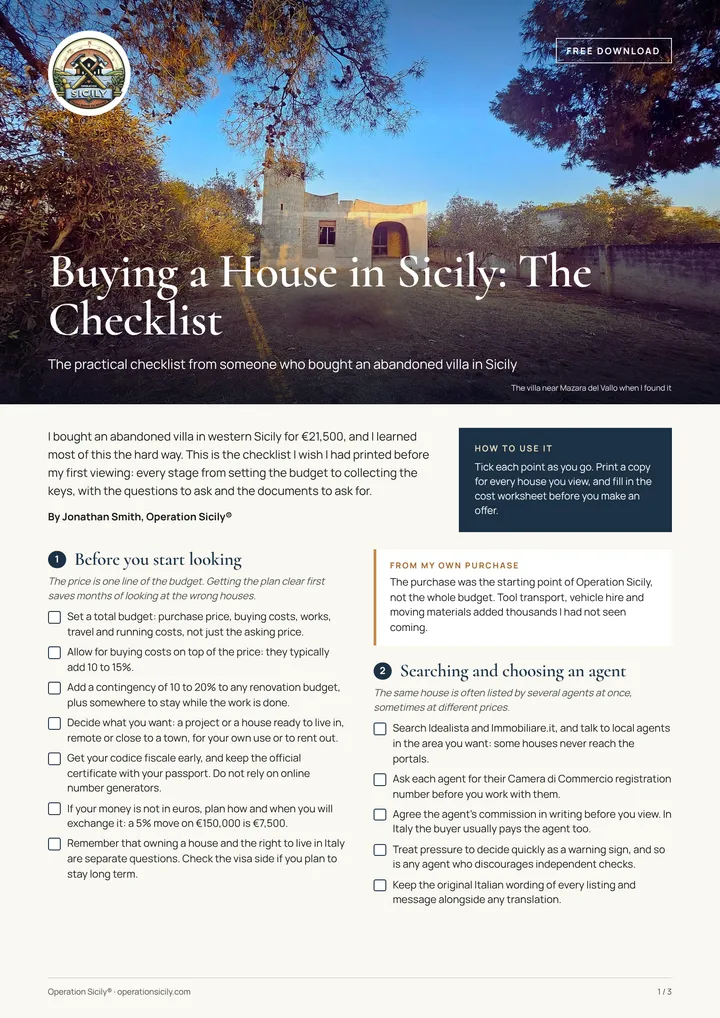
Free download
Buying a house in Sicily? Take my checklist.
Every step from budget to keys, the questions to ask at a viewing and the documents to ask for, as a PDF you can print.
Here is your checklist. Download the checklist (PDF)
Weather and climate in Augusta
34.6°Caverage July high
7.1°Caverage January low
572 mmrain a year, on about 75 days
68days a year above 30°C
| Month | Average temperature | Rain |
|---|---|---|
| January | 11°C | 74 mm |
| February | 11°C | 66 mm |
| March | 13°C | 51 mm |
| April | 16°C | 33 mm |
| May | 20°C | 14 mm |
| June | 26°C | 10 mm |
| July | 29°C | 4 mm |
| August | 29°C | 10 mm |
| September | 25°C | 57 mm |
| October | 21°C | 74 mm |
| November | 17°C | 92 mm |
| December | 13°C | 87 mm |
Averages for 2015 to 2024. Winters are mild, though stone houses still feel cold without heating. Summers are very hot, so shade, thick walls and air conditioning matter.
See what each month brings in Sicily month by month, or size a solar system with the off-grid solar calculator.
Who lives there
- Population
- 34,717
- Change since 2019
- -0.4%
- Median age
- 46
- Foreign residents
- 1,170 (3.4%)
Registered residents from abroad include 5 British, 15 American, 17 German, 5 Dutch, 31 French, 3 Belgian, 1 Irish, 1 Australian, 1 Canadian, 1 Swiss, 12 Spanish, 166 Polish, 234 Romanian, 77 Albanian and 29 Ukrainian citizens. Most of the rest come from countries outside Europe and the Americas. Others own holiday homes here without registering as residents.
Augusta lives mainly for its own residents rather than for visitors, with only about 1,656 tourist beds, so everyday life changes little between summer and winter.
Beaches in Augusta
Augusta has 2 beaches in our beach guide, and one more named beach or cove mapped along its coast. 100% of its officially monitored bathing waters were rated excellent in the latest EU assessment.
- Agnone Bagni Beach sand, water excellent
- Brucoli rocks, water excellent
Things to see and do in and around Augusta
Start on the island: the Porta Spagnola, Piazza Duomo with the Chiesa Madre, the Museo della Piazzaforte in the town hall, which tells the story of Augusta as a fortress town, and the walls of the Swabian castle. From the waterfront you can see the Torre Avalos standing in the bay. The Dominican church of San Domenico, tied to the town's patron, is worth a look for its place in local legend, and the huge concrete airship hangar of 1920 is a striking piece of industrial history.
South of town, the archaeological site of Megara Hyblaea is one of the best places in Sicily to see the plan of an early Greek colony, though it sits close to the industrial zone and opening hours are limited. North, Brucoli has its castle, a lighthouse and rocky coves for swimming, and Agnone Bagni has sand. Siracusa and Catania are both within easy day-trip reach.
- Megara Hyblaea
- Castello di Augusta
- Porta Spagnola
- Anime Sante del Purgatorio
- Chiesa di Santa Maria Assunta
- Brucoli Lighthouse
- San Domenico
- Isola di Torre Avalos
- Brucoli Castle
- Torre Avalos Lighthouse
- Catacombe del Mulinello
- Castello Svevo
- Museo della Piazzaforte
Beaches within the comune include Costa Pergola.
Famous people born in Augusta include Giovanni Lavaggi (Italian racing driver); Rosario Fiorello (Italian comedian); Emanuele d'Astorga (Italian composer); Orso Mario Corbino (Italian physicist); Antonio Scaduto (Italian canoe racer).
Earthquake, landslide and flood risk
Augusta is in seismic zone 1, the highest of Italy’s four seismic zones. The zone sets the anti-seismic standard for any new building, extension or structural renovation, which affects both the design and the cost. A structural survey is worth paying for before you buy any older building, stone house or flat.
0.2% of the comune's land is mapped by ISPRA as high or very high landslide hazard, where 0.3% of residents live, and 1.4% of the land could flood in a medium-probability flood (under 0.1% of residents). Ask for the hazard maps (PAI) for any house you are considering; the comune's technical office or your geometra can check them.
Check what you can build or change with the building permit checker, and keep a margin with the renovation contingency calculator.
The comune: useful details
- Official name
- Comune di Augusta
- Province
- Siracusa (Libero consorzio comunale di Siracusa)
- Postcode (CAP)
- 96011
- Dialling code
- 0931
- Area
- 110 km²
- Height above sea level
- 15 m
- ISTAT code
- 089001
- Cadastral code
- A494 (used in the codice fiscale of people born here)
- Official website
- comune.augusta.sr.it
Registering as a resident, paying local taxes and building permits all go through the comune. If you were born abroad, get your Italian tax code first with the codice fiscale calculator.
Nearby towns
Augusta borders 2 other comuni:
- Carlentini €759/m²
- Melilli €798/m²
Towns like Augusta elsewhere in Sicily
- Licata (Agrigento province)
- Barcellona Pozzo di Gotto (Messina province)
- Mazara del Vallo (Trapani province)
- Sciacca (Agrigento province)
- Gela (Caltanissetta province)
- Mascali (Catania province)
Augusta on our lists
- The cheapest seaside towns in Sicily
- Towns within an hour of Catania airport
- Sicilian towns with €1 homes schemes
- The biggest towns in Sicily
See every town in Siracusa province (21 comuni), or let Find your town suggest places that match what you want.
Frequently asked questions
Where is Augusta in Sicily?
Augusta is in the province of Siracusa, about 20 km north of Siracusa. The centre sits about 15 metres above sea level and its land runs down to the coast.
What is Augusta known for?
The old centre became an island in the sixteenth century, when the Spanish cut the isthmus to defend it. Frederick II founded the town in 1232 under the name Augusta Veneranda. Augusta's first oil refinery opened in 1949, the start of one of Europe's largest petrochemical districts.
Is Augusta a good place to live?
It depends what you want. Anyone who wants a real, everyday Sicilian town by the sea with a long history and lower prices than Siracusa, and who does not mind industry on the horizon. The nearest emergency department is about 5 minutes away, and homes average about €715 per m².
How much do houses cost in Augusta?
Official figures from the Agenzia delle Entrate put homes in Augusta at about €715 per square metre on average, so a 100 m² home in normal condition would be roughly €72,000. That is close to the typical town in the province (€690) and above the typical Sicilian town (€593). Houses needing work sell for less, and the best homes for more.
What is the nearest airport to Augusta?
Catania Fontanarossa airport is the nearest, about 41 minutes away by car (44 km). Comiso is about 1 hour 39 minutes away. Times are for a clear road and will be longer in summer traffic.
What is the weather like in Augusta?
Summers are very hot: July afternoons average about 34.6°C, with around 68 days a year above 30°C. Winter nights in January average about 7.1°C. Rain totals about 572 mm a year, falling mostly between October and March.
How many people live in Augusta?
34,717 people live in the comune of Augusta, according to ISTAT. The population stayed about the same between 2019 and 2025. Half the residents are older than 46.
Is there a hospital near Augusta?
The nearest hospital with an emergency department (pronto soccorso) is Ospedale Muscatello, about 5 minutes away by car. In an emergency anywhere in Italy, call 112.
Is Augusta in an earthquake zone?
Augusta is in seismic zone 1, the highest of Italy’s four seismic zones. New building and structural work anywhere in Italy must follow anti-seismic rules, and the zone sets how strict they are, so ask your geometra or engineer to check any house you plan to buy or renovate.
Does Augusta count for the 7% flat tax for pensioners?
No. On the population figure used for the limit, about 34,697 residents, Augusta is over the 30,000 limit for Italy's 7% flat tax for foreign pensioners. Many smaller towns nearby do qualify. Check the details with our 7% flat tax town checker and a qualified adviser.
Does Augusta sell houses for €1?
Augusta is one of the Sicilian towns that has run a €1 homes scheme. Schemes open, close and change, so check the comune's own website for the houses on offer now and the conditions, which usually include renovating within about three years.
Does Augusta have fast internet?
In parts. About 41.1% of addresses in Augusta can get full fibre (FTTH), according to AGCOM. Elsewhere, fibre to the cabinet, fixed wireless or 4G and 5G home broadband fill the gap. Check the exact address before you buy.
Is Augusta polluted?
The bay is shared with a large petrochemical complex, and the plants are clearly visible south of the old town. Many people prefer Brucoli or Agnone Bagni, further from the industry. Visit and judge for yourself, and notice which way the wind blows before buying.
Credits
Photo: fragavio from Augusta, Sicily, Italy, CC BY 2.0, via Wikimedia Commons.
Figures: ISTAT, Agenzia delle Entrate (OMI), Copernicus ERA5-Land, AGCOM, Dipartimento della Protezione Civile, ISPRA, Ministero della Salute, Ministero dell'Istruzione e del Merito, IndicePA, Open-Meteo, NASA POWER, Wikidata and © OpenStreetMap contributors, with several series gathered by the expatliving-data open data collection. Map boundaries ISTAT via openpolis (CC BY 4.0). Sicily as a whole: 4,787,390 people in 391 comuni.
 The weekly YouTube series