
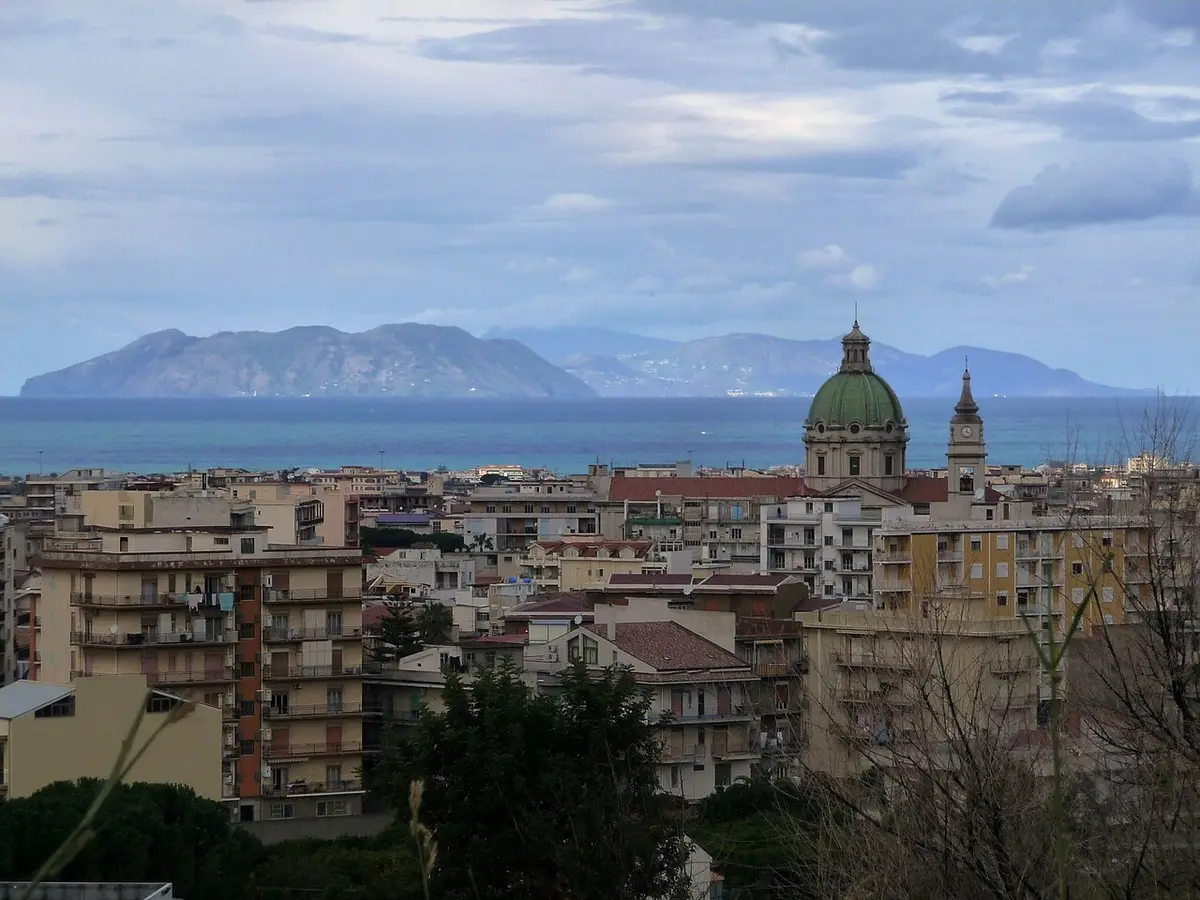
About Barcellona Pozzo di Gotto
The comune runs from the Tyrrhenian up to the Peloritani crest at the Colle del Re, almost 1,200 metres. The Longano torrent runs through the middle, once dividing Pozzo di Gotto on its east bank from Barcellona on its west.
Around the centre lie dozens of frazioni: Calderà, Spinesante and Cicerata on the coast, Gala, San Paolo and Cannistrà in the foothills, Migliardo highest of all. The plain is intensely farmed with market gardens, citrus, olives, vines and plant nurseries, and the town is the seat of a law court. The A20 motorway has a junction here and the station sits outside the centre.
Living in Barcellona Pozzo di Gotto
Barcellona does not depend on tourism, so it feels the same in February as in August. The population is broadly stable, with a sizeable foreign community. Almost everything you need is here, Milazzo next door adds the port, and Messina is the city for specialist services. Cultural life is good for a provincial town, with the rebuilt Teatro Mandanici, the open air Arena Montecroci and four museums; in summer life moves to the beaches of Calderà and Spinesante.
The downsides: a dense, traffic heavy centre, a mostly modern townscape, and a history of floods, in 2008, 2011 and 2020 among other years. A large share of residents live in mapped flood zones, so check the street and ground floor of any property.
A short history
Bronze and Iron Age settlements have been found at Maloto and Pizzo Lando. The Battle of the Longano, between Hiero II of Syracuse and the Mamertines in the third century BC, is traditionally placed nearby, though the site is disputed. The Basilian monastery of Santa Maria di Gala was refounded around 1105 under Countess Adelaide.
Pozzo di Gotto is named after an irrigation well on land of the Messinese noble Nicolò Gotho, recorded in 1463; long subject to Milazzo, it won freedom as a royal city on 22 May 1639. Barcellona, west of the river under Castroreale, perhaps reminded the Aragonese of the Catalan city, and became autonomous in 1815.
Ferdinand II merged the two by a decree of 1835 that took effect on 1 June 1836. The town backed the 1848 revolution and helped Garibaldi before the battle of Milazzo in 1860. Allied bombing on 15 August 1943 killed 74 people.
Food, festivals and traditions
The plain grows citrus, olives, vegetables and vines, and the cooking pairs fish from the beaches with produce from the market gardens. Saint Sebastian is the patron. On Good Friday two processions of Vare, twenty six groups showing the Passion, many made in papier mâché by the local artist Matteo Trovato, cross the town at the same time. On 17 August San Rocco is carried by boat along the whole Barcellona coast.
Interesting facts about Barcellona Pozzo di Gotto
- The town was created on 1 June 1836 by merging Barcellona and Pozzo di Gotto, which faced each other across the Longano torrent.
- The Vittorio Madìa judicial asylum, opened in 1925 in a late Liberty building, was the largest of Italy's seven criminal asylums until they were ordered closed in 2015.
- A proposal in 1974 to merge Barcellona, Milazzo and Merì into one comune called Duilia came to nothing.
- On Good Friday two processions of Passion floats cross the town simultaneously.
House prices in Barcellona Pozzo di Gotto
€680average price per m² to buy
€4.67average rent per m² a month
€68,000a 100 m² home at that price
These are the official averages from the Agenzia delle Entrate's property market observatory (OMI) for homes in normal condition across the town's 4 price zones. Prices in Barcellona Pozzo di Gotto are close to the typical town in Messina province (€644 per m²) and above the typical Sicilian town (€593 per m²). Detached houses (villini) average about €1,250 per m².
Why these figures can look low: they come from the values on real sales, which sit below advertised asking prices, and the typical Sicilian town is the middle of all 391 comuni, most of them small inland towns. Island-wide averages quoted on property portals, around €1,100 to €1,300 per m², lean towards the cities and the coast, where most homes are listed. Rents work the same way: listings usually ask well above the official rent figure, often double or more.
Houses that need work, which is most of the cheap ones you see advertised, sell well below these figures. The renovation comes on top, so budget for both.
Work out the return on a let with the rental yield calculator, or see the steps from offer to keys in the buying timeline planner.
Getting there and getting around
| From the centre to | By car | Distance |
|---|---|---|
| Catania Fontanarossa airport (CTA) | 1 hour 50 minutes | 140 km |
| Palermo Falcone Borsellino airport (PMO) | 2 hours 45 minutes | 219 km |
| Comiso airport (CIY) | 3 hours 9 minutes | 224 km |
| Trapani Birgi airport (TPS) | 3 hours 43 minutes | 297 km |
| Palermo city centre | 2 hours 16 minutes | 187 km |
| Catania city centre | 1 hour 40 minutes | 130 km |
| Messina, for ferries to the mainland | 37 minutes | 40 km |
| Nearest railway station (Barcellona-Castroreale) | 4 minutes | 3 km |
Times are by road on a clear day, worked out from OpenStreetMap. Allow longer in summer and on market days. Barcellona Pozzo di Gotto has a railway station close to the centre, which helps for trips to the cities, but most residents still rely on a car, and buses are infrequent on Sundays and in August.
Planning flights and trips? See the Schengen 90/180 calculator if you are from outside the EU.
Everyday life: shops, health and schools
- Hospital with A&E
- Ospedale Cutroni Zodda, about 2 minutes by car
- Pharmacies in the comune
- 12
- Supermarkets
- 15
- Schools
- State: 31 nursery schools, 20 primary schools, 5 middle schools, 13 secondary schools; plus 9 independent (paritaria)
- Banks and cash machines
- 8
- Cafés and bars
- 16
- Restaurants
- 16
- Full fibre broadband
- 69.7% of addresses
Pharmacies and schools come from the official Ministry of Health and Ministry of Education lists. The other counts are of places mapped in OpenStreetMap inside the comune's boundary, so a small shop or a doctor's surgery can be missing. “Not fully mapped yet” means the volunteer map clearly has gaps here, not that the town has none. For a family doctor (medico di base, what the British call a GP), you register with the local health authority (ASP Messina) once you are resident.
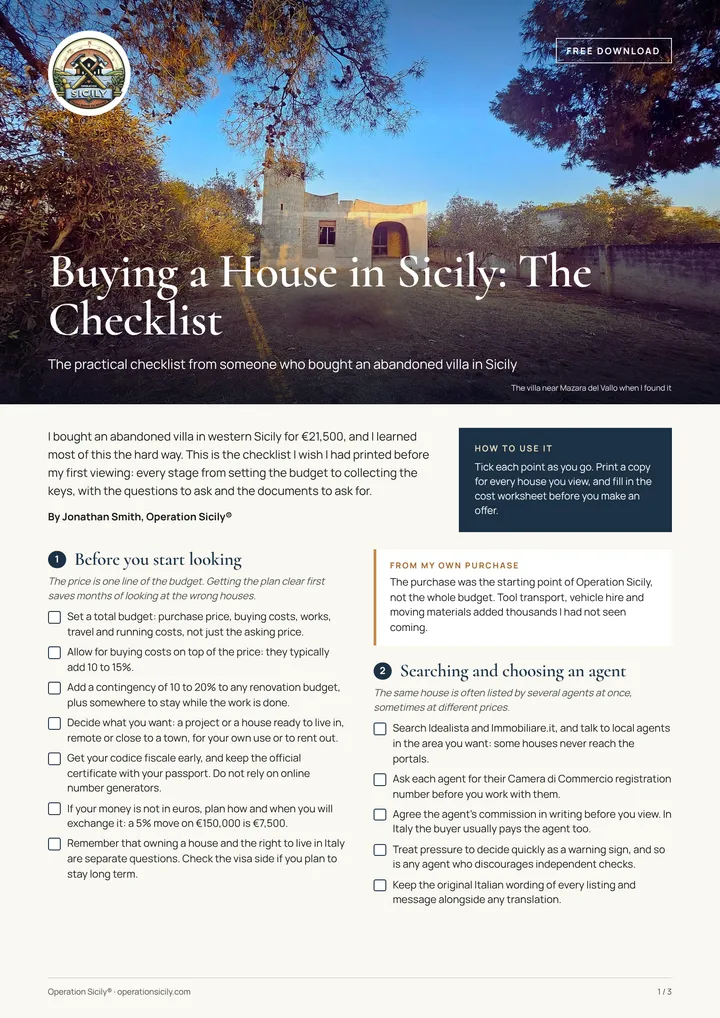
Free download
Buying a house in Sicily? Take my checklist.
Every step from budget to keys, the questions to ask at a viewing and the documents to ask for, as a PDF you can print.
Here is your checklist. Download the checklist (PDF)
Weather and climate in Barcellona Pozzo di Gotto
33.2°Caverage July high
7.3°Caverage January low
903 mmrain a year, on about 118 days
| Month | Average temperature | Rain |
|---|---|---|
| January | 12°C | 109 mm |
| February | 11°C | 98 mm |
| March | 13°C | 86 mm |
| April | 16°C | 63 mm |
| May | 20°C | 30 mm |
| June | 25°C | 27 mm |
| July | 28°C | 14 mm |
| August | 28°C | 23 mm |
| September | 25°C | 86 mm |
| October | 21°C | 109 mm |
| November | 17°C | 128 mm |
| December | 13°C | 127 mm |
Averages for 2015 to 2024. Winters are mild, though stone houses still feel cold without heating. Summers are very hot, so shade, thick walls and air conditioning matter.
See what each month brings in Sicily month by month, or size a solar system with the off-grid solar calculator.
Who lives there
- Population
- 39,763
- Change since 2019
- -2.1%
- Median age
- 44
- Foreign residents
- 2,736 (6.9%)
- People from Barcellona Pozzo di Gotto are called
- barcellonesi
Registered residents from abroad include 5 German, 6 French, 1 Belgian, 1 Irish, 1 Canadian, 3 Swiss, 8 Spanish, 84 Polish, 432 Romanian, 487 Albanian and 49 Ukrainian citizens. Most of the rest come from countries outside Europe and the Americas. Others own holiday homes here without registering as residents.
Barcellona Pozzo di Gotto lives mainly for its own residents rather than for visitors, with only about 117 tourist beds, so everyday life changes little between summer and winter.
Beaches near Barcellona Pozzo di Gotto
- Tonnarella Beach, Furnari Furnari, 9 km, sand and pebbles, water excellent
- Baia del Tono Milazzo, 11 km, pebbles, water excellent
- Laghetti di Marinello Beach Patti, 13 km, fine sand
- Baia di Sant'Antonio Milazzo, 13 km, pebbles, water excellent
Things to see and do in and around Barcellona Pozzo di Gotto
See the Basilica of San Sebastiano, the Duomo of Santa Maria Assunta and older churches such as San Vito, begun in 1472, and the Carmine of 1579. At Santa Venera is a rock cut Byzantine chapel with an octagonal dome, and San Rocco at Nasari holds a marble Saint Catherine by Vincenzo Gagini of 1560. The Nello Cassata ethnographic museum and the Parco Museo Jalari, an open air museum park in the hills, are the best of the museums. Castroreale is just uphill, Tindari along the coast, and the Aeolian ferries leave from Milazzo.
- Dôme de Barcellona Pozzo di Gotto
- Nello Cassata Ethnohistory Museum
- Sant'Antonio di Padova
- Santa Maria Assunta
- Santa Maria di Gala
- San Francesco all'Immacolata
- Sant'Antonio Abate
- Maria Santissima del Tindari
- Anime Purganti
- San Giovanni Battista
- San Vito (Barcellona Pozzo di Gotto)
- Our Lady of Mount Carmel Church
- Chiesa di Gesù e Maria
- Santissimo Crocifisso
Famous people born in Barcellona Pozzo di Gotto include Francesca Chillemi (Italian actress, television presenter, television personality and model); Emilio Fede (Italian journalist, writer and politician).
Earthquake, landslide and flood risk
Barcellona Pozzo di Gotto is in seismic zone 2, the second highest of Italy’s four seismic zones. The zone sets the anti-seismic standard for any new building, extension or structural renovation, which affects both the design and the cost. A structural survey is worth paying for before you buy any older building, stone house or flat.
1.1% of the comune's land is mapped by ISPRA as high or very high landslide hazard, where under 0.1% of residents live, and 9.6% of the land could flood in a medium-probability flood (31.5% of residents). Ask for the hazard maps (PAI) for any house you are considering; the comune's technical office or your geometra can check them.
Check what you can build or change with the building permit checker, and keep a margin with the renovation contingency calculator.
The comune: useful details
- Official name
- Comune di Barcellona Pozzo di Gotto
- Province
- Messina (Città metropolitana di Messina)
- Postcode (CAP)
- 98051
- Dialling code
- 090
- Area
- 59 km²
- Height above sea level
- 60 m
- ISTAT code
- 083005
- Cadastral code
- A638 (used in the codice fiscale of people born here)
- Official website
- comune.barcellona-pozzo-di-gotto.me.it
Registering as a resident, paying local taxes and building permits all go through the comune. If you were born abroad, get your Italian tax code first with the codice fiscale calculator.
Nearby towns
Barcellona Pozzo di Gotto borders 5 other comuni:
- Castroreale €548/m²
- Merì €725/m²
- Milazzo €1,228/m²
- Santa Lucia del Mela €745/m²
- Terme Vigliatore €820/m²
Towns like Barcellona Pozzo di Gotto elsewhere in Sicily
- Avola (Siracusa province)
- Augusta (Siracusa province)
- Licata (Agrigento province)
- Pachino (Siracusa province)
- Sciacca (Agrigento province)
- Mazara del Vallo (Trapani province)
Barcellona Pozzo di Gotto on our lists
See every town in Messina province (108 comuni), or let Find your town suggest places that match what you want.
Frequently asked questions
Where is Barcellona Pozzo di Gotto in Sicily?
Barcellona Pozzo di Gotto is in the province of Messina, about 30 km west of Messina. The centre sits about 60 metres above sea level and its land runs down to the coast.
What is Barcellona Pozzo di Gotto known for?
The town was created on 1 June 1836 by merging Barcellona and Pozzo di Gotto, which faced each other across the Longano torrent. The Vittorio Madìa judicial asylum, opened in 1925 in a late Liberty building, was the largest of Italy's seven criminal asylums until they were ordered closed in 2015. A proposal in 1974 to merge Barcellona, Milazzo and Merì into one comune called Duilia came to nothing.
Is Barcellona Pozzo di Gotto a good place to live?
It depends what you want. Anyone wanting a full service town at sensible cost, with the Aeolian ferries at Milazzo and the hills of Castroreale both close, will find Barcellona does the job well. The nearest emergency department is about 2 minutes away, and homes average about €680 per m².
How much do houses cost in Barcellona Pozzo di Gotto?
Official figures from the Agenzia delle Entrate put homes in Barcellona Pozzo di Gotto at about €680 per square metre on average, so a 100 m² home in normal condition would be roughly €68,000. That is close to the typical town in the province (€644) and above the typical Sicilian town (€593). Houses needing work sell for less, and the best homes for more.
What is the nearest airport to Barcellona Pozzo di Gotto?
Catania Fontanarossa airport is the nearest, about 1 hour 50 minutes away by car (140 km). Palermo Falcone Borsellino is about 2 hours 45 minutes away. Times are for a clear road and will be longer in summer traffic.
What is the weather like in Barcellona Pozzo di Gotto?
Summers are very hot: July afternoons average about 33.2°C. Winter nights in January average about 7.3°C. Rain totals about 903 mm a year, falling mostly between October and March.
How many people live in Barcellona Pozzo di Gotto?
39,763 people live in the comune of Barcellona Pozzo di Gotto, according to ISTAT. The population fell by 2.1% between 2019 and 2025. Half the residents are older than 44.
Is there a hospital near Barcellona Pozzo di Gotto?
The nearest hospital with an emergency department (pronto soccorso) is Ospedale Cutroni Zodda, about 2 minutes away by car. In an emergency anywhere in Italy, call 112.
Is Barcellona Pozzo di Gotto in an earthquake zone?
Barcellona Pozzo di Gotto is in seismic zone 2, the second highest of Italy’s four seismic zones. New building and structural work anywhere in Italy must follow anti-seismic rules, and the zone sets how strict they are, so ask your geometra or engineer to check any house you plan to buy or renovate.
Does Barcellona Pozzo di Gotto count for the 7% flat tax for pensioners?
No. On the population figure used for the limit, about 39,756 residents, Barcellona Pozzo di Gotto is over the 30,000 limit for Italy's 7% flat tax for foreign pensioners. Many smaller towns nearby do qualify. Check the details with our 7% flat tax town checker and a qualified adviser.
Does Barcellona Pozzo di Gotto have fast internet?
Yes, for most homes: about 69.7% of addresses in Barcellona Pozzo di Gotto can get full fibre (FTTH), according to the communications regulator AGCOM. Check the exact address before you buy.
Does Barcellona Pozzo di Gotto flood?
Parts of it have, several times: the Longano and nearby streams broke their banks in 2008 and 2011, and a cloudburst in 2020 flooded several districts. Check the flood maps for any address.
Credits
Photo: Utente:Ma patros, CC BY-SA 3.0, via Wikimedia Commons.
Figures: ISTAT, Agenzia delle Entrate (OMI), Copernicus ERA5-Land, AGCOM, Dipartimento della Protezione Civile, ISPRA, Ministero della Salute, Ministero dell'Istruzione e del Merito, IndicePA, Open-Meteo, NASA POWER, Wikidata and © OpenStreetMap contributors, with several series gathered by the expatliving-data open data collection. Map boundaries ISTAT via openpolis (CC BY 4.0). Sicily as a whole: 4,787,390 people in 391 comuni.
 The weekly YouTube series