
About Pachino
The town was planned from scratch in the 1760s on the hill of the Scibini fief, around a central square and the Chiesa Madre of the Santissimo Crocifisso, built in 1790 by the marquis Vincenzo Starrabba, whose remains lie inside. Its streets are straight and practical rather than grand, with the nineteenth century Palazzo Tasca and its stone-paved courtyard among the few palaces. Unusually for Sicily, there is a Waldensian church, designed by the architect Leonardo Ricci in 1964.
Marzamemi, on the Ionian shore, is the town's seaside quarter. Its name comes from the Arabic for the bay of turtle doves. The present village took shape in 1752, when the Prince of Villadorata built the palazzo, the loggia, the new tuna fishery and the small church around the old Arab settlement; the tonnara worked until the 1950s. Granelli is a second coastal hamlet on the south-west side.
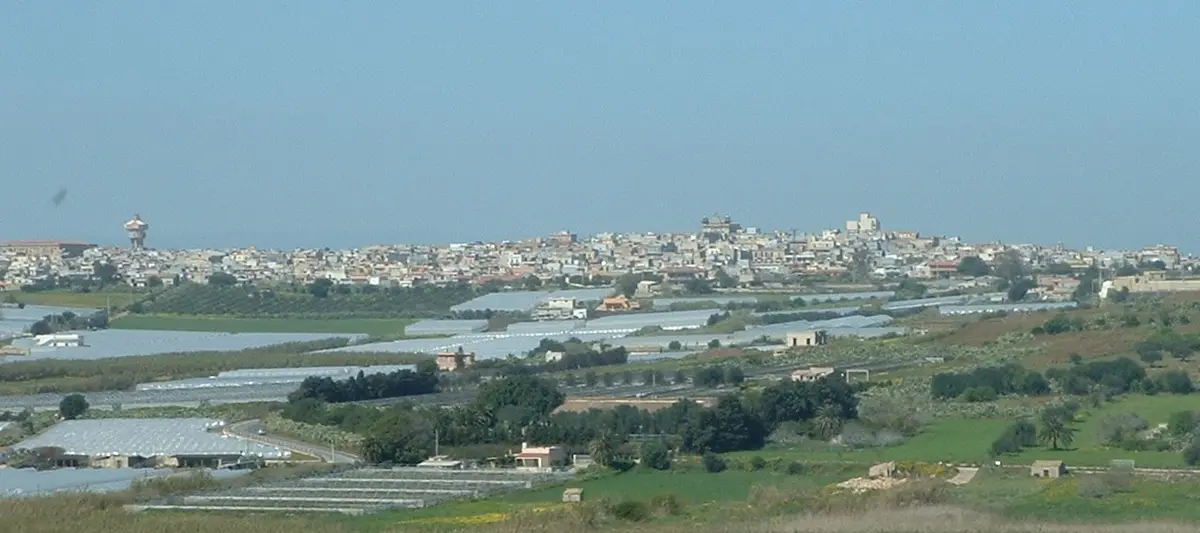
The economy is horticulture. The cherry tomato grown under glass here has PGI status as Pomodoro di Pachino, alongside the ribbed costoluto tomato, and wine, once shipped to northern Italy and France for blending, is coming back as quality Nero d'Avola.
Living in Pachino
Pachino is a working town with a summer life on its coasts. The centre stays busy all year with farming, markets and schools, while Marzamemi and the beaches fill in July and August and go quiet in winter. The population is growing, unusually for Sicily, and the town has one of the larger foreign communities in the province, reflecting the demand for labour in the greenhouses.
Day to day you have shops, two secondary schools, a fortnightly market and plenty of bars and restaurants. For bigger shopping and services, people go to Noto, Avola or Siracusa, and Ispica and Modica are within reach to the west.
Pros: beaches in every direction, some of the best produce in Italy, a young population and a lively summer. Cons: plastic greenhouses dominate much of the landscape, the town itself is plain, and public transport is thin, so a car is essential.
A short history
Caves around Pachino were lived in from the Palaeolithic onwards, and the Grotta Calafarina has Neolithic remains. The Greek name Pachynos, from a word meaning fertile, referred to the cape at Sicily's south-eastern corner. Arabs founded Marzamemi, built the tuna fishery and salt pans, and dug irrigation wells still in use.
In 1494 Count Antonio de Xurtino built the Torre Scibini against theft and pirate raids. The modern town was founded in 1760, when the Starrabba brothers, princes of Giardinelli, obtained a royal licence from the Bourbon king Ferdinand IV; families from Malta were invited to settle and many accepted.
On 10 July 1943 the Allied landings in Sicily began along the coast from Licata to Pachino, and British troops of the Eighth Army came ashore near the town and Marzamemi. The writer Vitaliano Brancati was born in Pachino in 1907.
Food, festivals and traditions
The Pomodoro di Pachino, the cherry tomato, is sold all over Italy, and here you eat it fresh, dried and in sauces. Marzamemi is known for tuna preserved in oil, bottarga and other fish products, and Nero d'Avola from the local vineyards is increasingly bottled under the estates' own names; the town belongs to the Città del Vino association.
The patron is the Assumption of Mary, celebrated in mid-August. Pachino has hosted a film festival since 2000, and the area has been a set for directors such as the Taviani brothers, Gabriele Salvatores and Giuseppe Tornatore.
Interesting facts about Pachino
- Pachino was founded in 1760, and Maltese families were invited to help settle it.
- The Pomodoro di Pachino cherry tomato has PGI status.
- Marzamemi's name comes from the Arabic for the bay of turtle doves.
- The Allied landings of 10 July 1943 included the coast at Pachino.
- The writer Vitaliano Brancati was born here in 1907.
House prices in Pachino
€638average price per m² to buy
€2.60average rent per m² a month
€64,000a 100 m² home at that price
These are the official averages from the Agenzia delle Entrate's property market observatory (OMI) for homes in normal condition across the town's 7 price zones. Prices in Pachino are close to the typical town in Siracusa province (€690 per m²) and close to the typical Sicilian town (€593 per m²). Detached houses (villini) average about €821 per m².
Why these figures can look low: they come from the values on real sales, which sit below advertised asking prices, and the typical Sicilian town is the middle of all 391 comuni, most of them small inland towns. Island-wide averages quoted on property portals, around €1,100 to €1,300 per m², lean towards the cities and the coast, where most homes are listed. Rents work the same way: listings usually ask well above the official rent figure, often double or more.
Houses that need work, which is most of the cheap ones you see advertised, sell well below these figures. The renovation comes on top, so budget for both.
Work out the return on a let with the rental yield calculator, or see the steps from offer to keys in the buying timeline planner.
Getting there and getting around
| From the centre to | By car | Distance |
|---|---|---|
| Catania Fontanarossa airport (CTA) | 1 hour 27 minutes | 104 km |
| Comiso airport (CIY) | 1 hour 36 minutes | 82 km |
| Palermo Falcone Borsellino airport (PMO) | 4 hours 18 minutes | 331 km |
| Trapani Birgi airport (TPS) | 5 hours 16 minutes | 409 km |
| Palermo city centre | 3 hours 49 minutes | 299 km |
| Catania city centre | 1 hour 29 minutes | 107 km |
| Messina, for ferries to the mainland | 2 hours 33 minutes | 200 km |
| Nearest motorway or main road junction (Noto) | 34 minutes | 30 km |
| Nearest railway station (Rosolini) | 23 minutes | 19 km |
Times are by road on a clear day, worked out from OpenStreetMap. Allow longer in summer and on market days. Most people living in Pachino rely on a car; buses link the bigger towns but are infrequent on Sundays and in August.
Planning flights and trips? See the Schengen 90/180 calculator if you are from outside the EU.
Everyday life: shops, health and schools
- Hospital with A&E
- Ospedale Trigona, about 30 minutes by car
- Pharmacies in the comune
- 7
- Supermarkets
- 12
- Schools
- State: 8 nursery schools, 7 primary schools, 2 middle schools, 5 secondary schools; plus 2 independent (paritaria)
- Banks and cash machines
- 8
- Cafés and bars
- 41
- Restaurants
- 23
- Full fibre broadband
- 83.6% of addresses
Pharmacies and schools come from the official Ministry of Health and Ministry of Education lists. The other counts are of places mapped in OpenStreetMap inside the comune's boundary, so a small shop or a doctor's surgery can be missing. “Not fully mapped yet” means the volunteer map clearly has gaps here, not that the town has none. For a family doctor (medico di base, what the British call a GP), you register with the local health authority (ASP Siracusa) once you are resident.
Free download
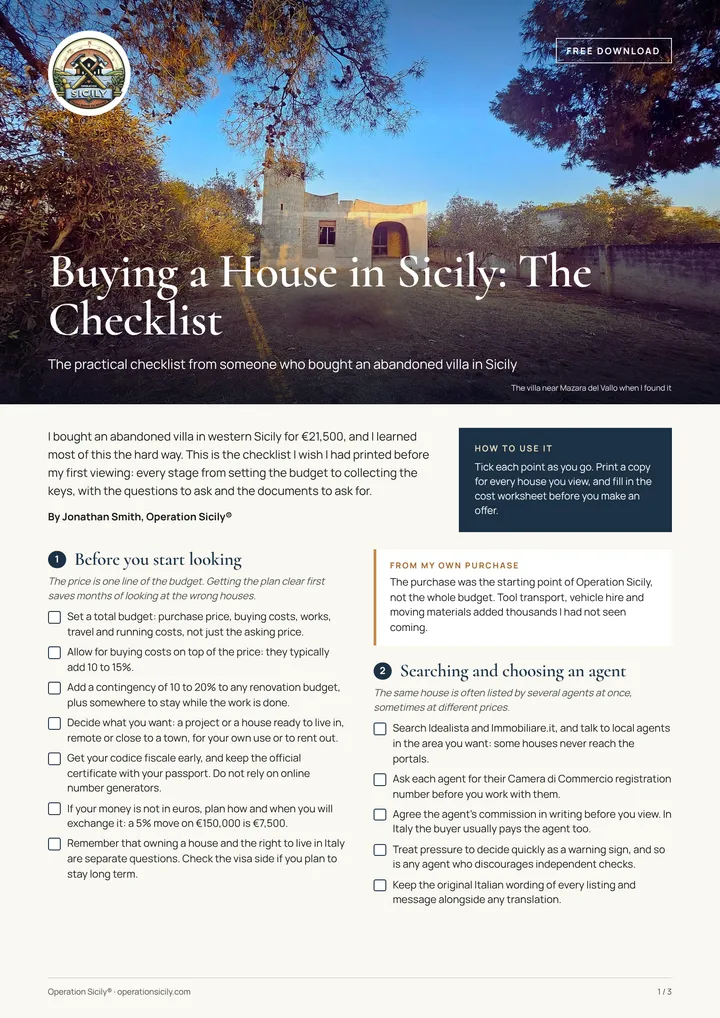
Buying a house in Sicily? Take my checklist.
Every step from budget to keys, the questions to ask at a viewing and the documents to ask for, as a PDF you can print.
Here is your checklist. Download the checklist (PDF)
Weather and climate in Pachino
30.6°Caverage July high
10.7°Caverage January low
447 mmrain a year, on about 65 days
19days a year above 30°C
| Month | Average temperature | Rain |
|---|---|---|
| January | 14°C | 57 mm |
| February | 13°C | 48 mm |
| March | 14°C | 39 mm |
| April | 16°C | 23 mm |
| May | 18°C | 14 mm |
| June | 22°C | 7 mm |
| July | 25°C | 5 mm |
| August | 26°C | 10 mm |
| September | 24°C | 44 mm |
| October | 22°C | 61 mm |
| November | 19°C | 75 mm |
| December | 15°C | 64 mm |
Averages for 2015 to 2024. Winters are mild, though stone houses still feel cold without heating. Summers are hot and dry.
See what each month brings in Sicily month by month, or size a solar system with the off-grid solar calculator.
Who lives there
- Population
- 22,117
- Change since 2019
- +3%
- Median age
- 42
- Foreign residents
- 2,016 (9.1%)
- People from Pachino are called
- pachinesi
Registered residents from abroad include 1 British, 1 American, 7 German, 2 French, 2 Canadian, 3 Spanish, 61 Polish, 189 Romanian, 24 Albanian and 16 Ukrainian citizens. Most of the rest come from countries outside Europe and the Americas. Others own holiday homes here without registering as residents.
Pachino lives mainly for its own residents rather than for visitors, with only about 586 tourist beds, so everyday life changes little between summer and winter.
Beaches in Pachino
Pachino has 3 beaches in our beach guide, and 2 more named beaches and coves mapped along its coast. 100% of its officially monitored bathing waters were rated excellent in the latest EU assessment.
- Carratois Beach fine sand, water excellent
- Granelli Beach fine sand, water excellent
- Morghella Beach sand, water excellent
Things to see and do in and around Pachino
Marzamemi is the place to linger: the square in front of the tonnara and the Villadorata palace, the fishermen's houses and the old church, best early in the morning or out of season. The beaches range from the Ionian sands of Lido, Cavettone and Morghella south of Marzamemi to the emerald water of Costa dell'Ambra and Granelli on the Mediterranean side.
The Vendicari reserve is just up the coast, Portopalo and the island of Capo Passero are at the very tip of Sicily, and the Pantano Longarini is a coastal lagoon on the way west. Noto, Ispica and Modica make good day trips inland.
- Grotta Calafarina
- Pantano Longarini
- Capo Passero lighthouse
Beaches within the comune include Spiaggia di Morghella, Spiaggia Calafarina, Spiaggia Vulpiglia.
Famous people born in Pachino include Vitaliano Brancati (Italian writer); Giuseppe Malandrino (Italian priest).
Earthquake, landslide and flood risk
Pachino is in seismic zone 2, the second highest of Italy’s four seismic zones. The zone sets the anti-seismic standard for any new building, extension or structural renovation, which affects both the design and the cost. A structural survey is worth paying for before you buy any older building, stone house or flat.
under 0.1% of the comune's land is mapped by ISPRA as high or very high landslide hazard, where under 0.1% of residents live, and 1.8% of the land could flood in a medium-probability flood (9.1% of residents). Ask for the hazard maps (PAI) for any house you are considering; the comune's technical office or your geometra can check them.
Check what you can build or change with the building permit checker, and keep a margin with the renovation contingency calculator.
The comune: useful details
- Official name
- Comune di Pachino
- Province
- Siracusa (Libero consorzio comunale di Siracusa)
- Postcode (CAP)
- 96018
- Dialling code
- 0931
- Area
- 50 km²
- Height above sea level
- 65 m
- ISTAT code
- 089014
- Cadastral code
- G211 (used in the codice fiscale of people born here)
- Official website
- comune.pachino.sr.it
Registering as a resident, paying local taxes and building permits all go through the comune. If you were born abroad, get your Italian tax code first with the codice fiscale calculator.
Nearby towns
Pachino borders 3 other comuni:
- Ispica €745/m²
- Noto €868/m²
- Portopalo di Capo Passero €680/m²
Towns like Pachino elsewhere in Sicily
- Palma di Montechiaro (Agrigento province)
- Licata (Agrigento province)
- Porto Empedocle (Agrigento province)
- Cinisi (Palermo province)
- Mascali (Catania province)
- Barcellona Pozzo di Gotto (Messina province)
Pachino on our lists
See every town in Siracusa province (21 comuni), or let Find your town suggest places that match what you want.
Frequently asked questions
Where is Pachino in Sicily?
Pachino is in the province of Siracusa, about 45 km south-west of Siracusa. The centre sits about 65 metres above sea level and its land runs down to the coast.
What is Pachino known for?
Pachino was founded in 1760, and Maltese families were invited to help settle it. The Pomodoro di Pachino cherry tomato has PGI status. Marzamemi's name comes from the Arabic for the bay of turtle doves.
Is Pachino a good place to live?
It depends what you want. Beach lovers, food lovers and families who want a real working town with two seas on the doorstep, at the far end of the island where the light is brightest. The nearest emergency department is about 30 minutes away, and homes average about €638 per m².
How much do houses cost in Pachino?
Official figures from the Agenzia delle Entrate put homes in Pachino at about €638 per square metre on average, so a 100 m² home in normal condition would be roughly €64,000. That is close to the typical town in the province (€690) and close to the typical Sicilian town (€593). Houses needing work sell for less, and the best homes for more.
What is the nearest airport to Pachino?
Catania Fontanarossa airport is the nearest, about 1 hour 27 minutes away by car (104 km). Comiso is about 1 hour 36 minutes away. Times are for a clear road and will be longer in summer traffic.
What is the weather like in Pachino?
Summers are hot and dry: July afternoons average about 30.6°C, with around 19 days a year above 30°C. Winter nights in January average about 10.7°C. Rain totals about 447 mm a year, falling mostly between October and March.
How many people live in Pachino?
22,117 people live in the comune of Pachino, according to ISTAT. The population grew by 3% between 2019 and 2025. Half the residents are older than 42.
Is there a hospital near Pachino?
The nearest hospital with an emergency department (pronto soccorso) is Ospedale Trigona, about 30 minutes away by car. In an emergency anywhere in Italy, call 112.
Is Pachino in an earthquake zone?
Pachino is in seismic zone 2, the second highest of Italy’s four seismic zones. New building and structural work anywhere in Italy must follow anti-seismic rules, and the zone sets how strict they are, so ask your geometra or engineer to check any house you plan to buy or renovate.
Does Pachino count for the 7% flat tax for pensioners?
On population, yes: Pachino is a Sicilian town under the 30,000 resident limit for Italy's 7% flat tax for foreign pensioners. The other conditions are about you, not the town. Check the details with our 7% flat tax town checker and a qualified adviser.
Does Pachino have fast internet?
Yes, for most homes: about 83.6% of addresses in Pachino can get full fibre (FTTH), according to the communications regulator AGCOM. Check the exact address before you buy.
Credits
Photo: Azotoliquido, CC BY-SA 3.0, via Wikimedia Commons.
Figures: ISTAT, Agenzia delle Entrate (OMI), Copernicus ERA5-Land, AGCOM, Dipartimento della Protezione Civile, ISPRA, Ministero della Salute, Ministero dell'Istruzione e del Merito, IndicePA, Open-Meteo, NASA POWER, Wikidata and © OpenStreetMap contributors, with several series gathered by the expatliving-data open data collection. Map boundaries ISTAT via openpolis (CC BY 4.0). Sicily as a whole: 4,787,390 people in 391 comuni.
 The weekly YouTube series