
About Noto
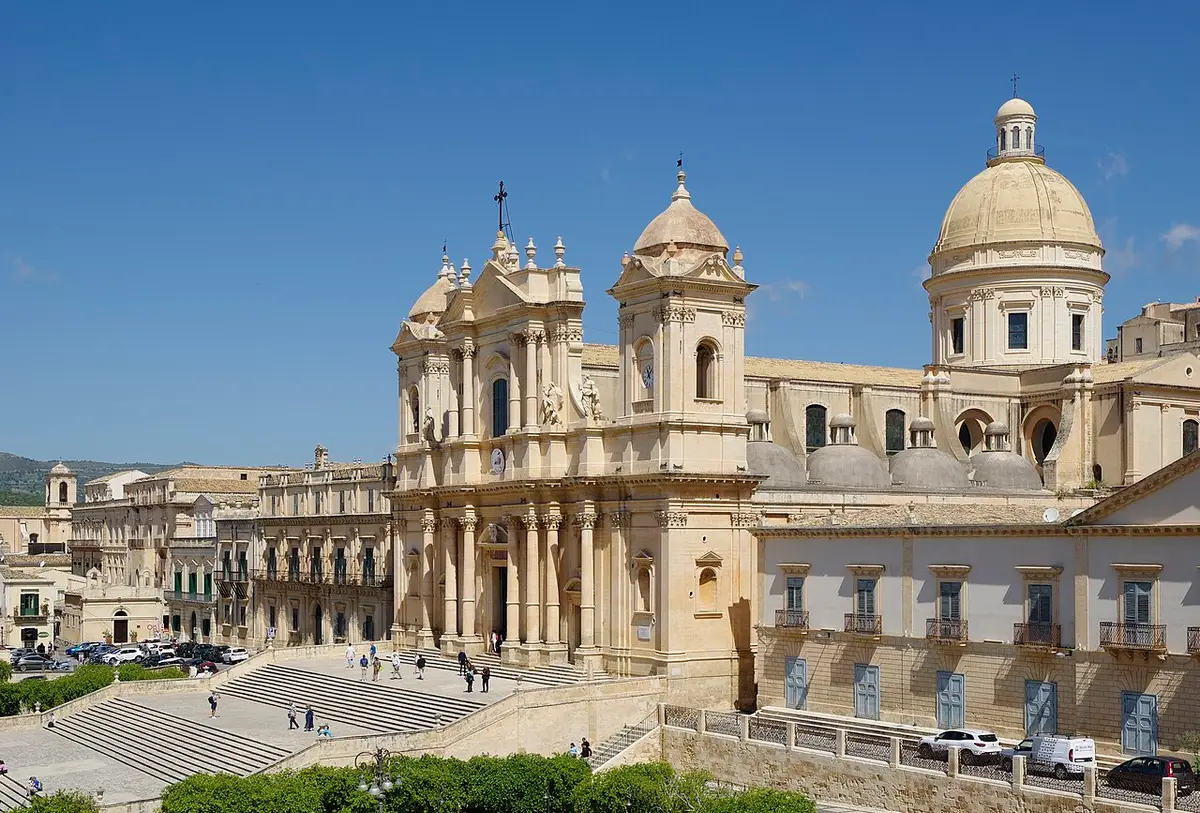
The new Noto was built on a gentle slope a few kilometres from the ruined old town, on a grid of long parallel streets linked by flights of steps, with the main squares given to the buildings of church, state and nobility. Corso Vittorio Emanuele runs from the Porta Reale, put up for King Ferdinand II's visit in 1838, past San Francesco, the convent of the Santissimo Salvatore, the cathedral of San Nicolò at the top of its grand staircase, Palazzo Ducezio, the town hall by Vincenzo Sinatra, and San Domenico by Rosario Gagliardi. Just off the Corso, Via Nicolaci is lined with the carved balconies of Palazzo Nicolaci di Villadorata, held up by horses, lions and grotesque faces.
On 13 March 1996 the cathedral's dome and part of the nave collapsed. The rebuilding took eleven years, and the church reopened on 18 June 2007. Up the hill, the Santissimo Crocifisso keeps sculptures and relics brought from the old town.
The comune covers more ground than any other in Sicily and is among the largest in Italy. It runs from the Iblei plateau, cut by gorges, down through the Tellaro valley to the sea, with seaside hamlets at Lido di Noto, Calabernardo and San Lorenzo, the hill hamlet of Testa dell'Acqua and San Corrado Fuori le Mura near the patron saint's hermitage. Farming, especially almonds, vines, olives and citrus, still matters, but tourism has grown fast since the UNESCO listing in 2002.
Living in Noto
Noto has changed more than most Sicilian towns in a generation. Visitors fill the centre from spring to autumn, the seaside hamlets swell in summer and many old palazzi have become guesthouses and holiday homes. Unusually for the province, the population is growing. In winter the centre is calmer and the town belongs again to its residents, with the cafés and the evening passeggiata on the Corso carrying on all year.
Daily life is easy: shops, schools, a railway station on the line to Siracusa, and Avola next door for extra choice. Siracusa is the city for bigger shopping, offices and specialists. Many people who live here split their time between the town and the coast, where Lido di Noto and Calabernardo are mainly second homes.
Pros: extraordinary beauty, wonderful coast and countryside, good food and a lively cultural life. Cons: busy summers, prices and rents pushed up by tourism, and the steep streets of the upper town. Like the whole area it is in the highest earthquake zone, though much of the centre has been carefully restored.
A short history
Old Noto, on Monte Alveria, was inhabited from the Early Bronze Age; nearby Castelluccio gave its name to a whole prehistoric culture. Greek historians record it as Neas or Neaton, birthplace of Ducetius, the Sicel leader who fought Siracusa's expansion in the fifth century BC. Under Rome it was Netum, and in late antiquity the luxurious Villa del Tellaro was built in its countryside.
Under the Arabs Noto gave its name to one of the three valli, or districts, of Sicily, the Val di Noto. In February 1091 its surrender to Count Roger I ended the Norman conquest of the island, as the last great Muslim stronghold to fall alongside Butera.
The earthquake of January 1693 almost entirely destroyed the old town and killed around a thousand people. After a heated debate, the town was rebuilt on a new site, and architects including Rosario Gagliardi and Vincenzo Sinatra created the baroque town of today. In 1837, after riots in Siracusa, the Bourbon government moved the provincial capital to Noto, which held it until Italian unification. After the Second World War heavy emigration emptied the town; a 1977 symposium on its architecture, attended by scholars such as Cesare Brandi and André Chastel, helped revive interest, and in 2002 the centre joined the UNESCO list with the other late baroque towns of the Val di Noto.
Food, festivals and traditions
Noto is almond country, and the nuts go into granita, pastries and nougat in the town's cafés. The countryside also produces olive oil, citrus and wine: Nero d'Avola and Moscato bianco grow here, and the Noto DOC was first recognised in 1974 as Moscato di Noto, alongside the Eloro DOC.
The patron, San Corrado Confalonieri, is celebrated on 19 February, the day of his death, with a procession of his silver urn, and again in summer in August. The Infiorata, born in 1980 from a meeting with the flower artists of Genzano di Roma, covers Via Nicolaci with carpets of petals each May. Holy Week is also observed with processions.
Interesting facts about Noto
- Noto has the largest territory of any comune in Sicily and is fourth largest in Italy.
- Its surrender to Roger I in February 1091 completed the Norman conquest of Sicily.
- The cathedral dome collapsed on 13 March 1996; the church reopened on 18 June 2007.
- Noto was capital of the province from 1837 until Italian unification.
- The Infiorata of Via Nicolaci began in 1980.
House prices in Noto
€868average price per m² to buy
€3.42average rent per m² a month
€87,000a 100 m² home at that price
These are the official averages from the Agenzia delle Entrate's property market observatory (OMI) for homes in normal condition across the town's 8 price zones. Prices in Noto are above the typical town in Siracusa province (€690 per m²) and above the typical Sicilian town (€593 per m²). Detached houses (villini) average about €1,024 per m².
Why these figures can look low: they come from the values on real sales, which sit below advertised asking prices, and the typical Sicilian town is the middle of all 391 comuni, most of them small inland towns. Island-wide averages quoted on property portals, around €1,100 to €1,300 per m², lean towards the cities and the coast, where most homes are listed. Rents work the same way: listings usually ask well above the official rent figure, often double or more.
Houses that need work, which is most of the cheap ones you see advertised, sell well below these figures. The renovation comes on top, so budget for both.
Work out the return on a let with the rental yield calculator, or see the steps from offer to keys in the buying timeline planner.
Getting there and getting around
| From the centre to | By car | Distance |
|---|---|---|
| Catania Fontanarossa airport (CTA) | 1 hour 8 minutes | 84 km |
| Comiso airport (CIY) | 1 hour 33 minutes | 81 km |
| Palermo Falcone Borsellino airport (PMO) | 3 hours 59 minutes | 312 km |
| Trapani Birgi airport (TPS) | 4 hours 57 minutes | 390 km |
| Palermo city centre | 3 hours 30 minutes | 280 km |
| Catania city centre | 1 hour 10 minutes | 88 km |
| Messina, for ferries to the mainland | 2 hours 14 minutes | 181 km |
| Nearest railway station (Noto) | 2 minutes | 1 km |
Times are by road on a clear day, worked out from OpenStreetMap. Allow longer in summer and on market days. Noto has a railway station close to the centre, which helps for trips to the cities, but most residents still rely on a car, and buses are infrequent on Sundays and in August.
Planning flights and trips? See the Schengen 90/180 calculator if you are from outside the EU.
Everyday life: shops, health and schools
- Hospital with A&E
- Ospedale Trigona, about 6 minutes by car
- Pharmacies in the comune
- 8
- Supermarkets
- 5
- Schools
- State: 9 nursery schools, 6 primary schools, 3 middle schools, 9 secondary schools; plus 3 independent (paritaria)
- Banks and cash machines
- 5
- Cafés and bars
- 46
- Restaurants
- 84
- Full fibre broadband
- 76% of addresses
Pharmacies and schools come from the official Ministry of Health and Ministry of Education lists. The other counts are of places mapped in OpenStreetMap inside the comune's boundary, so a small shop or a doctor's surgery can be missing. “Not fully mapped yet” means the volunteer map clearly has gaps here, not that the town has none. For a family doctor (medico di base, what the British call a GP), you register with the local health authority (ASP Siracusa) once you are resident.
Free download
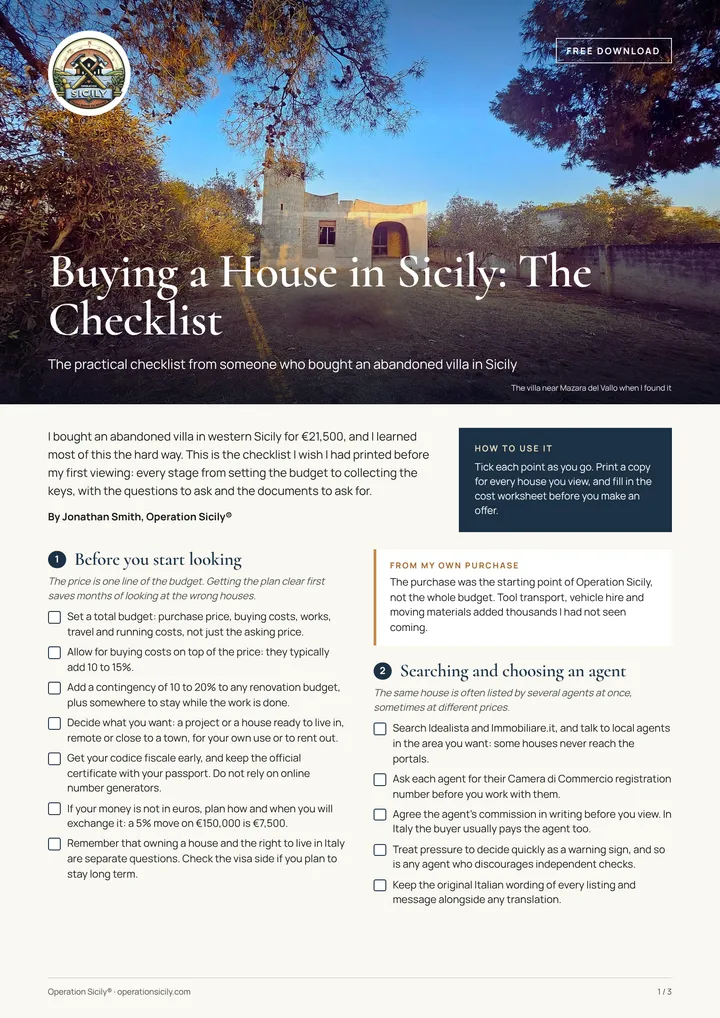
Buying a house in Sicily? Take my checklist.
Every step from budget to keys, the questions to ask at a viewing and the documents to ask for, as a PDF you can print.
Here is your checklist. Download the checklist (PDF)
Weather and climate in Noto
33.7°Caverage July high
6.6°Caverage January low
558 mmrain a year, on about 80 days
53days a year above 30°C
| Month | Average temperature | Rain |
|---|---|---|
| January | 10°C | 72 mm |
| February | 10°C | 64 mm |
| March | 12°C | 50 mm |
| April | 15°C | 32 mm |
| May | 20°C | 13 mm |
| June | 25°C | 9 mm |
| July | 29°C | 4 mm |
| August | 28°C | 9 mm |
| September | 24°C | 56 mm |
| October | 20°C | 72 mm |
| November | 16°C | 90 mm |
| December | 12°C | 85 mm |
Averages for 2015 to 2024. Winters are cool and damp, and you will want heating for three or four months. Summers are very hot, so shade, thick walls and air conditioning matter.
See what each month brings in Sicily month by month, or size a solar system with the off-grid solar calculator.
Who lives there
- Population
- 24,612
- Change since 2019
- +3.8%
- Median age
- 44
- Foreign residents
- 1,090 (4.4%)
- People from Noto are called
- netini
Registered residents from abroad include 36 British, 15 American, 39 German, 8 Dutch, 36 French, 8 Belgian, 5 Irish, 2 Australian, 1 Swedish, 11 Swiss, 7 Spanish, 81 Polish, 207 Romanian, 8 Albanian and 9 Ukrainian citizens. Most of the rest come from countries outside Europe and the Americas. Others own holiday homes here without registering as residents.
Noto is a working town first, busy all year round, with about 4,462 tourist beds. Visitors add to the summer crowds without changing the way the place lives.
Beaches in Noto
Noto has 8 beaches in our beach guide, and one more named beach or cove mapped along its coast. 95% of its officially monitored bathing waters were rated excellent in the latest EU assessment.
- Calabernardo Beach sand, water excellent
- Calamosche Beach fine sand, water excellent
- Eloro Beach fine sand, water excellent
- Lido di Noto Beach fine sand, water excellent
- Marianelli Beach sand, water excellent
- San Lorenzo Beach fine sand, water excellent
- Spinazza Beach fine sand, water excellent
- Vendicari Beach fine sand, water excellent
Things to see and do in and around Noto
Walk the Corso slowly, climb the cathedral steps at sunset, see the balconies of Via Nicolaci and the oval church of the Santissimo Salvatore. Then drive to Noto Antica on Monte Alveria, where walls, gates and the ruins of the castle and churches lie among trees, a moving sight after the finished perfection of the new town.
On the coast, the Vendicari reserve, set up in 1984, protects lagoons, dunes and beaches such as Calamosche, Marianelli, Eloro and San Lorenzo, with a Swabian tower and an old tuna fishery; it is an important stopover for migrating birds. Near the mouth of the Tellaro are the Greek city of Eloro and the Colonna Pizzuta, and inland the Villa Romana del Tellaro has fine late Roman mosaics. Cavagrande del Cassibile, Marzamemi and Siracusa are all easy trips.
- Noto Cathedral
- Helorus
- Netum
- Villa Romana del Tellaro
- Cavagrande del Cassibile Nature Reserve
- Castelluccio di Noto excavations
- Nature reserve of Vendicari
- Palazzo Ducezio
- Santa Maria dell'Arco
- Porta Reale
- Palazzo Nicolaci di Villadorata (Noto)
- San Carlo al Corso
- San Domenico, Noto
- Santissimo Crocefisso
Beaches within the comune include Spiaggia di Calamosche, Spiaggia di Marianelli, Spiaggia di Eloro, Spiaggia di Vendicari, Spiaggia di Lido di Noto, Spiaggia Scogli Bianchi.
Famous people born in Noto include Ducetius (5th-century BC Sicel chieftain); Giovanni Aurispa (Italian priest and classical scholar); Ibn Hamdis (Medieval Arab poet); Vincenzo Sinatra (Italian architect); Corrado Galzio (Italian musician).
Earthquake, landslide and flood risk
Noto is in seismic zone 1, the highest of Italy’s four seismic zones. The zone sets the anti-seismic standard for any new building, extension or structural renovation, which affects both the design and the cost. A structural survey is worth paying for before you buy any older building, stone house or flat.
0.2% of the comune's land is mapped by ISPRA as high or very high landslide hazard, where 0.6% of residents live, and 2.7% of the land could flood in a medium-probability flood (2.1% of residents). Ask for the hazard maps (PAI) for any house you are considering; the comune's technical office or your geometra can check them.
Check what you can build or change with the building permit checker, and keep a margin with the renovation contingency calculator.
The comune: useful details
- Official name
- Comune di Noto
- Province
- Siracusa (Libero consorzio comunale di Siracusa)
- Postcode (CAP)
- 96017
- Dialling code
- 0931
- Area
- 544 km²
- Height above sea level
- 152 m
- ISTAT code
- 089013
- Cadastral code
- F943 (used in the codice fiscale of people born here)
- Official website
- comune.noto.sr.it
Registering as a resident, paying local taxes and building permits all go through the comune. If you were born abroad, get your Italian tax code first with the codice fiscale calculator.
Nearby towns
Noto borders 8 other comuni:
- Avola €690/m²
- Canicattini Bagni €723/m²
- Ispica €745/m²
- Modica €993/m²
- Pachino €638/m²
- Palazzolo Acreide €769/m²
- Rosolini €693/m²
- Siracusa €1,230/m²
Towns like Noto elsewhere in Sicily
- Scicli (Ragusa province)
- Carini (Palermo province)
- Termini Imerese (Palermo province)
- Sciacca (Agrigento province)
- Palma di Montechiaro (Agrigento province)
- Casteldaccia (Palermo province)
Noto on our lists
- The best places to live in Sicily
- The best places to retire in Sicily
- Where British people live in Sicily
- The best towns in Sicily for expats
- The best seaside towns in Sicily
See every town in Siracusa province (21 comuni), or let Find your town suggest places that match what you want.
Frequently asked questions
Where is Noto in Sicily?
Noto is in the province of Siracusa, about 30 km south-west of Siracusa. The centre sits about 152 metres above sea level and its land runs down to the coast.
What is Noto known for?
Noto has the largest territory of any comune in Sicily and is fourth largest in Italy. Its surrender to Roger I in February 1091 completed the Norman conquest of Sicily. The cathedral dome collapsed on 13 March 1996; the church reopened on 18 June 2007.
Is Noto a good place to live?
It depends what you want. Anyone who wants to live inside great architecture, with beaches, wine country and a lively food scene on hand, and who accepts summer crowds and high demand for homes as the price. The nearest emergency department is about 6 minutes away, and homes average about €868 per m².
How much do houses cost in Noto?
Official figures from the Agenzia delle Entrate put homes in Noto at about €868 per square metre on average, so a 100 m² home in normal condition would be roughly €87,000. That is above the typical town in the province (€690) and above the typical Sicilian town (€593). Houses needing work sell for less, and the best homes for more.
What is the nearest airport to Noto?
Catania Fontanarossa airport is the nearest, about 1 hour 8 minutes away by car (84 km). Comiso is about 1 hour 33 minutes away. Times are for a clear road and will be longer in summer traffic.
What is the weather like in Noto?
Summers are very hot: July afternoons average about 33.7°C, with around 53 days a year above 30°C. Winter nights in January average about 6.6°C. Rain totals about 558 mm a year, falling mostly between October and March.
How many people live in Noto?
24,612 people live in the comune of Noto, according to ISTAT. The population grew by 3.8% between 2019 and 2025. Half the residents are older than 44.
Is there a hospital near Noto?
The nearest hospital with an emergency department (pronto soccorso) is Ospedale Trigona, about 6 minutes away by car. In an emergency anywhere in Italy, call 112.
Is Noto in an earthquake zone?
Noto is in seismic zone 1, the highest of Italy’s four seismic zones. New building and structural work anywhere in Italy must follow anti-seismic rules, and the zone sets how strict they are, so ask your geometra or engineer to check any house you plan to buy or renovate.
Does Noto count for the 7% flat tax for pensioners?
On population, yes: Noto is a Sicilian town under the 30,000 resident limit for Italy's 7% flat tax for foreign pensioners. The other conditions are about you, not the town. Check the details with our 7% flat tax town checker and a qualified adviser.
Does Noto have fast internet?
Yes, for most homes: about 76% of addresses in Noto can get full fibre (FTTH), according to the communications regulator AGCOM. Check the exact address before you buy.
Is Noto busy all year?
The centre is busiest from Easter to October and especially in August, when the seaside hamlets fill too. From November to March it is much quieter, with most cafés and shops still open and the town mainly to its residents.
Credits
Photo: Berthold Werner, CC BY-SA 4.0, via Wikimedia Commons.
Figures: ISTAT, Agenzia delle Entrate (OMI), Copernicus ERA5-Land, AGCOM, Dipartimento della Protezione Civile, ISPRA, Ministero della Salute, Ministero dell'Istruzione e del Merito, IndicePA, Open-Meteo, NASA POWER, Wikidata and © OpenStreetMap contributors, with several series gathered by the expatliving-data open data collection. Map boundaries ISTAT via openpolis (CC BY 4.0). Sicily as a whole: 4,787,390 people in 391 comuni.
 The weekly YouTube series