
About Calamosche Beach
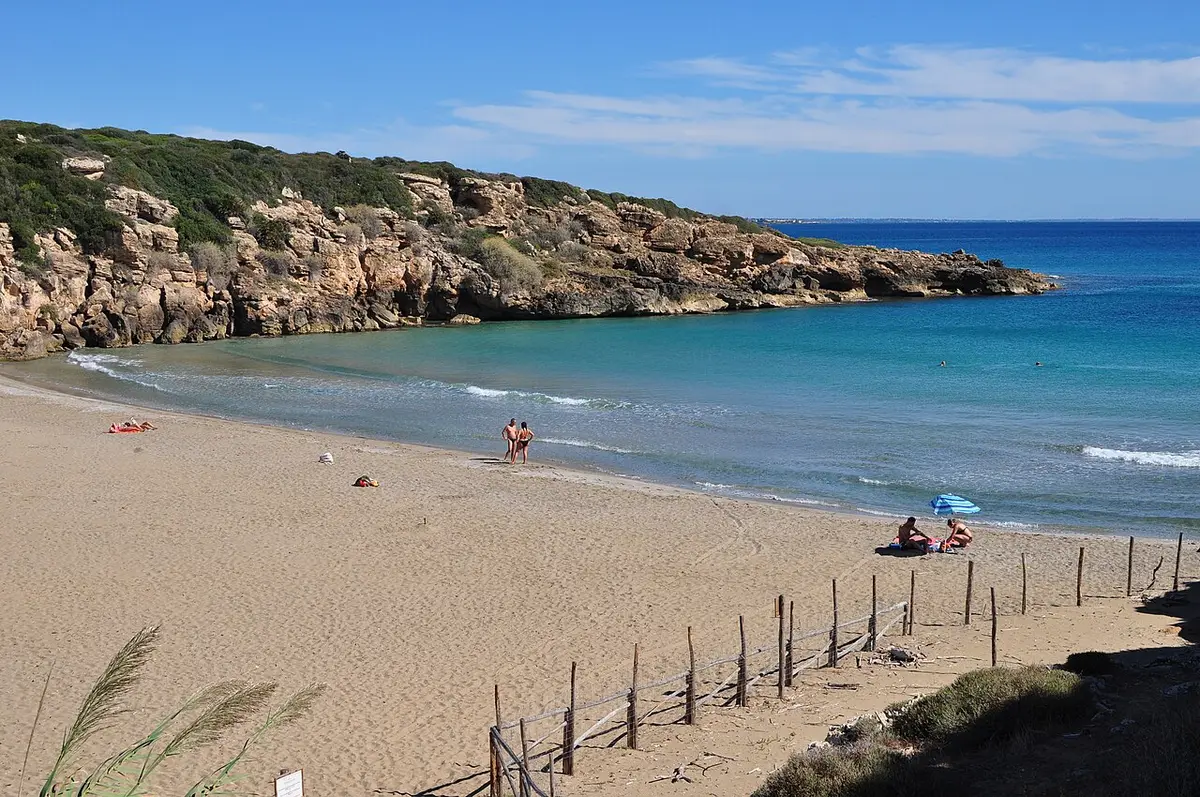
Calamosche, known in dialect as Funn'i Musca, is the smallest and most sheltered of the beaches in the Vendicari reserve. The sand fills a short bay roughly 200 metres across, closed at each end by low limestone headlands. Those headlands take the force out of the wind and the currents, which is why the sea here is so often flat when the longer beaches nearby have surf.
The seabed is sandy and very shallow in the middle of the bay and turns rocky along both sides. The rocks are full of small caves and hollows, above and below the waterline, and the deeper water off the points is where snorkellers go. Further out the colour shifts from pale green to deep blue.
In 2005 Legambiente's Guida Blu named Calamosche the most beautiful beach in Italy, and it has been on lists ever since. That fame is the main drawback: in August the cove fills up early and the path is busy from mid morning. There is nothing to buy on the beach, so the day is shaped by what you carry in.
Behind the sand is Mediterranean scrub with myrtle, dwarf palm and thyme along the paths. The reserve as a whole covers about 1,500 hectares of coast, salt pans and wetland and is a Ramsar site for migratory birds, so herons and, from autumn to spring, flamingos are part of the wider scene.
How to get to Calamosche Beach
Calamosche has its own entrance to the Vendicari reserve, signposted off the SP19 road between Noto and Pachino. A dirt track leads from the road to the car park by the ticket office; an entry ticket is charged for the reserve. From there it is a walk of roughly one kilometre, about 15 to 20 minutes, on a dirt path through scrub with almost no shade.
The last stretch drops down to the sand. The route is not suitable for wheelchairs and is hard work with a pushchair. You cannot drive closer, and parking on the verges near the reserve is not allowed.
About 1 km on foot along an unshaded dirt path from the reserve entrance off the SP19; there is no road to the sand.
By car, Calamosche Beach is about 1 hour 19 minutes from Catania Fontanarossa airport and 1 hour 41 minutes from Comiso airport.
Tips for visiting Calamosche Beach
- In July and August arrive before 9 am; the cove is small and fills quickly.
- Carry water, food, a hat and a sunshade. There are no bars or toilets on the beach.
- Wear proper shoes for the path; it is hot underfoot by midday.
- Bring a mask and snorkel for the caves along the headlands.
- Ball games and beach racquets are not allowed inside the reserve.
- Check the reserve's notices before setting out, as individual entrances are sometimes closed for works or safety.
What is there
- No lidos or sunbed hire, with a free public stretch.
- Inside the Riserva naturale orientata Oasi faunistica di Vendicari: follow the reserve’s rules on access, fires, dogs and taking sand or shells.
Water quality at Calamosche Beach
The nearest official monitoring point, Calamosche, was rated excellent for bathing in the 2025 season under the EU Bathing Water Directive, as it has been in each of the last 11 seasons.
- 2025Excellent
- 2024Excellent
- 2023Excellent
- 2022Excellent
- 2021Excellent
- 2020Excellent
- 2019Excellent
- 2018Excellent
Ratings run from excellent through good and sufficient to poor, and are set from four seasons of samples taken through each bathing season by the Italian health authorities and reported to the European Environment Agency.
Facts about Calamosche Beach
- Legambiente's Guida Blu named Calamosche the most beautiful beach in Italy in 2005.
- Its dialect name is Funn'i Musca.
- The cove is roughly 200 metres long and is sheltered by two rocky headlands.
- It lies inside the Vendicari reserve, a wetland of international importance under the Ramsar Convention.
Noto: the town
Noto is a baroque town of about 24,600 people south-west of Siracusa, rebuilt from scratch after the 1693 earthquake and now a UNESCO World Heritage Site, with the largest territory of any comune in Sicily running down to the Vendicari coast. Read our guide to living in Noto: house prices, the weather month by month, the nearest hospital and airports, history and food.
Beaches near Calamosche Beach
- Marianelli Beach Noto, 1 km, sand
- Eloro Beach Noto, 2 km, fine sand
- Vendicari Beach Noto, 3 km, fine sand
- Lido di Noto Beach Noto, 4 km, fine sand
- Calabernardo Beach Noto, 6 km, sand
- San Lorenzo Beach Noto, 7 km, fine sand
- Spinazza Beach Noto, 9 km, fine sand
- Pantanello Beach Avola, 10 km, sand
Frequently asked questions
How long is the walk to Calamosche Beach?
From the car park at the Calamosche entrance it is about one kilometre on a dirt path, which takes most people 15 to 20 minutes. The path has very little shade, so in summer go early in the morning or later in the afternoon, and carry water.
Are there any facilities at Calamosche?
No. Calamosche is inside a nature reserve and has no bar, no sunbeds, no umbrellas and no toilets on the beach. Bring food, plenty of water and something for shade. Ball games are not allowed, so it is a place for swimming, snorkelling and reading rather than beach sports.
Is the sea calm at Calamosche?
Usually, yes. The two headlands that close the cove shelter it from wind and currents, so the water is often flat when the open coast nearby is rough. The middle of the bay is sandy and shallow, while the sides are rocky and deeper, which suits snorkelling.
Is Calamosche good for young children?
The water in the centre of the cove is shallow and calm, which children enjoy, but the kilometre walk in the sun with all your kit is the real test. With toddlers and pushchairs, Eloro or San Lorenzo are easier days out on the same stretch of coast.
Is the water clean at Calamosche Beach?
The nearest official monitoring point, Calamosche, was rated excellent for bathing in the 2025 season under the EU Bathing Water Directive, as it has been in each of the last 11 seasons. Ratings are based on samples taken through the bathing season and checked for bacteria from sewage. After heavy rain, water near river mouths can be cloudy for a day or two.
Is Calamosche Beach sandy?
Yes, Calamosche Beach is a golden sand beach.
Featured in
Credits
Photo: Frédérique Voisin-Demery from Grenoble, France, CC BY 2.0, via Wikimedia Commons.
Written from 6 or more independent sources and checked. Figures: bathing water quality from the European Environment Agency (EU Bathing Water Directive), drive times and facilities from © OpenStreetMap contributors, map boundaries ISTAT via openpolis (CC BY 4.0).
Before you go: the latest sampling results and any bathing bans are on the Ministry of Health's Portale Acque, and local notices on the comune of Noto's website.
 The weekly YouTube series