
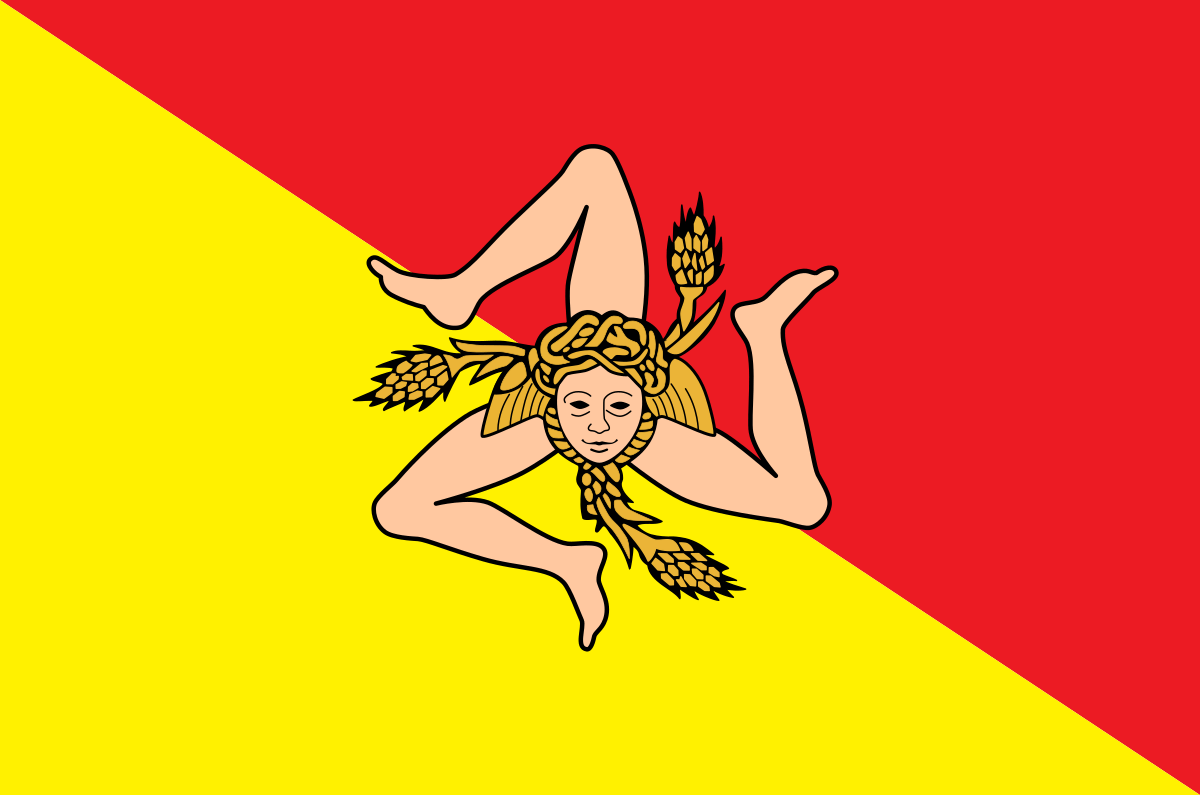
What is on the Sicilian flag
The flag is a rectangle, two units tall for every three long, cut corner to corner into two triangles: red above (the law calls it orange-red), yellow below. In the centre sits the emblem of the Sicilian Region, and the law sets its size at three fifths of the flag's height. A ribbon in the green, white and red of Italy is tied where the finial meets the staff.
The emblem in the middle has four parts:
| Part | What it is | What it stands for |
|---|---|---|
| Three bent legs | A triskelion (triscele in Italian), three legs joined at the hip and bent at the knee, as if running | The island's three capes |
| The face | The head of the Gorgon, usually called Medusa (the gorgoneion) | Protection: an ancient charm to ward off evil |
| Snakes and wings | Snakes in the hair and small wings at the temples, as later Greek and Roman art showed Medusa | The Gorgon of myth; the Region also reads the wings as time passing |
| Ears of wheat | Wheat woven through the hair with the snakes | Sicily's fertile land, and its old role as Rome's granary |
Together the legs and the head are what Sicilians call the Trinacria, and the name is used for the symbol and, in a poetic way, for the island itself.
Why the Sicilian flag has three legs
Look at Sicily on a map and it is close to a triangle. The Greeks who settled the island from the 8th century BC called it Trinakria, from the Greek for three (treis) and headlands (akra). The Athenian historian Thucydides, writing in the 5th century BC, says the island was called Trinacria before it was called Sicania. The three legs are the three headlands, one at each corner:
| Cape | Where | Corner |
|---|---|---|
| Capo Peloro (Punta del Faro) | Messina, facing mainland Italy across the Strait | North-east |
| Capo Passero | Province of Siracusa | South-east |
| Capo Lilibeo (Capo Boeo) | Marsala | West |
Capo Boeo is the cape nearest to us in Mazara del Vallo: the western tip of the triangle, where the old Roman name Lilybaeum survives.
The three-legged sign itself is older and wider than Sicily. Versions of it turn up in many ancient cultures, and the Regione Siciliana describes it as a very old sun symbol. In Sicily it appears on coins of Syracuse struck under Agathocles, who ruled the city from 317 BC, and the Greeks came to use it as the sign of the island. Over time it became a lucky charm as much as a map, which is why you still see it hung over doorways and on walls.
How to say it: Trinacria is tree-NAH-kree-ah, with the stress on the second syllable. The adjective, trinacrio, means simply Sicilian.
Whose face is on the Sicilian flag?
The face is the Gorgon. In Greek myth there were three Gorgon sisters, Stheno, Euryale and Medusa, and Medusa, the only mortal one, had snakes for hair and a gaze that turned people to stone. A Gorgon's head (a gorgoneion) was painted on shields, temples and pots across the Greek world to frighten off evil, and placing one at the centre of the three legs turned the Trinacria into a protective emblem.
The wheat is the Sicilian twist. The Regione Siciliana's own explanation says the Romans replaced the snakes with ears of wheat to stand for the fertility of the island and its role as the granary of Rome. That role is well documented: Cicero, prosecuting a corrupt Roman governor of Sicily in 70 BC, quotes Cato calling Sicily the nurse of the Roman people, a storehouse of grain for the Republic. When the wheat really joined the emblem is less certain, and the modern flag keeps both: the wheat sits alongside the snakes rather than in their place.
The Region also mentions that in some versions the head is that of a woman, perhaps a goddess, rather than a monster. That is one reason the face varies so much on souvenirs: some are fierce, some calm and almost pretty. On the official flag it is a calm face with wings, snakes and wheat.
What the red and yellow mean
The usual account, and the one the Regione Siciliana gives, is that the two colours are the civic colours of two towns: yellow for Palermo and red for Corleone, the first town to follow Palermo in the revolt against the French Angevin rulers known as the Sicilian Vespers, which broke out in Palermo on Easter Monday, 30 March 1282. The Region says a red and yellow banner was flown in that revolt. Sicily later became the Kingdom of Trinacria under the Peace of Caltabellotta of 1302, which ended the war that followed. There is more on that period in my guide to Sicily's history.
Here is the careful version. The Vespers revolt and its date are solid history. The link between the flag's colours and the Vespers is a tradition handed down over centuries, and I have not found a surviving 13th-century flag or document that shows it. Some accounts even give the colours the other way round (red for Palermo, yellow for Corleone), and another theory traces them to the red and gold of the Crown of Aragon, which took Sicily after the revolt. A diagonal red and yellow flag with the Trinacria was used by the Sicilian independence movement in the 1940s, and the Region made it official much later. So: Vespers colours by tradition, official since 2000.
When Sicily adopted its flag
Surprisingly recently. Sicily has been an autonomous region since 1946, with its own parliament since 1947, but for decades it had no official flag. Regional law no. 12 of 28 July 1990 gave the Region an official coat of arms (the Trinacria on a red and yellow shield) and a ceremonial banner, the gonfalone. The flag followed with regional law no. 1 of 4 January 2000, which made the flag, the coat of arms and the gonfalone the Region's three official symbols.
The 2000 law also sets out how the flag is used:
- It flies on 15 May, the anniversary of Sicilian autonomy, and on 25 May, the anniversary of the first sitting of the Sicilian Regional Assembly in 1947, and on other days the regional President decides.
- Outside public buildings it flies with the Italian flag and the European Union flag, all three the same size and height, with the Italian flag in the middle.
- It flies outside the Palazzo dei Normanni in Palermo, the seat of the Regional Assembly, while the Assembly sits, and outside the regional government and local councils while they meet. It also flies at schools on the first day of the school year, at universities on the first day of the academic year, and at polling stations during regional elections.
- Anyone may fly it privately, as long as it is done with respect, and a worn or tattered flag must not be shown.
Has the face changed? Not officially, as far as I can find. The emblem was fixed by the drawing attached to the 1990 law, and the 2000 law placed that same emblem on the flag. The differences you notice are between versions made by flag makers and souvenir producers, which vary a lot in colour and in the face itself. The illustration on this page is a public-domain drawing from Wikimedia Commons, which its maker based on the Region's own artwork file.
Is the Sicilian flag the same as the Isle of Man flag?
No, although they are cousins. The flag of the Isle of Man, in the Irish Sea, also has three legs running round a centre, and the symbol is called the Three Legs of Mann. The differences are easy to spot:
| Feature | Sicily | Isle of Man |
|---|---|---|
| Background | Red and yellow, split diagonally | Plain red |
| Legs | Bare, flesh coloured | In armour, with spurs |
| Centre | The Gorgon's head with snakes, wings and wheat | No face: the legs meet at the hip |
Whether one came from the other is not settled. The Regione Siciliana's page says the Normans took the Trinacria to the Isle of Man. Manx National Heritage says the three legs appear to have been adopted as the royal arms of the island's kings in the 13th century, and that nobody knows for sure why, with an old sun symbol and Norse triskele coins among the suggestions. Writers have suggested a link with Sicily since at least the early 17th century, but it has never been proven, so the honest answer is: same idea, separate flags, and a connection that may or may not be real.
Where you will see the Trinacria in Sicily
Once you know it, you will see it everywhere:
- On public buildings: the flag flies beside the Italian and EU flags outside regional offices and town halls, and the three legs appear on Regione Siciliana signs and documents.
- In ceramics: hand-painted Trinacria plates, tiles and wall plaques are a familiar sight in ceramic shops, and many people hang one at home as a good-luck charm.
- On souvenirs: magnets, keyrings, T-shirts, tea towels and model painted carts.
- On local products and packaging, where it simply means made in Sicily.
If you want to bring one home, a hand-painted ceramic Trinacria is the classic choice, and it is something Sicilians hang in their own homes too.
Frequently asked questions
Why does the Sicilian flag have three legs?
The three legs stand for the three capes at the corners of triangular Sicily: Capo Peloro near Messina, Capo Passero in the province of Siracusa and Capo Lilibeo (Capo Boeo) at Marsala. The ancient Greeks called the island Trinakria, the land of three headlands, and the three-legged symbol appears on coins of ancient Syracuse from the 4th century BC.
Whose face is on the Sicilian flag?
The face is the Gorgon, usually identified as Medusa from Greek myth. A Gorgon head was an ancient charm to ward off evil. On the Sicilian flag she has snakes and ears of wheat in her hair, and small wings.
What do the colours of the Sicilian flag mean?
By tradition, and according to the Regione Siciliana, the yellow comes from Palermo and the red from Corleone, the first town to join Palermo in the Sicilian Vespers revolt of 1282. The link to the Vespers is a long tradition rather than something proven by a surviving medieval flag, and some accounts give the colours the other way round.
Is the Sicilian flag the same as the Isle of Man flag?
No. Both use three legs running round a centre, but the Isle of Man flag is plain red with three armoured, spurred legs and no face, while the Sicilian flag is red and yellow with bare legs around a Gorgon head with wheat. A historical link between the two has long been suggested but has never been proven.
When did Sicily adopt its flag?
The flag became the official flag of the Sicilian Region with regional law no. 1 of 4 January 2000. The coat of arms with the Trinacria had been made official by regional law no. 12 of 28 July 1990. The red and yellow colours and the three legs are centuries older.
What is the Trinacria?
The Trinacria is the symbol at the centre of the Sicilian flag: three bent legs radiating from the head of the Gorgon, with ears of wheat. It takes its name from Trinakria, the ancient Greek name for Sicily, and is pronounced tree-NAH-kree-ah.
Is there a Sicilian flag emoji?
No. Unicode's standard emoji set has flags for countries, and for England, Scotland and Wales, but none for Italian regions, so people use the Italian flag or a picture of the Trinacria instead.
Sources and small print
- Regione Siciliana: La bandiera (the Region's explanation of the flag, the Trinacria, the Gorgon and the colours)
- Regione Siciliana: regional law no. 1 of 4 January 2000, adopting the flag
- Regione Siciliana: regional law no. 12 of 28 July 1990, adopting the coat of arms and gonfalone
- Manx National Heritage: Three Legs of Mann
- Museums Victoria: gold coin of Agathocles, Syracuse, 317 to 310 BC, with the triskeles
- Thucydides, History of the Peloponnesian War 6.2, and Cicero, Against Verres 2.2 (Perseus)
Where sources disagree, as they do over the colours, this page gives the Region's account and says so.
Credits
Drawing: Angelo Romano, public domain, via Wikimedia Commons.
 The weekly YouTube series