
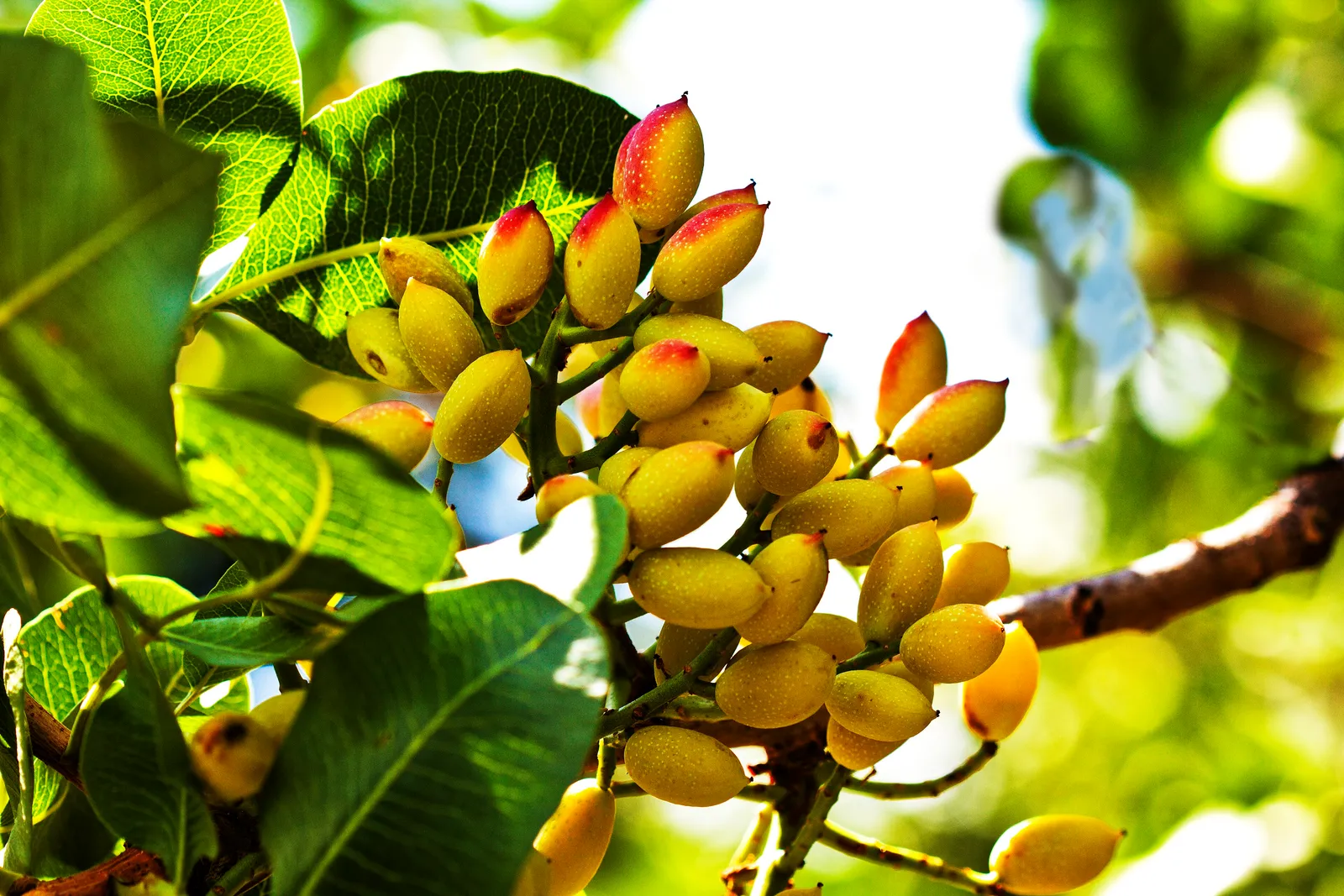
What is Bronte pistachio?
Pistacchio Verde di Bronte has a DOP, the European Union's protected designation of origin, registered under EU Regulation No 21/2010. The official specification sets out what can carry the name:
- Where: only the territories of Bronte, Adrano and Biancavilla, on the western side of Etna, between 400 and 900 metres above sea level.
- Which trees: Pistacia vera of the Napoletana variety, also called Bianca or Nostrale, grafted onto terebinth (Pistacia terebinthus), a wild relative that grows on its own on the lava.
- What it must be like: kernels of an intense green, a long shape, a strong aromatic flavour and a high share of monounsaturated fat.
- How much: no more than 1,700 kg of in-shell pistachios per hectare (about 1,500 lb an acre) over each two-year cycle.
The specification credits the volcanic soils, the dry summers, the big swings between day and night temperatures, the terebinth rootstock and the local practice of removing buds for the colour and flavour that are hard to find elsewhere, even on other slopes of Etna.
Where Sicily’s pistachios came from
The history in the DOP specification goes back a long way. Pistachio growing is said to have passed from Syria to Greece with the conquests of Alexander the Great, in the 4th century BC, and the Romans brought the tree to Italy at the end of the reign of Tiberius (emperor from AD 14 to 37), through Lucius Vitellius, governor of Syria, as Pliny the Elder records.
In Sicily, widespread growing is traced to the Arab period. The Sicilian words for the nut and the tree, frastuca and frastucara, come from the Arabic fustuq. Today Sicilian pistachio growing is concentrated in the province of Catania, around Bronte, Adrano and Biancavilla, and Bronte calls itself the city of the pistachio.
The harvest: once every two years, by hand
Bronte's pistachio trees are allowed to crop only every other year. In the off year, growers go over the trees and remove the developing buds by hand. Pistachio trees naturally alternate between heavy and light years; the specification says this practice, called degemmazione, makes the alternation sharper and helps keep pests and disease down. The local association Bronte Insieme explains that the harvest falls in odd-numbered years, and that the even years are the "rest" years in which the buds come off.
The orchards sit on rough lava with only a thin layer of soil, so machines cannot do the work. Pickers shake the branches over nets or sheets, or pick straight into baskets slung over the shoulder, and some hang an upturned umbrella from a branch to catch the nuts. The specification allows harvesting from the second ten days of August to the first ten days of October, depending on the year and the slope. Bronte Insieme describes the harvest as a month in which the whole town, old and young, heads out to the orchards.
Within 24 hours of picking, the soft outer hull must be removed so the shells do not darken. The nuts are then dried, traditionally in the sun, until the moisture in the kernel is 6% or less. The dried in-shell nut is called tignosella in Bronte. Shelling and the peeling that reveals the green kernel are done later, by machine.
How to tell real Bronte pistachio
Bronte's crop is small, and there is far more "pistachio" flavour in Sicily than Bronte could ever grow. Bronte Insieme itself warns that even at the town's own festival, only a few of the pistachio items on sale carry the DOP label. When it matters to you:
- Look for the full name, Pistacchio Verde di Bronte, which the rules require to be printed clearly.
- Look for the DOP logo, which shows Mount Etna and a pistachio.
- Check the label for the year of production, which the specification requires on DOP packs.
On a menu, "al pistacchio" on its own tells you the flavour, not the origin.
The Bronte pistachio festival (Sagra del Pistacchio)
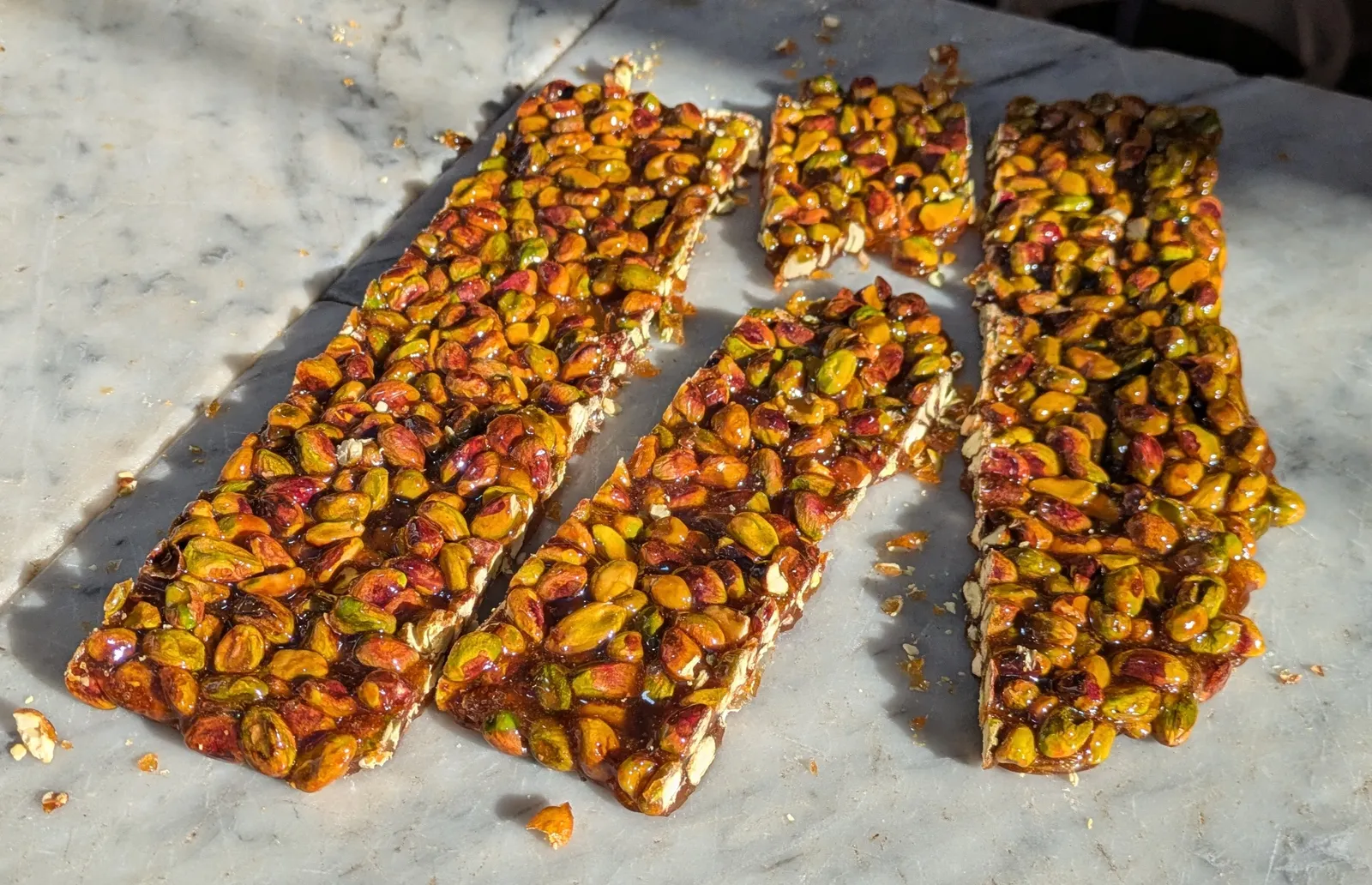
Every autumn Bronte holds the Sagra del Pistacchio, its pistachio festival, in the streets and squares of the old town. The 2026 edition, the 35th, ran over two long weekends, 25 to 27 September and 2 to 4 October, with stands, cooking shows and tastings; for the first time the DOP producers' consortium helped organise it. Dates change each year, so check with the town before you plan around it.
At the festival, and in Bronte's pastry shops and restaurants at any time, you find pistachio in almost everything: gelato, cakes and pastries, nougat, pistachio cream, arancini, sausage, panettone at Christmas and colomba at Easter. For the wider calendar of Sicilian sweets and the feasts they belong to, see my guide to Sicilian desserts, and for what the island is like that time of year, Sicily in September.
How Sicilians eat Bronte pistachio
The DOP specification says Bronte pistachio defines the sweets of Sicily, and especially of the Catania area: pistachio gelato, small nougats and dry pastries made with pistachio paste. But in Bronte it goes into savoury food too:
| Dish | What it is |
|---|---|
| Pennette al pistacchio | Short pasta in a pistachio sauce, famous across Sicily |
| Pasta with pistachio pesto | Spaghetti or other pasta tossed in a pan with pistachio pesto |
| Fresh pasta with pistachio flour | Homemade pasta with ground pistachio in the dough |
| Salsiccia al pistacchio | Pork sausage with pistachio, now much in demand in Bronte |
| Arancini al pistacchio | Fried rice balls with a pistachio filling, a Catania-area favourite |
| Gelato, cannoli and pistachio cake | The sweet side Bronte is famous for |
My guides to Sicilian pasta dishes and arancini cover those dishes in their wider setting.
Visiting Bronte
Bronte is on the northwest side of Etna, about 54 km (34 miles) from Catania. You can drive there on the roads around the western flank of the volcano, or take the Circumetnea railway from Catania, which runs right into the town. A visit pairs well with a day on the mountain; my guide to Mount Etna tours covers how to see the volcano, and my guide to Etna, Taormina, Catania and Siracusa covers the east of the island. For the rest of Sicily's food, start with my Sicily food guide.
Frequently asked questions
What makes Bronte pistachios special?
They are grown only around Bronte, Adrano and Biancavilla on the volcanic slopes of Etna, from the local Napoletana variety grafted onto wild terebinth. The DOP rules require an intense green kernel, a long shape, a strong aromatic flavour and a high share of monounsaturated fat, which the specification links to the lava soil, the climate and the off-year bud removal.
Why are Bronte pistachios harvested every two years?
Pistachio trees naturally alternate heavy and light crops. In Bronte, growers remove the buds by hand in the off year, which sharpens that rhythm and, according to the DOP specification, helps against pests and disease. The harvest falls in odd-numbered years.
When is the pistachio harvest in Bronte?
In odd-numbered years, between the second ten days of August and the first ten days of October under the DOP rules. It is done by hand, shaking the branches over nets or picking into baskets, because the lava ground rules out machines.
When is the Bronte pistachio festival?
The Sagra del Pistacchio is held in the autumn, usually over two long weekends at the end of September and the start of October. In 2026 the 35th edition ran from 25 to 27 September and 2 to 4 October. Dates change each year, so check with the town.
Where is Bronte in Sicily?
On the northwest slopes of Mount Etna, in the province of Catania, about 54 km (34 miles) from the city of Catania. It can be reached by road or on the Circumetnea railway from Catania.
Are all Sicilian pistachios from Bronte?
No. Only pistachios from Bronte, Adrano and Biancavilla that meet the DOP rules can be sold as Pistacchio Verde di Bronte, and plenty of pistachio food in Sicily is made with nuts from elsewhere. Look for the full name and the DOP logo, which shows Etna and a pistachio.
Why are Bronte pistachios so expensive?
Because there are few of them and they take a lot of work. They can only come from Bronte, Adrano and Biancavilla on the lava slopes of Etna, the trees are allowed to crop only every other year, and the nuts are picked by hand because the rough ground rules out machines. The crop is small compared with the demand for pistachio, which is why so much pistachio food in Sicily is made with nuts from elsewhere.
How are Bronte pistachios used?
In sweets above all: gelato, cannoli, cakes, nougat and pistachio cream. In Bronte they also go into pasta (pennette with pistachio sauce, pistachio pesto), sausage and arancini.
Sources and small print
- MASAF: Pistacchio Verde di Bronte DOP specification (area, variety, history, bud removal, harvest dates, drying, yield, characteristics and labeling) and Commission Regulation (EU) No 21/2010
- Bronte Insieme: the pistachio harvest (odd-year harvest, picking by hand, tignosella)
- Bronte Insieme: Sagra del Pistacchio (the 2026 festival, the dishes, the DOP label advice and getting to Bronte)
- Comune di Bronte: XXXV Sagra del Pistacchio, the 2026 dates
Festival dates change from year to year; check with the town before you travel.
Credits
Photo: Paolo Galli, CC BY-SA 3.0, via Wikimedia Commons.
Photo: Auregann, CC BY-SA 4.0, via Wikimedia Commons.
 The weekly YouTube series