
What makes Sicilian pasta different
Sicilian pasta is built on what grows and swims around the island: eggplant, tomatoes, almonds, pistachios, wild fennel, sardines, and sheep's milk cheeses such as pecorino and ricotta salata. Sweet and salty often meet in the same dish, with raisins and pine nuts next to anchovies.
Each dish below belongs to a particular city, though you will find most of them all over the island. The broader picture of what to eat is in my Sicily food guide; this page goes into the pasta.
Pasta alla Norma: Catania’s eggplant pasta
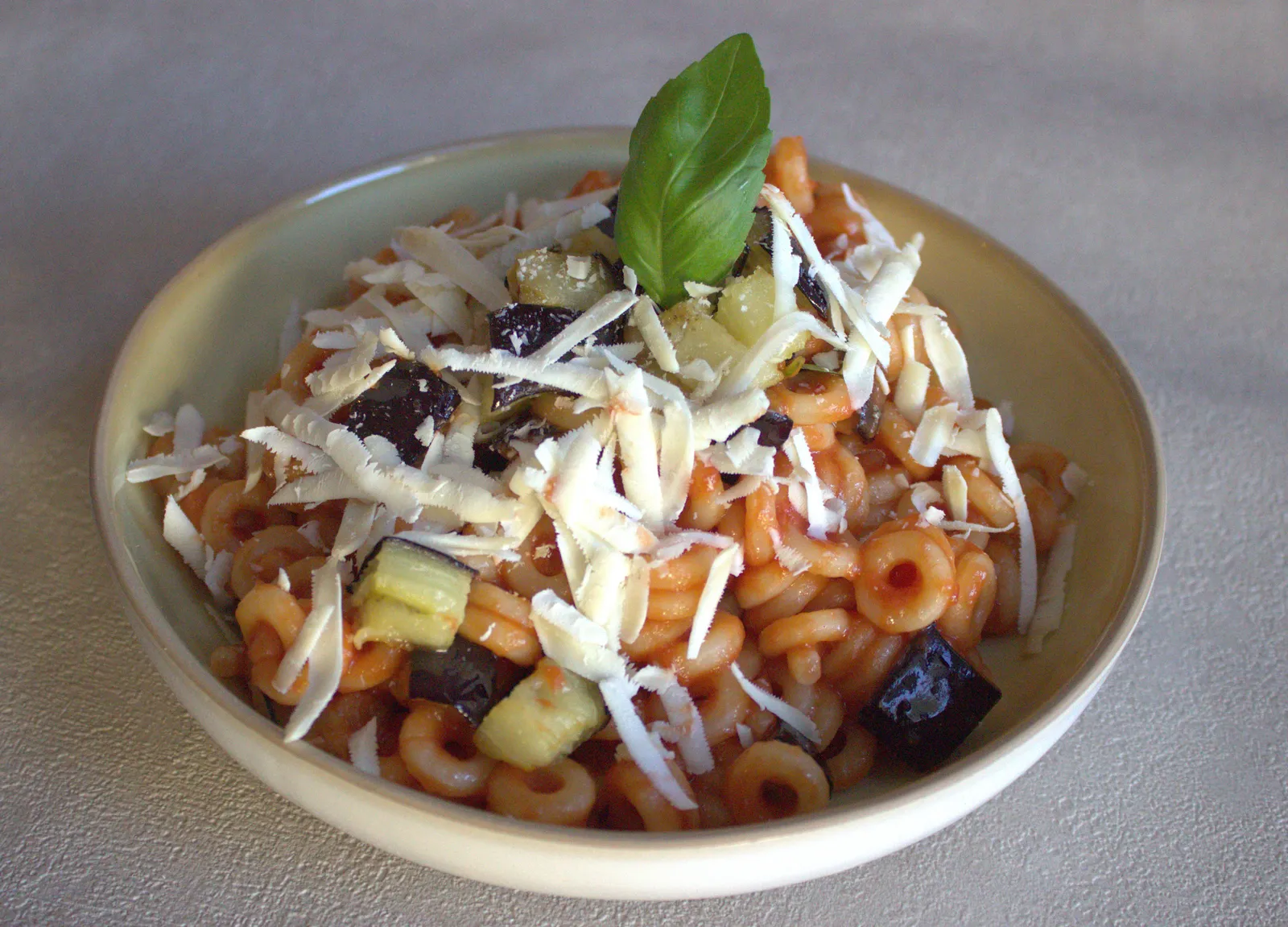
Pasta alla Norma is pasta, usually maccheroni, in a tomato sauce, finished with fried eggplant, grated ricotta salata and basil. It is credited to Catania, where it is the signature dish of the city's cooking, though pasta with eggplant and tomato was common across southern Italy long before it got its name.
The name almost certainly refers to Norma, the opera by Vincenzo Bellini, the composer from Catania. How it came about is not documented. One story credits the Sicilian playwright Nino Martoglio, who is said to have exclaimed "It's a Norma!" over a plate of it, meaning it was a masterpiece; another says a chef created the dish to honour the opera. Neither is proven. There is even a national Pasta alla Norma Day, on 23 September.
The same toppings turn up on pizza alla Norma, and in Catania on arancini alla norma too; my arancini guide has those. Ricotta salata, the firm, salted ricotta grated over the top, is explained in my guide to Sicilian cheese.
Pasta con le sarde: sardines and wild fennel
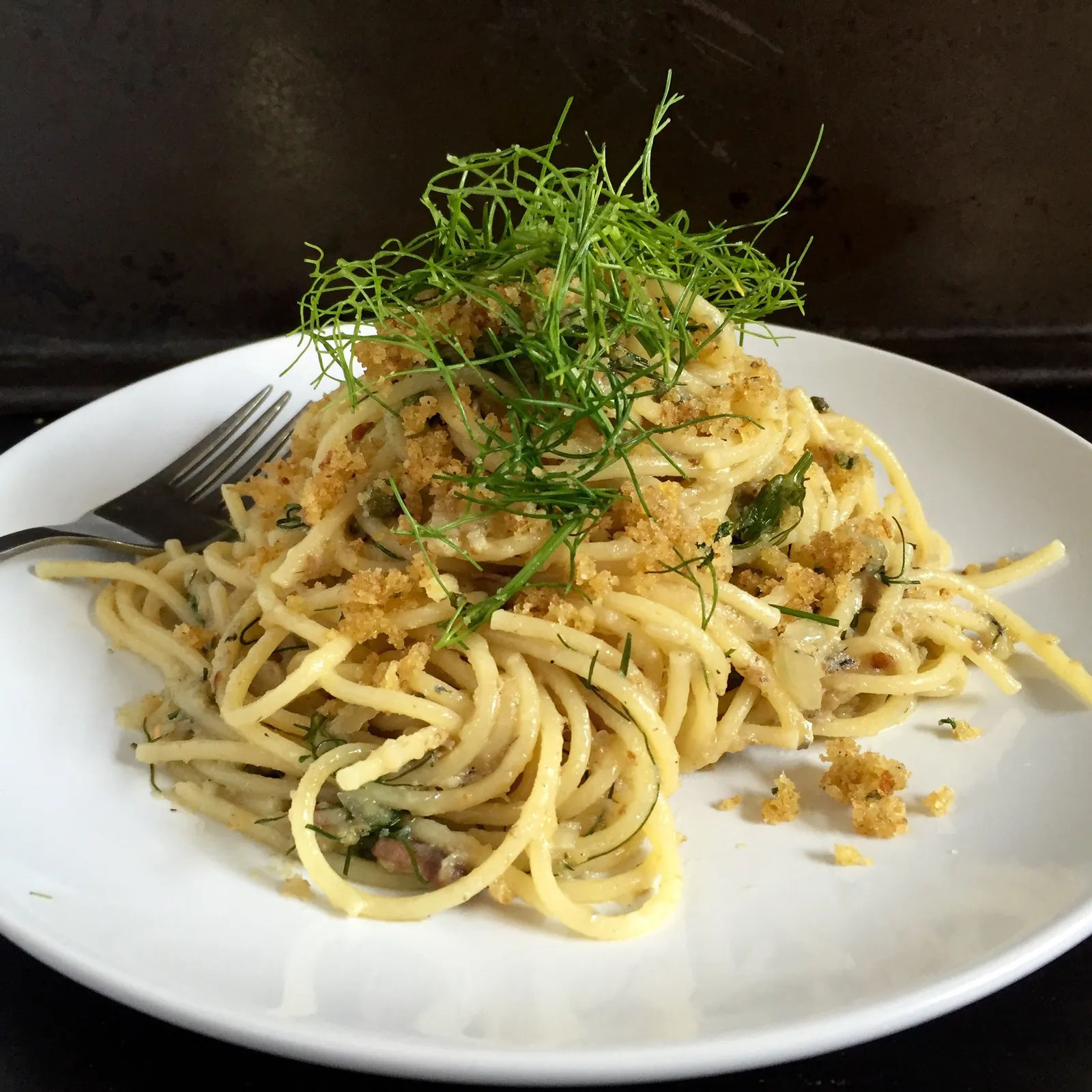
Pasta con le sarde (pasta chî sardi in Sicilian) is, for me, the dish that sums up Sicilian cooking in one bowl: fresh sardines and wild fennel, cooked with onion, salted anchovies, raisins, pine nuts and a pinch of saffron, tossed with long hollow pasta and served with toasted breadcrumbs. It is made all over Sicily but is most closely tied to Palermo, where the classic version is in bianco, without tomato.
- The pasta: bucatini, the slightly thicker perciatelli, or mezzani.
- The sardines must be fresh, cleaned and filleted; canned sardines in oil are not a substitute.
- The fennel is wild mountain fennel, using the tender shoots and feathery leaves.
- The season traditionally runs from March to September, when fresh sardines are in the markets and wild fennel can be picked.
There are many versions. Around Agrigento tomato paste goes in; around Messina the saffron is usually left out; some cooks finish it in the oven with chopped almonds; and alla milanisa adds tomato sauce. Pasta con le sarde is on the Ministry's list of traditional Sicilian products.
Busiate al pesto trapanese: Trapani’s almond pesto
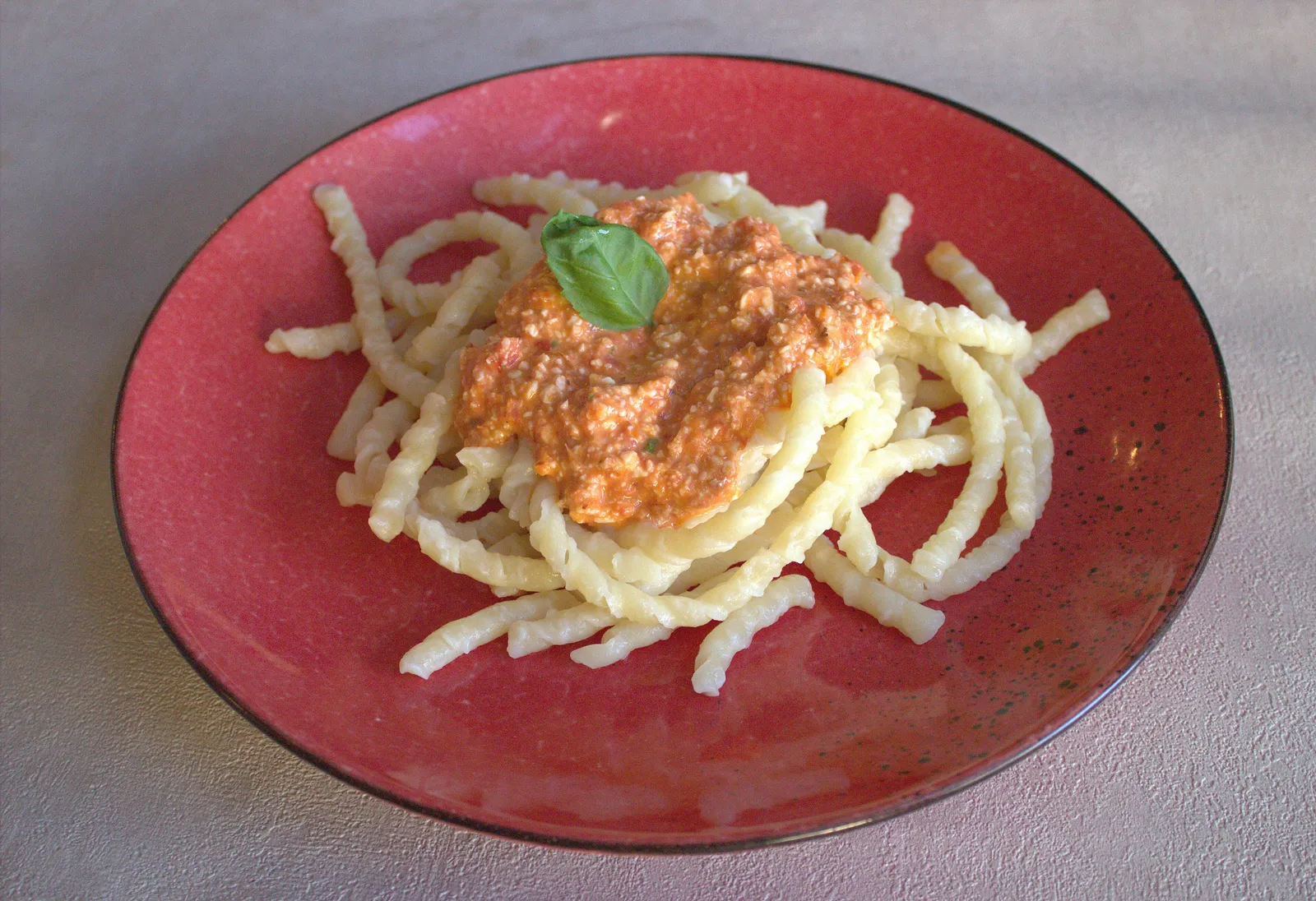
This is the pasta of my own corner of Sicily. Pesto alla trapanese is a raw sauce, pounded in a mortar, of tomato, almonds, basil, pecorino, red garlic and oil. Its traditional partner is busiate, a fresh pasta of durum wheat semolina, water and salt, twisted into long spirals. The name comes from busa, the stem of a Mediterranean grass the dough was once wound around; Trapani cooks often use a knitting needle instead. In 2025 the word busiata entered the Zingarelli, a standard dictionary of Italian.
The story told in Trapani is that Genoese ships stopping in the port on their way from the East brought the Ligurian agliata, a sauce of garlic and walnuts, and local sailors remade it with what they had: tomatoes and almonds. Busiate with pesto alla trapanese are on the Ministry's list of traditional Sicilian products. In Trapani the dish is often served with fried eggplant or potatoes, or with small fried fish. Busiate are also eaten with tomato sauce and fried eggplant, or with ragù.
Trapani is also where to look for couscous, which my food guide covers, and the salt pans are just outside town.
Anelletti al forno: Palermo’s baked pasta
Anelletti al forno is the Sunday and holiday dish of Palermo and its province: small rings of pasta, about a centimetre (under half an inch) across, layered with a meat ragù with peas and cheese such as caciocavallo, tuma or primosale, and baked into a firm timbale. Families add their own touches, from ham or hard-boiled egg to mozzarella or pecorino, and some versions add fried eggplant. Because it takes a long time to make, it is a dish for feast days.
It travels well, so it is the dish Palermo takes on outings, to the beach on Ferragosto (15 August) and during the feast of Santa Rosalia. Delis and rosticcerie also sell single portions called timballetti, baked in small cone-shaped tins, as a take-out lunch. If you are looking for Sicilian "pasta al forno", this is the one.
Pistachio pasta from Bronte
On the slopes of Etna, the pistachio town of Bronte puts its green nut into pasta as well as sweets: pennette with pistachio sauce, spaghetti with pistachio pesto and fresh pasta made with pistachio flour. My guide to Bronte pistachio explains what makes it special and when the town celebrates it.
Sicilian pasta by area
| Dish | Where it is from | What is in it |
|---|---|---|
| Pasta alla Norma | Catania | Tomato, fried eggplant, ricotta salata, basil |
| Pasta con le sarde | All over Sicily, especially Palermo | Fresh sardines, wild fennel, onion, anchovies, raisins, pine nuts, saffron, toasted breadcrumbs |
| Busiate al pesto trapanese | Trapani | Raw sauce of tomato, almonds, basil, pecorino, garlic |
| Anelletti al forno | Palermo and its province | Pasta rings, meat ragù with peas, cheese, baked |
| Pasta al pistacchio | Bronte and the Etna area | Pistachio sauce or pesto |
My guides to Palermo, Cefalù and Monreale and to Etna, Taormina, Catania and Siracusa cover the cities themselves.
How pasta con le sarde is made
Serves 4 | Prep about 40 min | Cook about 45 min | Source: GialloZafferano
This is GialloZafferano's version, summarised, not a family secret of mine. It gives every amount, so it is the one to cook from.
Ingredients
For the pasta and sauce
- 400 g (14 oz) spaghettoni
- 300 g (about 10 oz) fresh sardines, to clean and fillet
- 150 g (about 5 oz) wild fennel
- 3 litres (about 3 quarts) water, for the fennel and then the pasta
- 100 g (3.5 oz) spring onions
- 25 g (about 1 oz) raisins (Sicilian black raisins in the original)
- 20 g (about 3/4 oz) pine nuts
- 6 anchovy fillets in olive oil
- 0.5 g saffron threads and 200 ml (a scant cup) water
- Red garlic, dried chilli, olive oil and salt
For the crunchy breadcrumbs
- 150 g (about 5 oz) dry breadcrumbs, ideally durum wheat
- 30 g (2 tablespoons) tomato passata
- 40 g (about 3 tablespoons) olive oil
- Garlic, dried oregano, parsley and dried chilli
Method
- Trim the fennel, discarding the toughest stalks. Boil it in the 3 litres of water for 3 to 4 minutes if tender, 10 to 12 if older. Drain it and keep the water, because the pasta cooks in it. Press the fennel to squeeze its juice into the water, then chop it.
- Toast the saffron threads in a small pan for a couple of minutes, add the 200 ml of water and bring to the boil. Turn off the heat and leave it for 15 to 20 minutes.
- For the crunchy breadcrumbs, blend the passata, oil, chopped garlic, oregano, chilli and parsley, mix in the breadcrumbs, rub them through a coarse sieve and toast them in a dry pan with a little salt until dry and crisp.
- Clean the sardines: cut off the heads and fins, open them out like a book, lift out the backbone, rinse them in iced water, pat dry and cut each one into 3 pieces.
- Soften the finely chopped spring onions in oil with chopped garlic and the anchovies. When the anchovies break up, add a little of their oil and the chilli, then the saffron water, pine nuts, raisins, fennel and sardines. Season with salt, and add water if needed so the sardines are just covered.
- Bring the fennel water back to the boil, salt it and cook the spaghettoni. Drain them into the sauce, add a little more oil, toss gently for no more than a minute and serve at once, topped with the crunchy breadcrumbs.
The older method on Italian Wikipedia, drawn from Sicilian cookbooks, gives few amounts. It uses bucatini, boils the fennel for about 20 minutes, sears the sardines in oil before they go into the sauce and simmers the sauce for about 35 minutes before the pasta goes in.
Pasta alla Norma: a simple recipe
Serves 6 | Prep about 25 min | Cook about 60 min | Source: GialloZafferano
This is a standard recipe, summarised from GialloZafferano, not a family secret of mine. It serves 6. The sauce is made from fresh tomatoes and cooks slowly, so it is a dish for summer, when tomatoes and eggplant are at their best in Sicily.
Ingredients
- 500 g (about 1 lb) short pasta (the recipe uses sedani rigati)
- 1 eggplant (GialloZafferano uses the violet kind from Vittoria)
- 1.5 kg (about 3 1/4 lb) ripe tomatoes
- 150 g (about 5 oz) ricotta salata
- 4 cloves of garlic
- A bunch of basil
- Salt, and olive oil for frying
Method
- Slice the eggplant about 8 mm (1/3 inch) thick, put it in a colander, sprinkle it with salt and leave it for at least 15 minutes.
- Halve the tomatoes and put them in a pan with a pinch of salt, 3 cloves of garlic and most of the basil. Cook over low heat for 30 minutes without adding anything; the tomatoes give up their own water. Remove the garlic and basil and pass the tomatoes through a food mill.
- Put the sauce in a pan with the last clove of garlic and a sprig of basil and cook for another 40 minutes, stirring now and then, until thick.
- Rinse and dry the eggplant and fry it a few slices at a time in olive oil at about 170 to 180°C (340 to 355°F) until golden. Drain on paper towels.
- Take the basil out of the sauce and stir in a spoonful of the frying oil and a little raw olive oil.
- Cook the pasta until al dente, drain it and toss it briefly in the sauce. Serve topped with the fried eggplant, plenty of grated ricotta salata and a basil leaf.
Ricotta salata is the firm, salted ricotta explained in my guide to Sicilian cheese; it is grated, not crumbled.
Frequently asked questions
What is the most famous Sicilian pasta dish?
Pasta alla Norma, from Catania, and pasta con le sarde, most associated with Palermo, are the two best known. Norma is pasta with tomato, fried eggplant, ricotta salata and basil; pasta con le sarde has fresh sardines, wild fennel, raisins, pine nuts and saffron, topped with toasted breadcrumbs.
Why is it called pasta alla Norma?
It is almost certainly named after Norma, the opera by Vincenzo Bellini, who was born in Catania. One story says the playwright Nino Martoglio called the dish "a Norma", meaning a masterpiece; another says a chef created it to honour the opera. Neither story is documented.
What pasta is used for pasta con le sarde?
Long hollow durum wheat pasta: bucatini, the slightly thicker perciatelli, or mezzani. It is cooked in the water used to boil the wild fennel.
What are busiate?
A fresh pasta from Trapani made of durum wheat semolina, water and salt, twisted into long spirals around a thin stick or knitting needle. They are traditionally served with pesto alla trapanese, a raw sauce of tomato, almonds, basil, garlic and pecorino.
What is the difference between pesto alla trapanese and Genoese pesto?
Pesto alla trapanese is built on almonds and tomato, with basil, garlic and pecorino, pounded raw. The story in Trapani is that sailors adapted a Ligurian garlic and walnut sauce brought by Genoese ships, using local almonds and tomatoes.
What is anelletti al forno?
Palermo’s baked pasta: small pasta rings layered with meat ragù, peas and cheese and baked into a firm timbale. It is a feast-day dish, also sold in single portions called timballetti, and the food Palermo takes to the beach on 15 August.
Is pasta con le sarde seasonal?
Traditionally, yes. It was made from March to September, when fresh sardines are in the markets and wild fennel can be picked in the fields.
Sources and small print
- Pasta alla Norma (Italian Wikipedia, for the dish, the name stories and Pasta alla Norma Day)
- Pasta con le sarde (Italian Wikipedia, for the ingredients, season, variants and the older method)
- GialloZafferano: Pasta alla Norma (the recipe summarised above) and GialloZafferano: Pasta con le sarde (the pasta con le sarde recipe above)
- Pesto alla trapanese and Busiate trapanesi (Italian Wikipedia)
- Anelletti al forno (Italian Wikipedia)
- Regione Siciliana: Prodotti agroalimentari tradizionali and the Ministry of Agriculture's national PAT list (official lists of traditional products: pasta con le sarde and busiate with pesto trapanese)
- Sicilian traditional food products (PAT) (Italian Wikipedia summary of the Ministry's list)
- Bronte Insieme: Sagra del Pistacchio (for the pistachio pasta of Bronte)
Credits
Photo: 8w9d, CC0, via Wikimedia Commons.
Photo: Joy, CC BY 2.0, via Wikimedia Commons.
Photo: 8w9d, CC0, via Wikimedia Commons.
 The weekly YouTube series