
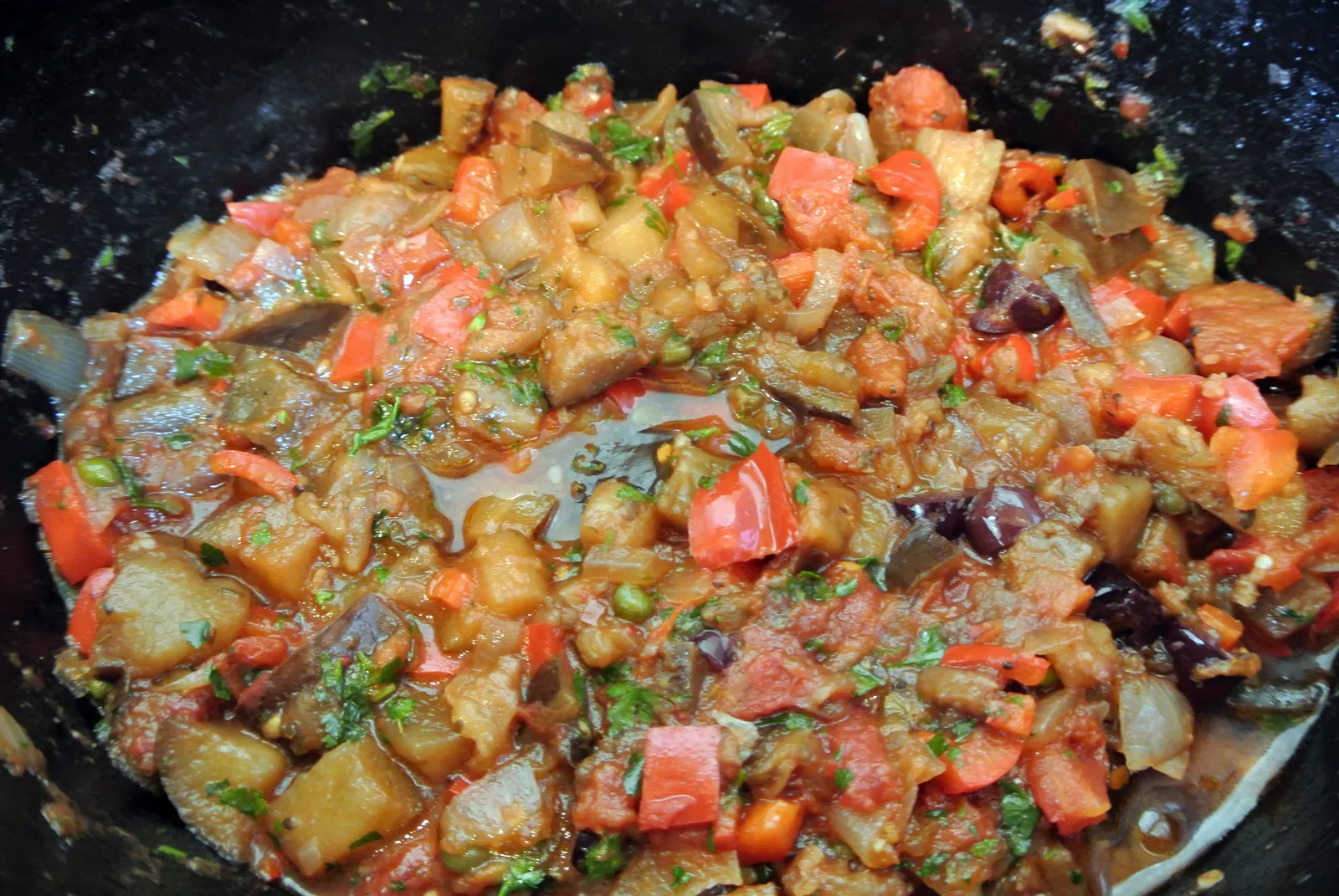
What is caponata?
Caponata is chunks of fried eggplant cooked with celery, onion, olives, capers and tomato, then finished with vinegar and sugar so that the whole dish is sweet and sour at once. The vegetables keep their shape: you should be able to see the pieces of eggplant and celery, not a purée. The classic recipe has no meat, fish or cheese in it.
In Italian terms it is a contorno, a side dish, or an antipasto, a starter. It also works spread on toasted bread as crostini. My Sicily food guide gives the overview of what to eat on the island; this page is the full story of caponata.
Where does caponata come from?
Caponata is Sicilian, and it belongs to a family of diced vegetable dishes found all around the Mediterranean, from Spanish pisto manchego to Maltese kapunata. What makes the Sicilian one different is the sweet and sour finish. Around the 18th century it was eaten as a main dish with bread; today it is a side or a starter.
Nobody is certain where the name comes from, and there are several theories:
- The sailors' capon. The cappone di galera was a sailors' dish of hard biscuits soaked in salt water and dressed with garlic, oil, vinegar and onion. The Latin caupona, a tavern, has also been suggested, which would make caponata a tavern dish.
- The capone fish. In Sicilian, capone is the mahi-mahi (lampuga in Italian), a fish once served to the aristocracy with a sweet and sour sauce. The story goes that ordinary families, who could not afford the fish, used eggplant instead.
- Chopping. The linguist Max Pfister linked the word to a Latin root meaning to chop into small pieces, which would also explain other Sicilian words such as capuliato, used for chopped sun-dried tomatoes in the southeast and for ground meat around Palermo.
The honest answer is that the origin of the name is uncertain. The dish itself is now firmly Sicilian, and it is on the Ministry of Agriculture's official list of traditional Sicilian food products (the PAT list).
Agrodolce: why caponata is sweet and sour
Agrodolce means sour-sweet. In caponata it comes from vinegar and sugar added near the end of cooking, cooked down until the sharp smell of the vinegar has gone. The result is a dish that is tangy, slightly sweet and salty from the olives and capers, all at once.
Sweet and sour combinations run through Sicilian food, from pasta con le sarde with its raisins to the island's sweets. My guide to Sicilian pasta dishes covers the savoury side.
Caponata across Sicily: Palermo, Catania, Trapani and more
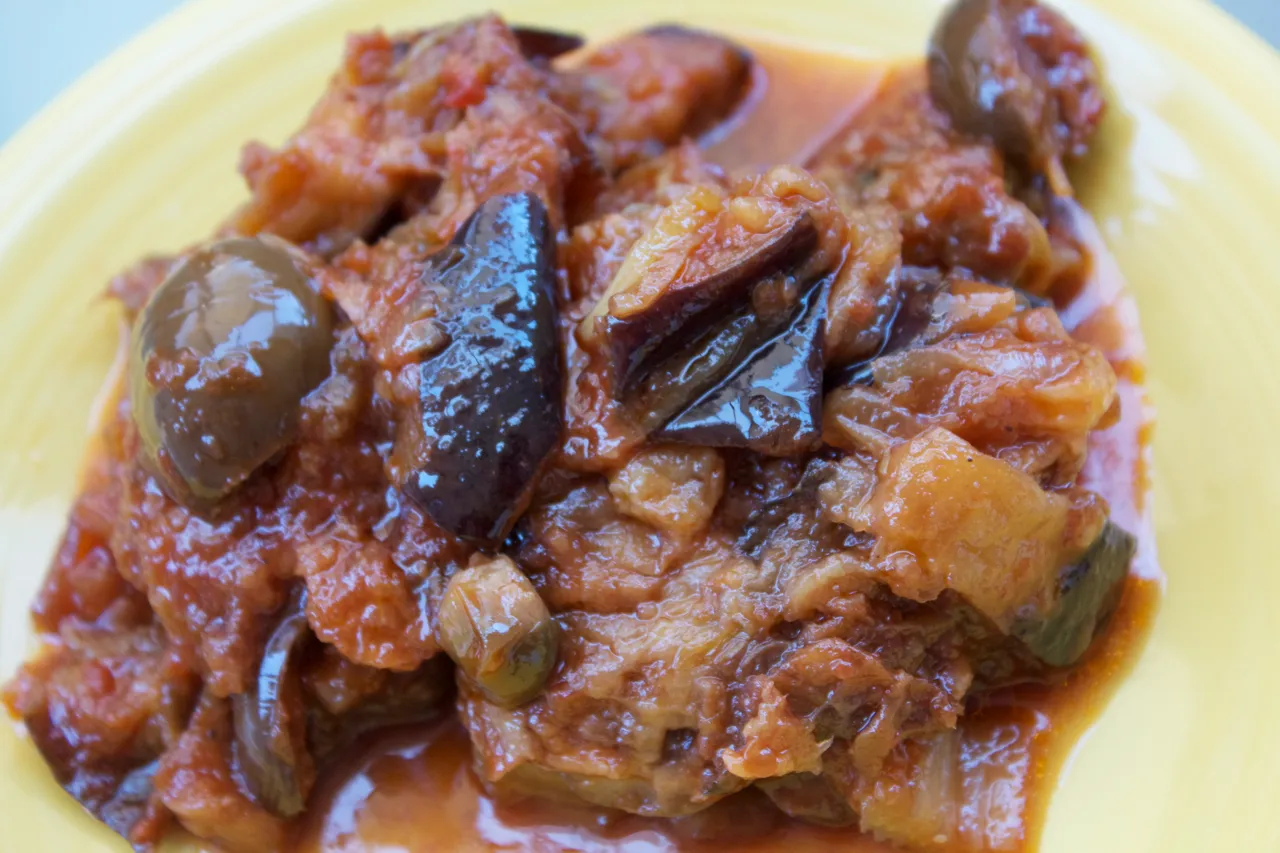
Every province, and nearly every family, has its own caponata. GialloZafferano, Italy's best-known recipe site, says there are at least 37 versions in Sicily alone. These are the main regional styles:
| Version | What makes it different |
|---|---|
| Palermo | The simplest: eggplant, green olives, onion, celery, capers, tomato sauce, vinegar and sugar, sometimes with basil, pine nuts and grated toasted almonds. The eggplant is cut in large chunks, about 4 to 5 cm (1.5 to 2 inches). |
| Trapani | Adds bell peppers, ripe tomatoes, raisins and toasted almonds. |
| Catania | Mostly eggplant and tomato, with pine nuts, raisins and fresh basil. |
| Siracusa | Uses fresh cherry tomatoes instead of tomato sauce, capers from Pantelleria and almonds, with a milder sweet and sour. |
| Messina | Uses whole peeled tomatoes instead of sauce, so each vegetable keeps its own flavour; finished with basil. |
| Agrigento | A richer mix that can include sweet green peppers, summer melon, raisins, pistachios and almonds. |
Around Catania there is also caponatina, a name used since 1916 for a version made to keep: smaller pieces, potatoes added and no sweet and sour sauce. In Palermo, GialloZafferano notes, caponata is sometimes served with small fried octopus.
How Sicilians eat caponata
Caponata is served cold or at room temperature, not hot, and almost every cook will tell you it is better the next day, once the flavours have settled. A few ways you will meet it:
- As an antipasto, in a small dish with bread, at the start of a meal.
- As a side dish with grilled meat or fish.
- On toasted bread as crostini, an easy party appetizer.
GialloZafferano suggests a glass of Sicilian red such as Nero d'Avola with it; my Sicilian wine guide covers the island's grapes.
Caponata or eggplant parmigiana?
Americans often know Sicily's other great eggplant dish first, as eggplant parm. The two are easy to tell apart. Caponata is a sweet and sour mix of fried eggplant and other vegetables, served cold. Parmigiana di melanzane is fried eggplant layered with tomato passata, basil, garlic and cheese and baked in the oven, with no vinegar or sugar.
Where parmigiana was born is still argued over. The Ministry of Agriculture lists it as a traditional product of Sicily, but also of Campania, Calabria and Puglia. The first recipe close to today's appeared in 1837 in a Neapolitan cookbook by Ippolito Cavalcanti, while the Sicilian claim rests on Vincenzo Mortillaro, who recorded the word in Sicily in 1844. The English food writer Elizabeth David noted that in Sicily it is called parmigiana di melanzane, not melanzane alla parmigiana.
If you love eggplant, the third dish to try is pasta alla Norma from Catania, with tomato, fried eggplant and ricotta salata; it is in my guide to Sicilian pasta dishes.
Where to eat caponata in Sicily
Caponata is everywhere in Sicily: on the antipasto spread of trattorias, in the cases of delis and rosticcerie, and at family tables all summer, when eggplant is at its best. Because each area has its own style, it is worth trying it in more than one place. Have it in Palermo, where the simple version rules (my guide to Palermo, Cefalù and Monreale covers the city), then compare it with the almond version around Trapani, at my end of the island, and the pine nut and raisin version in Catania.
If you are in Palermo, the city's street food is the other half of the picture: my Palermo street food guide covers panelle, crocchè and pane con la milza.
A simple caponata recipe
Serves 6 as a side dish | Prep about 40 min, plus resting | Cook about 40 min | Source: GialloZafferano
This is a standard recipe, summarised from GialloZafferano, not a family secret of mine. It serves 6 as a side dish. The only real rule is to fry the eggplant properly and let the finished caponata rest.
Ingredients
- 1 kg (about 2.2 lb) eggplant
- 400 g (about 14 oz) celery
- 250 g (about 9 oz) white onions
- 200 g (7 oz) ripe tomatoes
- 200 g (7 oz) green olives in brine, pitted
- 50 g (about 1.75 oz) salted capers, rinsed
- 50 g (about 1.75 oz) pine nuts
- 60 g (about 1/4 cup plus 1 tablespoon) sugar
- 60 g (about 1/4 cup) white wine vinegar
- 40 g (about 2 1/2 tablespoons) tomato paste
- Fresh basil, salt, and oil for frying and for the pan
Method
- Slice the onion thinly, cut the celery into rounds and halve the olives. Cut the eggplant and tomatoes into pieces of about 2.5 cm (1 inch).
- Toast the pine nuts in a dry pan for a few minutes until golden.
- Fry the eggplant in hot oil a few pieces at a time until golden, then drain on paper towels.
- In a wide pan, soften the onion in a little oil, add the celery and let it colour, then add the capers, olives, pine nuts and tomatoes. Cover and cook gently for 15 to 20 minutes.
- Mix the vinegar, tomato paste and sugar. Season the vegetables with salt, pour in the sauce, turn up the heat and stir until the smell of vinegar has gone.
- Take the pan off the heat, stir in the fried eggplant and plenty of basil, and leave to cool. Serve cold or at room temperature.
GialloZafferano says it keeps for 2 to 3 days in the fridge in a covered dish; take it out a couple of hours before serving. Raisins and strips of fried sweet pepper are both common additions.
Frequently asked questions
What is caponata?
Caponata is a Sicilian dish of fried eggplant cooked with celery, onion, olives, capers and tomato, finished with vinegar and sugar so that it is sweet and sour. It is served cold or at room temperature as a side dish or an appetizer, often with bread.
Is caponata served hot or cold?
Cold or at room temperature. It is usually made ahead, and most cooks say it tastes better the next day. If it has been in the fridge, take it out a couple of hours before serving.
What does caponata taste like?
Sweet, sour and salty at once. The fried eggplant is soft and rich, the vinegar and sugar give a tangy sweetness, and the olives and capers add salt. Celery and onion give it some crunch and depth.
Where does the word caponata come from?
Nobody knows for certain. Theories include the sailors’ dish called cappone di galera, the Latin caupona (a tavern), the capone fish (mahi-mahi), once served in sweet and sour sauce to the aristocracy, and a Latin root meaning to chop into small pieces.
What is the difference between Palermo and Catania caponata?
Palermo caponata is the simplest, with eggplant, green olives, celery, onion, capers and tomato sauce in sweet and sour, sometimes with pine nuts and almonds. Catania’s version leans on eggplant and tomato, with pine nuts, raisins and fresh basil. Trapani adds peppers and toasted almonds.
What is the difference between caponata and eggplant parmigiana?
Caponata is a sweet and sour mix of fried eggplant, celery, onion, olives and capers, finished with vinegar and sugar and served cold. Eggplant parmigiana is fried eggplant layered with tomato, basil and cheese and baked in the oven. Both are on the Italian list of traditional Sicilian products.
Is caponata the same as ratatouille?
No, though both belong to the Mediterranean family of diced vegetable dishes. Ratatouille, from Provence in France, is a stew of zucchini and other squash, tomatoes, eggplant, peppers and herbs, sautéed in olive oil, then simmered and usually served warm, according to Britannica. Caponata is built on fried eggplant with celery, olives and capers, finished with vinegar and sugar so it is sweet and sour, and served cold or at room temperature.
How do you pronounce caponata?
Kah-poh-NAH-tah, with the stress on the third syllable. In Sicilian the dish is capunata, said kah-poo-NAH-tah.
Is caponata vegan?
The classic recipe is: eggplant, celery, onion, olives, capers, tomato, vinegar, sugar, pine nuts and oil, with no meat, fish, eggs or dairy. Some restaurants serve it alongside fish, so ask if it matters.
How long does caponata keep?
About 2 to 3 days in the fridge, in a covered dish, according to GialloZafferano’s standard recipe. Bring it back to room temperature before serving.
Sources and small print
- Caponata (Italian Wikipedia, for the history, the theories about the name, the PAT listing and the regional versions; it cites Treccani, Max Pfister, Giannitrapani and Puca, and La Cucina Italiana)
- Sicilian traditional food products (PAT) (Italian Wikipedia summary of the Ministry's list)
- Regione Siciliana: Prodotti agroalimentari tradizionali and the Ministry of Agriculture's national PAT list (official lists of traditional products, where caponata di melanzane and parmigiana di melanzane appear)
- Parmigiana di melanzane (Italian Wikipedia, for the comparison with parmigiana, Cavalcanti, Mortillaro and Elizabeth David)
- Britannica: Ratatouille (for the comparison with ratatouille)
- GialloZafferano: Caponata (the standard recipe summarised above, the serving and keeping advice and the count of versions)
Credits
Photo: Karen and Brad Emerson, CC BY 2.0, via Wikimedia Commons.
Photo: Massimoweb, CC BY-SA 3.0, via Wikimedia Commons.
 The weekly YouTube series