
Are Sicilians Italian?
Legally there is no doubt. The Sicilian Statute, the island's own founding law, sets Sicily up as an autonomous region "within the political unity of the Italian State", and Sicilians hold Italian passports and vote in Italian elections. If you want the facts on the island's status, capital and population, they are in Is Sicily part of Italy?
Identity is another matter, and here I can only tell you what I see as a foreigner living in western Sicily since 2024. People here are proud of being Sicilian in a way that runs alongside being Italian rather than against it. The red and yellow Trinacria flag flies next to the Italian tricolour, and loyalty to your own town, your paese, often comes first of all. That is common across Italy, a country that only became one state in the 1860s.
Why Sicily feels different: a separate history
For most of its history Sicily was not ruled from Rome. Greeks, Carthaginians, Romans, Byzantines, Arabs, Normans, the emperor Frederick II, the Aragonese and Spanish crowns and the Bourbons of Naples all held it before it became part of Italy, and each left buildings, words and dishes behind. My journey through Sicilian history goes through the periods one by one.
The Arab period, from 827 until the Norman conquest of the island was completed in 1091, is the one people notice most in daily life, in irrigation, citrus and words. You can see it in the language: Treccani's encyclopedia of Italian lists Sicilian words such as caddu (a bucket) and casirìa (a flowerpot) as coming from Arabic.
Sicilian vs Italian language
Sicilian (sicilianu) is not Italian with an accent. It has its own sounds, grammar and a large vocabulary of its own, and it has an international ISO 639-3 language code, scn. In Italy it is usually called a dialect, and it is not among the twelve minority languages protected by Italy's law 482 of 1999. In my experience almost everyone who speaks Sicilian also speaks Italian, and Italian is what you get at the town hall, the bank or the doctor.
A few quick examples of how different it can be:
| English | Sicilian | Italian |
|---|---|---|
| child | picciriddu | bambino |
| boy | carusu | ragazzo |
| to look | taliari | guardare |
| beautiful | beddu, bedda | bello, bella |
| tailor | custureri | sarto |
| grapes | racina | uva |
I have put the sounds, the borrowed words, sayings and the dictionary sources for all of these in a separate guide: The Sicilian language: words and phrases.
Sicilian vs Italian food
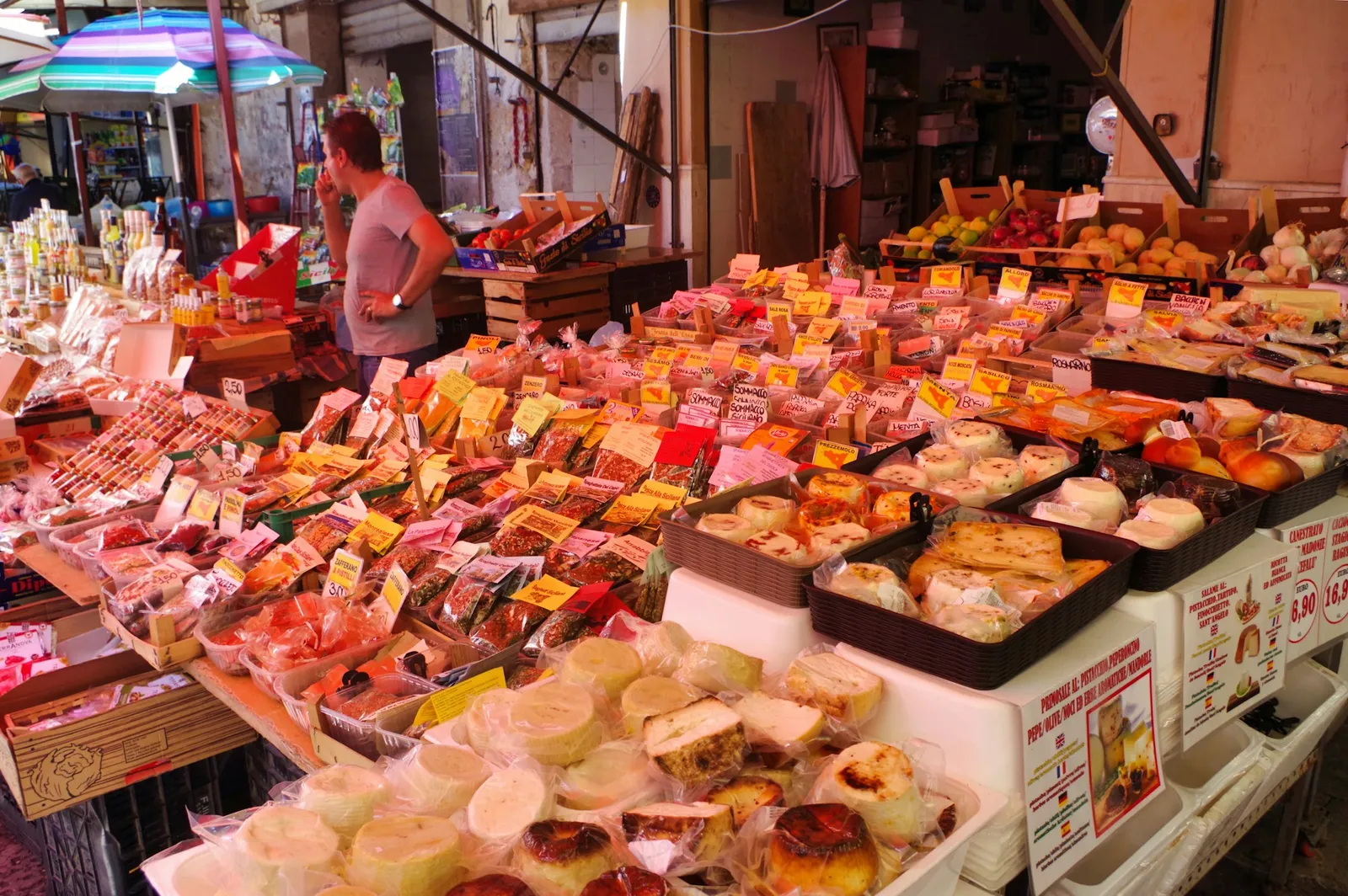
Food is where most visitors feel the difference first. Sicilian cooking shares Italy's pasta, olive oil and respect for ingredients, but it has its own sweets, street food and vocabulary, and arguments that the rest of Italy does not have.
The best example is the fried rice ball. In Palermo and the west it is an arancina, feminine, and round; in Catania and the east it is an arancino, masculine, and often pointed. The Accademia della Crusca, Italy's language academy, looked into it and found the feminine form used in western Sicily and the masculine in the east, with exceptions around Ragusa and Siracusa.
It also found that the often repeated Arab origin of the dish is unproven: there is no trace of it before the second half of the 19th century. The Crusca also notes that arancine are eaten on the feast of Santa Lucia, together with panelle and cuccìa. My guide to arancini, Palermo vs Catania covers the types and a simple recipe.
For the rest of the Sicilian table, I have separate guides to Sicilian desserts such as cannoli and cassata, Sicilian cheese and Sicilian wine.
Sicilian Americans
The reason so many Americans ask whether Sicilians are Italian is family history. The Library of Congress estimates that about four million immigrants came to the United States from southern Italy and Sicily between 1880 and 1920, most of them between 1900 and 1914. A National Archives data set of 845,368 passengers who arrived between 1855 and 1900 lists about 99 percent as coming from Italy or from an Italian region, Sicily among them.
If your family came from Sicily, you are of Sicilian and Italian descent at the same time, and the records that prove it are Italian records. My guides to Sicilian surnames and tracing your Sicilian ancestry explain where to look, my page on what DNA studies say about Sicilian ancestry covers the genetics, and Italian citizenship by descent covers the legal side, which tightened in 2025: a great-grandparent is no longer enough, and a grandparent who became American usually closes the route.
Is it offensive to call a Sicilian Italian?
No. Sicilians are Italian, and calling them Italian is simply accurate. What people here do appreciate is when you know the difference: that Sicily has its own history and language, that an arancina in Palermo is not an arancino, and that the town someone comes from matters to them. Asking "which town is your family from?" will get you much further than any debate about nationality.
Frequently asked questions
Are Sicilians Italian?
Yes. Sicily is an autonomous region of Italy and Sicilians are Italian citizens with Italian passports. Many have a strong Sicilian identity as well, rooted in the island's separate history, its language and its food, but that is a regional identity within Italy, not a different nationality.
What is the difference between Sicilian and Italian?
Sicilian describes the island and its people, a region of Italy with its own history of Greek, Arab, Norman and Spanish rule, its own language (Sicilian, used alongside Italian) and its own cuisine. Italian describes the whole country and its national language. Every Sicilian is Italian, but not every Italian is Sicilian.
Is Sicilian a different language from Italian?
Sicilian has its own vocabulary, sounds and grammar and its own ISO 639-3 code, scn, so it is not simply Italian with an accent. In Italy it is usually called a dialect and it is not one of the minority languages protected by law 482 of 1999. Most Sicilians speak both.
Is it arancini or arancine?
Both, depending on where you are. Western Sicily, including Palermo, says arancina (plural arancine) for a round rice ball; eastern Sicily, including Catania, says arancino (plural arancini), often for a pointed one. The Accademia della Crusca describes both uses.
Is it offensive to call a Sicilian Italian?
No. Sicilians are Italian, so it is accurate. Many Sicilians will add that they are Sicilian, or name their town, and showing an interest in where they come from goes down well.
Are Sicilians considered Italian in the US?
Yes. Sicily has been part of Italy since the 1860s, and US immigration records list Sicilians under Italy or under the region of Sicily. People of Sicilian descent are of Italian descent.
Sources and small print
- Assemblea Regionale Siciliana: Statuto della Regione Siciliana (article 1)
- Accademia della Crusca: Si dice arancino o arancina? (Stefania Iannizzotto, 2016)
- Treccani, Enciclopedia dell'Italiano: siciliani, calabresi e salentini, dialetti (2011)
- SIL International: ISO 639-3 code scn, Sicilian
- Parlamento italiano: law no. 482 of 15 December 1999, on historic linguistic minorities
- Antonino Traina, Nuovo vocabolario siciliano-italiano (1868), on Wikisource
- Library of Congress: America's War, major themes, and National Archives: Electronic records for genealogy
Credits
Photo: Piermario Eva, Unsplash Licence, via Unsplash.
 The weekly YouTube series