
Is Sicily part of Italy?
Yes. Article 1 of the Sicilian Statute, the island's founding law, says that Sicily, with the Aeolian, Egadi and Pelagie islands, Ustica and Pantelleria, is an autonomous region with its own legal personality, "within the political unity of the Italian State". The Statute was approved in May 1946 and became part of Italy's constitutional law in February 1948, and the Italian Constitution itself, in article 116, names Sicily as one of five regions with special forms of autonomy, alongside Sardinia, Valle d'Aosta, Trentino-Alto Adige and Friuli Venezia Giulia.
So when Sicilians talk about "the region", they mean an Italian region with more powers than most, not a separate state. The island joined the new Kingdom of Italy after Garibaldi's landing at Marsala in 1860; I tell that part of the story in my guide to Sicily's history, so I won't repeat it here.
| Sicily | |
|---|---|
| Country | Italy |
| Status | Autonomous region with a special statute (1946, constitutional law since 1948) |
| Capital | Palermo |
| Population | 4,787,390 (31 December 2024, ISTAT) |
| Area | The region: 9,974 sq mi (25,832 km², ISTAT), the largest region in Italy. The main island alone: about 9,830 sq mi (25,460 km²), the largest in the Mediterranean |
| Highest point | Mount Etna, about 11,000 ft (3,350 m), Europe's highest active volcano; its height changes with eruptions |
| Towns and cities (comuni) | 391 |
| Currency | The euro (€), as in the rest of Italy |
Is Sicily a country?
No. Sicily is not an independent country and does not issue its own passports or currency. What it does have is more self-government than an ordinary Italian region: its own statute, a regional assembly that sits in the Palazzo dei Normanni in Palermo, and a regional government with a President. It even has its own flag, made official in 2000, which is why you see the red and yellow Trinacria flag flying beside the Italian and EU flags on public buildings.
The comparison I give American friends is a loose one: think of a state with unusually wide powers inside a single country, rather than a nation of its own. Sicilians are Italian citizens, vote in Italian elections and carry Italian passports. Whether they feel Sicilian first or Italian first is a different and more interesting question, which I come to in Sicilian vs Italian: are Sicilians Italian?
Was Sicily ever its own country?
Yes, for long stretches, though as a kingdom rather than a modern nation. Britannica records that Roger II, the Norman ruler of the island, was crowned the first king of Sicily in Palermo cathedral on Christmas Day 1130. For centuries after that Sicily remained a kingdom under a series of ruling dynasties, at times united with Naples and southern Italy. In 1815 the two were merged into the Kingdom of the Two Sicilies, and Sicily lost its autonomy. Garibaldi's revolt freed the island from the Bourbons in 1860, and in 1861 it became part of the united Kingdom of Italy.
After the Second World War a separatist movement campaigned for an independent Sicily. Italy's answer was autonomy: in May 1946 the state granted the island the special statute it still has, which, as one history of the period puts it, undercut the remaining separatist threat. My guide to Sicily's history tells the longer story.
Is Sicily in Europe?
Yes, politically and in practice. Sicily is part of Italy, and Italy has been a member of what is now the European Union since 1 January 1958. Italy has used the euro since 1 January 1999 and has been in the Schengen area since 26 October 1997, so the same entry rules apply whether you fly into Rome, Milan, Palermo or Catania. For a US visitor, Sicily is simply Italy: there is no extra border or passport check when you cross from the mainland.
Geographically it sits right at Europe's southern edge. Britannica puts Sicily about 100 miles (160 km) northeast of Tunisia, and the island's language still carries words from Arabic and Greek.
Where is Sicily?
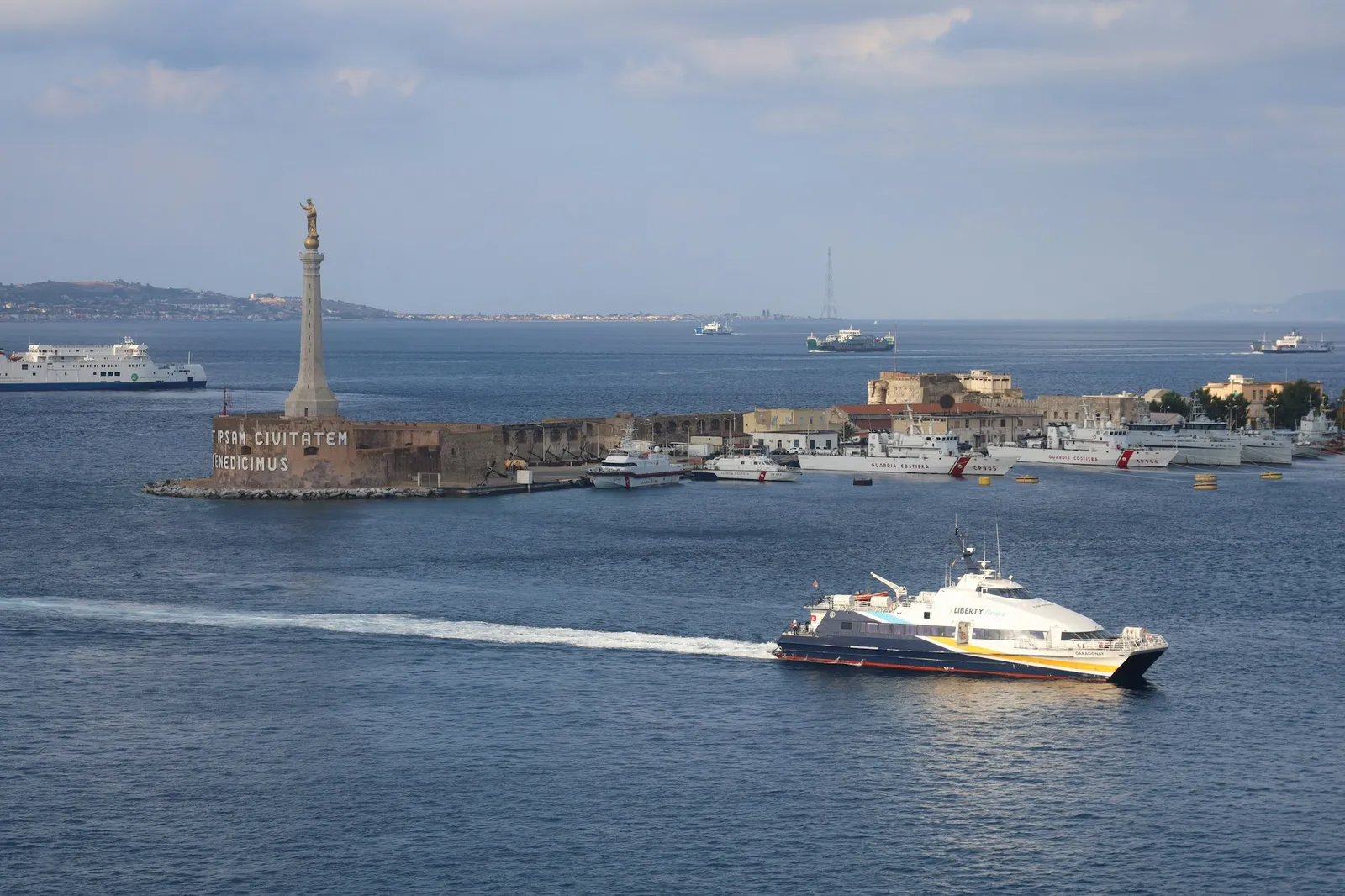
Sicily lies off the southwestern tip of mainland Italy, the toe of the boot, in the middle of the Mediterranean. The Strait of Messina separates it from Calabria on the mainland, and Britannica gives its width as about 2 miles (3 km) at the northern end, widening to about 10 miles (16 km) in the south. Most people cross it by ferry or hydrofoil, like the one in the photo at the top of this page.
The island is roughly triangular, which is where its old Greek name, Trinakria, comes from, and it covers about 9,830 square miles (25,460 km²). The region also takes in the smaller islands around it: the Aeolian, Egadi and Pelagie islands, Ustica and Pantelleria.
We live in the far west, near Mazara del Vallo. If you want to get your bearings before a trip, my Sicily travel guide breaks the island into its regions, and Sicily town by town lets you look up any of its 391 comuni.
What is the capital of Sicily?
Palermo, on the northwest coast. It is the seat of the regional assembly and government and by far the largest city on the island. Catania, on the east coast under Etna, is second, followed by Messina, facing the mainland across the Strait. My guide to Palermo, Cefalù and Monreale covers what to see in the capital.
| City | Population | Where |
|---|---|---|
| Palermo | 626,273 | Northwest coast, the regional capital |
| Catania | 296,984 | East coast, below Mount Etna |
| Messina | 216,458 | Northeast tip, on the Strait of Messina |
| Siracusa (Syracuse) | 115,515 | Southeast coast |
Sicily is divided into nine provinces, though since a regional law of 2015 they have new names. Palermo, Catania and Messina are metropolitan cities; Agrigento, Caltanissetta, Enna, Ragusa, Siracusa and Trapani are "free municipal consortia". Most people, me included, still just say "the province of Trapani".
Sicily population
Sicily had 4,787,390 residents on 31 December 2024, according to ISTAT, Italy's national statistics office, down from 4,797,359 a year earlier.
Sicilians have left in large numbers before. Between 1880 and 1920 an estimated four million people left southern Italy and Sicily for the United States, according to the Library of Congress, which is why so many Americans have Sicilian roots. If you are one of them, my guides to Sicilian surnames and tracing your Sicilian ancestry are the place to start.
Getting your bearings
My map of Sicily shows the provinces, cities and airports. When you look at a map of the island, these are the reference points worth knowing:
- The three corners: Messina and the Strait in the northeast, the Capo Passero area in the southeast, and Marsala and Trapani in the west.
- Mount Etna, the great volcano above Catania on the east side.
- The north coast from Palermo to Cefalù and on to Messina, with the Aeolian Islands offshore.
- The south coast facing Africa, with Agrigento and its Valley of the Temples.
- The hilly interior around Enna and Caltanissetta.
The island is bigger than many visitors expect. If you are not planning to drive, read Sicily without a car before you choose where to stay.
Frequently asked questions
Is Sicily part of Italy?
Yes. Sicily is an autonomous region of Italy. Its own statute, approved in 1946 and part of Italian constitutional law since 1948, says it is an autonomous region within the political unity of the Italian State. It has been part of Italy since unification in the 1860s.
Is Sicily a country?
No. Sicily is a region of Italy, not an independent country. It has special autonomy, with its own regional assembly, government and flag, but Sicilians are Italian citizens and use Italian passports and the euro.
What country is Sicily in?
Italy. Sicily is one of Italy’s 20 regions, and one of the five with special autonomy, so it is part of the Italian Republic and, with it, of the European Union.
Was Sicily ever an independent kingdom?
Yes. Roger II was crowned the first king of Sicily in Palermo on Christmas Day 1130, and Sicily remained a kingdom for centuries, at times united with Naples. In 1815 it was merged into the Kingdom of the Two Sicilies, and after Garibaldi’s revolt of 1860 it joined the united Kingdom of Italy in 1861.
Is Sicily in Europe?
Yes. Sicily is part of Italy, which has been in the European Union since 1958, in the Schengen area since 1997 and in the euro since 1999. Geographically it lies at the southern edge of Europe, about 100 miles (160 km) from Tunisia.
What is the capital of Sicily?
Palermo, on the northwest coast, is the capital of Sicily and its largest city, with about 626,000 people. It is the seat of the Sicilian regional assembly and government.
What is the population of Sicily?
Sicily had 4,787,390 residents on 31 December 2024, according to ISTAT, Italy's national statistics office. That is about 10,000 fewer than a year earlier.
Do you need a passport to go from Italy to Sicily?
No. Sicily is part of Italy, so there is no border between the mainland and the island. You only need your passport to enter Italy or the Schengen area in the first place.
Sources and small print
- Encyclopaedia Britannica: Sicily (location, area, the Strait of Messina, Etna, distance to Tunisia)
- Assemblea Regionale Siciliana: Statuto della Regione Siciliana (article 1)
- Senato della Repubblica: Italian Constitution, article 116
- Regional law no. 15 of 4 August 2015, on the free municipal consortia and metropolitan cities
- Tuttitalia, from ISTAT data: population of Sicily and population of its comuni
- European Union: Italy (EU, euro and Schengen dates)
- ISTAT: La superficie dei comuni, delle province e delle regioni italiane (the area of the region, in Italian)
- INGV Vulcani: La Voragine diventa la nuova vetta dell'Etna (the height of Etna, in Italian)
- Encyclopaedia Britannica: Roger II and Kingdom of the Two Sicilies; Monte S. Finkelstein, Separatism, the Allies, and the Mafia (Lehigh University Press), on the separatist movement of 1943 to 1948
- Library of Congress: America's War, major themes (immigration from southern Italy and Sicily, 1880 to 1920)
Credits
Photo: Kiran Naidu, Unsplash Licence, via Unsplash.
 The weekly YouTube series