
Is there a bridge from Italy to Sicily?
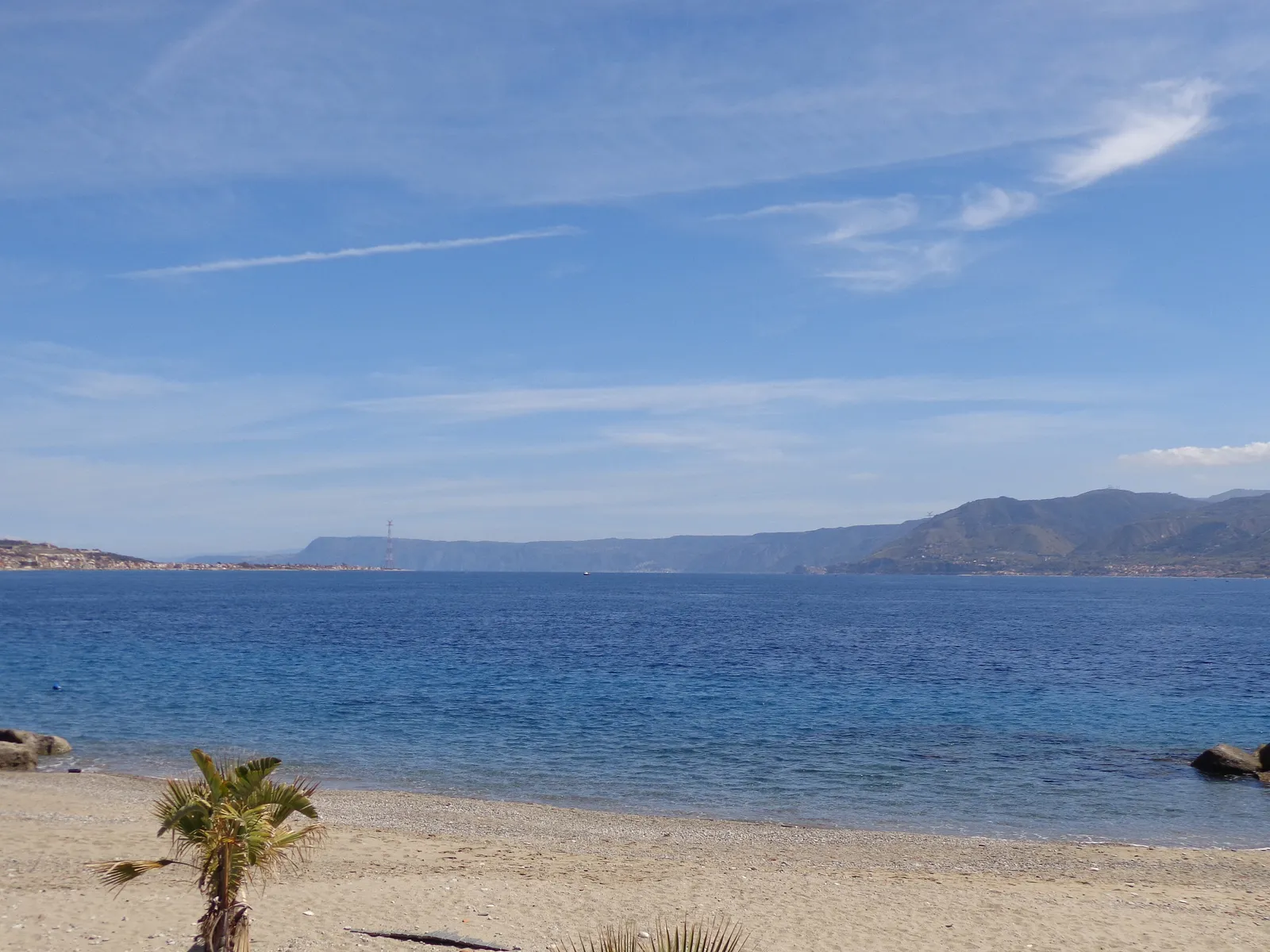
No. Sicily is an island, and the only fixed links to the mainland are on paper. Everyone and everything that crosses the Strait of Messina, cars, trucks, trains and foot passengers, goes by sea or by air. This surprises a lot of Americans, partly because the strait looks so narrow on a map: Britannica gives its width as about 2 miles (3 km) at the northern end, widening to about 10 miles (16 km) further south.
The crossing is short, frequent and, most of the time, easy. You drive onto a ferry in Villa San Giovanni, on the toe of Italy, and drive off in Messina about twenty minutes later. My guide to getting to Sicily from Rome and Naples explains how it works by car, train, ferry and plane, and my piece on whether Sicily is part of Italy covers the strait itself and Sicily's place in the country.
What is the Messina Strait Bridge?
The Ponte sullo Stretto di Messina is a planned suspension bridge between Calabria, on the mainland, and Sicily. It is being developed by Stretto di Messina SpA, a company owned by the Italian state: the Ministry of the Economy and Finance holds about 55%, the road agency ANAS about 37%, the rail network company RFI almost 6%, and the regions of Calabria and Sicily just over 1% each. The towers would stand between Punta Pezzo and Cannitello on the Calabrian side and in the Pantani area, near Messina, on the Sicilian side.
| Messina Strait Bridge (as designed) | |
|---|---|
| Type | Single-span suspension bridge, road and rail |
| Central span | 3,300 m (about 2 miles) |
| Total length | 3,666 m (about 2.3 miles) |
| Tower height | 399 m (about 1,309 ft) |
| Road | Three lanes each way, plus two service lanes |
| Rail | Two tracks; capacity of 200 trains a day |
| Road capacity | 6,000 vehicles an hour |
| Clearance for ships | 72 m (236 ft), over a width of 600 m |
| Designed for | Winds of 216 km/h (134 mph) and an earthquake of magnitude 7.1 |
| Design life | 200 years |
The central span is the headline. The longest suspension span in the world today is the 1915 Çanakkale Bridge in Turkey, at 2,023 m, ahead of Japan's Akashi Kaikyō Bridge at 1,991 m. At 3,300 m, the Messina bridge would beat it by more than a kilometre. The earthquake figure matters here: the company says the bridge is designed to withstand a quake comparable to the one that destroyed Messina and Reggio Calabria in 1908.
Why is there no bridge to Sicily?
People have talked about bridging the strait since antiquity, but the reasons it has never happened are thoroughly modern: money, politics, procedure and risk.
- The engineering is extreme. No suspension bridge anywhere has a span this long. The strait is deep, the currents are strong, the winds are high, and it sits in one of the most earthquake-prone areas of Europe.
- The cost is huge. The latest estimate is about €13.5 billion, all of it public money. Critics argue it would be better spent on Sicily's roads, railways and water supply; supporters argue that the island will never catch up without a fixed link.
- Politics changes. The bridge has been a flagship project for some governments and been dropped by others. It has been approved, suspended and restarted several times since the 1970s.
- The approvals are long and complex. A project of this size needs environmental, technical and financial approvals at national and European level, and each stage can be challenged.
On the 2012 cancellation, the project company says plainly that the Monti government halted the bridge for financial reasons, not technical ones.
A short history of the Messina bridge
These milestones come from the project company's own timeline, with the most recent steps from the Court of Auditors and the Italian press.
| Year | What happened |
|---|---|
| 1968 | ANAS holds an international competition of ideas for a fixed link |
| 1971 | Law 1158 provides for a company to build and run the link |
| 1981 | Stretto di Messina SpA is set up; its concession follows in 1985 |
| 1992 | The design for a single-span suspension bridge is completed |
| 2001 | The bridge is listed among strategic national works |
| 2003 | The government planning committee (CIPE) approves the preliminary design |
| 2006 | Contracts are signed; later that year a new law drops the bridge as a priority |
| 2008 | CIPE reconfirms the project |
| 2011 | The final design is approved by the company board |
| 2012 | The government halts the project and the company is put into liquidation |
| 2023 | A law decree revives the company and the project |
| August 2025 | The planning committee, now CIPESS, approves the final design, at about €13.5 billion |
| October 2025 | The Court of Auditors refuses to register that approval |
| November 2025 | The Court also refuses an update to the concession |
The Court of Auditors (Corte dei conti) checks that major government acts are lawful before they take effect. When it refused to register the CIPESS approval on 29 October 2025, the approval could not take effect, so work could not begin. The press reported that its concerns included European rules on how far a contract awarded in 2006 can be changed. In 2026 the government said it would put a new approval through the committee and back to the Court.
Is the Messina bridge being built?
Not yet. As of November 2026, construction of the bridge itself had not started. The process the project company describes is this: CIPESS approves the final design, the Court of Auditors registers that approval, it is published in Italy's Official Gazette, and only then can the main works begin. After the 2025 refusal, that sequence had to start again. In autumn 2026 the Sicilian press reported that the new committee meeting had not yet been called, that the Court would have to examine the new approval, and that a request for a referendum on the bridge law had been filed.
Start dates have been announced and moved many times, so I will not give you one. If the approvals go through, the company says construction would take about seven and a half years. The Ministry of Infrastructure has spoken of the bridge opening to traffic in the 2030s. Treat any date as a target, not a promise, and check the latest news before you plan anything around it. Small preparatory works were done in the past, including the realignment of the railway at Cannitello in Calabria, finished in 2012.
What the bridge would change
According to Stretto di Messina SpA, the bridge would save about an hour for road traffic and two to three hours for trains, compared with the ferries. The bigger saving for trains comes from no longer having to load the carriages onto ferries and off again. The estimate also covers about 40 km (25 miles) of new road and rail links, three new railway stations and an operating centre.
For a visitor the difference would be smaller than it sounds. The ferry itself is short; the time goes in queuing in summer, and on long-distance trains in loading them onto the ferry. A bridge would make the Sicily trip by car or train more predictable, but the long drive down the toe of Italy, or the night train from Rome, would still be the bulk of the journey.
How to cross the Strait of Messina today
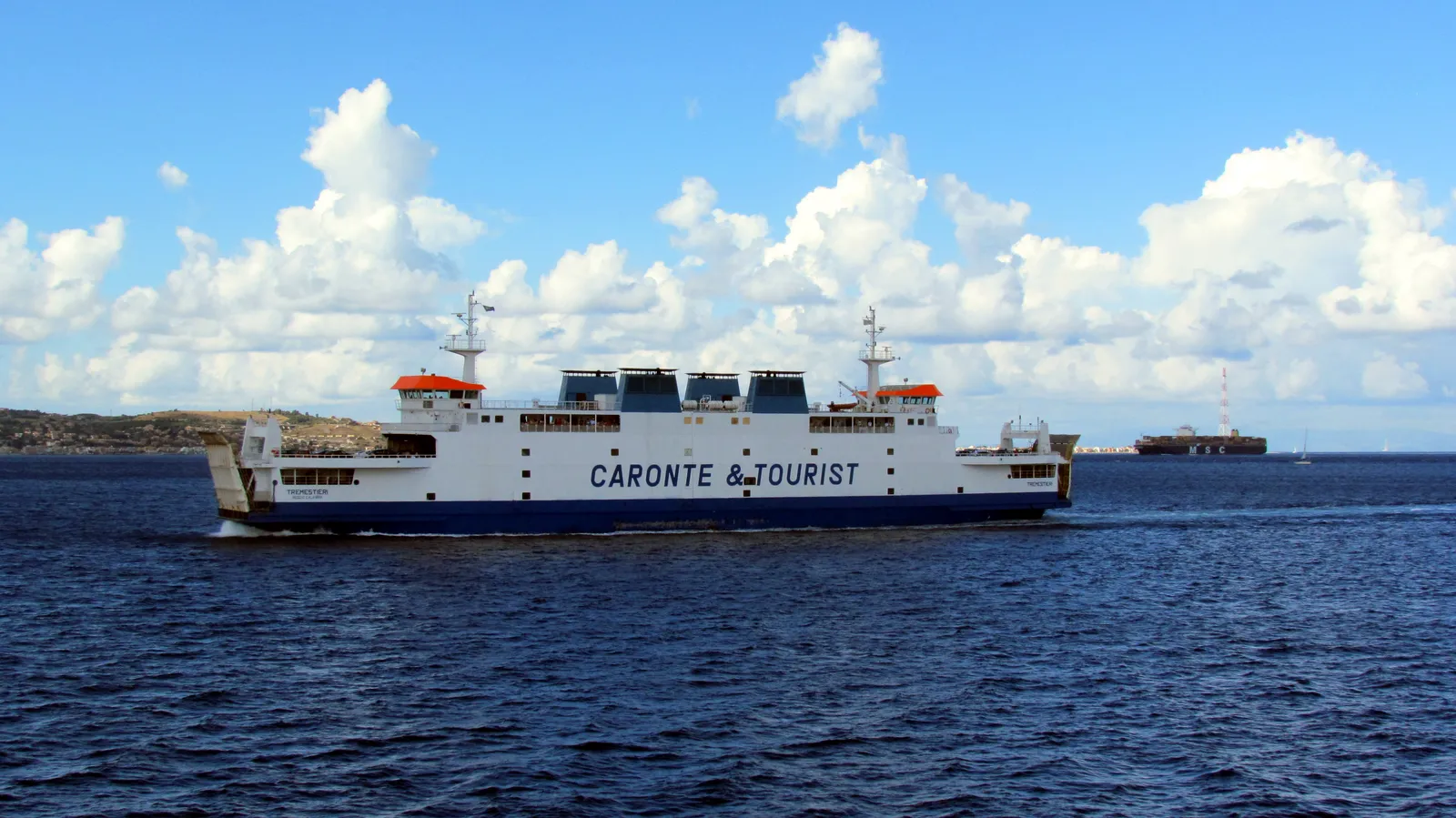
- By car. Caronte & Tourist car ferries run day and night between Villa San Giovanni and Messina, about every 40 minutes, and the crossing takes about 20 minutes.
- By train. Intercity trains from Rome and Naples, including the night trains, are rolled onto a ferry at Villa San Giovanni and carried across to Messina. You stay on the train.
- On foot. Foot passengers can ride the same car ferries for a few euros.
- By plane. For most Americans, flying into Palermo or Catania is simpler than any of the above.
The details, with operators, prices and times, are in my guide to getting to Sicily from Rome and Naples. If you are arriving by sea, my guide to the Messina and Catania cruise ports covers the harbour, and the Messina town page has more on the city. For flights, start with my guide to Sicily's airports.
Seeing the strait for yourself
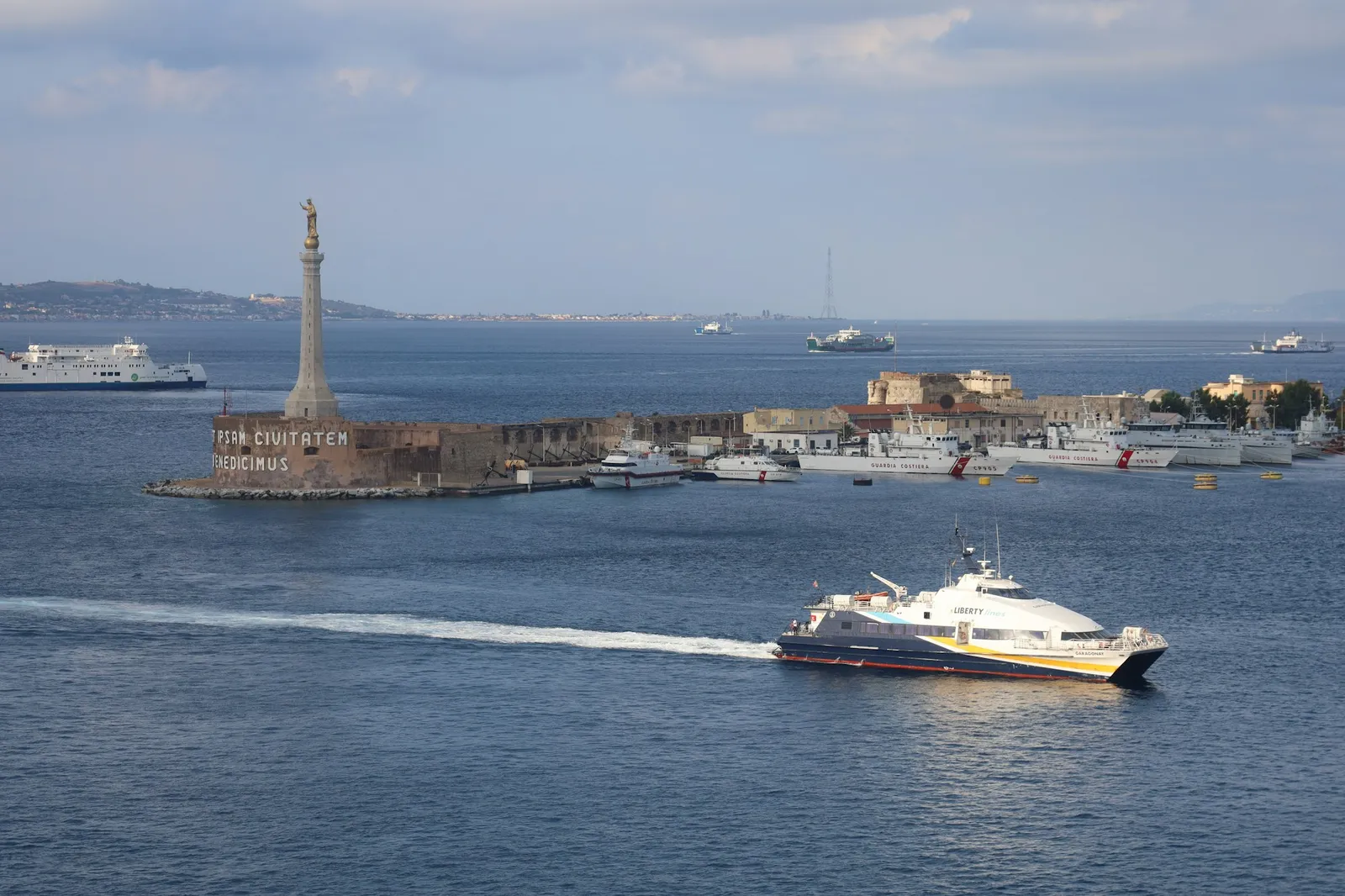
The crossing is worth enjoying rather than enduring. Stand on the ferry deck and you can see both shores at once, the hills of Calabria on one side and Messina spread along its harbour on the other, with the golden Madonnina at the harbour mouth.
North of the city, the coast road runs out to the tip of Sicily at Torre Faro and Ganzirri, the closest point to the mainland not far from where the Sicilian end of the bridge would go. From there the mainland looks close enough to swim to, which is exactly why people have dreamed of a bridge for so long.
If your trip continues east, my guide to eastern Sicily, Etna, Taormina, Catania and Syracuse picks up from Messina, and the Aeolian Islands are a short drive west from Messina to the port at Milazzo.
Frequently asked questions
Is there a bridge between Sicily and Italy?
No. There is no bridge or tunnel between Sicily and mainland Italy. Cars, trains and passengers cross the Strait of Messina by ferry, a trip of about 20 to 30 minutes. A suspension bridge has been planned for decades, but as of November 2026 construction had not started.
Why is there no bridge to Sicily?
Because of cost, engineering, politics and long approvals. The planned bridge would need the longest suspension span in the world, in an earthquake zone with strong winds and currents, at an estimated €13.5 billion of public money. It has been approved, halted in 2012 and revived in 2023, and in 2025 the Court of Auditors refused to register its approval.
How long would the Messina bridge be?
According to Stretto di Messina SpA, the bridge would be 3,666 m long in total, with a central suspension span of 3,300 m, about 2 miles. Its towers would be 399 m tall, and the deck would carry six road lanes and two railway tracks.
How much would the Strait of Messina bridge cost?
The project company estimates about €13.5 billion, roughly $15 billion, entirely from public funds. That figure includes about 40 km of connecting roads and railways, three new stations and an operating centre, not just the bridge itself.
When will the Messina bridge be finished?
There is no reliable date. Work can only start once the government's approval is registered by the Court of Auditors and published, which had not happened as of November 2026. The project company says construction would then take about seven and a half years.
How do you get from mainland Italy to Sicily without a bridge?
By ferry across the Strait of Messina. Car ferries run day and night from Villa San Giovanni to Messina in about 20 minutes, foot passengers can use them too, and Intercity trains from Rome are carried across on train ferries. Most overseas visitors simply fly to Palermo or Catania.
How wide is the Strait of Messina?
Britannica gives it as about 2 miles (3 km) wide at the northern end, between Torre Faro in Sicily and the Calabrian coast, widening to about 10 miles (16 km) further south. The planned bridge would cross near the narrowest point.
Would the Messina bridge be the longest in the world?
Its main span would be the longest of any suspension bridge. At 3,300 m it would beat the current record holder, the 1915 Çanakkale Bridge in Turkey, at 2,023 m, and Japan's Akashi Kaikyō Bridge, at 1,991 m.
Sources and small print
- Stretto di Messina SpA: the bridge, design figures
- Stretto di Messina SpA, FAQ: main milestones, cost and funding, CIPESS and when work starts, completion, time saved, location and the 2012 shelving
- Stretto di Messina SpA: about us and shareholders
- Corte dei conti: press release on the CIPESS resolution for the bridge (October 2025)
- Il Sole 24 Ore: every stage of the bridge, from the decree to the Court of Auditors and the new CIPESS process
- La Sicilia: the latest delay to the start of works (November 2026)
- Britannica: Sicily (the width of the strait)
The bridge's status changes with each decision by the government, the Court of Auditors and the courts. For the latest position, check the project company and the news.
Credits
Photo: Effems, CC0, via Wikimedia Commons.
Photo: Marinaio56, CC BY-SA 4.0, via Wikimedia Commons.
Photo: Kiran Naidu, Unsplash Licence, via Unsplash.
 The weekly YouTube series