
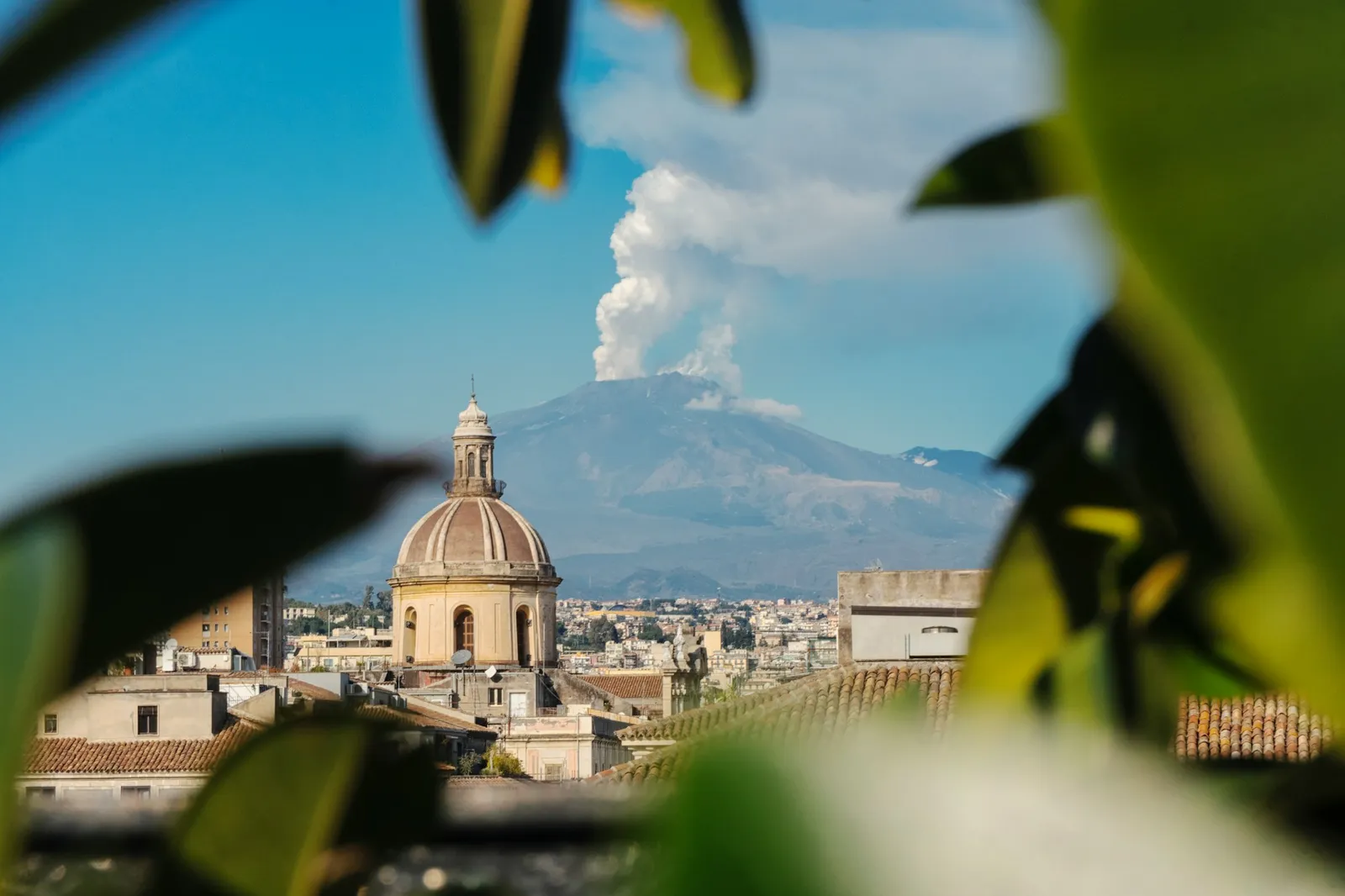
Sicily’s festival calendar: the year at a glance
Fixed feast days fall on the same date every year. Carnival and Holy Week follow Easter, so they move, and the almond blossom, Infiorata and Greek plays are set by their organisers each year, so check the official programme before you book.
| When | What | Where |
|---|---|---|
| 3 to 5 February | Feast of St Agatha, with a smaller feast on 17 August | Catania |
| Before Lent (usually February or early March) | Carnival, with papier-mâché floats | Acireale, Sciacca and many other towns |
| Usually February or March | Mandorlo in Fiore, the almond blossom festival | Agrigento and the Valley of the Temples |
| 19 March | St Joseph's Day and the St Joseph's tables | Salemi and across the island |
| Holy Week (March or April) | Easter processions, including the Misteri | Trapani, Caltanissetta and many towns |
| Usually May | Infiorata, a street carpeted in flowers | Noto |
| Usually May and June | Classical Greek plays in the ancient theatre | Siracusa |
| 10 to 15 July | The Festino of Santa Rosalia | Palermo |
| 25 July | Feast of St James; the tiled staircase lit with lamps | Caltagirone |
| 12 to 14 August | Palio dei Normanni, a medieval pageant | Piazza Armerina |
| 15 August | Ferragosto, a public holiday; the Vara procession in Messina | Messina and the whole island |
| Night of 4 September | The pilgrimage walk up Monte Pellegrino to Santa Rosalia | Palermo |
| Usually late September | Cous Cous Fest, ten days of cooking competitions and tastings | San Vito Lo Capo |
| 13 December | Santa Lucia | Siracusa and Palermo |
| 8 December to 6 January | The Christmas season and living nativities | Across the island |
In 2027 Easter Sunday falls on 28 March, so Carnival ends on Shrove Tuesday, 9 February, only four days after the Feast of St Agatha. Holy Week begins on Palm Sunday, 21 March, the Misteri procession in Trapani starts on Good Friday, 26 March, and Easter Monday is 29 March.
Who was St Agatha of Sicily?
St Agatha is one of the most venerated virgin martyrs of the early Church, and the patron saint of Catania. Britannica dates her death to about 251, in Catania, under the emperor Decius, but notes that the traditional details of her martyrdom are of little historical value. Palermo and Catania are both named as her possible birthplace.
In the story, she refused the advances of the Roman governor, was tortured and had her breasts cut off, was saved from burning at the stake by an earthquake, and died in prison. That torture is often shown in paintings of her, and it is why she is the patron saint of breast cancer patients.
In Catania she is also the city's protector against Etna. The best-known miracle attributed to her is from 252, a year after her death, when the people carried her veil in procession towards a lava flow and it stopped short of the city. She is still invoked against eruptions, earthquakes and fire. Her feast day in the Church calendar is 5 February.
The Feast of St Agatha in Catania (3 to 5 February)
Every year on 3, 4 and 5 February, Catania gives itself over to its patron. The Regione's tourism site compares it to Holy Week in Seville and says up to a million people come, between the faithful and visitors.
- 3 February: the offering of wax, a procession of the city's authorities, and a big fireworks display in Piazza Duomo in the evening.
- 4 February: at dawn the silver reliquary bust of the saint is brought out of the cathedral to a roar of "Cittadini, viva Sant'Agata!". Thousands of devotees in the traditional white robe (the sacco), black cap and cord pull her silver float, the fercolo, on two long ropes on a route around the old city that lasts until late at night.
- 5 February: after a solemn mass, the second procession crosses the centre. The carnations on the float change from red, for martyrdom, to white, for purity, and the hardest moment is the steep climb of Via San Giuliano.
The float is led by the candelore, huge carved and gilded wooden candle towers that represent the city's trades and quarters, carried on the shoulders of teams of men with a rolling gait. There is a smaller feast on 17 August, remembering the return of her relics to Catania in 1126. If you go in February, book a room well ahead and be ready for crowds like nothing else in Sicily; my guide to Etna, Taormina, Catania and Siracusa covers the rest of the city, and Catania airport is the way in.
Santa Rosalia and the Festino in Palermo
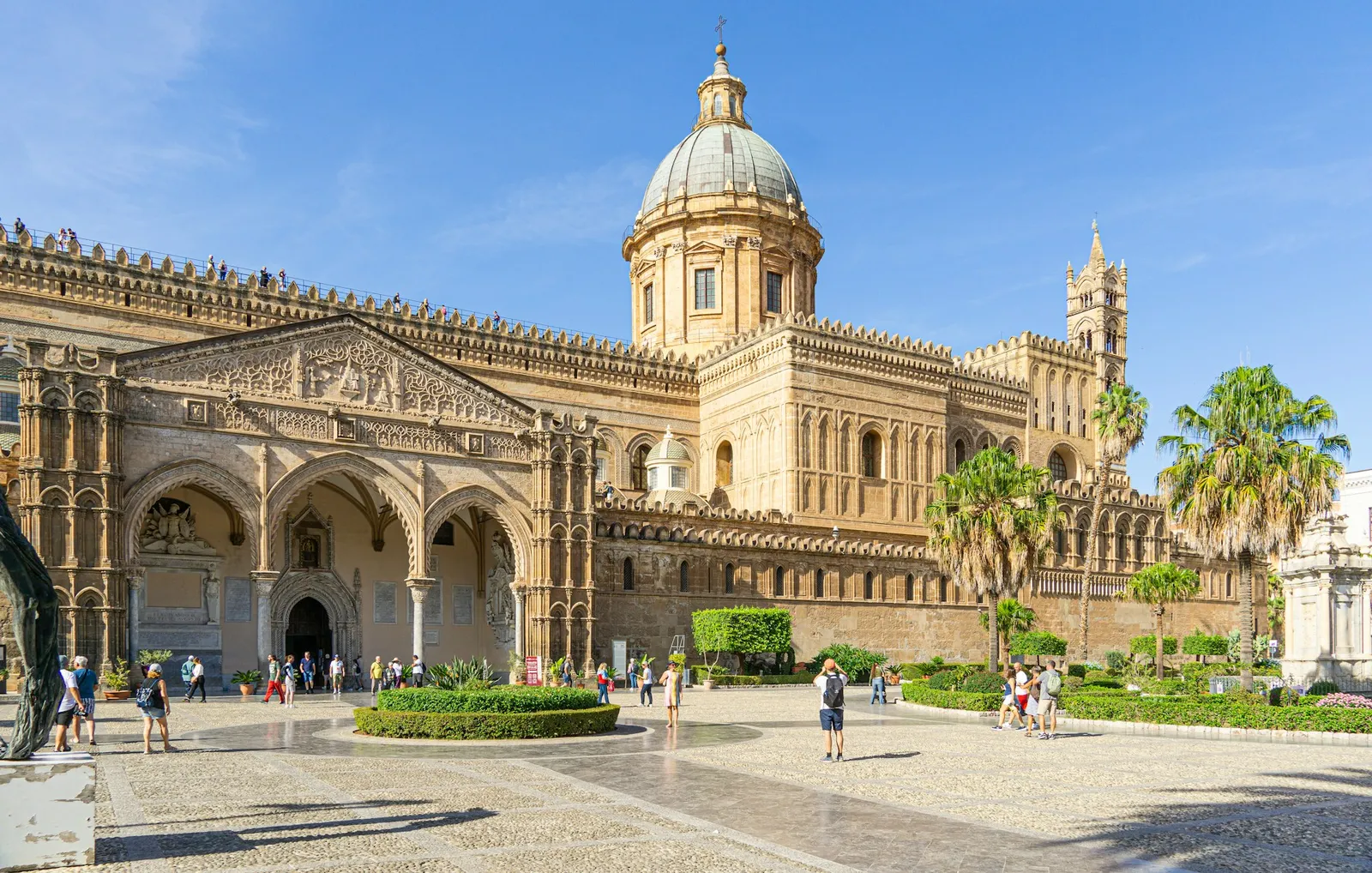
Rosalia was a twelfth-century noblewoman of Palermo who left her family to live as a hermit, rather than make the marriage they wanted for her. On 15 July 1624, with Palermo in the grip of plague, her remains were found in a cave on Monte Pellegrino, the mountain above the city.
The city Senate made her patron of Palermo on 27 July 1624, her relics were carried through the streets on 9 June 1625, and the city was declared free of the plague. Her relics are kept in Palermo cathedral in a silver urn made in 1631, and Palermitans call her the Santuzza, the little saint.
The Festino (u Fistinu) runs from 10 to 15 July, according to the Comune di Palermo. On the night of 14 July a towering triumphal float carrying her statue, rebuilt every year, is drawn along the city's main axis from the Palazzo Reale, past the cathedral and the Quattro Canti, where the mayor offers roses to cries of "Viva Palermo e Santa Rosalia!", down to the sea at Porta Felice for the fireworks. On 15 July the urn with her relics is carried in procession through the old centre.
There is a second, quieter date. On the night of 4 September, the eve of her liturgical feast, many Palermitans walk up Monte Pellegrino to her sanctuary in the cave, some barefoot and carrying a candle; this is the acchianata, the climb. My Palermo, Cefalù and Monreale guide covers the city and Monte Pellegrino; note that the Rosalia Lombardo of the Capuchin Catacombs is a different person, a little girl who died in 1920.
Who is the patron saint of Sicily?
There is no single saint that every Sicilian would name for the whole island. Ask a Sicilian and you will usually get the name of their own city's saint, because the great feasts belong to cities. The three women saints Americans most often mean are St Agatha, patron of Catania, Santa Rosalia, patron of Palermo, and Santa Lucia (St Lucy), patron of Siracusa, whose feast on 13 December I cover in my guide to Christmas in Sicily. St Joseph, whose day on 19 March is one of the great family feasts of the island, has his own guide: St Joseph's Day in Sicily.
Carnival in Sicily: Acireale and Sciacca
Carnival ends on Shrove Tuesday, the day before Lent begins, so its dates follow Easter and usually fall in February or early March. Almost every town marks it, but two are famous for their floats.
- Acireale, just north of Catania, has celebrated Carnival for more than five hundred years, according to the Regione. Since 1880 it has paraded great allegorical floats in papier-mâché, with flower-covered floats alongside, and its old masks, the Abbatazzu and the Baruni, were made to mock the aristocracy. The Regione calls it the most beautiful Carnival in Sicily.
- Sciacca, on the south-west coast, parades giant papier-mâché floats with performances in dialect. Its star is the mask Peppe Nappa, who from the Thursday before Carnival hands out wine and grilled sausages to the crowd, and the festival ends with Peppe Nappa burned on a bonfire.
Cannoli were traditionally a Carnival sweet; my guide to Sicilian desserts has the sweets of each feast.
Easter and Holy Week in Sicily
Holy Week, from Palm Sunday to Easter, is when Sicily's towns are at their most theatrical, with processions of carved statues carried by brotherhoods and guilds.
- Trapani: the Procession of the Misteri leaves on the afternoon of Good Friday and winds through the city until the following afternoon. Eighteen great sculptural groups telling the Passion are carried through the streets, with statues of the dead Christ and Our Lady of Sorrows. It is one of the most extraordinary religious events in Sicily; my Trapani guide has more on the city.
- Caltanissetta: plays on Monday and Tuesday, the procession of the Real Maestranza, the craft guilds, on Wednesday, the Vare, sculptures of the Passion, on Thursday, and the Black Christ (Cristo Nero) on Good Friday, ending with the Easter Sunday procession.
Easter Monday (Pasquetta) is a public holiday in Italy, a day out for many families, so expect shops and offices to be closed.
Spring and summer: almond blossom, flowers and Greek plays
- Mandorlo in Fiore, Agrigento: a ten-day festival of spring among the almond trees and the Valley of the Temples, with an international folklore festival, a parade of traditional Sicilian carts and bands, and almond tastings. It is usually held in February or March: the 2026 edition, the 78th, ran from 7 to 15 March. My Agrigento and Valley of the Temples guide covers the site.
- Infiorata, Noto: every May, the sloping Via Nicolaci, below the church of Montevergini, becomes a canvas of about 700 square metres (7,500 square feet) on which artists lay pictures in flower petals, with a new theme each year. See my guide to Noto and the baroque towns.
- Greek plays, Siracusa: since 1914 the Istituto Nazionale del Dramma Antico (INDA) has staged ancient Greek tragedies and comedies in the Greek theatre of Siracusa. The season usually runs from May to late June.
- Caltagirone: for the feast of St James on 25 July, the town's 142-step tiled staircase is lit with thousands of coloured lamps arranged into designs. My guide to Sicilian ceramics and Moor's heads explains the tiles.
August and September: the Palio, the Vara and couscous
- Palio dei Normanni, Piazza Armerina: every year from 12 to 14 August, according to the Regione's tourism site, the town re-enacts the entry of Count Roger's Norman troops, with about 600 people parading in medieval costume. The last day ends with the Quintana, a joust on horseback between the town's four quarters for the palio, the banner. It combines well with the mosaics of the Villa Romana del Casale, just outside the town.
- Ferragosto and the Vara, Messina: 15 August, the feast of the Assumption, is Ferragosto, a public holiday across Italy, when many shops and offices close and the beaches are at their busiest. In Messina it is the day of the Vara, a votive float about 14 m (46 ft) high showing the Assumption of the Virgin, pulled by hand on long ropes from Piazza Castronovo to the cathedral square, with fireworks at night. In the days before, the giant figures of Mata and Grifone, on horseback, parade through the city.
- Cous Cous Fest, San Vito Lo Capo: about ten days of cooking competitions, couscous tastings and cooking shows, usually in the second half of September; in 2026 it ran from 18 to 27 September.
Tips for visiting a Sicilian festival
- Book early. For St Agatha, the Festino and Holy Week in Trapani, rooms in the city fill up months ahead.
- Expect crowds and late nights. The big processions last many hours and run into the early morning. Keep valuables close and agree a meeting point if you get separated.
- Dress for church. If you go inside during a feast, cover shoulders and knees.
- Check the programme each year. Times, routes and dates of the movable events are published by the comune or the organisers shortly before.
- Plan around the weather. February can be cold and wet, July hot. My Sicily in February and Sicily in July guides give the averages.
Frequently asked questions
Who was St Agatha of Sicily?
An early Christian virgin martyr and the patron saint of Catania, who died in Catania in about 251 under the emperor Decius, according to Britannica, which notes that the details of her story are of little historical value. She is the patron saint of breast cancer patients and is invoked against eruptions of Etna, earthquakes and fire. Her feast day is 5 February.
When is the Feast of St Agatha in Catania?
Every year on 3, 4 and 5 February, with the great processions on 4 and 5 February. There is also a smaller feast on 17 August, remembering the return of her relics to Catania in 1126.
Who is Saint Rosalia of Palermo?
Rosalia was a twelfth-century noblewoman of Palermo who lived as a hermit. Her remains were found in a cave on Monte Pellegrino on 15 July 1624, during a plague, and the city made her its patron. Palermo celebrates her with the Festino from 10 to 15 July and a pilgrimage up Monte Pellegrino on the night of 4 September.
Who is the patron saint of Sicily?
There is no single saint that every Sicilian would name for the whole island: the great feasts belong to cities, so Sicilians usually name their own city’s saint. The three best known are St Agatha, patron of Catania, Santa Rosalia, patron of Palermo, and Santa Lucia, patron of Siracusa. St Joseph, celebrated on 19 March, is also much loved across the island.
When is Carnival in Sicily?
Carnival ends on Shrove Tuesday, the day before Lent, so its dates move with Easter and usually fall in February or early March; in 2027 it ends on 9 February. The most famous carnivals are in Acireale, near Catania, and Sciacca, on the south-west coast, both with giant papier-mâché floats.
What is Easter like in Sicily?
Holy Week brings processions of carved statues in many towns. The most famous is the Procession of the Misteri in Trapani, which runs from the afternoon of Good Friday to the following afternoon with eighteen sculptural groups of the Passion; in 2027 Good Friday is 26 March and Easter Sunday 28 March. Caltanissetta has processions every day from Wednesday to Good Friday.
What is the best festival to see in Sicily?
For sheer scale, St Agatha in Catania (3 to 5 February) and the Festino of Santa Rosalia in Palermo (night of 14 July). For something gentler, the Infiorata in Noto in May or the almond blossom festival in Agrigento. Pick the one that fits the time of year you can travel.
When is the Festino of Santa Rosalia?
From 10 to 15 July every year. The big night is 14 July, when the triumphal float travels from the Palazzo Reale to the sea at Porta Felice for fireworks; on 15 July her relics are carried in procession.
Sources and small print
- Britannica: St. Agatha
- Visit Sicily (Regione Siciliana): La festa di Sant'Agata a Catania
- Italian Wikipedia: Festa di sant'Agata (candelore, 17 August)
- Comune di Palermo: Storia del Festino di Santa Rosalia
- Visit Sicily: Festival of Santa Rosalia
- Visit Sicily: Carnevale in Sicilia and the Regione's big events brochure (Acireale, Sciacca, Mandorlo in Fiore, Holy Week in Caltanissetta and Trapani, Infiorata)
- Visit Sicily: Palio dei Normanni, The Vara and the Giants of Messina and Cous Cous Fest 2026
- Provincia di Caltanissetta: Holy Week
- Comune di Agrigento: the 78th Mandorlo in Fiore
- INDA, Istituto Nazionale del Dramma Antico and Comune di Siracusa
Credits
Photo: Samir Kharrat, Unsplash Licence, via Unsplash.
Photo: Vincenzo Inzone, Unsplash Licence, via Unsplash.
 The weekly YouTube series