
What is St Joseph’s Day?
The feast of St Joseph, husband of Mary and foster father of Jesus, falls on 19 March. It always comes during Lent, which is why everything served on the day is meatless. In Italy it is Father's Day (la festa del papà), but it is no longer a public holiday: a 1977 law removed 19 March from the civil holidays, so it is a normal working day.
In Sicily, Joseph has a particular place. The best-known story, told in Sicily and repeated in New Orleans, is that during a drought and famine in the Middle Ages, Sicilians prayed to Saint Joseph for help, and were saved by the fava beans that had until then been grown as animal feed. In gratitude they built altars in his honour. Whatever its origins, the idea of a table laid for the saint and then shared with others is the heart of the day.
What is a St Joseph’s table?
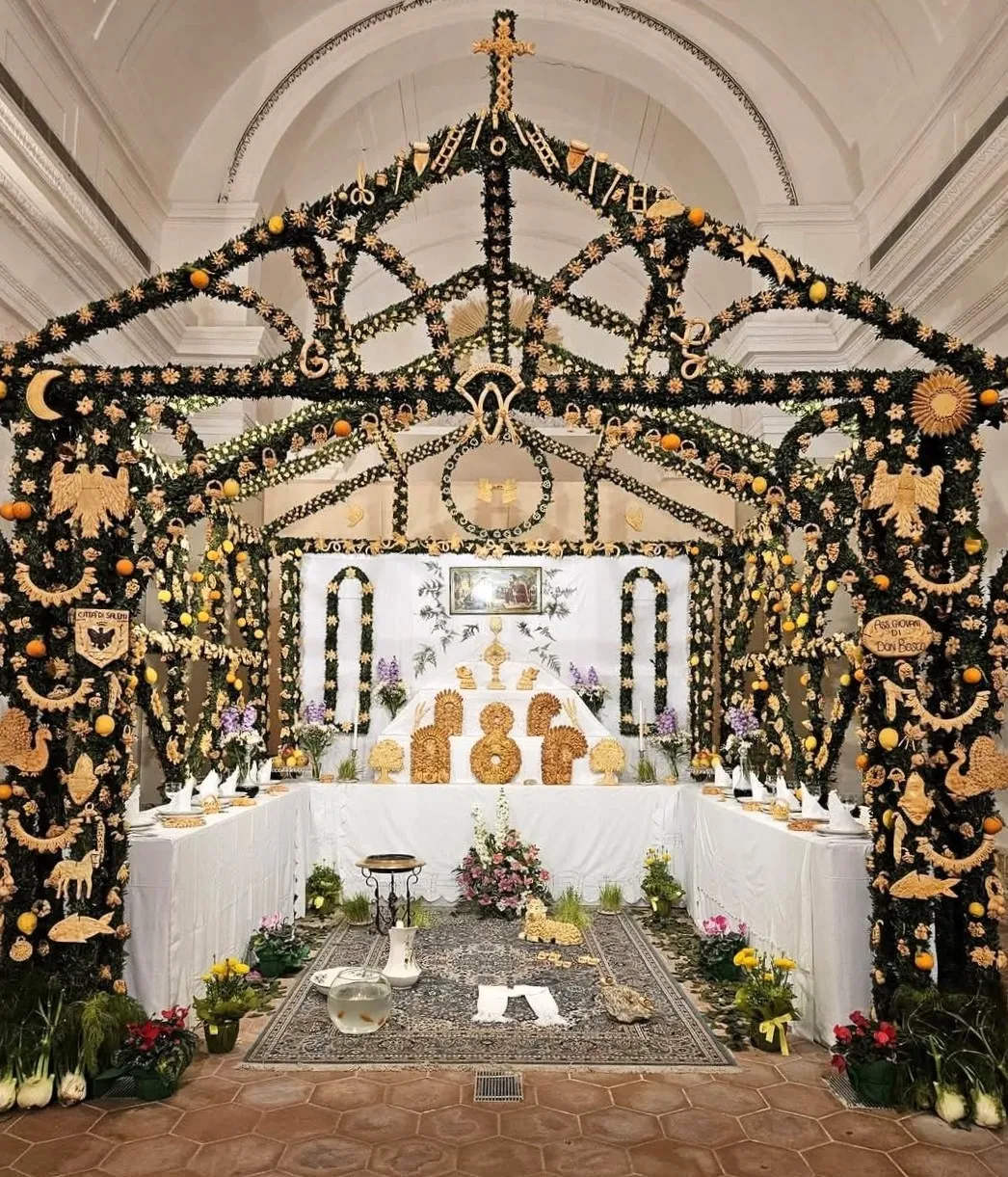
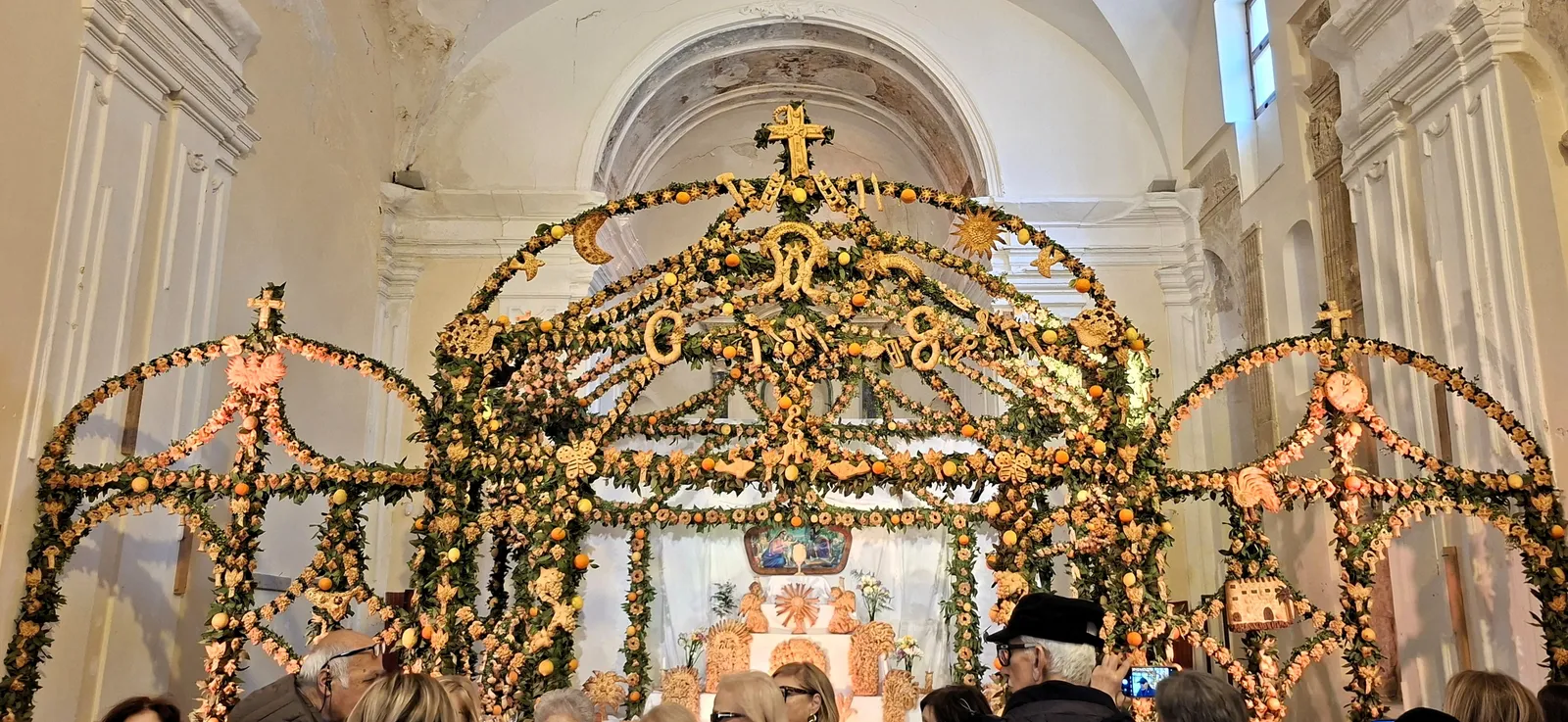
In Salemi, a St Joseph's table, the cena di San Giuseppe, begins with a vow. As the president of the town's Pro Loco explained to Quotidiano Nazionale, a family promises the saint a cena in return for a grace received, and then builds an altar: a frame of wood or iron covered in dark green myrtle and bay leaves and hung with the town's decorated breads, lemons and oranges. The breads are shaped by hand into Christian symbols and forms from nature, and they are a craft handed down in Salemi families.
On 19 March the family holds the invito dei Santi, the invitation to the saints. Three children represent Joseph, Mary and the infant Jesus, and 101 dishes are prepared for them: food of every kind except meat, because it is Lent. Since three children cannot eat it all, they hand the dishes out to everyone who helped build the altar and bake the breads, and the ritual turns into a shared meal for several hundred people. The day also includes Mass and the recital of the Parti di San Giuseppe, traditional verses passed down by word of mouth.
Similar customs survive elsewhere on the island: the Region has entered the feast of San Giuseppe at Villadoro, in the province of Enna, with its altars, in its register of intangible heritage.
St Joseph’s Day in Salemi: the bread altars
Salemi is a hill town in the province of Trapani, and its feast, now billed as Festa di San Giuseppe, Contemporanea Tradizione, is the best place in Sicily to see the bread altars. In 2026 it ran from 15 to 22 March, with altars in homes and churches, tastings, exhibitions and bread-making workshops through the week, and the Mass, the invitation of the saints and the recital of the Parti on 19 March itself. In 2024, the tenth festival since its relaunch, five Salemi families also went back to building altars in their own homes, according to the town's Pro Loco.
- When: the week around 19 March. Dates change each year, so check the town's and Visit Sicily's listings from early March.
- Where: the altars are spread across the old town, in churches, oratories, association premises and the town's bread museum, the Museo del Pane Rituale.
- Getting there: Salemi is inland from Trapani and Marsala, and a car is the easiest way to reach it; my guide to driving in Sicily covers renting one.
- Weather: March is spring in Sicily but not beach weather; my guide to Sicily in March has the temperatures and what else is on.
Base yourself in Trapani or Marsala and combine it with the coast: my guide to Trapani covers the city and Erice, and the salt pans lie on the coast between the two.
St Joseph altars in New Orleans
The tradition crossed the Atlantic with Sicilian immigrants. According to 64 Parishes, the encyclopedia of the Louisiana Endowment for the Humanities, Sicilian farm workers came to New Orleans after the Civil War to work the plantations, and added their altars to the city's Catholic Creole traditions. At first the altars were private, open to friends, family and anyone who knew the sign: a palm frond over the door.
A New Orleans altar is usually built in three tiers for the Holy Family, with a statue of Saint Joseph at the top. As in Salemi there is no meat. There are vegetables and fruit, stuffed artichokes, fried fish, and St Joseph's pasta (pasta Milanese) with an anchovy, raisin and fennel sauce, topped with mudica, toasted breadcrumbs that stand for the sawdust of Joseph's workshop. There are breads shaped like crosses, hearts, hammers and nails, and cookies such as fig-filled cuccidati and pignolati. Visitors often leave with a fava bean, kept in a wallet so that you will never be without money.
| Salemi, Sicily | New Orleans | |
|---|---|---|
| Why | A vow to the saint for a grace received | To ask a favour, give thanks, or honour someone who has died |
| The structure | A frame covered in myrtle and bay, hung with breads and citrus | Three tiers for the Holy Family, with a statue of Joseph |
| The breads | Hand-shaped into Christian symbols and forms from nature | Crosses, hearts, hammers, nails, sandals, fish |
| The food | 101 meatless dishes served to three children as the Holy Family, then shared | Meatless dishes, fruit, vegetables, breads and cookies laid out on the altar |
| To take home | A share of the meal | A fava bean, cookies, a prayer card and bread |
Sfince and zeppole: the sweets of St Joseph’s Day
Two fried pastries belong to the day, and they come from different places. In Palermo it is the sfincia di San Giuseppe: a large, irregular puff of fried dough, split and filled with sweet ricotta and decorated with chocolate, candied orange, a candied cherry and pistachio. My guide to Sicilian desserts covers sfince and the rest of the feast-day sweets.
Zeppole di San Giuseppe, the ones most Americans know, are from Naples: rings of choux pastry, fried or baked, covered with pastry cream and topped with amarena cherries in syrup. That version is usually credited to the Naples pastry cook Pintauro, around 1840. It grew out of much older zeppole, simple sugared fritters that Goethe saw being sold in huge numbers in the streets of Naples on 19 March 1787. Sfince are the Sicilian ones.
Planning a March trip around St Joseph’s Day
Salemi makes a good day out from anywhere in western Sicily. If you want the sweets rather than the altars, Palermo's pastry shops make sfince for the feast; my guide to Palermo, Cefalù and Monreale covers the city. For the rest of the food year, see my Sicily food guide.
Frequently asked questions
When is St Joseph’s Day?
On 19 March every year. It falls during Lent, so the food of the day is meatless. In Italy it is also Father's Day, but it has not been a public holiday since a 1977 law removed it from the civil holidays.
What is a St Joseph’s table?
An altar of food built in honour of Saint Joseph, usually to fulfil a vow. In Salemi, Sicily, it is a frame covered in myrtle and hung with decorated breads and citrus; on 19 March three children playing the Holy Family are served 101 meatless dishes, which are then shared with everyone who helped. In New Orleans, altars are built in three tiers with a statue of Saint Joseph, and visitors often leave with cookies, bread and a lucky fava bean.
Why do Sicilians celebrate St Joseph’s Day?
Tradition says that during a medieval famine Sicilians prayed to Saint Joseph and were saved by fava beans, until then grown as animal feed, and built altars in his honour in gratitude. Today the altars are built to ask a favour, to give thanks for one, or to remember someone.
Where can I see St Joseph’s altars in Sicily?
Salemi, in the province of Trapani, is the best place: during its festival week around 19 March, bread altars are built in churches, oratories, associations and private homes across the old town. In 2026 the festival ran from 15 to 22 March. Villadoro, in the province of Enna, keeps a feast with altars too.
What is the fava bean on St Joseph’s Day?
The fava bean recalls the legend of a Sicilian famine ended by fava beans after prayers to Saint Joseph. At New Orleans altars, guests are often given a fava bean to take home, and people keep it in a wallet or purse in the belief that they will never be without money.
Why is there no meat on a St Joseph’s table?
Because 19 March always falls during Lent, when Catholics traditionally abstained from meat. The tables in Salemi and New Orleans are laden with meatless dishes, vegetables, fruit, breads and sweets instead.
What is St Joseph’s Day in New Orleans?
A tradition brought by Sicilian immigrants who came to work on the plantations after the Civil War. In the days before 19 March, Catholics of Sicilian descent in southeast Louisiana build St Joseph altars laden with breads, cookies and meatless dishes, and guests often leave with a lucky fava bean.
What is the difference between sfince and zeppole?
Sfince (sfincia di San Giuseppe) are Palermo's St Joseph's pastry: large, irregular puffs of fried dough filled with sweet ricotta. Zeppole di San Giuseppe are from Naples: rings of choux pastry, fried or baked, covered with pastry cream and topped with amarena cherries.
Is St Joseph’s Day a holiday in Italy?
Not a public holiday. It was one until 1976; a 1977 law removed 19 March from Italy's civil holidays, so it is now a normal working day. It is still celebrated as a religious feast and as Father's Day.
Sources and small print
- Visit Sicily (Regione Siciliana): Festa di San Giuseppe, Contemporanea Tradizione 2026, Salemi
- Quotidiano Nazionale: Festa di San Giuseppe, cene e altari di pane votivo nel borgo di Salemi (Laura De Benedetti, 14 March 2024)
- 64 Parishes: St. Joseph Altars (Laura Guccione, Louisiana Endowment for the Humanities)
- Regione Siciliana: intangible heritage entered in the REIS register
- Italian Chamber of Deputies research dossier on restoring 19 March as a holiday (on Law 54 of 1977)
- Zeppola and Sfincia di San Giuseppe (Italian Wikipedia)
Credits
Photo: Effems, CC BY-SA 4.0, via Wikimedia Commons.
Photo: Effems, CC BY-SA 4.0, via Wikimedia Commons.
 The weekly YouTube series