
What is the Villa Romana del Casale?
It was the centre of a great country estate, the kind of property on which the rural economy of the western Roman Empire was based. UNESCO describes it as one of the most luxurious villas of its kind, and the official site explains that it combined three roles: running the estate, housing the owner and his guests, and impressing visitors. Around it were the fields, vineyards, olive groves and flocks that paid for it.
The villa you visit was built in the first half of the fourth century AD, around 320 to 350 according to Italia.it, the Italian national tourism site, over an older villa of the late first to third centuries. It was enlarged after an earthquake in the 360s. It is laid out on several levels and divided into four parts: the official reception rooms; rooms for administration, informal dining and worship; the private apartments with their service rooms; and the corridors and service areas linking it all together.
Who owned it?
Nobody knows for certain. Over the years historians have suggested an emperor, including Maximian, who ruled alongside Diocletian. The view the villa's official site gives today is that it belonged to a senior member of the Roman senatorial aristocracy, perhaps a praefectus urbi, the official responsible for public order in the city of Rome. Italia.it names the most widely held candidate as Lucius Aradius Valerius Proculus Populonius, governor of Sicily from 327 to 331 and consul in 340. Penn Museum's Expedition magazine mentions another family of urban prefects, the Ceionii Rufii. Whoever he was, he was very rich.
The mosaics at Piazza Armerina
The mosaics are why you come. The official site gives over 3,000 square metres of them; Italia.it and Penn Museum put the figure at about 3,500. They cover almost every room, and UNESCO's judgement is that they are the finest mosaics in situ, meaning still where they were laid, anywhere in the Roman world.
They were made by craftsmen from Roman North Africa. The Region's tourism site, VisitSicily, links the workshops to the great African centres of Carthage, Hippo and Caesarea, which makes the villa one of the most important records of African mosaic art of the late Roman period. You can see it in the subjects: African animals, desert hunting scenes and a bright, crowded, realistic style.
The mosaics not to miss
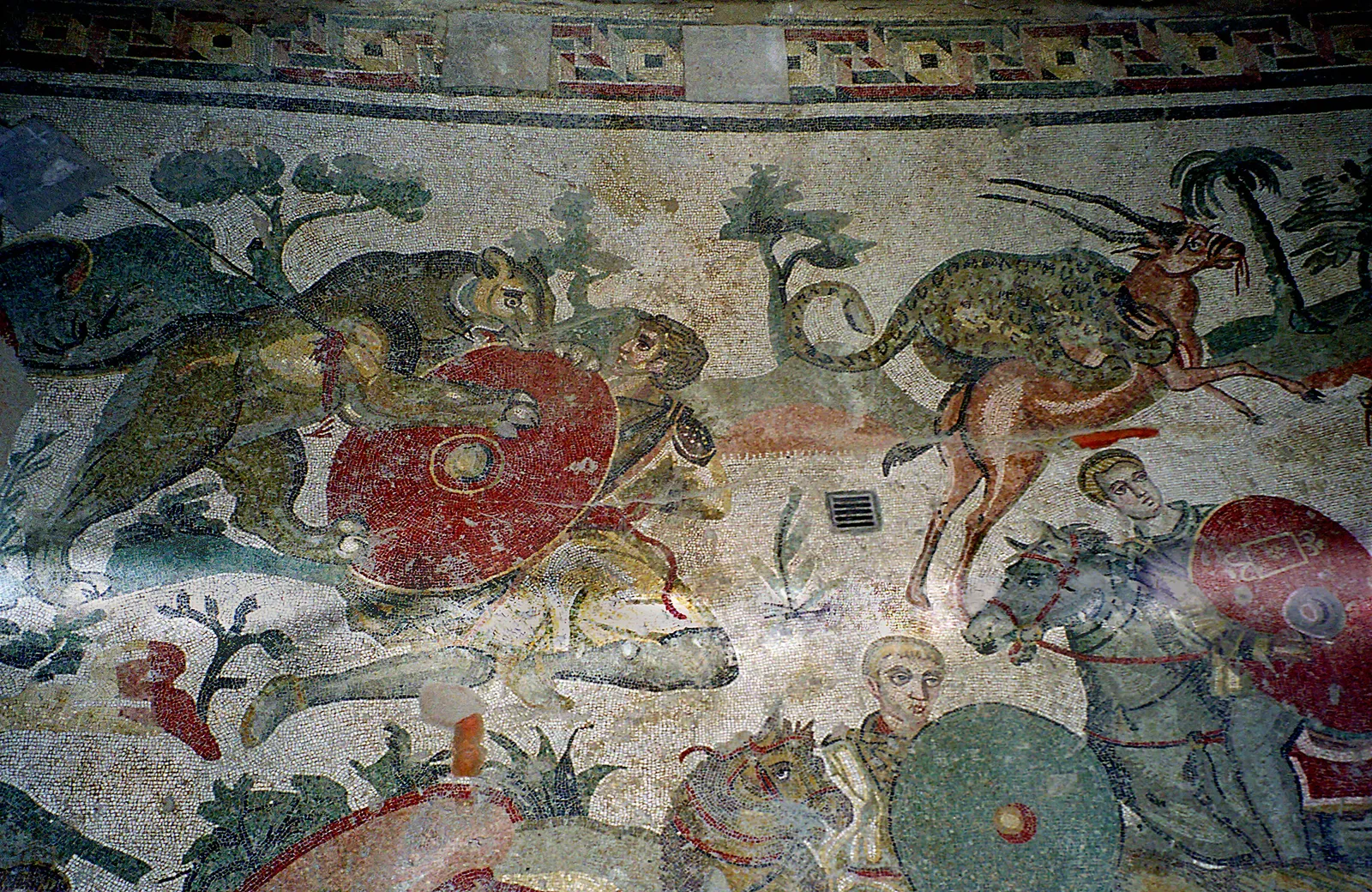
- The Great Hunt. The most famous mosaic, filling a very long corridor: Italia.it describes it as a very long mosaic of the capture of wild animals in Africa. Walk the whole length slowly; the details of the animals and the men trying to catch them are extraordinary.
- The "Bikini Girls". The room of the ten young women in two-piece costumes is the one everyone photographs. Italia.it calls it one of the few depictions of women's sport from the ancient world: the women throw the discus, exercise with weights and run.
- The Small Hunt. A smaller, gentler hunting mosaic, closer to the kind of hunting a landowner did on his own estate.
- Hercules in the dining hall. The great triclinium, the formal dining room, shows the labours of Hercules: Penn Museum lists the Nemean lion, the Hydra, the Stymphalian birds, the Cretan bull, the cattle of Geryon and the Augean stables.
- Ulysses and Polyphemus. The Cyclops and the hero of the Odyssey, one of the mythological scenes among the private rooms.
Take your time over the ordinary rooms too. Nearly every floor is decorated, including geometric patterns in corridors that most visitors walk straight past.
History: from Roman palace to buried ruin
The villa had a long life after the Romans. According to the official site, in the fifth and sixth centuries its walls were thickened and parts were fortified, and its rooms were gradually reoccupied and rebuilt.
During Islamic rule a large settlement grew up here, which the twelfth-century Arab geographer al-Idrisi recorded. It was destroyed in 1161 under the Norman king William I, and in 1163 a new fortified town was founded on today's site of Piazza Armerina, settled by Lombards who had come to Sicily with the Normans. A few houses survived near the ruins into the fifteenth century, known as the old Saracen hamlet, the Casale dei Saraceni, which is where the name comes from.
What saved the mosaics was mud. A flood in the Middle Ages buried much of the villa under debris, protecting the floors for centuries. Proper excavation began in the 1950s under the archaeologist Gino Vinicio Gentili, and in the same decade the architect Franco Minissi covered the site with a transparent roof so that the mosaics could stay where they were rather than go to a museum. Penn Museum notes that the cover was innovative but not ideal for conservation. The villa has been through a long programme of restoration and new excavation since, and Italia.it says the villa was fully brought back to light by the end of 2012.
Tickets and opening hours
| Villa Romana del Casale | |
|---|---|
| Full ticket | About €14 (age 25 and over, including over 65s) |
| Ages 18 to 24 | About €7 |
| Under 18s, teachers, disabled visitors | Free |
| Free days | First Sunday of every month, and some national holidays |
| Hours | Daily, 9am to 7pm; ticket office closes 6pm |
| Booking | Not needed; buy at the ticket office (cash or card, no Amex) |
| Combined ticket | With Morgantina, the Aidone museum, the Piazza Armerina city museum and the Enna museum |
The park has also run evening openings in summer, which are worth catching if you are here in July or August: the villa is cooler and quieter after dark. Times and special tickets change, so check the official site before you go. There is a large paid car park at the entrance, and an official list of accredited guides if you want someone to walk you through it.
How to get to the Villa Romana del Casale
The villa is in the countryside a few kilometres southwest of Piazza Armerina, in the valley of the river Gela below Monte Mangone. Piazza Armerina is roughly in the middle of Sicily, which makes the villa a natural stop between east and west.
- By car. This is the easy way, and the one I would choose. It also lets you add Morgantina and Aidone, or carry on to Caltagirone or Agrigento. My guide to renting a car in Sicily has the practical side.
- By bus to Piazza Armerina. Regional buses run to Piazza Armerina, including services from Catania airport; my Catania airport guide lists the companies.
- From Piazza Armerina to the villa. A local shuttle runs between the town and the villa several times a day; Italia.it mentions departures from Piazza Falcone Borsellino. The park publishes the timetable on its site.
- On a tour. Organised day tours run from the main resorts. They make for long days but save the driving.
If you are coming from the east, the villa fits well into a route that also takes in the east of the island; from the west, it is a long day there and back, so I would stay a night in Piazza Armerina.
Tips for visiting
- Go early. Coach tours arrive mid-morning. At 9am you will have the walkways almost to yourself.
- Mind the heat. Central Sicily is hot in summer. Bring water, and in July and August go first thing or late in the day.
- Follow the route. Italia.it suggests starting at the monumental entrance with its horseshoe-shaped courtyard and the baths, then the private rooms, the Great Hunt corridor and the basilica, and coming back by the oval peristyle and the vestibule.
- Look down, then look closer. You walk on raised walkways above the floors. Binoculars, or just a phone camera zoom, help with the details in the far corners.
- Winter is good too. It is quieter and cooler, and the hills are green. My Sicily month by month tool shows what each month is like inland.
Roman villas in Sicily: Piazza Armerina, Patti and Tellaro
Piazza Armerina is not the only Roman villa in Sicily, just the grandest. VisitSicily notes that from the fourth century the finest late Roman villas on the island, at Patti on the north coast, at Tellaro near Noto in the southeast and at Piazza Armerina, were rebuilt on older farmhouses on an ever more monumental scale, with baths, dining rooms, basilicas, private apartments and mosaics. If the Casale leaves you wanting more, Patti and Tellaro are smaller, quieter and fit easily into a trip along the north coast or around the baroque towns of the Val di Noto.
For the Greek side of Sicily's ancient past, from Segesta and Selinunte to Agrigento and Syracuse, see my guide to the Greek temples and ruins of Sicily.
Nearby: Morgantina, Aidone and Piazza Armerina
Do not drive straight off after the villa. Morgantina, a Greek and Roman town on a long ridge near Aidone, is part of the same park and on the same combined ticket. The archaeological museum in Aidone holds the statue known as the Goddess of Morgantina, returned to Sicily by the Getty Museum in 2011, and a silver treasure that came home in 2010. Further on, Enna, high on its rock, has the museum included in the combined ticket and one of the best views in Sicily.
Piazza Armerina itself is a handsome hill town with a medieval centre, worth an evening stroll and a dinner. If you are thinking about the town as a place to live rather than visit, my Piazza Armerina town page covers that side; in August the town holds its Palio dei Normanni, a medieval pageant.
Frequently asked questions
Is the Villa Romana del Casale worth visiting?
Yes. UNESCO describes its floor mosaics as the finest Roman mosaics still in place anywhere in the Roman world, and they cover more than 3,000 square metres. Even people with little interest in archaeology tend to be amazed by the Great Hunt corridor and the "bikini girls". Allow two to three hours.
How much are tickets to the Villa Romana del Casale?
About €14, or around $15, for adults aged 25 and over, about €7 for ages 18 to 24, and free for under 18s, teachers and disabled visitors. Entry is free on the first Sunday of every month. You buy at the ticket office; booking is not needed. A combined ticket adds Morgantina and nearby museums.
What are the opening hours of the Villa Romana del Casale?
The park lists daily opening from 9am to 7pm, with the ticket office closing at 6pm. In summer there have also been evening openings. Hours can change, so check the official site before you go.
How do I get to the Villa Romana del Casale?
By car is easiest. The villa is a few kilometres southwest of Piazza Armerina, in the province of Enna. Without a car, take a regional bus to Piazza Armerina, including from Catania airport, then the local shuttle to the villa. Organised day tours also run from the main resorts.
What is the bikini mosaic in Sicily?
It is a floor mosaic at the Villa Romana del Casale near Piazza Armerina showing ten young women in two-piece costumes taking part in sport: throwing the discus, exercising with weights and running. It dates from the fourth century AD and is one of the few images of women's sport from the ancient world.
How old are the Piazza Armerina mosaics?
The villa and its mosaics date from the first half of the fourth century AD, around 320 to 350, with additions after an earthquake in the 360s. They were laid by craftsmen from Roman North Africa and were preserved because a medieval flood buried much of the villa in mud.
Who owned the Roman villa at Piazza Armerina?
Nobody knows for certain. Older theories pointed to an emperor such as Maximian. Today the villa's official site attributes it to a senior Roman senator, perhaps a prefect of the city of Rome, and Italia.it names Lucius Aradius Valerius Proculus Populonius, governor of Sicily and consul in 340, as the leading candidate.
Are there other Roman villas in Sicily?
Yes. Besides the Villa Romana del Casale, there are late Roman villas at Patti on the north coast and at Tellaro near Noto in the southeast, both with mosaics. They are smaller and quieter, and easy to add to a trip along the north coast or around Noto.
Sources and small print
- UNESCO World Heritage Centre: Villa Romana del Casale
- Villa Romana del Casale, official site: tickets and services and the villa and its history
- Parco archeologico di Morgantina e della Villa Romana del Casale: tickets and hours
- Italia.it: La Villa Romana del Casale
- VisitSicily (Regione Siciliana): Villa Romana del Casale
- Penn Museum, Expedition magazine: The Villa del Casale of Piazza Armerina
Prices and opening hours are the park's published figures for 2026 and can change; dollar amounts are rough, at about $1.10 to the euro.
Credits
Photo: Jerzy Strzelecki, CC BY-SA 3.0, via Wikimedia Commons.
 The weekly YouTube series