
Caltagirone ceramics: the capital of Sicilian pottery
According to the Regione Siciliana's tourism site, ceramics in Caltagirone go back to the Arab-Norman period, when glazing and decoration grew into an art of their own, and the skills have been handed down by master potters ever since. The colours tell you where you are: the blue of the sea, the yellow of the sun, the green of the countryside and the red of the earth, painted as flowers, geometric patterns, Moor's heads and Mediterranean landscapes on plates, vases, tiles and lamps.
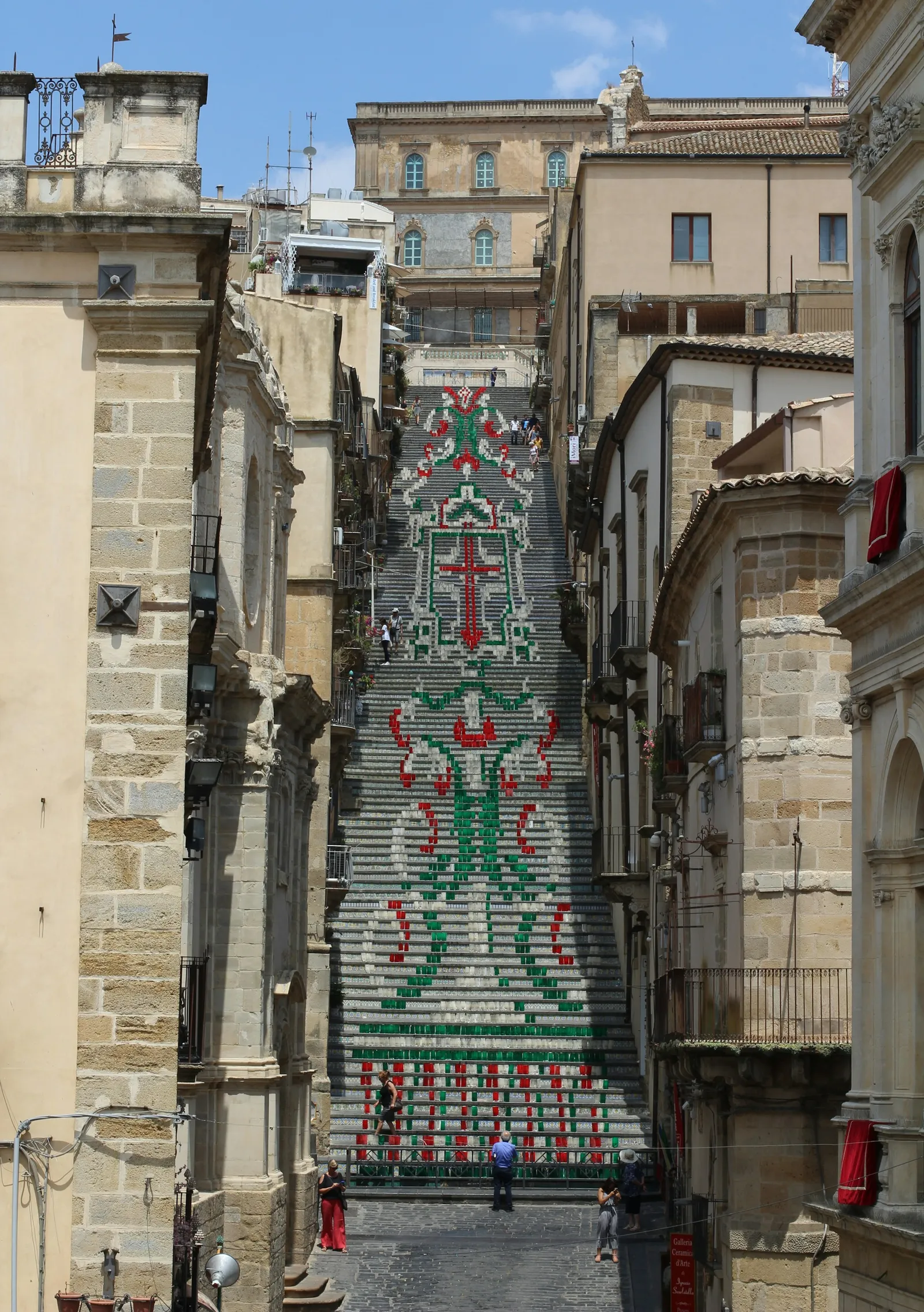
The town wears its craft on the outside. The Scala di Santa Maria del Monte climbs 142 steps from the old civic centre to the church at the top, and every riser is faced with different hand-painted tiles; on the feast of St James, 25 July, it is lit with thousands of coloured lamps. There is a regional ceramics museum, and the workshops let you watch the stages of the work, from shaping the clay to drying, painting and the final glaze. Caltagirone has also applied for an EU geographical indication (IGP) for its ceramics, which would protect the name.
Caltagirone is about an hour by car from Catania, and its late baroque centre is part of the Val di Noto UNESCO World Heritage site, so it pairs well with my guide to Noto, Ragusa, Modica and Scicli. The Caltagirone town page covers living there and house prices; at Christmas, its nativity scenes are in my Christmas in Sicily guide.
A short history of Sicilian pottery
Pottery in Sicily is far older than the painted maiolica in the shops. Around Caltagirone the hills were settled in prehistory and pottery goes back at least to the fifth century BC, and in the caves near Collesano, in the Madonie, pottery has been found from the seventh century BC. The name Caltagirone itself comes from the Arabic qal'at, a fortress.
The bright glazed ware that Sicily is known for grew out of the Arab-Norman centuries, when glazing and decoration became an art in their own right. Palermo's tradition, in the words of the Italian Association of Ceramics Cities, runs from those Arab-Norman influences through the maiolica of the eighteenth century and the Liberty (Art Nouveau) period to the work of today.
Earthquakes and landslides shaped the ceramics towns as we see them: Caltagirone was rebuilt in late baroque style within a decade of the earthquake of 1693, which is why its churches and bridges are dressed in tiles, and Santo Stefano di Camastra was rebuilt on a new geometric plan after a landslide destroyed the old town in 1682.
The legend of the Moor’s head (testa di moro)
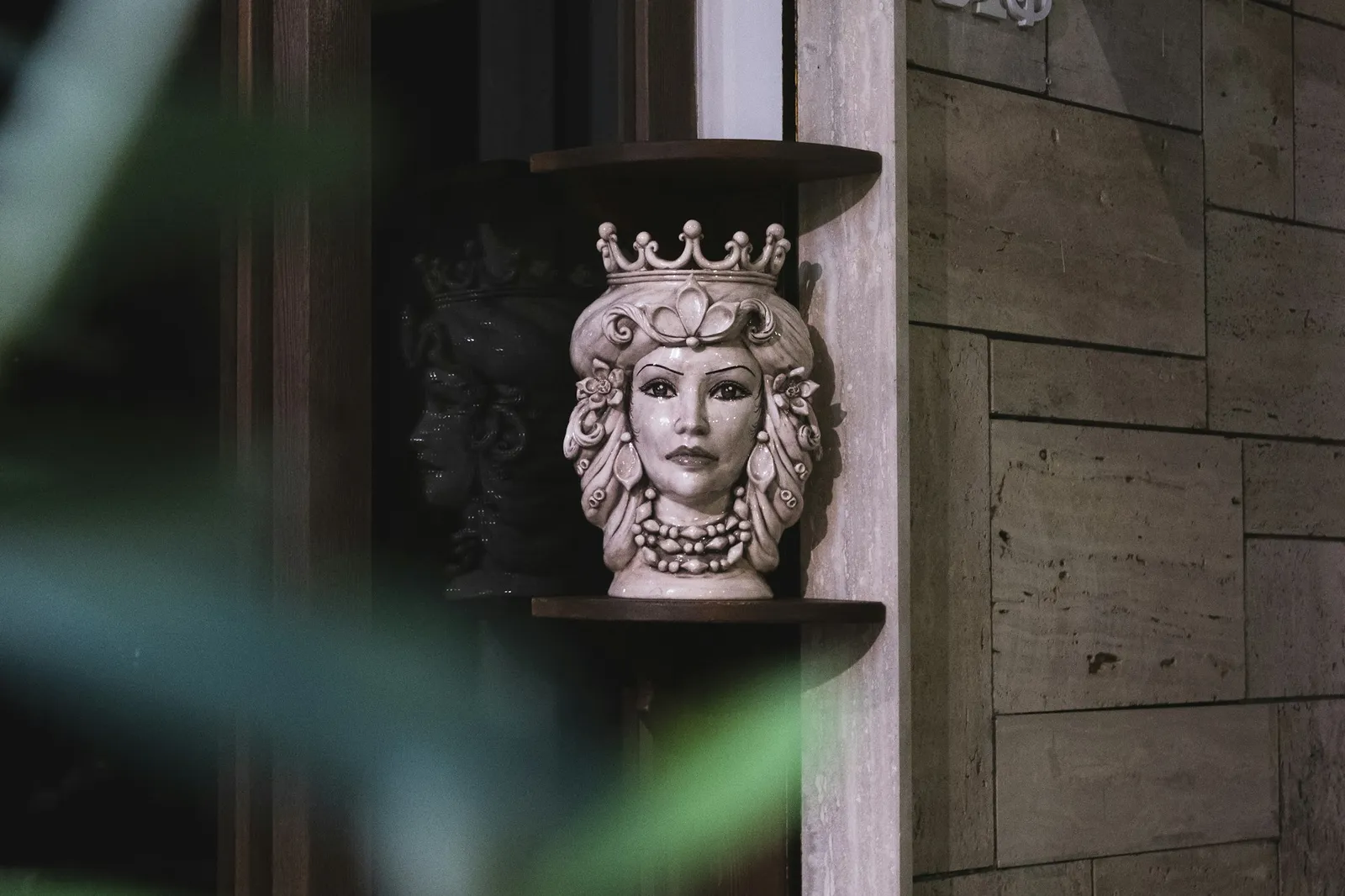
Moor's heads are vases in the shape of a man's head, often crowned, and by tradition they are made in pairs. Their story is a legend, not history, and the version the Regione tells goes like this.
During the Moorish rule of Sicily, a beautiful young woman lived in the Kalsa, the Arab quarter of Palermo, and loved to tend the plants on her balcony. A Moor saw her, fell in love, and she returned his love. When she discovered that he would soon go back to the East, where a wife and children were waiting for him, she killed him in his sleep, cut off his head and used it as a pot, planting basil in it. Watered with her tears, the basil grew so lush that the neighbours, envious, had ceramic vases made in the shape of the Moor's head, and a fashion was born.
In a second version, the two were young lovers, she a Sicilian noblewoman and he a young Arab. When her family found out, they beheaded both, and hung the heads on a balcony as a warning. That, the story goes, is why the heads are made in pairs, in memory of the two lovers.
Where Sicilian ceramics are made
The Italian Association of Ceramics Cities (AiCC) names Sicily's centres of ancient ceramic tradition as Caltagirone, Sciacca, Santo Stefano di Camastra, Burgio, Collesano and Monreale, and Palermo joined the association in 2026. Each has its own look.
- Santo Stefano di Camastra, on the Tyrrhenian coast between Cefalù and Messina, is the one you drive through: giant painted jars and plates are stacked outside workshops along the main road, the street names are tiled, and Palazzo Trabia houses the ceramics museum. It is about an hour and 20 minutes from Palermo.
- Sciacca, on the south-west coast, is a fishing and spa town where ceramics are the other great craft, and its old centre is full of workshops.
- Burgio, a village in the hills inland from Sciacca, is known for ceramics in green and sand tones with flowers and birds, and has its own ceramics museum.
- Collesano, in the Madonie mountains above the north coast, has a long tradition of painted pottery.
The tiles that Americans search for as "Sicilian tile" are maiolica, tin-glazed and hand-painted. Besides the Caltagirone staircase, the old cemetery of Santo Stefano di Camastra has nearly a hundred tombs decorated with about 75 different tile patterns.
Sicilian folk art: painted carts and the Opera dei Pupi
The same bright colours turn up in Sicily's two other famous folk arts, and you will often find them in the same towns as the pottery.
The Sicilian cart (carretto siciliano). According to the Regione's tourism site, the painted carts date from around the eighteenth century, and they were working vehicles, built by local cartwrights to carry goods of every kind. Several craftsmen had a hand in each one: the blacksmith made the ironwork, including the wrought-iron frame between the axle and the bed of the cart, the saddler dressed the horse in tassels, ribbons, bells, gilded studs and red and yellow plumes, the colours of Sicily, and the carver decorated the side panels with paintings and carvings, more elaborate the more important the owner.
The scenes range from the Virgin and the saints to episodes from the tales of chivalry, everyday life and historical events. Today you see them in the parades of village feasts, best known at the feast of Sant'Alfio in Trecastagni, on the slopes of Etna, and Aci Sant'Antonio, near Catania, calls itself the town of the Sicilian cart and has a museum of painted carts.
The Opera dei Pupi. Sicily's puppet theatre was proclaimed by UNESCO in 2001 and inscribed in 2008 on its Representative List of the Intangible Cultural Heritage of Humanity. UNESCO says it emerged at the beginning of the nineteenth century and was hugely popular with the island's working people. The puppeteers told stories from medieval tales of chivalry, Renaissance Italian poems, the lives of saints and the deeds of notorious bandits, largely improvising the dialogue, and shows used to run over several evenings.
There were two main schools, Palermo and Catania, which differ in the size and shape of the puppets, the way they are worked and the painted backdrops. The puppets themselves, carved, painted and armoured by craftsmen in traditional ways, are known for their intense expressions. UNESCO calls it the only uninterrupted tradition of its kind in Italy, and also notes that puppeteers can no longer make a living from it.
You can still find puppet theatres and museums: Acireale has puppet museums, Caltagirone has its Teatro Stabile dei Pupi near the Scala, and in Sortino, near Siracusa, the Puglisi family has kept the pupi going for generations with the deeds of Orlando and the paladins of France.
Planning a ceramics day out
The ceramics towns are spread around the island, so pick the one nearest your base rather than trying to see them all. Drive times below are typical times without traffic, from the same Mapbox figures as my town pages.
- From Catania or the east coast: Caltagirone is about an hour and 5 minutes from Catania. Climb the Scala early, before the heat and the tour groups, then walk the workshops in the streets around it. The other baroque towns of the Val di Noto are within reach for a longer loop.
- From Palermo or Cefalù: Santo Stefano di Camastra is about an hour and 20 minutes from Palermo along the north coast, and Collesano, inland in the Madonie, is about an hour and 10 minutes from Palermo. The shops along Santo Stefano's main road are easy to stop at on a drive between Palermo and Messina.
- From Agrigento or the west: Sciacca is about an hour and 40 minutes from Palermo and sits on the coast road between Agrigento and Marsala, with Burgio a short drive inland.
If you are flying in, my Sicily airports guide explains which airport suits which corner, and my guide to renting a car in Sicily covers the car you will almost certainly need for the inland towns.
How to tell handmade Sicilian ceramics
The souvenir shops in the busiest towns sell both handmade pieces and factory ones, and they can look alike at a glance. These are the things I look at.
- Brush marks. Hand painting leaves strokes you can see and feel, lines that thicken and thin, and colours that pool slightly. A printed decoration is flat and perfectly even.
- Small differences. On a set of handmade plates or tiles, no two are quite the same, and a pair of Moor's heads will differ in the details. Identical pieces with an identical pattern are a sign of a transfer print.
- The base. Many makers sign or mark the underside, often with the town's name. Look too at where the glaze stops: on handmade pieces the edge is rarely machine-neat.
- The official mark. Under Italian law 188 of 1990, ceramics made in the towns of recognised tradition can carry the mark "ceramica artistica e tradizionale", which identifies the maker, the place of origin and the type of material, such as maiolica or terracotta.
- Buy where it is made. In Caltagirone, Santo Stefano or Sciacca you can watch pieces being painted in the workshop and ask the maker directly.
Can you eat off Sicilian ceramics?
Only if the maker tells you the piece is made for food. Many Sicilian pieces are decorative. The US Food and Drug Administration warns that lead can be present in the glazes or decorations of some traditional pottery and can get into food, that items made only for decoration may be stamped on the bottom with a warning such as "Not for Food Use. May Poison Food", and that if you cannot confirm a piece is safe you should not use it for cooking, serving or storing food or drink.
So ask in the workshop, and keep the decorative pieces for the wall, the balcony or flowers.
Frequently asked questions
What are the Sicilian heads called?
They are called teste di moro, Moor's heads: hand-painted ceramic vases in the shape of a head, often crowned, and by tradition made in pairs. They are made in Caltagirone and the other Sicilian ceramics towns and are often used as planters.
What is the legend of the Moor’s head in Sicily?
In the best-known version, a young woman in Palermo's Kalsa quarter fell in love with a Moor, then learned he had a wife and children in the East. She killed him as he slept, cut off his head and grew basil in it, and her envious neighbours had ceramic copies made. It is a legend, not history.
Why are Moor’s heads sold in pairs?
According to a second version of the legend, a Sicilian noblewoman and her young Arab lover were both beheaded by her family and their heads hung on a balcony as a warning. The pairs remember the two lovers.
Where are ceramics made in Sicily?
Caltagirone is the most famous centre. The Italian Association of Ceramics Cities also lists Sciacca, Santo Stefano di Camastra, Burgio, Collesano and Monreale, and Palermo joined the association in 2026.
What is Caltagirone famous for?
Ceramics. Caltagirone has been making pottery since the Arab-Norman period, and its Scala di Santa Maria del Monte has 142 steps, each faced with different hand-painted tiles. Its late baroque centre is part of the Val di Noto UNESCO World Heritage site.
How can you tell if Sicilian pottery is handmade?
Look for visible brush strokes, small differences between pieces in a set, and a maker's mark or the town's name on the base. Printed decoration is flat and identical from piece to piece. Ceramics from the recognised towns may also carry the official mark ceramica artistica e tradizionale.
Is Sicilian pottery safe to eat from?
Only if the maker confirms it is made for food. The US FDA warns that some traditional pottery has lead in its glaze or decoration, and that if you cannot confirm a piece is safe, you should not use it for food or drink. Decorative pieces may carry a 'Not for Food Use' warning.
What is the Opera dei Pupi?
Sicily's traditional puppet theatre, on UNESCO's Representative List of the Intangible Cultural Heritage of Humanity since 2008 (first proclaimed in 2001). It emerged in the early nineteenth century, with carved, painted and armoured puppets acting out tales of chivalry, saints' lives and bandit stories. Palermo and Catania have the two main schools.
What is a Sicilian cart?
A carretto siciliano is a painted wooden cart, dating from around the eighteenth century, once used to carry goods. Its side panels are painted and carved with saints, tales of chivalry, everyday life and history. Today the carts appear in feast-day parades, notably for Sant'Alfio in Trecastagni, and Aci Sant'Antonio has a cart museum.
Is Caltagirone worth visiting?
Yes, if you like craft, baroque streets and hill towns. It is about an hour by car from Catania, and you can climb the tiled staircase, visit the ceramics museum and watch potters at work in a day.
Sources and small print
- Visit Sicily (Regione Siciliana): Caltagirone ceramics
- Visit Sicily: La storia delle Teste di Moro
- Buongiorno Ceramica (AiCC): the Regione Siciliana and Palermo join the Italian Association of Ceramics Cities
- Law 188 of 9 July 1990 on artistic and traditional ceramics
- Visit Sicily: Carretti siciliani
- UNESCO Intangible Cultural Heritage: Opera dei Pupi, Sicilian puppet theatre
- US FDA: Questions and answers on lead-glazed traditional pottery
- UNESCO: Late Baroque Towns of the Val di Noto
- Drive times: Mapbox Directions, typical traffic, as on the town pages
Credits
Photo: Marino La Porta, Unsplash Licence, via Unsplash.
Photo: Antonino Cicero, Unsplash Licence, via Unsplash.
 The weekly YouTube series