
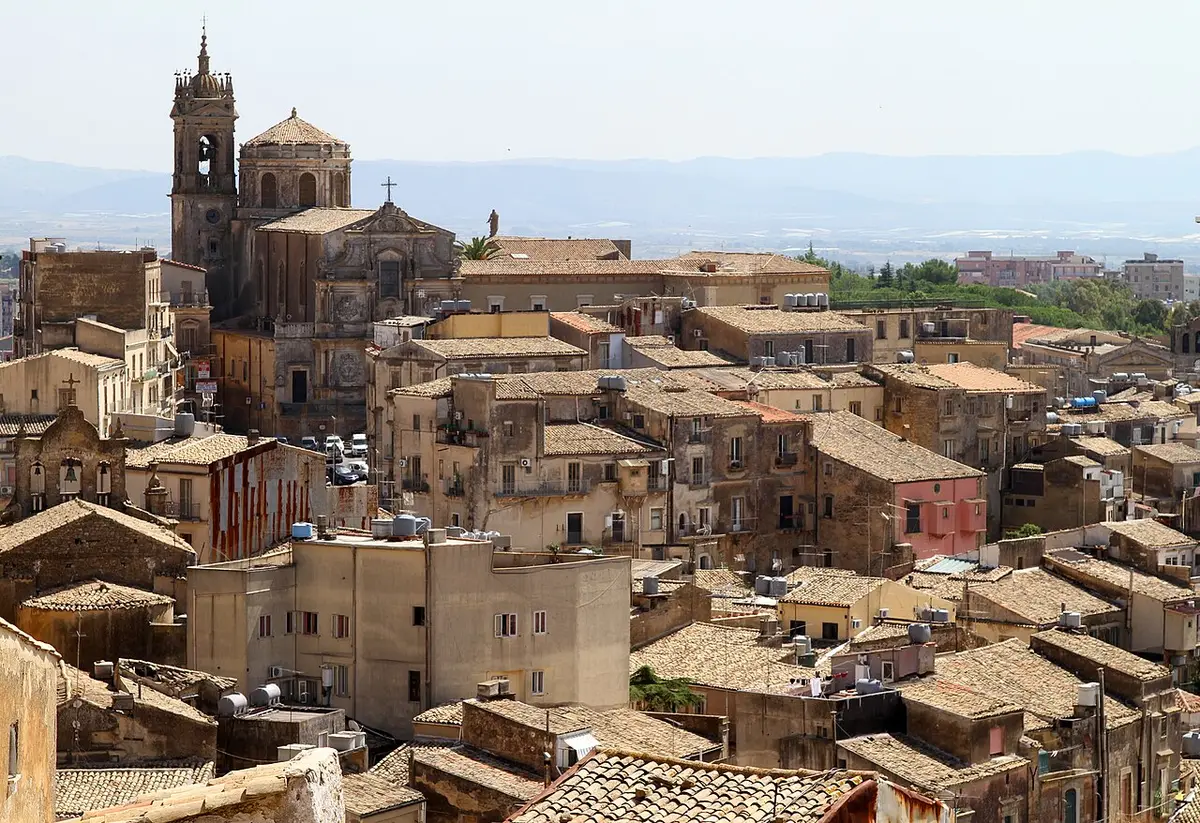
About Caltagirone
The Scala di Santa Maria del Monte, begun in 1608, climbs 142 steps from the old civic heart to the church at the top, each riser faced with different hand-painted tiles. The cathedral of San Giuliano, Norman in origin and a cathedral since 1816, has a majolica dome and bell tower and an early twentieth-century façade; the Liberty period added Palazzo della Magnolia and the Politeama Ingrassia. Behind the ceramics museum lies the Villa Vittorio Emanuele, one of the largest public gardens in Sicily.
The comune is the largest in the metropolitan city by area. To the south lie the frazioni of Granieri, known for table grapes, Piano San Paolo and Santo Pietro, next to the cork oak reserve of Bosco di Santo Pietro. Farming, from grapes and artichokes to oranges and olives, ceramics, commerce and tourism are the economy.
Living in Caltagirone
Caltagirone is a real town all year, with a modest share of tourist beds and visitors spread across the seasons, peaking for the July illumination of the Scala. The population is falling, and the old centre has emptied as people moved to the newer districts; that is the reason the comune has offered abandoned houses through a one-euro scheme.
Daily life is well served, with schools, courts, theatres and puppet shows, but services have drifted to the new town and a car is almost essential. Unemployment is high, especially among the young. In its favour: beauty, culture and craft at low prices. Against: steep streets, foggy and cold winters by Sicilian standards, and distance from the coast.
A short history
The hills were settled in prehistory and pottery here goes back at least to the fifth century BC. The name comes from the Arabic qal'at, fortress. The medieval town grew with settlers from Liguria, and after it helped Count Roger take the Rocca di Iudica it received huge lands, the basis of its wealth.
Caltagirone joined the Vespers revolt, and in 1496 it was made a royal city with the title Urbs Gratissima. The fifteenth to seventeenth centuries were its golden age, with a Jesuit university. The earthquake of 1693 killed about a thousand people here, but the street plan survived and the city was rebuilt in late baroque within a decade.
In the twentieth century the priest Luigi Sturzo, born here, served as deputy mayor and modernised the town; a fierce opponent of Fascism and the leading figure of Catholic popolarismo, he went into exile in London and New York. Allied bombing in 1943 caused heavy losses, and on 14 July 1943 American soldiers shot 74 Italian and 2 German prisoners at the Santo Pietro airfield, the Biscari massacre.
Food, festivals and traditions
Local specialities include cuddureddi, Christmas pastries filled with almonds, cubbaita nougat, maccu virdi, a soup of fresh broad beans and wild fennel, and sausage chopped with a knife. At Easter children get panareddi, pastry baskets holding boiled eggs, and Piano San Paolo holds a sagra of bagged peaches in September.
The patron, Saint James, is honoured on 25 July, when the Scala is lit with thousands of coloured lamps arranged into designs. May brings the Madonna di Conadomini, August the Madonna del Ponte, and Easter the Giunta, the meeting of the risen Christ with the Virgin.
Interesting facts about Caltagirone
- The Scala di Santa Maria del Monte has 142 steps, each faced with different hand-painted tiles.
- Caltagirone's late baroque centre was added to the UNESCO list in 2002 as part of the Val di Noto towns.
- Mazzarrone was part of Caltagirone until it became a separate comune in 1976.
House prices in Caltagirone
€537average price per m² to buy
€1.96average rent per m² a month
€54,000a 100 m² home at that price
These are the official averages from the Agenzia delle Entrate's property market observatory (OMI) for homes in normal condition across the town's 5 price zones. Prices in Caltagirone are below the typical town in Catania province (€665 per m²) and below the typical Sicilian town (€593 per m²). Detached houses (villini) average about €651 per m².
Why these figures can look low: they come from the values on real sales, which sit below advertised asking prices, and the typical Sicilian town is the middle of all 391 comuni, most of them small inland towns. Island-wide averages quoted on property portals, around €1,100 to €1,300 per m², lean towards the cities and the coast, where most homes are listed. Rents work the same way: listings usually ask well above the official rent figure, often double or more.
Houses that need work, which is most of the cheap ones you see advertised, sell well below these figures. The renovation comes on top, so budget for both.
Caltagirone has run a €1 homes scheme. Check the comune's own website for the houses on offer now and the conditions.
Work out the return on a let with the rental yield calculator, or see the steps from offer to keys in the buying timeline planner.
Getting there and getting around
| From the centre to | By car | Distance |
|---|---|---|
| Comiso airport (CIY) | 52 minutes | 43 km |
| Catania Fontanarossa airport (CTA) | 1 hour 6 minutes | 68 km |
| Palermo Falcone Borsellino airport (PMO) | 3 hours 12 minutes | 224 km |
| Trapani Birgi airport (TPS) | 4 hours 10 minutes | 302 km |
| Palermo city centre | 2 hours 43 minutes | 192 km |
| Catania city centre | 1 hour 6 minutes | 69 km |
| Messina, for ferries to the mainland | 2 hours 15 minutes | 164 km |
| Nearest motorway or main road junction (Molona) | 5 minutes | 5 km |
| Nearest railway station (Caltagirone) | 3 minutes | 2 km |
Times are by road on a clear day, worked out from OpenStreetMap. Allow longer in summer and on market days. Caltagirone has a railway station close to the centre, which helps for trips to the cities, but most residents still rely on a car, and buses are infrequent on Sundays and in August.
Planning flights and trips? See the Schengen 90/180 calculator if you are from outside the EU.
Everyday life: shops, health and schools
- Hospital with A&E
- Ospedale Gravina, about 4 minutes by car
- Pharmacies in the comune
- 12
- Supermarkets
- 12
- Schools
- State: 21 nursery schools, 16 primary schools, 4 middle schools, 15 secondary schools; plus 4 independent (paritaria)
- Banks and cash machines
- 7
- Cafés and bars
- 29
- Restaurants
- 10
- Full fibre broadband
- 76.1% of addresses
Pharmacies and schools come from the official Ministry of Health and Ministry of Education lists. The other counts are of places mapped in OpenStreetMap inside the comune's boundary, so a small shop or a doctor's surgery can be missing. “Not fully mapped yet” means the volunteer map clearly has gaps here, not that the town has none. For a family doctor (medico di base, what the British call a GP), you register with the local health authority (ASP Catania) once you are resident.
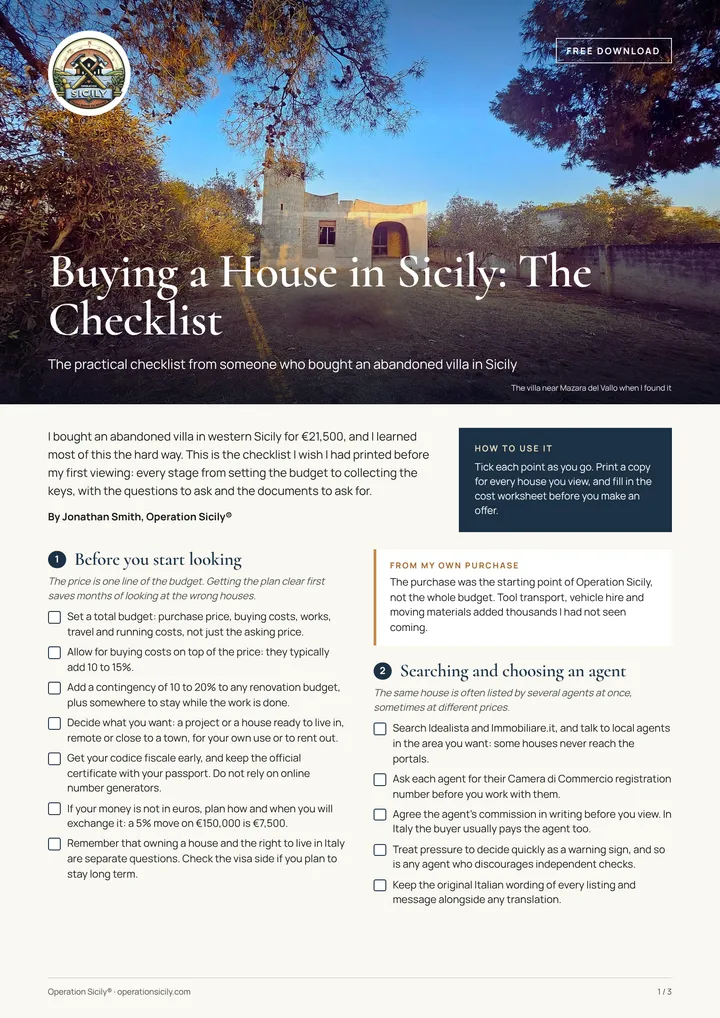
Free download
Buying a house in Sicily? Take my checklist.
Every step from budget to keys, the questions to ask at a viewing and the documents to ask for, as a PDF you can print.
Here is your checklist. Download the checklist (PDF)
Weather and climate in Caltagirone
31.3°Caverage July high
3.3°Caverage January low
548 mmrain a year, on about 73 days
| Month | Average temperature | Rain |
|---|---|---|
| January | 8°C | 75 mm |
| February | 8°C | 63 mm |
| March | 9°C | 54 mm |
| April | 12°C | 35 mm |
| May | 16°C | 13 mm |
| June | 21°C | 11 mm |
| July | 25°C | 5 mm |
| August | 25°C | 9 mm |
| September | 21°C | 51 mm |
| October | 17°C | 70 mm |
| November | 13°C | 84 mm |
| December | 9°C | 79 mm |
Averages for 2015 to 2024. At 608 metres, Caltagirone is cooler than the coast. Winter nights are cold, with frost and some snow on the higher ground, so plan on heating from November to March. Summers are hot and dry.
See what each month brings in Sicily month by month, or size a solar system with the off-grid solar calculator.
Who lives there
- Population
- 35,475
- Change since 2019
- -3.2%
- Median age
- 44
- Foreign residents
- 1,528 (4.3%)
- People from Caltagirone are called
- calatini
Registered residents from abroad include 2 British, 3 American, 7 German, 1 Dutch, 6 French, 1 Irish, 2 Australian, 1 Swiss, 3 Spanish, 15 Polish, 280 Romanian, 59 Albanian and 41 Ukrainian citizens. Most of the rest come from countries outside Europe and the Americas.
Caltagirone lives mainly for its own residents rather than for visitors, with only about 826 tourist beds, so everyday life changes little between summer and winter.
Beaches near Caltagirone
- Gela Beach Gela, 30 km, fine sand, water excellent
- Marina di Acate Beach Acate, 31 km, fine sand, water excellent
- Manfria Beach Gela, 36 km, sand, water excellent
- Scoglitti Beach Vittoria, 39 km, fine sand, water excellent
Things to see and do in and around Caltagirone
Climb the Scala, then visit the regional ceramics museum, opened in 1965, and the contemporary ceramics museum in Palazzo Reburdone. The civic museum in the old Bourbon prison, the Sturzo gallery and the Teatro Stabile dei Pupi are close by. The monumental cemetery, designed by Giovan Battista Nicastro in 1866, is a national monument, and the Crocifisso del Soccorso sanctuary is reached along a road lined with majolica panels.
Outside town, walk in the cork oak woods of Santo Pietro, see the remains of the Cistercian abbey of Terrana, or visit the archaeological site of Monte San Mauro.
- Cathedral of San Giuliano
- Santa Maria del Monte, Caltagirone
- Chiesa del Gesù
- Basilica of St. James
- Monte San Mauro
- Museo Civico, Ex Carcere Borbonico
- Riserva naturale orientata Bosco di Santo Pietro
- Villa Vittorio Emanuele
- Chiesa del Santissimo Salvatore
- Chiesa di San Domenico
- San Francesco di Paola, Caltagirone
- Chiesa di San Francesco d'Assisi
- Santa Chiara
- San Giuseppe
The quickest beach to reach by car, Spiaggia Marina de Acate, is about 54 minutes away.
Famous people born in Caltagirone include Mario Scelba (Italian politician); Luigi Sturzo (Italian Catholic priest and politician); Nicolò Longobardo (Italian missionary); Giuseppe Mascara (Italian footballer); Rosina Anselmi (Italian actress).
Earthquake, landslide and flood risk
Caltagirone is in seismic zone 2, the second highest of Italy’s four seismic zones. The zone sets the anti-seismic standard for any new building, extension or structural renovation, which affects both the design and the cost. A structural survey is worth paying for before you buy any older building, stone house or flat.
1.2% of the comune's land is mapped by ISPRA as high or very high landslide hazard, where 6.2% of residents live, and 0.2% of the land could flood in a medium-probability flood (under 0.1% of residents). Ask for the hazard maps (PAI) for any house you are considering; the comune's technical office or your geometra can check them.
Check what you can build or change with the building permit checker, and keep a margin with the renovation contingency calculator.
The comune: useful details
- Official name
- Comune di Caltagirone
- Province
- Catania (Città metropolitana di Catania)
- Postcode (CAP)
- 95041
- Dialling code
- 0933
- Area
- 379 km²
- Height above sea level
- 608 m
- ISTAT code
- 087011
- Cadastral code
- B428 (used in the codice fiscale of people born here)
- Official website
- comune.caltagirone.ct.it
Registering as a resident, paying local taxes and building permits all go through the comune. If you were born abroad, get your Italian tax code first with the codice fiscale calculator.
Nearby towns
Caltagirone borders 11 other comuni:
- Acate €646/m²
- Gela €742/m²
- Grammichele €415/m²
- Licodia Eubea €368/m²
- Mazzarino €525/m²
- Mazzarrone €390/m²
- Mineo €422/m²
- Mirabella Imbaccari €360/m²
- Niscemi €577/m²
- Piazza Armerina €644/m²
- San Michele di Ganzaria €381/m²
Towns like Caltagirone elsewhere in Sicily
- San Cataldo (Caltanissetta province)
- Canicattì (Agrigento province)
- Caltanissetta (Caltanissetta province)
- Leonforte (Enna province)
- Mussomeli (Caltanissetta province)
- Favara (Agrigento province)
Caltagirone on our lists
See every town in Catania province (58 comuni), or let Find your town suggest places that match what you want.
Frequently asked questions
Where is Caltagirone in Sicily?
Caltagirone is in the province of Catania, about 60 km south-west of Catania. The centre sits about 608 metres above sea level.
What is Caltagirone known for?
The Scala di Santa Maria del Monte has 142 steps, each faced with different hand-painted tiles. Caltagirone's late baroque centre was added to the UNESCO list in 2002 as part of the Val di Noto towns. Mazzarrone was part of Caltagirone until it became a separate comune in 1976.
Is Caltagirone a good place to live?
It depends what you want. Lovers of craft, art and baroque streets who want a proper small city in the interior, and who do not need to be near the sea. The nearest emergency department is about 4 minutes away, and homes average about €537 per m².
How much do houses cost in Caltagirone?
Official figures from the Agenzia delle Entrate put homes in Caltagirone at about €537 per square metre on average, so a 100 m² home in normal condition would be roughly €54,000. That is below the typical town in the province (€665) and below the typical Sicilian town (€593). Houses needing work sell for less, and the best homes for more.
What is the nearest airport to Caltagirone?
Comiso airport is the nearest, about 52 minutes away by car (43 km). Catania Fontanarossa is about 1 hour 6 minutes away. Times are for a clear road and will be longer in summer traffic.
What is the weather like in Caltagirone?
Summers are hot and dry: July afternoons average about 31.3°C. Winter nights in January average about 3.3°C. Rain totals about 548 mm a year, falling mostly between October and March.
How many people live in Caltagirone?
35,475 people live in the comune of Caltagirone, according to ISTAT. The population fell by 3.2% between 2019 and 2025. Half the residents are older than 44.
Is there a hospital near Caltagirone?
The nearest hospital with an emergency department (pronto soccorso) is Ospedale Gravina, about 4 minutes away by car. In an emergency anywhere in Italy, call 112.
Is Caltagirone in an earthquake zone?
Caltagirone is in seismic zone 2, the second highest of Italy’s four seismic zones. New building and structural work anywhere in Italy must follow anti-seismic rules, and the zone sets how strict they are, so ask your geometra or engineer to check any house you plan to buy or renovate.
Does Caltagirone count for the 7% flat tax for pensioners?
No. On the population figure used for the limit, about 35,373 residents, Caltagirone is over the 30,000 limit for Italy's 7% flat tax for foreign pensioners. Many smaller towns nearby do qualify. Check the details with our 7% flat tax town checker and a qualified adviser.
Does Caltagirone sell houses for €1?
Caltagirone is one of the Sicilian towns that has run a €1 homes scheme. Schemes open, close and change, so check the comune's own website for the houses on offer now and the conditions, which usually include renovating within about three years.
Does Caltagirone have fast internet?
Yes, for most homes: about 76.1% of addresses in Caltagirone can get full fibre (FTTH), according to the communications regulator AGCOM. Check the exact address before you buy.
Credits
Photo: Carlo Pelagalli, CC BY-SA 3.0, via Wikimedia Commons.
Figures: ISTAT, Agenzia delle Entrate (OMI), Copernicus ERA5-Land, AGCOM, Dipartimento della Protezione Civile, ISPRA, Ministero della Salute, Ministero dell'Istruzione e del Merito, IndicePA, Open-Meteo, NASA POWER, Wikidata and © OpenStreetMap contributors, with several series gathered by the expatliving-data open data collection. Map boundaries ISTAT via openpolis (CC BY 4.0). Sicily as a whole: 4,787,390 people in 391 comuni.
 The weekly YouTube series