
Where is Syracuse, Sicily?
Syracuse is on the south-east coast of Sicily, about 67 km (41 miles) south of Catania. It is a city of about 116,000 people and the capital of its own province, and in Italian it is Siracusa: same place, two spellings. Americans sometimes mix it up with Syracuse, New York, which took its name from the Sicilian city.
It was founded by Greek colonists from Corinth in the 8th century BC, on the island of Ortigia, and grew into one of the greatest cities of the Greek world; Cicero called it the greatest Greek city and the most beautiful of all. Archimedes was born here. Since 2005, Syracuse and the rock tombs of Pantalica, inland, have been a UNESCO World Heritage Site.
The stories, from the nymph Arethusa to Archimedes and the Roman siege, are in my eastern Sicily guide. Living in Syracuse and house prices are on the Siracusa town page. This page is the visitor's side.
Things to do in Ortigia
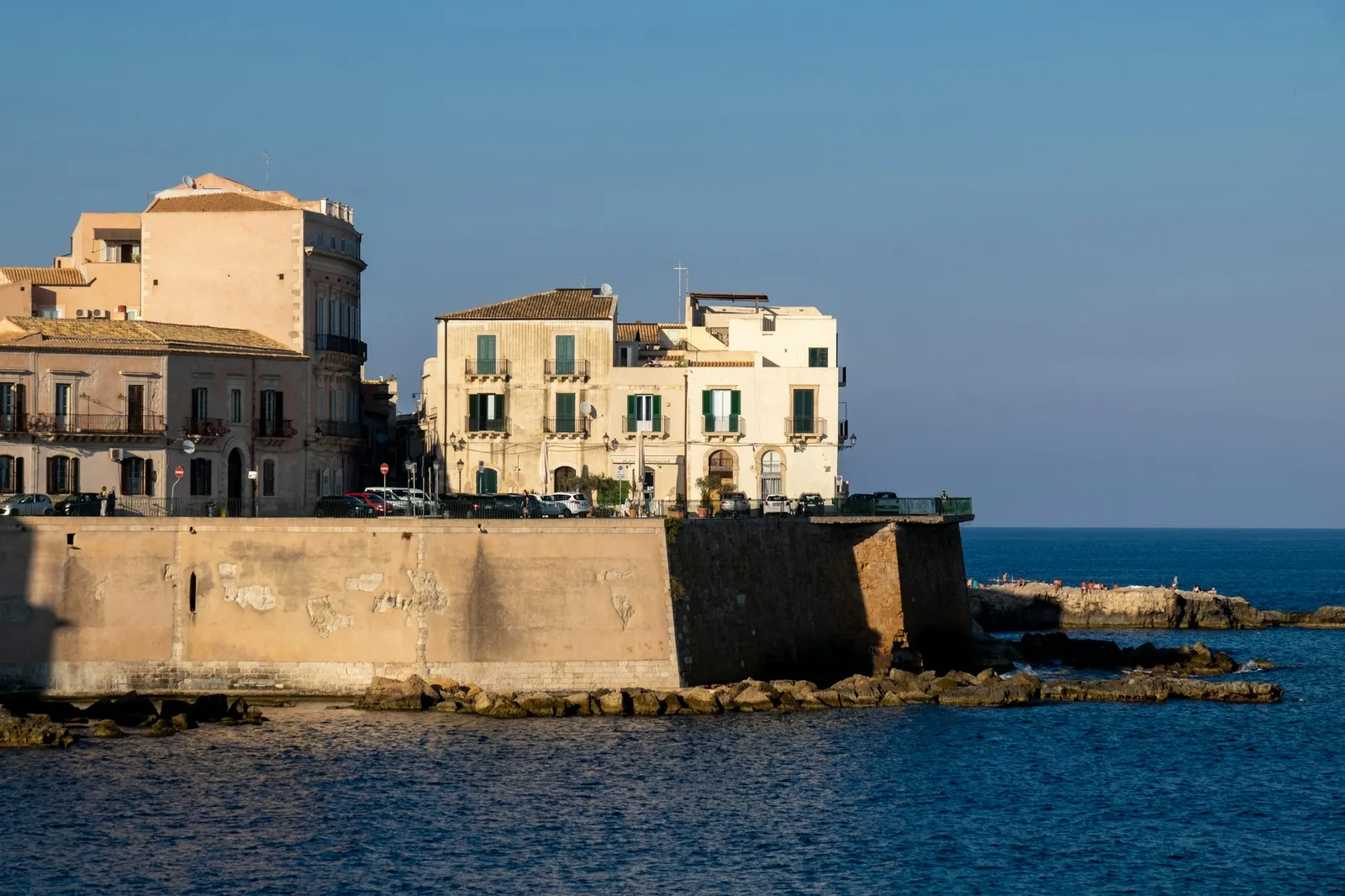
Ortigia is a small island joined to the mainland by bridges, a maze of pale limestone streets with the sea at the end of almost every lane. Give it at least a full day. The sights to look for:
- The Temple of Apollo. The ruins near the bridges from the mainland. UNESCO calls it the most ancient Doric temple in western Greece, from the 6th century BC.
- The market. Ortigia's morning market, for fish, fruit and vegetables. Go before lunch.
- Piazza Duomo and the cathedral. One of the finest squares in Italy. The cathedral was built into a Greek temple of Athena of the 5th century BC, and you can see its Doric columns in the walls, inside and out.
- The Fountain of Arethusa. A freshwater spring a few steps from the sea, with papyrus growing in it. Go at sunset, and walk the seafront promenade beside it.
- Castello Maniace. The castle on the southern tip of the island, with views out to sea.
- The Giudecca. The old Jewish quarter, with a Byzantine-era miqweh, a ritual bath often described as the largest and oldest in Europe.
- Palazzo Bellomo. The regional art gallery.
Syracuse also has two great paintings: Caravaggio's Burial of Saint Lucy, painted here in 1608, and Antonello da Messina's Annunciation of 1474. The city of Syracuse lists the Caravaggio on the altar of the sanctuary of Santa Lucia al Sepolcro, on the mainland, though it has been shown in other churches over the years, including Santa Lucia alla Badia on Piazza Duomo, so check where it is before you go.
The Neapolis Archaeological Park
The Neapolis park, on the mainland, holds the monuments most people picture when they think of ancient Syracuse. The regional archaeological park lists:
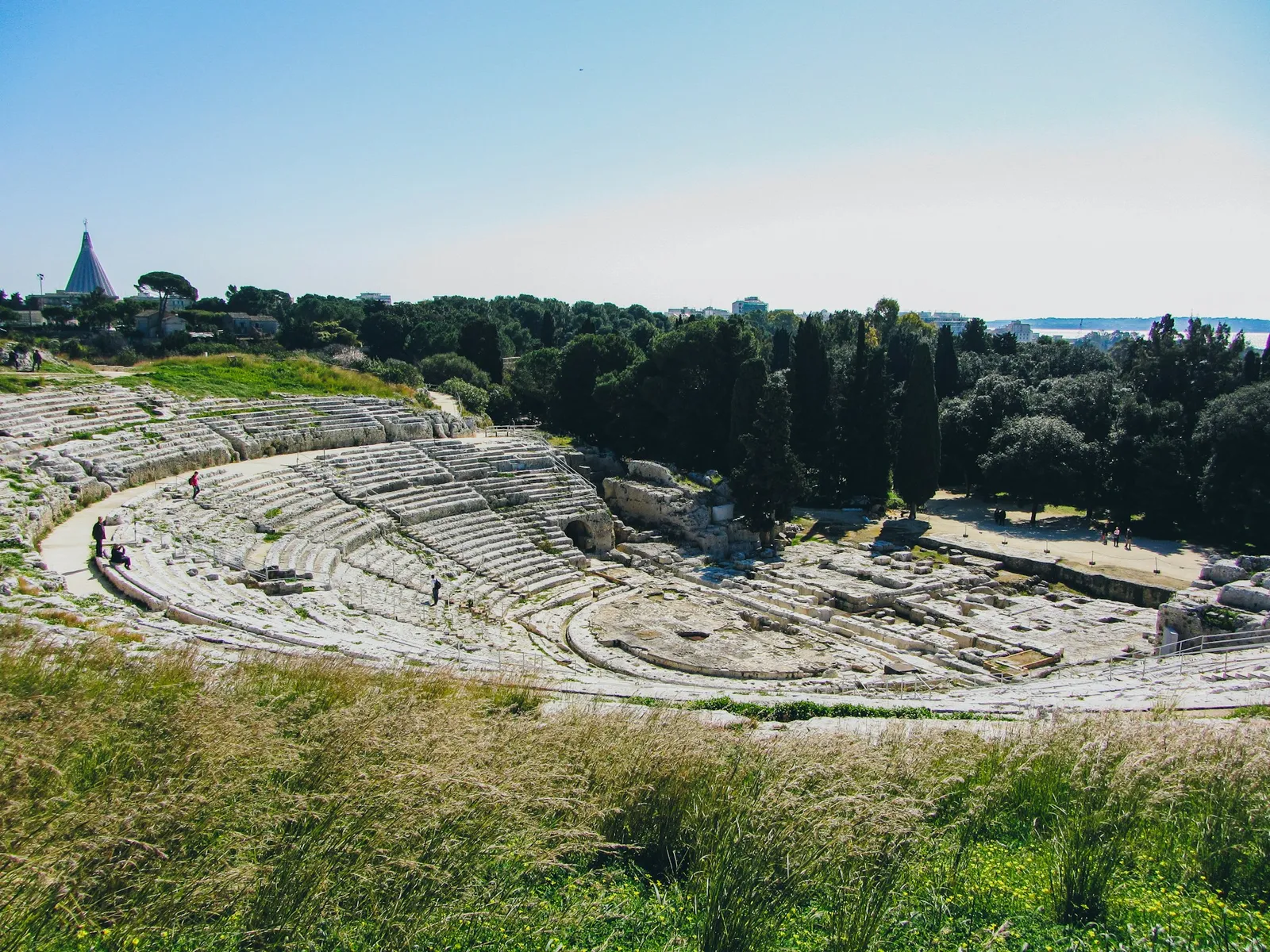
- The Greek theatre, in its present form from the 3rd century BC, but there since the second half of the 5th century BC, cut into the rock of the hill. It is the largest ancient theatre in Sicily.
- The Ear of Dionysius, a tall, narrow cave, about 23 m (75 ft) high, in the old stone quarry of the Latomia del Paradiso. The painter Caravaggio is said to have given it the name in 1608, after the legend that the tyrant Dionysius used its echo to overhear his prisoners. Stand inside and speak softly: the acoustics are remarkable.
- The Grotta dei Cordari, the ropemakers' cave, in the same quarries, which are now overgrown with orange trees.
- The Roman amphitheatre, dated by some to Augustus and by others to Septimius Severus.
- The Altar of Hieron II, a huge altar for the city's public sacrifices.
- The so-called Tomb of Archimedes, a Roman-era tomb cut into the rock with a carved front; the name is tradition, not proof.
| Ticket | About |
|---|---|
| Neapolis archaeological park | €14 ($15), reduced €7 |
| Neapolis park and the Paolo Orsi museum together | €18 ($20), reduced €9 |
The park opens at 8:30am. Outside summer it closes in the late afternoon from Monday to Saturday and in the early afternoon on Sundays and holidays, and the ticket office shuts about an hour before the gates, so do not leave it until after lunch. The park's ticket page has the current hours. Allow two to three hours, wear a hat and carry water: there is little shade.
The Paolo Orsi museum, also on the mainland, is one of the great archaeological museums of Europe, and worth the combined ticket. Nearby are the catacombs of San Giovanni. To see how Syracuse fits with Segesta, Selinunte and Agrigento, read my guide to the Greek temples and ruins of Sicily.
Greek plays in the theatre of Syracuse
Every year the Istituto Nazionale del Dramma Antico (INDA), founded in 1914, stages Greek tragedies and comedies in the theatre where they were first performed. The season runs from May into late June or early July, and INDA publishes each year's dates and programme. Book ahead through INDA's own site. Sitting on the stone tiers as the light goes, with a play written for that kind of stage, is one of the great evenings in Sicily.
Swimming in Syracuse
You do not need to leave town to swim. On Ortigia itself, people swim off wooden platforms and rocks in summer: Cala Rossa and the Forte Vigliena platform are on the island. For sand, the beaches south of the city are a short drive: Arenella, Ognina and Fontane Bianche. On the Plemmirio peninsula, which is a marine reserve and good for snorkeling, Pillirina is wilder.
Day trips from Syracuse: Noto and beyond
| Day trip | Distance by road | Driving time | What it is |
|---|---|---|---|
| Noto | About 41 km (26 miles) | About 50 minutes | The Baroque town rebuilt after 1693, on the UNESCO list |
| Vendicari nature reserve | About 46 km (29 miles) | About 55 minutes | Coastal lagoons, birds and beaches |
| Pantalica, via Ferla | About 43 km (27 miles) to Ferla | About 70 minutes to Ferla | More than 5,000 tombs cut into the rock, part of the UNESCO site |
| Catania | About 67 km (41 miles) | About an hour | Sicily’s second city, the fish market and Etna |
| Taormina | About 120 km (75 miles) | About 1 hour 30 minutes | The Greek theatre and Isola Bella |
- Noto is the classic trip and an easy one: Interbus coaches also run there. My guide to the Baroque towns of the Val di Noto covers Noto, Ragusa, Modica and Scicli, and the Noto town page has more.
- Pantalica is a gorge with prehistoric rock tombs, most from the 13th to the 7th century BC, reached from Ferla or Sortino. You need a car and good shoes.
- Catania and Taormina fit in a day each; see my guides to things to do in Catania and things to do in Taormina.
Getting to Syracuse from Catania airport
The nearest airport is Catania. Interbus coaches run from the airport to Siracusa in about 70 minutes, arriving at the bus station beside Siracusa railway station; from there Ortigia is about 1.9 km (just over a mile), 20 to 25 minutes on foot over the bridge, so take a taxi with a heavy case. By car, it is about an hour. My Catania airport guide covers the coaches and car rental, and my guide to Sicily without a car explains why Ortigia is one of the best car-free bases on the island.
If you do drive, remember that Ortigia's streets are narrow and access for cars is limited: leave the car in a parking lot on the mainland side or ask your hotel before you arrive. Before you rent, read my guide to renting a car in Sicily as an American.
Where to stay in Syracuse, and how many days
For a visit, stay on Ortigia: you walk to everything, eat by the water and see the island at its best early and late. It is busy and dearer, especially in August. The mainland is where most people live and is cheaper, but you will be taking taxis or walking 20 minutes to the old town. The seaside districts to the south, such as Fontane Bianche, suit a beach week with a car.
Two days is right for Syracuse: one for Ortigia, one for the Neapolis park and the Paolo Orsi museum, with a swim at the end of each. Add a third for Noto or Pantalica. Spring and fall are the best seasons, and summer is hot; my month pages, such as Sicily in May and Sicily in October, give temperatures in °F and °C. If you are here in December, Saint Lucy's procession on 13 December is the city's great feast; my guide to Christmas in Sicily explains it.
Frequently asked questions
What are the best things to do in Syracuse, Sicily?
Walk Ortigia from the Temple of Apollo to Piazza Duomo, the cathedral built into a Greek temple, the Fountain of Arethusa and Castello Maniace; visit the Neapolis park for the Greek theatre and the Ear of Dionysius; see the Paolo Orsi museum; swim off the rocks; and take a day trip to Noto.
What is Ortigia?
Ortigia is the small island that forms the old town of Syracuse, joined to the mainland by bridges. It is where the Greeks first settled in the 8th century BC, and it holds the cathedral, the Fountain of Arethusa, the Temple of Apollo and Castello Maniace.
Is Siracusa the same as Syracuse?
Yes. Siracusa is the Italian name and Syracuse the English one for the same city on the south-east coast of Sicily. Syracuse, New York, was named after it.
What is the Ear of Dionysius?
A tall, ear-shaped cave about 23 m (75 ft) high in an ancient quarry in the Neapolis archaeological park. Its name is said to have been given by Caravaggio in 1608, after the legend that the tyrant Dionysius listened to his prisoners through its echo.
How much is the Neapolis archaeological park in Syracuse?
About €14 (about $15), with a reduced price of €7, or about €18 ($20) for a combined ticket with the Paolo Orsi archaeological museum. The park opens at 8:30am and closes earlier on Sundays and holidays.
How many days do you need in Syracuse?
Two days: one for Ortigia and one for the Neapolis park and the Paolo Orsi museum. Add a third day for Noto, the Vendicari reserve or Pantalica.
How do I get from Catania to Syracuse?
By Interbus coach from Catania airport or from beside Catania Centrale station, in about 70 to 80 minutes, or by car in about an hour (about 67 km, 41 miles). The railway between the two has been closed for long periods for works, so check before you rely on the train.
When are the Greek plays in Syracuse?
Each year from May into late June or early July, staged by INDA in the ancient Greek theatre. INDA publishes each year’s dates and programme on its own site. Book ahead.
Sources and small print
- Parco archeologico di Siracusa, the regional archaeological park, tickets, opening hours and the Neapolis monuments
- UNESCO, Syracuse and the Rocky Necropolis of Pantalica
- INDA, the Istituto Nazionale del Dramma Antico, the season of classical plays
- Comune di Siracusa, Caravaggio's Burial of Saint Lucy
Ortigia, the museums and the food are from my town data for Siracusa. Driving times are from Mapbox directions without traffic and rounded; coach times from the operators and earlier guides on this site.
Credits
Photo: Casey Lovegrove, Unsplash Licence, via Unsplash.
Photo: Alexandra Smielova, Unsplash Licence, via Unsplash.
 The weekly YouTube series