
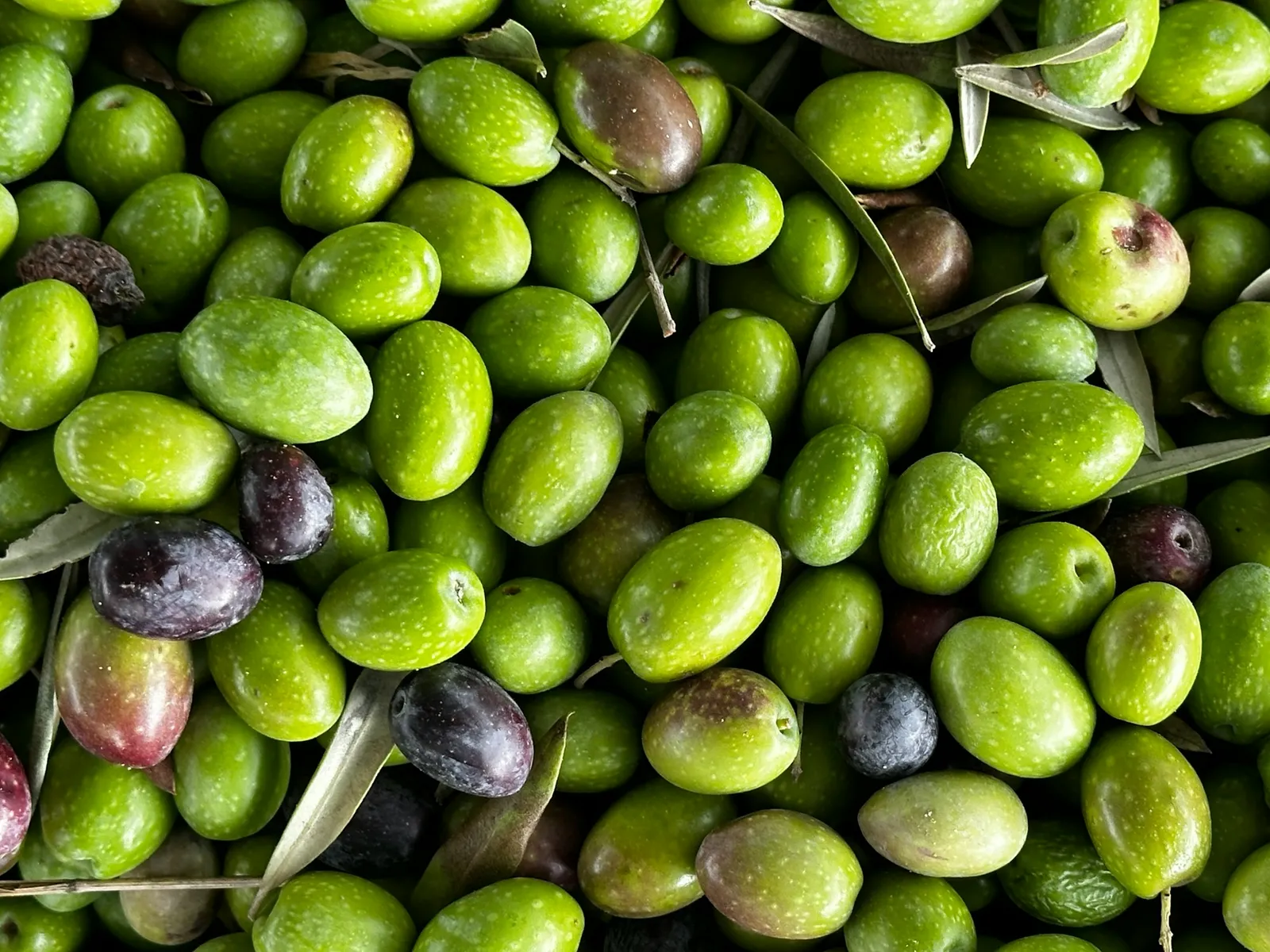
What is new season olive oil?
Olive oil is made once a year. The olives ripen through the autumn, and the mills (frantoi) work almost around the clock from October until the harvest is done, often into December or January. New season oil, or olio nuovo, is simply oil from this harvest, sold straight away rather than being stored and filtered first. It is also sold as olio novello.
It is a seasonal food in the same way the first asparagus or the new wine is. In olive-growing parts of Italy, people take their own olives to the mill and go home the same day with cans of their own oil, and the first evening is spent pouring it over toasted bread. In Tuscany that is fettunta; in Sicily it is just pane e olio, bread and oil, often with salt, oregano or a rubbed tomato.
You will also see it sold as "new harvest" oil, and in the southern hemisphere, where the harvest runs from about April to June, new season oil from Australia, Chile or South Africa reaches the shops in mid-year.
When is new season olive oil available?
In Sicily the harvest generally starts in October, earlier on the coast and for green table olives, later inland and for late varieties. My own variety, Nocellara del Belice, is a late one, picked for oil from October into December. Across Italy as a whole the main season is October to December.
- In Italy: from the mills and farm shops from late October and through November, at its most intense until around February.
- In the UK and northern Europe: specialist importers and some shops bring in new season Italian and Spanish oil from late November and December, often flown or rushed in for Christmas.
- Labelled harvest years: look for the harvest year on the label, such as 2026/27. EU rules only allow it when all the oil in the bottle comes from that harvest.
If you are visiting Sicily in November, it is worth asking at any frantoio you pass whether they sell oil direct. Many do, and some let you watch the milling.
Why does new season olive oil look green and cloudy?
The colour comes from chlorophyll and other pigments in the olive skin. Olives picked early, while still green or only just turning purple, give the greenest oil, and the green slowly fades towards gold as oil ages and is exposed to light. Colour is a hint of how early the olives were picked, not a measure of quality on its own.
The cloudiness is tiny particles of olive flesh and droplets of water still suspended in the oil. Most oil is filtered or left to settle in tanks for weeks before bottling, which makes it clear. New season oil is usually sold straight off the line, so it is cloudy, and a layer of sediment collects at the bottom of the bottle over a few weeks. I explain the trade-offs in harvesting olive oil in Sicily.
Why is new season olive oil bitter and peppery?
This is the question I get most from people tasting fresh oil for the first time. The bitterness and the pepperiness are signs of a fresh, well-made oil, not faults.
- Bitterness comes mainly from natural phenolic compounds in the olive, the same family that makes raw olives straight from the tree inedibly bitter. Green, early-picked olives have the most.
- Pepperiness, the burning catch at the back of the throat, comes mostly from one of those compounds, called oleocanthal. It stings the throat rather than the tongue, which is why a very fresh oil can make you cough.
Tasters even grade it informally: a "one-cough" oil is pleasantly peppery; a "three-cough" oil is serious stuff. In the official tasting standard, bitterness and pungency are two of the three positive qualities of extra virgin oil, alongside fruitiness. An oil with none of the three is flat.
These compounds are at their highest in the weeks after milling and decline steadily from then on, which is why new season oil bites and year-old oil does not.
Why does olive oil make you cough?
Because of where oleocanthal is felt. Most of the sensations in olive oil are on the tongue, but oleocanthal acts on receptors at the back of the throat, so the sting arrives a second or two after you swallow and catches you off guard. Fresh oil from early-picked olives has the most, so it makes people cough the most.
If you find it too strong, it calms down fast. Over a few months a fierce new oil becomes a pleasantly peppery one, and with food, on warm bread or vegetables, it is much gentler than sipped on its own.
How long does new season olive oil stay fresh?
The fresh, green, peppery character is at its peak for roughly the first three to four months and softens through the following spring and summer. The oil is still good to use for much longer, but it becomes a different, rounder oil.
Unfiltered new oil keeps less well than filtered oil, because the particles and water in it can start to ferment and give off-flavours over time. So:
- Buy it to use, not to store. Plan to finish a bottle of olio nuovo within a few months.
- Keep it cool and dark, tightly closed.
- If it has a thick layer of sediment, you can carefully pour the clear oil off into a clean bottle after a few weeks.
How long does olive oil last? covers storage in more detail, including how to keep oil in a hot kitchen.
How to use new season olive oil
Raw, and generously. Cooking drives off most of what makes new oil special. In Sicily in November and December it goes on:
- Toasted bread with salt, the classic first taste, sometimes rubbed with garlic or a cut tomato.
- Bean and chickpea soups, and pasta with beans, poured on at the table.
- Grilled or roasted vegetables, especially artichokes, fennel and cauliflower.
- Boiled potatoes, winter salads of orange and fennel, and grilled fish.
- Fresh ricotta, with a little salt and black pepper.
Keep a cheaper, older oil for frying and roasting. The Sicily food guide has more of what we eat here.
How to choose a good new season oil
- A harvest year or milling date on the label, for this season.
- A named producer and place. New oil is a small-producer product at heart.
- Dark glass or tins. Fresh oil is still sensitive to light.
- Taste it if you can. It should be fruity, green and clearly bitter and peppery, with no fusty, muddy or winey smell. A fresh oil that already smells stale was made from olives left too long before milling.
The same label checks apply as for any oil; see how to tell if olive oil is real.
Our own trees and the first oil

Our five Nocellara trees at the villa near Mazara del Vallo were pruned back hard in February 2026 after twenty years of neglect, and they are being brought back into full production. How I pruned them is in how to prune olive trees.
Harvest season is when the whole of western Sicily smells of crushed olives, and the mills run day and night. What happens on the day we take our olives to the mill is in harvesting olive oil in Sicily.
Frequently asked questions
What is olio nuovo?
Olio nuovo is Italian for new oil, also called olio novello: extra virgin olive oil from the current harvest, sold within days or weeks of milling and usually unfiltered. It is greener, cloudier, more bitter and more peppery than older oil, and in Italy it appears from late October and November.
When is new season olive oil available?
In Italy and the rest of the northern hemisphere, from about late October and November, as the mills start work, and at its most intense until around February. Specialist shops in the UK and northern Europe usually have it from late November or December. Southern hemisphere new oil arrives in mid-year.
Why is new olive oil so peppery?
Fresh oil is full of natural phenolic compounds. One of them, oleocanthal, stings the back of the throat, which gives the peppery catch and can make you cough. These compounds are highest just after milling and fade over the following months.
Is bitter olive oil bad?
No. Bitterness is one of the three positive qualities of extra virgin olive oil in the official tasting standard, with fruitiness and pungency. It is strongest in fresh oil from early-picked olives. An oil that tastes of crayons, putty or stale nuts is the one with a problem: it has gone rancid.
Why is new olive oil cloudy?
Because it has not been filtered or left to settle. Tiny particles of olive flesh and droplets of water stay suspended in the oil, and over a few weeks they sink to form sediment. Cloudiness is normal in new season oil.
How long does new season olive oil last?
Its fresh, green, peppery character is at its best for about three to four months and then softens. Unfiltered new oil keeps less well than filtered oil, so it is best bought to use within a few months, stored cool, dark and tightly closed.
Can you cook with new season olive oil?
You can, but heat drives off most of the fresh flavour that makes it special, so it is a waste of good new oil. Use it raw on bread, soups, beans, vegetables and fish, and keep an older, cheaper oil for frying and roasting.
Sources and small print
- International Olive Council: method for the organoleptic assessment of virgin olive oil (fruity, bitter, pungent)
- Food Safety Authority of Ireland: olive oil labelling, including the harvest year (Commission Delegated Regulation (EU) 2022/2104)
- International Olive Council: World Catalogue of Olive Varieties, Nocellara del Belìce
- Beauchamp and others (2005), Nature: the discovery of oleocanthal and the throat-catching sensation
Harvest months vary with the year, the variety and the place; those given are typical for Sicily and Italy.
Credits
Photo: John Cameron, Unsplash Licence, via Unsplash.
Photo: Operation Sicily®, all rights reserved, via operationsicily.com.
 The weekly YouTube series