
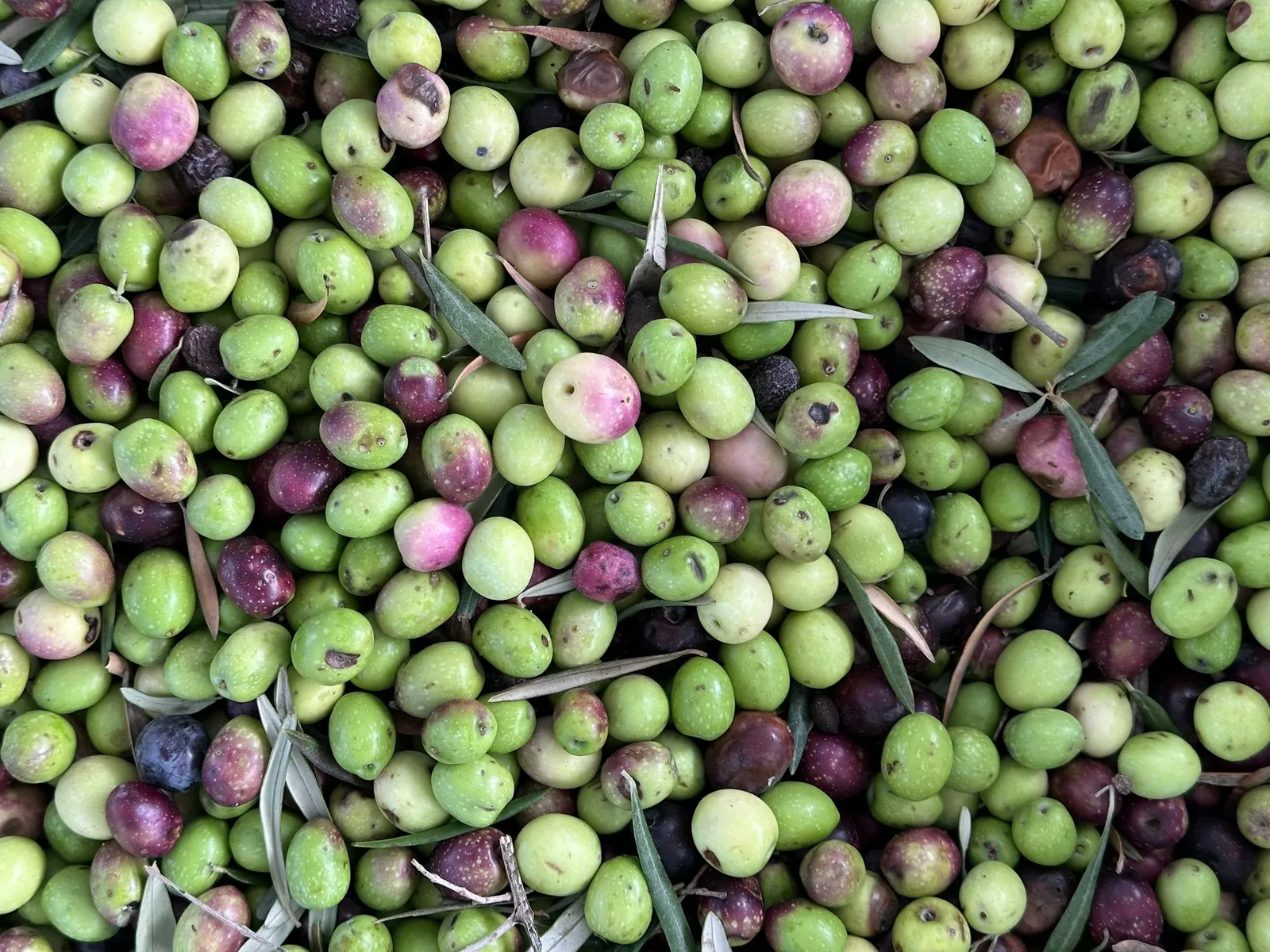
What happens before the olives reach the mill?
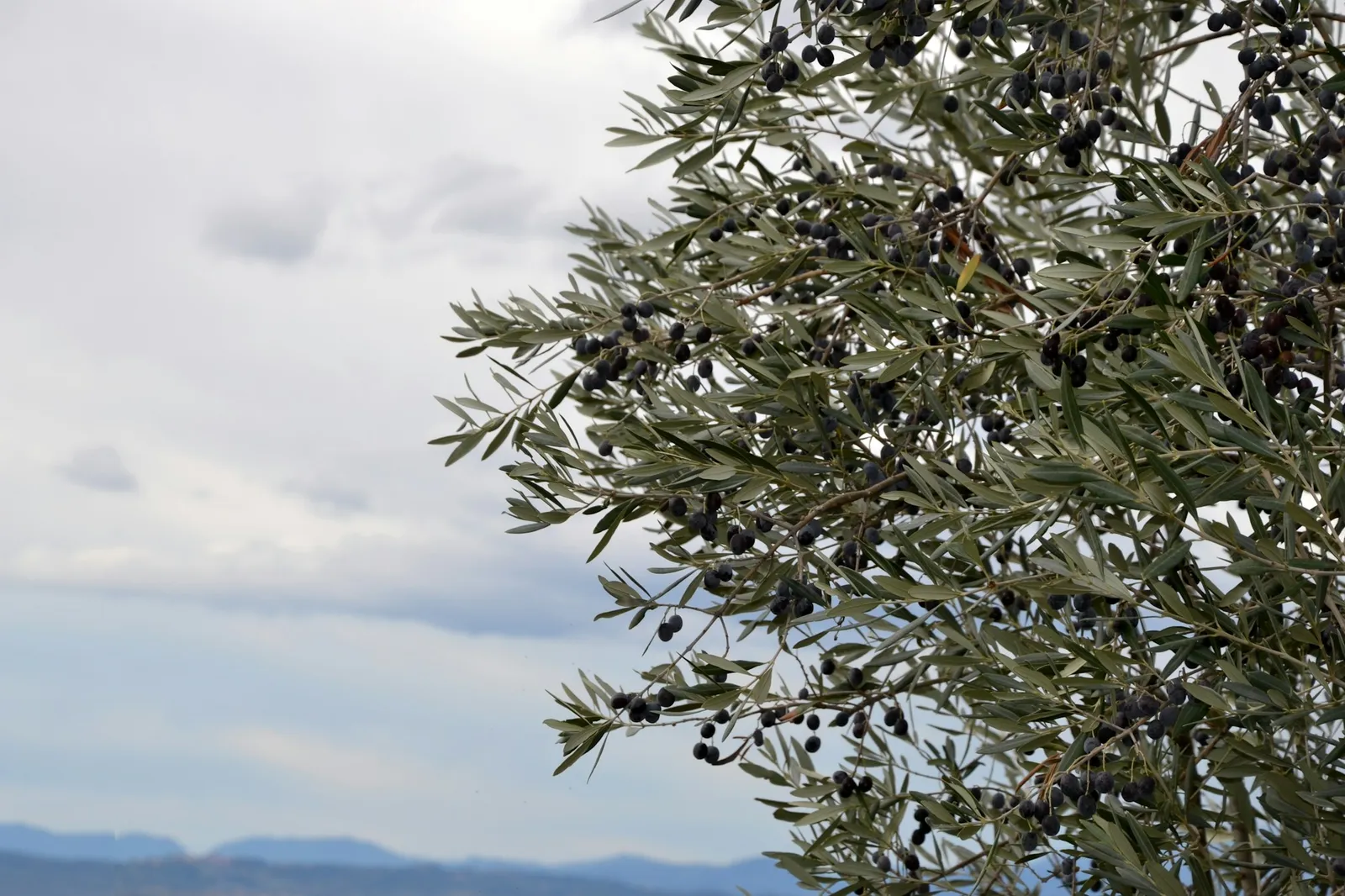
Good oil starts on the tree. Olives for oil are picked from October to December in Sicily, by hand, with hand rakes or with handheld shakers, onto nets spread under the tree. Fruit that has lain on the ground starts to ferment and spoils the oil, so careful growers never pick it up. When to pick is a decision in itself, and it changes both the flavour and the amount of oil; I cover it in when to harvest olives.
From the moment it is picked, an olive starts to break down. The olives travel in shallow, ventilated crates, never in sacks, and the aim is to mill them within 24 hours. The Valle del Belìce DOP, the protected oil of the valley next to us, allows no more than two days. Olives left in a warm heap ferment and give the fusty, muddy defect that no amount of filtering can remove.
What is a frantoio?
A frantoio is an olive mill, from the Italian frangere, to break. Most villages in olive country once had one, and many still do: in western Sicily the local mill serves everyone from the big estates to families with a handful of trees, who bring their crates, have their own olives milled, and go home with their own oil. That system, called molitura conto terzi (milling for others), is how small growers get their olives milled.
A modern frantoio is a line of stainless steel machines: a hopper and conveyor, a leaf remover and washer, a crusher, a row of malaxers, a horizontal decanter centrifuge, a vertical separator and storage tanks. A traditional mill has granite millstones and a hydraulic press instead. Both make olive oil from nothing but olives.
When your olives arrive, a good miller looks at them before anything is tipped in: how sound they are, how ripe and how wet. The University of California guide notes that fruit with a moisture content of about 50 to 56% extracts best. Drier fruit makes a stiff paste and can give the oil flat, dry notes, while wetter fruit tends to form emulsions that hold on to the oil. That is one reason a miller may ask about recent rain before setting up the line.
How olive oil is made, step by step
| Step | What happens | Why it matters |
|---|---|---|
| 1. Weighing | The olives are weighed on arrival | The basis for the bill and the oil yield |
| 2. Leaf removal | A fan blows off leaves and twigs | Leaves left in can give a harsh, leafy taste |
| 3. Washing | Olives pass through water to remove soil and stones | Protects the machines; skipped for clean fruit to avoid extra water |
| 4. Crushing | A hammer, disc or stone crusher grinds whole olives to a paste | Breaks the cells and frees the oil |
| 5. Malaxation | The paste is mixed slowly, usually for 20 to 60 minutes | Small droplets merge so the oil can be separated; much of the aroma forms here |
| 6. Separation | A decanter centrifuge (or a press) splits oil from water and solids | Produces the raw oil and the pomace |
| 7. Cleaning | A vertical centrifuge removes remaining water and fine solids | Wet oil ferments and spoils |
| 8. Settling or filtering | The oil rests in tanks or is filtered | Removes sediment so the oil keeps |
| 9. Storage | Stainless steel, cool, dark and sealed from air | Oxygen, light and heat age the oil |
In a modern continuous mill the whole run, from tipping the crates into the hopper to oil coming out of the separator, takes roughly an hour or two, and most of that time is in the malaxer.
Crushing and malaxation: where the flavour is made
The whole olive goes into the crusher, stone included. Most mills now use a hammer mill, which a technical guide from the University of California describes as the most common crusher for its output and simplicity; others use discs, knives or a de-stoner. The miller sets the screen size to the fruit: a fine paste for small, green, firm olives and a coarser one for large, ripe or watery fruit.
The paste then goes into the malaxer, a trough with slowly turning blades. This is where the operator's choices matter most. Warmer, longer mixing gets more oil out, but costs aroma and freshness; cooler, shorter mixing keeps the green, fruity notes but leaves more oil behind. The UC guide says quality mills keep the temperature as low as possible, but not below about 22°C, so that the oil still separates well. Watery paste can turn into an emulsion that holds on to its oil; the International Olive Council describes adding micronised talc at the start of malaxation as the processing aid that works best.
Modern malaxers are closed, and some are flushed with nitrogen, to keep the paste away from air. Open troughs with paste churning in the air are a sign of an older line.
Decanter centrifuge or traditional press?
The decanter. Almost every mill now separates the oil in a horizontal centrifuge called a decanter, which spins the paste at high speed so the heavy solids, the water and the light oil separate by density. It is fast, continuous, enclosed and easy to clean between lots.
The traditional press. In the old system the olives are crushed under heavy granite wheels, the molazze, and the paste is spread on round mats, the fiscoli, which are stacked on a spindle and squeezed in a hydraulic press. The liquid that runs out is oil and water, separated afterwards by settling or a centrifuge. It is slow, uses a lot of labour, and the mats are hard to keep clean, and the paste is open to the air for longer. A few mills still work this way, and they are worth seeing, but most good oil today comes from modern lines.
| Two-phase decanter | Three-phase decanter | Traditional press | |
|---|---|---|---|
| Outputs | Oil and a wet pomace | Oil, water and a drier pomace | Oil and water mix, plus pressed cake |
| Water added | Little or none | Warm water added to the paste | None, or a little |
| Effect on oil | Tends to keep more bitterness and pungency | Slightly milder, as some compounds leave with the water | Depends heavily on clean mats and speed |
| Waste | Less waste water, very wet pomace | Large volumes of waste water | Waste water and dry cake |
The UC guide notes that extraction results are similar for two-phase and three-phase decanters, and that two-phase machines have become more common because they use less water and energy and give more intense oils.
Is olive oil pressed or spun? Cold extraction at the mill
Both are protected label terms in the EU. Under Commission Delegated Regulation (EU) 2022/2104, "first cold pressing" may only be used for extra virgin or virgin olive oil obtained below 27°C from a first mechanical pressing of the paste in a traditional hydraulic press. "Cold extraction" may only be used for extra virgin or virgin olive oil obtained below 27°C by percolation or centrifugation of the paste.
So "cold extraction" is the correct term for nearly all modern oil, and "first cold pressing" describes a method few mills still use. There is no second pressing of the paste in a modern mill. What is left, the pomace, goes to separate plants that extract a lower-grade oil with solvents, which can only be sold as olive pomace oil. What these words are worth on a label is in what cold pressed means on olive oil.
Settling, filtering and storage: what happens after the decanter?
Oil leaving the decanter still holds water and fine particles, and if they stay in, they ferment and spoil it. A vertical centrifuge removes most of them, and the oil is then either left to settle for a day or two in conical stainless steel tanks, with the sediment drained off, or passed through a filter. The University of California guide aims to bring the water in the finished oil below 0.2%, and keeps settling tanks above about 18°C so the sediment drops out. New oil sold straight from the mill is often unfiltered, cloudy and bright green. Filtered vs unfiltered olive oil covers the difference, and new season olive oil explains why fresh oil tastes so peppery.
From then on, the enemies are air, light and heat. Mills store oil in sealed stainless steel tanks in a cool room. At home, the same rules apply, as I explain in how long olive oil lasts. How much oil a tree gives, and what a mill's yield figure means, is in how much oil an olive tree produces.
Mills also produce two by-products: the pomace (sansa) and the vegetation water (acque di vegetazione). The pomace goes to pomace oil plants or is used as fuel or compost, and Italian law has allowed controlled spreading of mill waste water on farmland since 1996.
Can you make olive oil at home?
You can make a little, but not much, and not easily. Without a decanter, household methods leave most of the oil in the paste. If you want to try with a few kilos of your own olives:
- Use sound, freshly picked olives, and remove leaves and stalks.
- Crush them whole, stones included, in a heavy mortar or a sturdy food processor, in short bursts so the paste does not heat up.
- Stir the paste slowly by hand for 30 to 40 minutes at room temperature.
- Squeeze it through a clean cloth or press it, collect the liquid in a tall glass jar, and leave it to settle. The oil rises to the top.
- Spoon or siphon off the oil, let it settle again, and use it within a few weeks, because home oil still holds water and spoils faster than mill oil.
Expect far less than the 150 to 200 ml per kilo that a mill would get. Small benchtop extractors exist for hobby growers, but for anyone with a tree or two the local mill is far easier. With our five trees I would not consider anything else.
Visiting an olive mill in Sicily during the harvest
The mills in western Sicily run from about October to December, and in the busiest weeks of November many work late into the night. If you are on the island then, a visit is one of the best things you can do. Driving through the olive country around Mazara del Vallo and Castelvetrano at that time of year, you can smell the crushed olives in the air. Some of the larger producers run organised tours, and an agriturismo host may be able to introduce you to a mill nearby.
What to expect, and how to go about it:
- Ask politely. A mill in full swing is a working building, not an attraction. Ask at the door, or ask your host to call ahead. Possiamo vedere la molitura? (Can we watch the milling?) goes a long way. Many small mills are happy to let you watch.
- Bring your own olives, if you have them. Growers book a slot, arrive with their crates, and can usually watch their own olives being milled from start to finish, which is the best way to see the whole process.
- Noise, warmth and smell. Expect loud machinery, a warm room, wet floors and an overpowering smell of green olives. Wear shoes you do not mind getting oily.
- Taste. If you are offered fresh oil on bread, accept: it will be cloudy, green, bitter and peppery, and nothing like oil that has sat on a shelf.
- Bring containers. Growers take their oil home in clean stainless steel containers or tins; glass and old plastic bottles are a poor choice.
- Payment. Mills charge for milling, usually by the weight of olives, and practices vary, so ask about price and minimum quantities when you book.
What a harvest day at the villa involves is in harvesting olive oil in Sicily, and the wider food of the area in my Sicily food guide.
Frequently asked questions
How is olive oil made step by step?
Olives are picked and taken to a mill within a day or two, where leaves are removed and the fruit is washed. A crusher turns the whole olives into a paste, which is mixed slowly for 20 to 60 minutes. A decanter centrifuge or press separates the oil, a second centrifuge cleans it, and it is settled or filtered and stored cool and dark.
Is olive oil still pressed?
Rarely. Almost all olive oil is now separated in a decanter centrifuge rather than pressed. Traditional mills with stone wheels and hydraulic presses still exist, and only oil made that way below 27°C may be labelled "first cold pressing" in the EU.
What does cold extraction mean on olive oil?
In the EU, "cold extraction" may only be used for extra virgin or virgin olive oil obtained below 27°C by centrifugation or percolation of the olive paste. It is the accurate term for oil from modern mills.
What is the difference between two-phase and three-phase olive oil extraction?
A three-phase decanter adds water to the paste and gives three outputs: oil, water and a fairly dry pomace. A two-phase decanter adds little or no water and gives oil and a wet pomace. Two-phase uses less water and tends to give a more intense oil.
What is malaxation in olive oil making?
Malaxation is the slow mixing of the crushed olive paste, usually for 20 to 60 minutes, so the tiny oil droplets merge into larger ones that can be separated. Much of the oil's aroma forms at this stage, which is why mills keep the paste cool and the time short.
Are the stones crushed with the olives?
Yes. Mills crush whole olives, stones included. The broken stone helps break up the paste and ends up in the pomace. Some mills have de-stoning machines, but they are the exception.
Can you visit an olive mill in Sicily?
Often, yes, between October and December. Ask politely at the mill or have your host call ahead, as mills are busy working buildings. Many small mills let visitors watch, and growers can usually watch their own olives being milled.
What happens to the pomace and waste water from an olive mill?
The pomace usually goes to pomace oil plants, which extract a lower grade oil with solvents that can only be sold as olive-pomace oil, or it is burned as fuel or composted. The waste water, called vegetation water, may be spread on farmland in Italy under controlled conditions, which the law has allowed since 1996 (Law 574/1996).
Sources and small print
- UC Davis, UC Food Quality: olive oil processing (crushing, malaxation, decanters, settling and filtration)
- EUR-Lex: Commission Delegated Regulation (EU) 2022/2104 on olive oil marketing standards, Article 10
- International Olive Council: Guide for the determination of the characteristics of oil-olives
- International Olive Council: olive oil categories, including olive pomace oil
- UC Davis Olive Center
Mills differ in machinery and practice; ask your own mill how it works.
Credits
Photo: John Cameron, Unsplash Licence, via Unsplash.
Photo: Alfredo De Angelis, Unsplash Licence, via Unsplash.
 The weekly YouTube series