
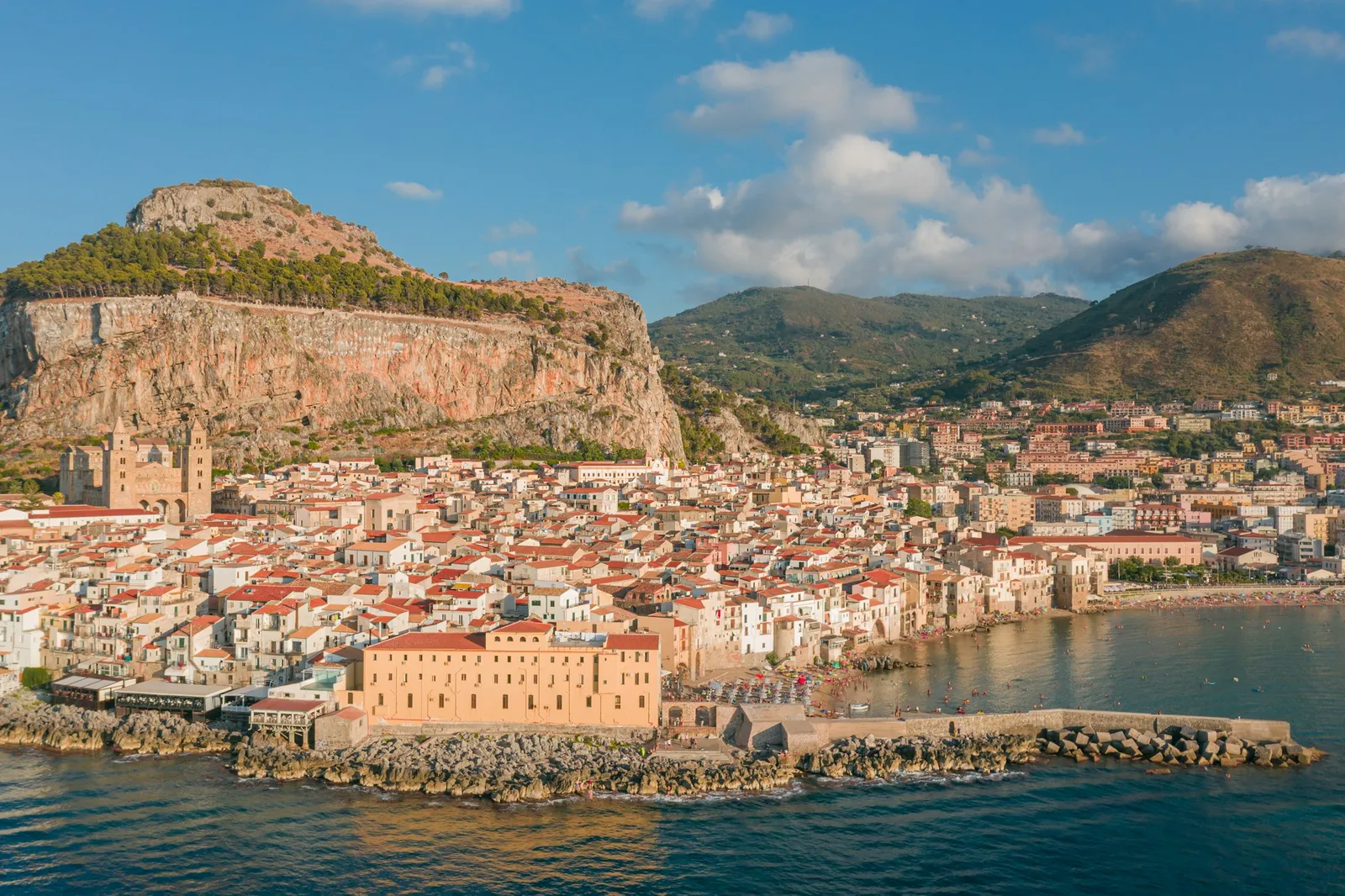
The best things to do in Cefalù, at a glance
Cefalù is a small fishing town on the north coast, squeezed between a huge rock and the sea, and it is the place I send people who want Sicily in miniature: a Norman cathedral, a medieval street plan, a hike and a beach, all within a few minutes of each other. These are the sights, with what they cost and how long to allow. Prices are from the town's own pages and they change, so check before you go.
| Sight | Why go | Allow | Ticket, about |
|---|---|---|---|
| La Rocca and the Temple of Diana | The view over the town, a megalithic temple and castle ruins | 2 to 3 hours | €5 ($5.50) |
| Cefalù Cathedral | The Norman church and its gold mosaic of Christ Pantocrator | 45 minutes, more with the towers | Church free; towers, treasury and cloister extra |
| Mandralisca Museum | Antonello da Messina’s Portrait of an Unknown Man | 1 hour | €8 ($9) |
| The medieval wash house | Water running from 22 spouts into stone basins | 15 minutes | Free |
| The old town and the seafront | Corso Ruggero, the old harbour and the sea wall at sunset | 1 to 2 hours | Free |
| Cefalù beach | A long sandy beach under the old town | As long as you like | Free, or a lido |
The story of the town and of Roger II, who founded the cathedral, is in my guide to Palermo and the north, with Cefalù and Monreale. This page is the practical side.
Hiking La Rocca and the Temple of Diana
La Rocca is the 270 m (886 ft) rock behind the town, and the walk up is the best thing to do in Cefalù if you are reasonably fit. The path starts from Piazza Garibaldi, on Corso Ruggero, up the Salita Saraceni. On the way up you pass the Temple of Diana, a megalithic building whose oldest part, according to the comune, is a cistern from the 9th century BC; at the top are the ruins of a 12th and 13th century castle, and the walls that ring the rock run for more than 2 km.
- The ticket is about €5 ($5.50), or €2.50 for children aged 6 to 14, over-65s and teachers.
- The comune gives three seasons of opening times. In summer it is open from 8am to 8pm, with last entry at 6pm; from mid-September, 8am to 7pm, last entry 5pm; in winter, 8am to 5pm, last entry 3pm.
- Wear proper shoes. Open shoes and smooth soles are not allowed, children must be with an adult, and you must keep to the marked paths and not climb on the walls.
The path is steep, stepped in places and exposed to the sun. In summer I would go at opening time with plenty of water, and leave the beach for the afternoon.
Cefalù Cathedral and its mosaics
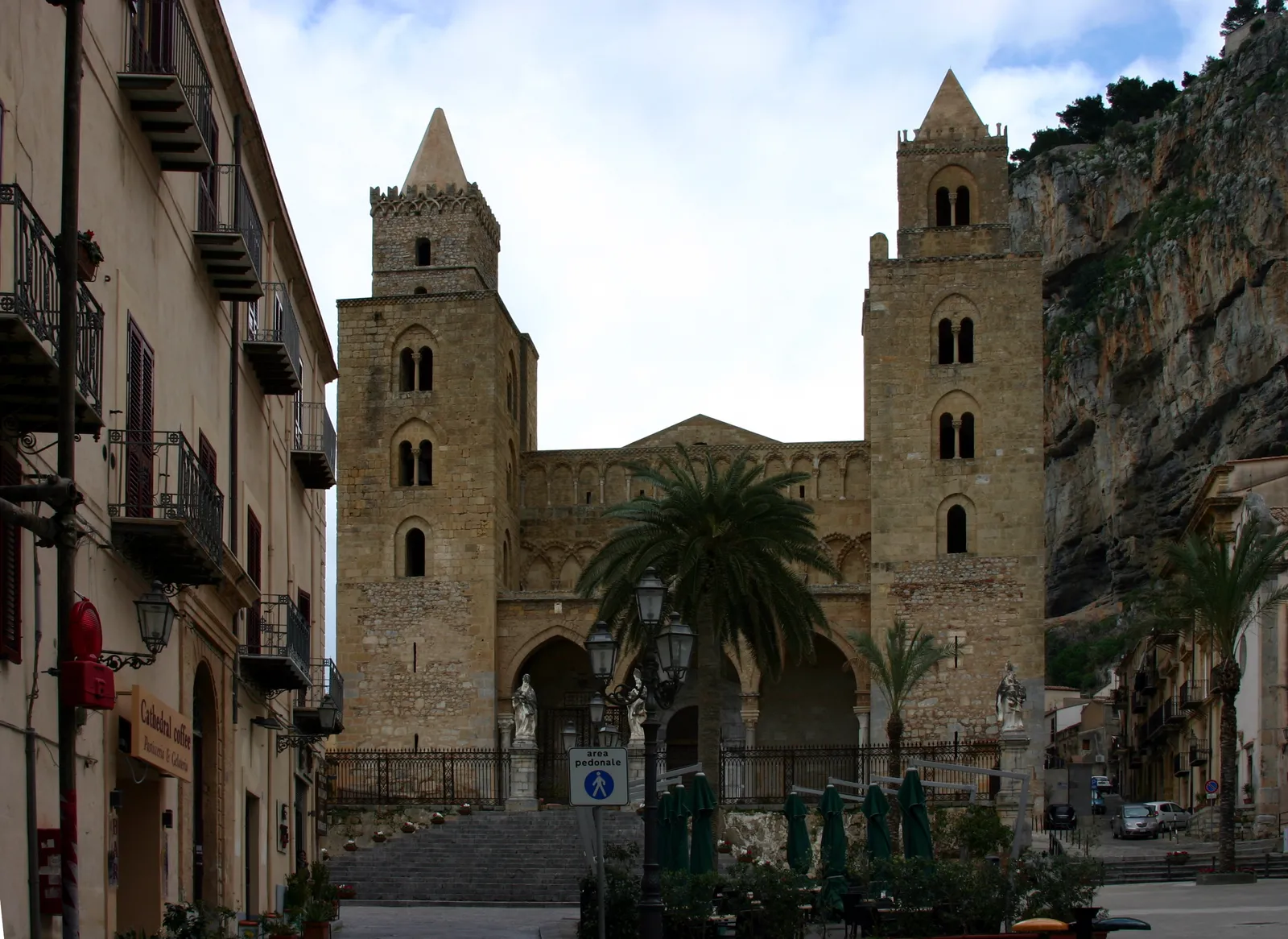
Roger II began the cathedral in 1131, and the mosaic of Christ Pantocrator in the apse is dated 1148 by the inscription beneath it. It is one of the nine Arab-Norman buildings on the UNESCO World Heritage list, with Palermo and Monreale, and I think the mosaic is the most beautiful single image in Sicily. The church faces the main square, Piazza del Duomo, where you can sit and look at the twin towers.
The church is free to enter. The cathedral's own site sells ticketed itineraries for the parts you cannot otherwise see: the towers and the roofs, a closer view of the mosaics, the treasury, the bishop's palace and the cloister. There is a full route, a quick one and one for the treasury, and the prices and times are on the cathedral's site. As in any church here, cover shoulders and knees, and avoid Mass times.
The Mandralisca Museum
The Museo Mandralisca is at Via Mandralisca 13, a couple of minutes from the cathedral. Its star is Antonello da Messina's Portrait of an Unknown Man, a half-smiling face that follows you round the room. The other piece I like is a painted krater, a wine-mixing vase, of about 370 BC showing a tuna seller at work, which tells you how long people here have been eating fish.
- Open daily from 9am to 7pm from April to October, and 10am to 8pm in June, July and August. From November to March it is open Tuesday to Sunday, 9am to 7pm, and closed on Mondays.
- The full ticket is about €8 ($9); there are reductions for children aged 6 to 15 and for groups.
The medieval wash house and the old town
On Via Vittorio Emanuele is the Lavatoio Medievale, the medieval wash house, down a stone stair, where the water still runs out through 22 cast-iron spouts, most of them shaped as lions' heads, into the stone basins. It is free, takes ten minutes and is the coolest place in town in August.
From there, carry on down to the old harbour and the sea wall. Corso Ruggero, the main street, runs from Piazza Garibaldi to Piazza del Duomo, and the lanes off it to the sea are where to wander. If you are here in early August, the town's feast of the Santissimo Salvatore runs from 2 to 6 August.
Cefalù beach and the coves nearby
The town beach is a long stretch of sand from the old town west along the seafront, with free sand and paid lidos, a short walk from the station. It is the beach where The White Lotus filmed its hotel's beach scenes, and it is very busy in July and August. My Cefalù beach guide has the detail on lidos, parking and when to go.
For something quieter, there is Settefrati near Mazzaforno, a small undeveloped bay a few kilometres west, and to the east the pebbles of Caldura and the beach at Sant'Ambrogio.
Day trips from Cefalù
- The Madonie mountains. Cefalù is the gateway to the Madonie park, and Trenitalia lists a bus link from Cefalù station to Castelbuono, Geraci Siculo and Gangi, hill towns with castles, churches and mountain food. With a car, you can make a loop of them in a day. For the trails, see my guide to hiking in Sicily.
- Gibilmanna. The sanctuary of Gibilmanna is in the hills above the town, within Cefalù's own comune, a short drive inland.
- The Aeolian Islands. In summer, boats leave the Presidiana marina for the islands; check the operators' timetables for the season.
- Palermo. An hour west by train or car; my guide to things to do in Palermo has the sights and the tickets.
Film fans: Cefalù turns up in Cinema Paradiso, The White Lotus and Indiana Jones and the Dial of Destiny, where it stands in for Syracuse. My page on films shot in Sicily has the scenes. The Abbey of Thelema, the villa where Aleister Crowley lived until he was expelled from Italy in 1923, is on the edge of town, but there is nothing to visit: the FAI describes it as little more than a ruin.
Is Cefalù worth a day trip from Palermo?
Yes. It is the easiest day trip from Palermo after Monreale, and you do not need a car. Regional trains run along the coast from Palermo Centrale to Cefalù, whose station is a short walk from both the beach and the old town, and Trenitalia lets you take a bike on board free. By car it is about 68 km (42 miles) on the A20 motorway, roughly an hour; from Palermo airport it is about 100 km (62 miles), roughly an hour and a half.
A day is enough for the rock, the cathedral, the museum and a swim. One or two nights is better if you want to climb La Rocca early, eat in the old town after the day trippers have gone, or spend a day in the Madonie. For more on getting around by train and bus, see Sicily without a car. Choosing between Cefalù and Taormina? See things to do in Taormina.
Where to stay in Cefalù
I am not naming hotels, but the choice of area is simple:
- The old town. Atmospheric and close to everything, but the streets are narrow, many rooms are up stairs, and you will need to park outside it.
- The newer town by the beach and the station. Easier with a car or luggage, a short walk to the sand and to the train, and a few minutes from the old town.
- The coast either side, towards Mazzaforno to the west or Caldura and Sant'Ambrogio to the east. Quieter and good for a beach vacation, but you will drive or take a taxi into town.
Parking along the seafront and in the car parks around the old town fills by mid morning in high season, so if you drive, arrive early or stay somewhere with parking.
Frequently asked questions
What is Cefalù known for?
Its Norman cathedral, begun by Roger II in 1131, with a gold mosaic of Christ Pantocrator, the rock of La Rocca that rises behind the town, a long sandy beach below the old town, and Antonello da Messina’s Portrait of an Unknown Man in the Mandralisca Museum.
Is Cefalù worth visiting?
Yes. In one small town you get a UNESCO-listed Norman cathedral, a hike with a view, a good museum, a medieval street plan and a beach. It is about an hour from Palermo by train or car.
How many days do you need in Cefalù?
One full day covers La Rocca, the cathedral, the Mandralisca Museum, the wash house and the beach. Stay one or two nights if you want to climb the rock early, see the town in the evening or visit the Madonie mountains.
How long does it take to hike La Rocca in Cefalù?
Allow two to three hours up and down, with time at the Temple of Diana and the castle ruins. The rock is 270 m high, the path is steep and sunny, and you need proper shoes. The ticket is about €5.
Is Cefalù Cathedral free?
Yes, the church is free to enter. The towers, the roofs, the treasury, the bishop’s palace and the cloister are visited on ticketed itineraries sold by the cathedral.
How do you get from Palermo to Cefalù?
By regional train from Palermo Centrale along the coast, which drops you a short walk from the beach and the old town, or by car on the A20 motorway, about 68 km and roughly an hour.
Is Cefalù a good day trip from Palermo?
Yes, one of the best. Take an early train, climb La Rocca in the morning, see the cathedral and the museum after lunch and swim before the train back.
Do you need a car in Cefalù?
Not for the town. The station is a short walk from the beach and the old town, and everything in the centre is walkable. A car helps for the Madonie and for the quieter beaches outside town.
Sources and small print
- Comune di Cefalù, La Rocca, tickets, opening times, the Temple of Diana and the rules for the climb
- Comune di Cefalù, Museo Mandralisca, opening times, tickets and the collection
- Basilica Cattedrale di Cefalù, the cathedral's ticketed itineraries
- Trenitalia, Cefalù, regional trains, bikes on board and the bus link to the Madonie
- UNESCO, Arab-Norman Palermo and the Cathedral Churches of Cefalù and Monreale
- FAI, Villa Santa Barbara, the Abbey of Thelema
Driving times are measured on the road network and rounded. Hours and prices change, so check the official sites before you go.
Credits
Photo: Henrique Ferreira, Unsplash Licence, via Unsplash.
Photo: José Luiz, CC BY-SA 4.0, via Wikimedia Commons.
 The weekly YouTube series