
Can foreigners get a mortgage in Italy?
Yes. There is no law that stops a foreigner borrowing from an Italian bank, and nationality alone is not a bar. What the law does require, under the consumer mortgage rules in Italy's banking code (the Testo Unico Bancario, which brought the EU mortgage credit directive into Italian law), is that the bank checks properly that you can repay before it lends. So the real question is not whether foreigners may borrow, but whether a particular bank's lending policy covers someone in your position.
Three things decide that:
- Where you live and pay tax. A foreigner who is resident in Italy, with Italian income and an Italian tax return, is assessed much like an Italian; my guide to registering residency in Sicily covers how that status works. A non-resident whose income, assets and credit history are all abroad is harder for the bank to check, and harder to chase if things go wrong.
- Where your money comes from. Salaried income with payslips is the easiest to prove. Self-employed income, pensions paid in pounds or dollars, and rental income need more paper.
- The house. The bank lends against the property as well as against you. A tidy apartment in Palermo or Siracusa is a very different proposition from a stone farmhouse that has been empty for decades.
Who lends to foreigners
In practice there are two routes. The first is to approach the big Italian banks directly. National groups such as Intesa Sanpaolo, UniCredit, BPER and Banco BPM all publish an information sheet for each mortgage product, setting out who it is open to and the maximum it will lend, and these sheets are a good first filter. They are updated often, so read the current version rather than a summary on a forum. I name these banks only as examples of where to look, not as recommendations.
The second route is a credit broker (mediatore creditizio), who knows which banks are currently willing to look at non-resident applications and packages your file for them. Specialist brokers who work with foreign buyers are common in the popular regions. In Italy a credit broker must be registered with the OAM, the Organismo Agenti e Mediatori, and you can check any broker's registration on the OAM website before you share your documents. Ask in writing how the broker is paid, and by whom.
If you already have an account with an Italian bank, start there; a relationship helps. My guide to banking in Italy as a foreigner covers opening one, and you will need a codice fiscale before any bank will talk to you seriously.
How much will an Italian bank lend a non-resident?
The ceiling is set by the bank's valuation, not by the price you agreed. The Banca d'Italia's own guide to mortgages says that, in general, the amount lent does not exceed 80% of the value of the property as set by an independent valuer, together with the bank's view of your creditworthiness. That ceiling applies to everyone. Across Italy in 2025, the capital lent came to about 79% of the estimated value of homes bought with a mortgage, according to the Agenzia delle Entrate's 2026 housing market report.
Non-residents get less. There is no written rule, but specialist brokers and agencies that handle foreign buyers consistently quote a loan to value of around 50 to 60% for non-residents, occasionally a little more for very strong applicants. The reason is practical: a bank lending to someone whose life is abroad has fewer ways to check the application and fewer ways to recover its money, so it asks for a bigger deposit instead.
Watch which value the percentage is applied to. Many banks lend against the lower of the price and their valuation. If you agree €150,000 for a house and the bank's valuer puts it at €130,000, 60% is €78,000, not €90,000, and you need €12,000 more of your own money. On top of the deposit you pay the purchase taxes, the notary, the agent and your geometra in cash.
| Valuation €150,000 | Valuation €130,000 | |
|---|---|---|
| Loan at 60% of the lower figure | €90,000 | €78,000 |
| Your deposit | €60,000 | €72,000 |
| Buying costs | On top, in cash | On top, in cash |
How Sicily compares
Mortgages are less common in Sicily than in Italy as a whole. In 2025 about 33% of homes bought by private individuals in Sicily were bought with a mortgage, against about 46% nationally, and the average loan in Sicily was around €116,100. The average Sicilian home sold that year for an estimated €95,800. Those figures cover all buyers, mostly Sicilians, but they show the shape of the market: modest prices, and many purchases made without a bank.
What documents do you need for an Italian mortgage?
Each bank has its own list, but a non-resident application usually looks like this. Start gathering it before you make an offer, because documents from abroad take longest.
| Document | Notes |
|---|---|
| Passport and codice fiscale | The tax code is essential; without it nothing moves. |
| Proof of residence abroad | A recent utility bill or bank statement with your address. |
| Proof of income | Recent payslips and an employment letter if employed; two or three years of tax returns and accounts if self-employed; pension statements if retired. |
| Tax returns from your country | Usually the last two years. |
| Bank statements | Several months, showing income arriving and your outgoings. |
| Existing loans and mortgages | Statements and repayment schedules for anything you owe. |
| A credit report from home | Not always asked for, but useful when you have no Italian history. |
| Source of the deposit | Both the bank and the notary must check where the money comes from under anti-money laundering rules. |
| Property papers | The signed proposal or compromesso, the previous deed, the cadastral plan (planimetria) and records, and the building permits or condono papers. |
Most banks will want the foreign documents translated into Italian, and some will want the translation certified. Ask the bank or broker exactly which ones need a sworn translation and which they will accept in English, so you do not pay to translate a stack of bank statements nobody reads.
The property papers matter as much as yours. The bank's valuer will compare the house with its cadastral plan and its building permits, and any mismatch can stop the loan. My buying checklist lists the documents to ask the seller for, and the property glossary explains the Italian terms.
How do Italian credit checks work (CRIF and the Centrale dei Rischi)?
Italy has no single credit score of the kind British or American borrowers know. Banks look at two kinds of database.
- The Centrale dei Rischi, run by the Banca d'Italia, records the debts of households and businesses to banks and finance companies. A borrower appears in it when they owe one lender €30,000 or more, or €250 or more if the debt has gone bad (a sofferenza). Banks can consult it for anyone who has applied to them for credit. You can see your own record free of charge by asking the Banca d'Italia.
- Private credit bureaux (sistemi di informazioni creditizie), of which CRIF is the best known, alongside Experian, CTC and Assilea. These are private systems that lenders join voluntarily, and the Banca d'Italia does not regulate or supervise them. They record smaller loans, such as phone contracts paid in instalments and consumer credit.
For most foreigners the problem is not a bad record but an empty one. If you have never borrowed in Italy, neither database says anything about you, so the bank relies on what you can prove from home: tax returns, bank statements, existing loan statements and, where your country has one, a credit report. An Italian current account that has run cleanly for a while does help, because it gives the bank something of its own to look at.
If an Italian bank tells you there is a problem with a record held about you, ask which database it comes from. Errors in the Centrale dei Rischi have to be corrected by the lender that reported them, and you can complain to that lender, to the Arbitro Bancario Finanziario or to a court.
How do you prove foreign income to an Italian bank?
This is where non-resident applications slow down. The bank has to assess income it cannot check directly, so it wants it documented, consistent and, ideally, translated.
- Employed: recent payslips, an employment contract or letter, and tax returns that match them.
- Self-employed: two or three years of tax returns and accounts, usually signed off by an accountant. Expect more questions, and possibly a lower loan.
- Retired: pension statements and bank statements showing the payments arriving. Check the bank's age limit too: most set a maximum age at which the loan must be repaid.
Translation, apostille and the currency question
Official documents from abroad, such as a power of attorney or a certificate, normally need an apostille (or legalisation, for countries outside the Hague Convention) and a translation into Italian before an Italian notary can use them. Bank statements and payslips usually need only a translation, if that. Your broker or bank will tell you which.
If you are paid in pounds, dollars or another currency, a euro loan is a foreign currency loan in the eyes of the EU mortgage rules Italy follows. The law gives you the right to convert such a loan into the currency of your income, and the bank must warn you about the exchange rate risk. Some banks lend less for that reason, and you should think hard about what a 10 or 20% swing in the exchange rate would do to your monthly payment.
What is the perizia, the bank valuation?

Before it lends, the bank sends a valuer (perito) to inspect the house and write a report, the perizia. The valuer is chosen by the bank. The fee is usually charged to you, and is typically around €250 to €400, depending on the bank and the property.
The valuer looks at three things:
- Value. What the house is worth on the open market, which is what the bank would get if it had to sell. The loan is then a percentage of that figure.
- Conformity. Whether the house matches its cadastral plan and the building permits on file at the comune. Extra rooms, closed-in terraces, a changed layout or an outbuilding that was never authorised all show up here.
- Saleability. Whether the bank could actually resell it: access, condition, whether it has its certificate of habitability (agibilità), and whether anything about it would put an ordinary buyer off.
Banks refuse or reduce loans for irregularities for a simple reason: if they ever have to repossess, they must be able to sell the house. Cadastral mismatches make the value uncertain and can lead to ownership disputes, building abuses can end in a demolition order, and a house without agibilità is harder to sell. Where the problem can be put right, a bank may make the loan conditional on fixing it, or wait until the regularisation is complete. Where it cannot, finding a lender is very hard.
The lesson is to have your own geometra check the house before you sign anything binding, so that the bank's valuer finds nothing you did not already know about. A well-prepared seller will have had the same check done; my guide to selling a house in Sicily explains why, so ask the seller for it. My guide to the geometra explains what they check. My own geometra cost €2,500.
How long does an Italian mortgage take?
Longer than a cash purchase, and the delay is mostly in the paperwork. The Consiglio Nazionale del Notariato says that, as a rule, 60 days can be more than enough to obtain a mortgage, provided you start early and tell the bank clearly what your deadlines are. Banks' own information sheets typically quote around 30 to 45 days for their review once the file is complete. For a non-resident, getting the file complete is the slow part: foreign documents to gather, translate and check, and questions to answer from a distance. Agencies working with foreign buyers commonly suggest allowing three to four months or more from accepted offer to completion when a mortgage is involved.
The usual sequence is:
- A first conversation with a bank or broker to find out what you could borrow, before you make offers.
- The application, with your documents, and the bank's check of your creditworthiness.
- The perizia on the house you have chosen, and the notary's report on its title.
- The bank's approval (delibera) and a binding offer, with the European standard information sheet, called the PIES in Italy.
- A reflection period of at least seven days from the binding offer, during which the bank is bound by it and you can accept at any time.
- Signing the mortgage deed before the notary, normally on the same day as the purchase deed.
Protect yourself in the compromesso
If you need a mortgage, say so in the preliminary contract. Give yourself a realistic completion date, and ask your notary or lawyer to draft a condition that lets you withdraw without losing your deposit if the loan is refused. Signing a compromesso with a short deadline and a large deposit, and then waiting on an Italian bank, is the classic way to lose money. My step by step buying guide covers the compromesso, and the buying timeline planner helps you set the dates.
Fixed or variable: which Italian mortgage should you choose?
Italian mortgages come as fixed rate (tasso fisso), variable rate (tasso variabile), or mixtures of the two. On a fixed rate the interest stays the same for the whole loan, usually priced off the Eurirs swap rate plus the bank's margin (the spread). On a variable rate the interest follows a reference rate, usually Euribor or the European Central Bank's rate, plus the spread, so your payments rise and fall with it. Some banks offer a variable rate with a cap, which limits how far it can rise.
The notaries' advice is sensible: the choice depends less on guessing where rates are going than on whether you could afford a rising payment. For a non-resident already carrying exchange rate risk, a fixed rate removes one of the two moving parts.
Compare the TAEG, not the headline rate
The headline rate (TAN) is only the interest. The TAEG is the annual cost of the whole loan, including arrangement fees, the valuation, collection charges, compulsory insurance and the account if you must keep one with the bank. It does not include the notary's fees. When you compare offers, compare TAEGs, and read the PIES the bank must give you.
Two protections worth knowing
- Early repayment. On a mortgage taken by a private individual to buy or renovate a home, the bank cannot charge a penalty for repaying early, in full or in part.
- Moving the mortgage (surroga). You can move your mortgage to another lender willing to take it on, without the first bank's consent, and the law makes both closing the old loan and opening the new one free of charge. The existing mortgage registration is carried over, so no new one is needed.
If a bank asks you to take out life insurance to secure the loan, it must accept an equivalent policy you find yourself, without changing the loan terms. Fire cover on the house is a different matter; see the notary chapter below and my guide to home insurance in Italy.
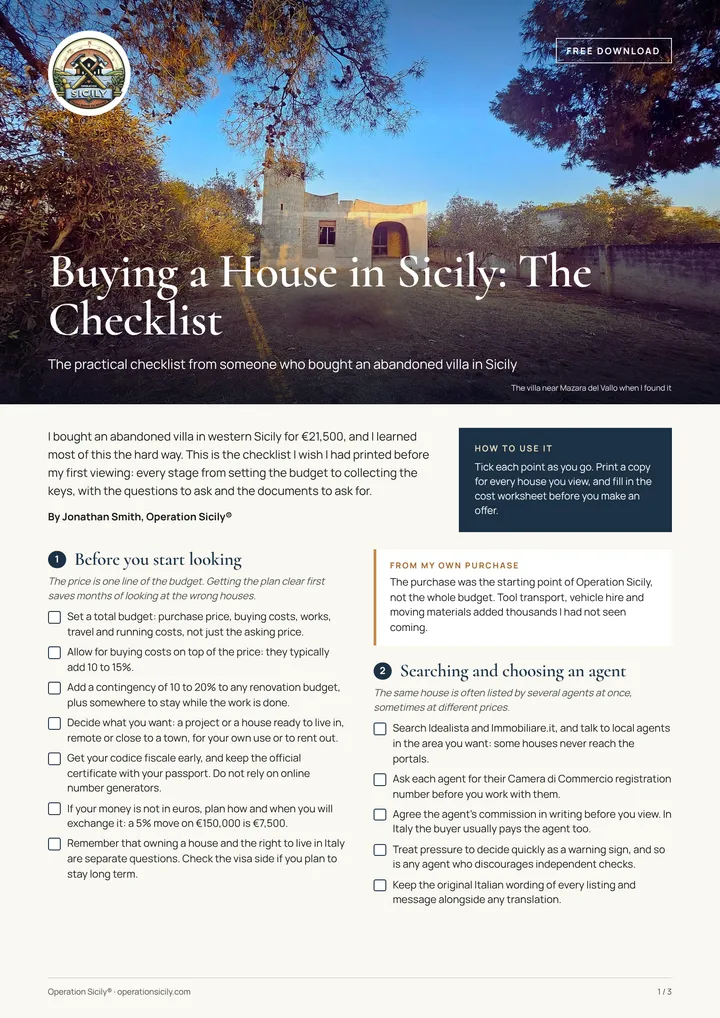
Free download
Buying a house in Sicily? Take my checklist.
Every step from budget to keys, the questions to ask at a viewing and the documents to ask for, as a PDF you can print.
Here is your checklist. Download the checklist (PDF)
Can you get a mortgage on a rural, old or abandoned house in Sicily?
Often not, or not for much. This is the point most mortgage guides skip, and it matters more in Sicily than almost anywhere, because so much of what foreigners buy here is old, rural or unfinished.
The houses that tend to struggle with a bank are:
- Ruins and roofless buildings. A building recorded in the cadastre as a unità collabente (category F/2) is so dilapidated that it has no cadastral income at all. It is not a home in the bank's eyes, and there is little for a valuer to put a figure on.
- Rural buildings never properly registered, or registered with plans that bear no relation to what stands there today.
- Houses with unauthorised work: rooms added, terraces enclosed, outbuildings built without permits, or a condono application from decades ago that was never completed.
- Houses without agibilità, or without utilities, road access or a clear right of way.
- Houses with tangled title, such as several heirs, an inheritance never formally accepted, or a recent gift in the chain of ownership, which some banks treat with caution.
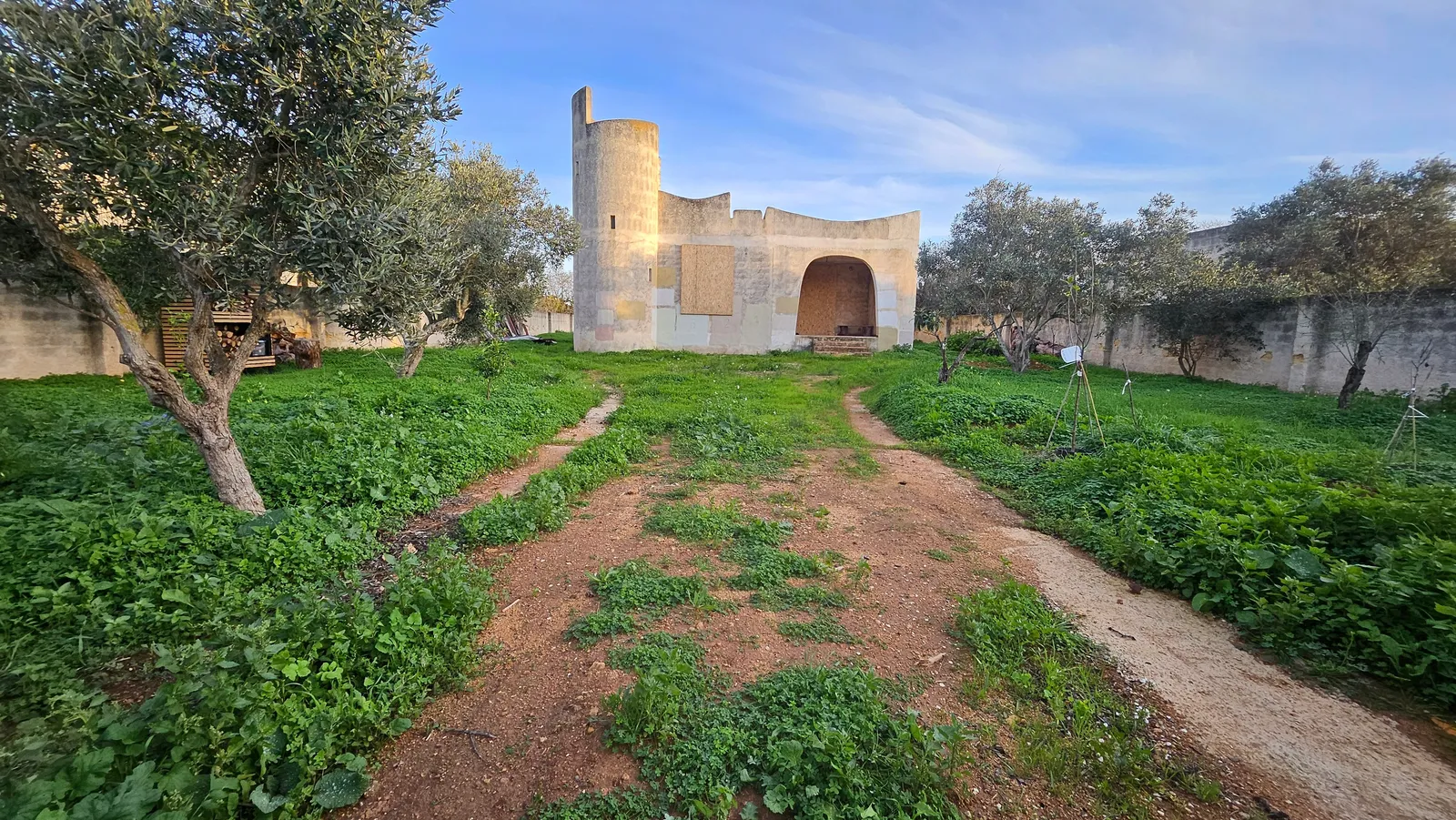
I bought my own villa, empty for over 20 years, for about €20,000. A house in that state, needing a roof, systems and years of work, is exactly the kind of property a bank will not take as security for a purchase loan. If that is your plan, budget to buy it with your own money, and see my guide to buying an abandoned house and my renovation cost breakdown.
Once a house is renovated, registered correctly and has its paperwork in order, it can become mortgageable, and some banks offer loans for renovation as well as purchase. That can be a way to release money later, but plan the project as if no loan will come, and use the renovation contingency calculator to size your reserve.
Why do many Sicily buyers pay cash or remortgage at home?
Because, at Sicilian prices, the effort and cost of an Italian mortgage often outweigh the benefit. Put the pieces together:
- the average Sicilian home sold for an estimated €95,800 in 2025, and many houses foreigners look at cost far less;
- a non-resident might borrow only 50 to 60% of the bank's valuation, so on a €60,000 house the loan is small;
- the fixed costs of a mortgage, the arrangement fee, the valuation, the notary's work on the mortgage deed and its registration, and the compulsory insurance, are much the same whether you borrow €40,000 or €140,000;
- the timetable stretches by weeks or months, which a seller in a hurry may not accept;
- and the houses with the most appeal, old and rural, are the ones least likely to pass the valuation.
So the common pattern among foreign buyers is to pay cash: savings, the sale of a house at home, or money borrowed at home against property they already own there, by remortgaging or releasing equity. Lenders at home generally will not take a Sicilian house as security, but they will lend against a house in their own country. That keeps the Sicilian purchase simple, and the seller sees a cash buyer, which can help on price.
Borrowing at home has its own risks: your home secures the loan, and the money still has to be moved into euros. Take advice from a regulated adviser in your own country, and read my guide for American buyers, my guide for Australians or my guide for Canadians for moving money from those countries.
What does the notary do with the mortgage deed?
In Italy the mortgage is a separate contract from the purchase, made by public deed before a notary. When you buy with a loan, the notary coordinates both: the purchase deed (the rogito) and the mortgage deed (atto di mutuo) are normally signed one after the other at the same appointment, with the bank's representative present.
- You choose the notary. The notaries' national council is clear that the choice belongs to the borrower. Choosing one early, and briefing them on the loan, avoids last minute problems.
- The notary's report. Before signing, the notary prepares a report (relazione notarile) for the bank confirming that the seller owns the house and whether anything, such as an earlier mortgage, is registered against it.
- The registered mortgage is larger than the loan. Banks usually register the mortgage (the ipoteca) for well above the amount lent, often one and a half to two times, to cover interest, late interest and recovery costs. You do not owe that figure; it is the ceiling of the bank's security. A registration lasts 20 years unless renewed.
- When the money arrives. Make sure the bank releases the funds at signing. If it pays out later, the purchase and the loan must be timed so you can still pay the seller in full on the day.
- Insurance. Lenders require the house to be insured against fire and explosion (incendio e scoppio), often with the policy tied to the bank. You can usually take it from any insurer that offers the cover the bank requires.
- Language. If you do not speak Italian well, the notary must make sure you understand the deed, through an interpreter or a translation. If you cannot be there, someone can sign for you under a power of attorney (procura), which must be in the form the notary asks for.
There are taxes on the mortgage deed as well as on the purchase; the notary will state them in the estimate. My guide to Italian notaries covers the rest of the notary's work.
Frequently asked questions
Can a non-resident get a mortgage in Italy?
Yes. No law prevents it, but each bank sets its own eligibility and decides case by case. Non-residents usually borrow less than residents, typically around 50 to 60% of the bank’s valuation, and need more paperwork: proof of income and tax returns from abroad, bank statements, an Italian tax code, and often translations. A specialist credit broker registered with the OAM can tell you which banks are currently lending to non-residents.
How much deposit do I need to buy a house in Italy with a mortgage?
As a non-resident, plan on a deposit of around 40 to 50% of the value, plus all the buying costs in cash: purchase taxes, notary, agent and geometra. Italian banks normally lend at most 80% of their own valuation even to residents, and often apply the percentage to the lower of the price and the valuation, so a low valuation increases the deposit you need.
Do Italian banks check your credit score?
Italy has no single credit score. Banks check the Banca d’Italia’s Centrale dei Rischi, which records debts of €30,000 or more with any one lender, and private credit bureaux such as CRIF. Foreigners usually have no Italian record at all, so banks rely on documents from abroad: tax returns, bank statements, existing loan statements and a credit report from your own country if available.
What is a perizia for a mortgage in Italy?
The perizia is the bank’s valuation of the house, carried out by a valuer the bank chooses. It typically costs around €250 to €400, charged to you. The valuer sets the value the loan is based on, and checks that the house matches its cadastral plan and building permits. Irregularities or a missing certificate of habitability can lead the bank to reduce or refuse the loan.
How long does it take to get a mortgage in Italy as a foreigner?
The Italian notaries say about 60 days is usually enough for a mortgage, if you start early. Banks typically quote 30 to 45 days to review a complete file. For non-residents the documents from abroad add time, so allow three to four months or more from accepted offer to completion, and set the dates in your compromesso to match.
Can I get an Italian mortgage on an old or abandoned house?
Rarely for the purchase itself. Banks lend against property they could resell, so ruins, roofless buildings registered as F/2 collabenti, houses without a certificate of habitability, and houses with unauthorised work or messy title are often refused or valued low. Most people buying a house to restore in Sicily pay cash, and some borrow later once the house is renovated and its paperwork is in order.
Is a fixed or variable mortgage better in Italy?
It depends mainly on whether you could cope with higher payments. A fixed rate, priced off the Eurirs, stays the same for the life of the loan. A variable rate follows Euribor or the ECB rate, so payments can rise. Non-residents earning in another currency already carry exchange rate risk, which is one reason many prefer a fixed rate. Compare offers by their TAEG, not the headline rate.
Can I repay an Italian mortgage early?
Yes. For a mortgage taken by a private individual to buy or renovate a home, Italian law does not allow the bank to charge a penalty for repaying early, in full or in part. You can also move the mortgage to another bank (surroga) without the first bank’s consent, and the law makes both closing the old loan and opening the new one free of charge.
Is home insurance compulsory with an Italian mortgage?
Lenders require the house to be insured against fire and explosion (incendio e scoppio) for as long as the loan runs, and usually want the policy tied to the bank. You can normally buy that cover from any insurer offering what the bank requires. Life insurance is different: if the bank asks for it, it must accept an equivalent policy you find yourself.
Do I need to be in Italy to sign a mortgage?
The mortgage deed is signed before an Italian notary, usually on the same day as the purchase. If you cannot be there, someone can sign for you under a power of attorney (procura). One made abroad is normally signed before a notary in your own country, apostilled and translated into Italian. Ask the Italian notary for the exact form before you sign anything.
Sources and small print
- Banca d'Italia: Il mutuo ipotecario in parole semplici (loan to value, PIES, reflection period, TAEG, surroga)
- Banca d'Italia: Centrale dei Rischi and FAQ on the Centrale dei Rischi and CRIF
- Consiglio Nazionale del Notariato: Mutuo Informato (choice of notary, timescales, the mortgage registration)
- Notariato: early repayment without penalties
- Agenzia delle Entrate: Rapporto Immobiliare 2026, residential (Sicily mortgage share, average loan, average price, national loan to value proxy)
- Testo Unico Bancario, art. 120-quaterdecies (foreign currency loans)
- OAM: register of credit agents and brokers
- idealista: why banks refuse mortgages for irregular properties
- MutuiSupermarket: typical valuation fees
Loan to value figures for non-residents are market practice reported by brokers and agencies, not a legal rule. Each bank sets its own terms; read its current information sheet before you apply.
Credits
Photo: Josep M. Gracia, CC BY-SA 4.0, via Wikimedia Commons.
Photo: Alexandra Smielova, Unsplash Licence, via Unsplash.
Photo: Casey Lovegrove, Unsplash Licence, via Unsplash.
Photo: Operation Sicily®, all rights reserved, via operationsicily.com.
 The weekly YouTube series